A district usually starts shopping for a classroom trailer rental when the problem already feels urgent. A subdivision fills faster than projected. A roof replacement slips into the school year. A special program gets approved before permanent space exists. Then someone asks the dangerous question: “How fast can a portable get here?”
That's the wrong first question.
The right questions are harder and far more useful. How long will the district really need the space? Can the site support safe access, supervision, and utilities without wrecking circulation? Will the unit be used only for instruction, or is someone expecting it to absorb offices, intervention rooms, storage, or staff swing space too? Those decisions shape cost, schedule, and compliance more than the base monthly rent.
A good classroom trailer rental solves a capacity problem. A bad one creates three new ones: site conflict, code trouble, and an ugly lease renewal no one budgeted for.
Table of Contents
- The Capacity Crunch Most Districts Underestimate
- How Widespread Portable Classrooms Really Are
- Sizing the Right Classroom Trailer for Your Campus
- Lease Terms, Monthly Rent, and the Math Districts Miss
- Delivery, Site Prep, and Hookup From Truck to First Class
- ADA, Accessibility, and Furnishing Packages That Actually Work
- A Final Readiness Checklist Before You Sign the Lease
The Capacity Crunch Most Districts Underestimate
Most districts don't get blindsided by one big event. They get squeezed by three smaller ones at once. Enrollment rises faster than last year's projection. A renovation schedule slips past summer. A program expansion gets approved before facilities staff can align site, budget, and board approvals.
That's why classroom trailer rental decisions often feel rushed even when the warning signs were visible months earlier. The pressure points are familiar: roof replacements, HVAC overhauls, ADA retrofits, surge enrollment, and new instructional programs such as pre-K or reading intervention space.
The planning mistakes that force bad leases
Facilities teams usually know demand is coming. The problem is timing.
Board meeting cadence slows procurement. Old enrollment assumptions keep circulating because they're politically comfortable. Capital plans are built around ideal construction windows that don't survive real bidding, permitting, or contractor availability. By the time the district acts, the conversation has already narrowed to “find a box that fits.”
That's where regret starts.
A trailer placed in the obvious parking lot location may damage student drop-off flow, break supervision lines, or isolate a program that needs proximity to the main building. Districts also underestimate how often portable space creates campus operations issues unrelated to seat count. The tightest constraint may be staff visibility, secure circulation, playground loss, or adjacency to special services.
Practical rule: Capacity should be forecast in programs and schedules first, not just in students per room.
What smart districts do before signing
The districts that make better rental decisions start with an operational checklist, not a product brochure. They ask:
- What triggered the need: Renovation swing space and enrollment growth require different lease strategies.
- How long the need will last: A unit used through one semester should be evaluated differently from one likely to stay through multiple budget cycles.
- Which program will occupy it: General education, early childhood, and special services don't use space the same way.
- Where supervision works: A legal site isn't always a functional site.
When the campus is also trying to modernize, examples of modern elementary school architecture help districts think beyond “where can a trailer fit” and toward “how should temporary space support the campus plan.” For districts still deciding whether relocatable space is the right general approach, modular classrooms for growing school districts offers a useful overview of the broader option set.
How Widespread Portable Classrooms Really Are
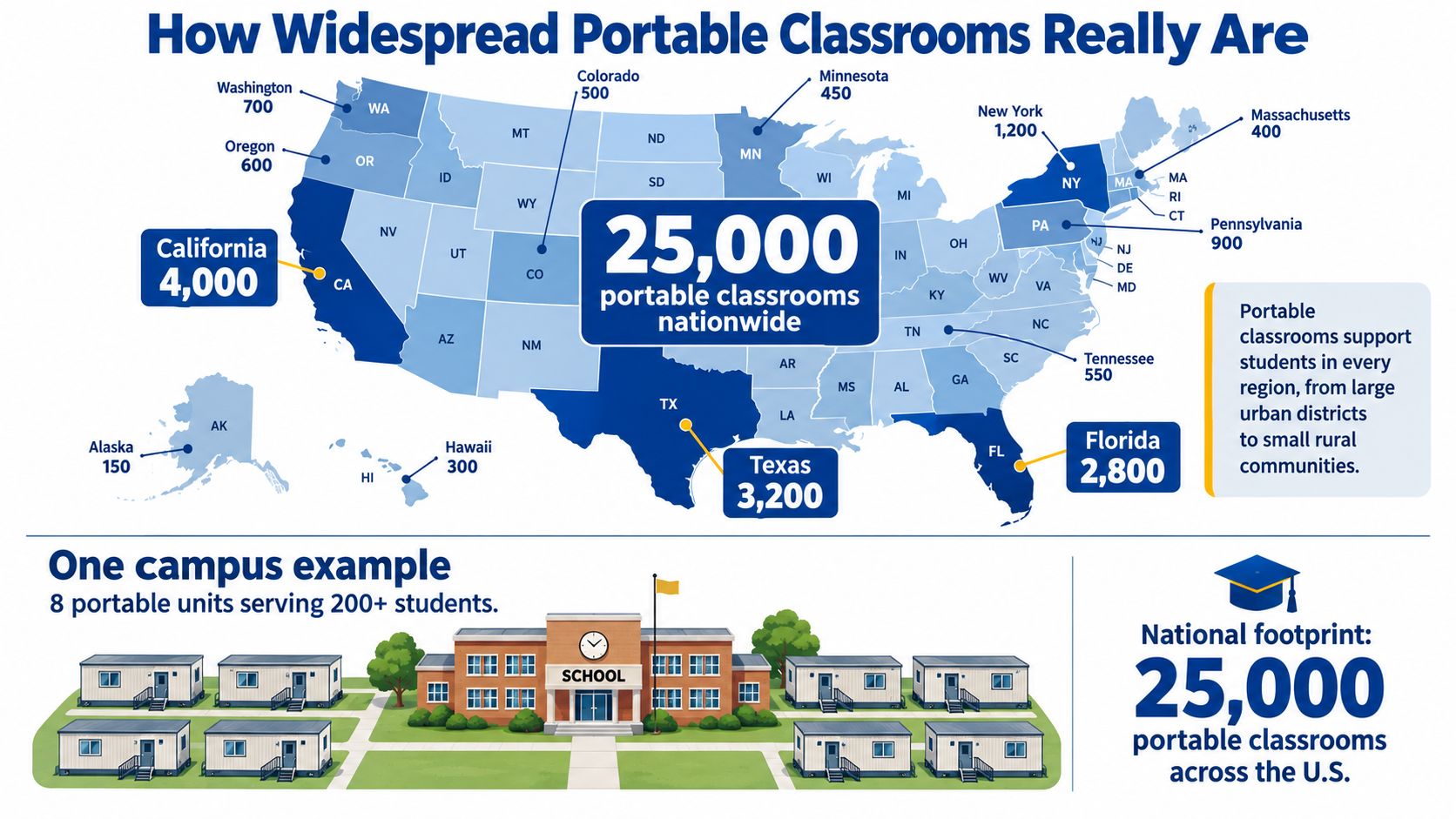
Portable classrooms aren't an edge case. They're part of the standard K-12 capacity playbook.
In the United States, 37% of all public schools had portable buildings, and those schools accounted for 33% of public-school students enrolled in buildings with portable classrooms, according to the National Center for Education Statistics report on educational facilities. The concentration was even higher in large schools, where 52% used portables, and in the West, where 62% of schools had them, which tells districts something important: portable space isn't a sign of poor planning by itself. It's often the default response when permanent construction can't move as fast as demand.
The temporary label is often fiction
The bigger misconception is duration. A portable may be leased as a short-term fix, then remain part of campus operations for years.
A study of Ontario's 27 largest school boards found the average number of portable classrooms stayed almost flat over 2010 to 2020, with only a 1.3% overall change and an annual average of about 5,279 portables. The same study found 65.5% of schools in the sample used at least one portable during that decade, and among schools that used them, the average was about three portables per school, based on the Canadian Journal of Education study on portable classrooms.
That matters because a district shouldn't evaluate classroom trailer rental like a six-month inconvenience if the unit may shape circulation, maintenance, and supervision for several budget cycles.
What the numbers mean on one campus
At campus level, widespread use translates into a simple operational truth. Once a school adds one portable successfully, adding a second or third gets easier politically and procedurally. That's how “temporary” space becomes a semi-permanent site strategy.
Portable classrooms solve capacity fast. They also lock in daily walking patterns, staffing routines, and maintenance obligations that stick around much longer than the first lease conversation suggests.
District leaders should treat every portable decision like a campus planning move, not a one-off rental. That mindset changes everything downstream, especially sizing, lease structure, and site prep.
Sizing the Right Classroom Trailer for Your Campus
A campus adds one trailer for enrollment overflow. Six months later, the principal is using it for intervention groups, the special education team is borrowing a corner for testing, and staff are hauling materials across the site twice a day. The unit was large enough on paper. It was undersized in actual use.
Start sizing from the school day, not from square footage.
Bell schedule, class changes, staffing pattern, storage load, and the exact program assigned to the unit should drive the decision. A trailer that technically fits 25 desks can still be the wrong unit if students rotate in groups, staff need built-in casework, or the room sits too far from restrooms, nurse access, or the main office.
Standard sizes are only a starting point
Most districts begin with two common formats: a single classroom around 24×40 feet and a larger classroom around 24×60 feet. Those benchmarks help with early planning and budgeting. They do not answer the harder question, which is whether the space will support the program without daily workarounds.
Use the layout test. Ask four blunt questions:
- How many adults are in the room at the same time?
- What stays in the room all day?
- What has to move in and out between periods?
- What support spaces must sit nearby for the room to function well?
That last point gets missed constantly. A trailer used for general instruction can tolerate some separation from the main building. A trailer used for early childhood, evaluation, speech, or intensive intervention usually cannot. If students and staff need frequent access to toilets, sensory equipment, health services, secure records, or pull-out support, location and adjacency matter as much as square footage.
Classroom Trailer Size Comparison
| Configuration | Typical Footprint | Best Use Case | Monthly Rent Range |
|---|---|---|---|
| Single classroom | 24×40 ft, about 960 sq ft | General instruction, overflow homeroom, short-term swing space | Varies by market and lease term |
| Double classroom | 24×60 ft, about 1,440 sq ft | Larger grade-level overflow, programs needing more flexibility | Varies by market and lease term |
| Multi-unit layout | Joined units with shared deck or support space | Campuses balancing several programs or needing grouped temporary space | Varies by configuration |
A single classroom works well for one teacher, one roster, and a predictable furniture plan. It breaks down fast when the district tries to stack multiple uses into the same box.
Larger or linked units earn their keep when the program has movement, equipment, aides, or changing group sizes. Special education is the classic example. Districts routinely underestimate storage, quiet-test space, and the floor area consumed by adult support staff. The same mistake shows up in pre-K, intervention, and bilingual support rooms.
Some uses should trigger a second look before you rent a classroom trailer at all. Administrative swing space, counseling, records storage, staff workrooms, and health services often fit poorly in a standard classroom layout. In those cases, an office modular may be the better tool. Districts waste money when they force a classroom box to do office work.
Common sizing mistakes are predictable:
- Using student count alone: Occupancy is only one variable. Program type changes the layout more than headcount does.
- Ignoring furniture depth and circulation: A floor plan can look fine until you account for backpacks, aide stations, small-group tables, and ADA turning space.
- Forgetting storage: Curriculum materials, assistive devices, testing carts, and teacher supplies consume usable area quickly.
- Skipping entry and security details: Door location, sightlines, and queuing space affect supervision every day.
- Choosing the biggest box instead of the best location: A slightly smaller unit near the main building often performs better than a larger unit at the edge of campus.
The right trailer is the one that supports the schedule, supervision plan, and program setup without forcing staff to improvise every day.
My recommendation is simple. Build the room on paper before you lease it. Place the actual furniture, count the adults, mark the storage, and trace the student path from arrival to dismissal. If that exercise exposes crowding, awkward circulation, or support-space gaps, fix the scope before the order goes in. That is much cheaper than solving it after delivery.
Lease Terms, Monthly Rent, and the Math Districts Miss
A facilities director gets a quote for a portable at a low monthly rate and feels relieved. Six months later, the district is paying extension fees, carrying utility and maintenance costs nobody modeled, and trying to unwind a lease that no longer fits the capital schedule. That is the mistake. Districts price the trailer. They fail to price the decision.
Monthly rent is only one line item. The question is how long the district will need the space, how likely that timeline is to slip, and what it costs if the district guesses wrong.
A short lease usually buys flexibility and a higher monthly rate. A longer lease usually lowers the monthly burn and increases the cost of being wrong. Those are the trade-offs. Treat them that way.
Industry rental examples from Temporary Modular Buildings show the spread can be wide between shorter and longer commitments for similar temporary classroom space. The exact quote will depend on region, inventory, configuration, and site conditions, but the pattern is consistent. The district that expects to stay in a unit for several years should not shop like it is solving a one-semester problem.
Low monthly rent can still be the wrong deal
A 12-month lease makes sense for true swing space. Use it for a defined renovation window, a known insurance loss, or a short enrollment spike tied to a specific event.
It is a poor fit for a problem the district already knows will last.
If the bond project schedule is soft, permit timing is uncertain, or redistricting has not been approved, assume the portable may stay longer than the first calendar says. That changes the math. A cheap monthly quote can become an expensive occupancy decision once extensions, change orders, and removal timing start shifting.
Classroom Trailer Lease Cost Comparison
| Cost Item | Short-Term Lease (12-24 mo) | Long-Term Lease (36+ mo) |
|---|---|---|
| Monthly rent | Higher monthly rate | Lower monthly rate |
| Flexibility | Easier exit if the need changes | Harder to unwind without penalties or buyout questions |
| Budget predictability | Weaker if extensions are likely | Better if demand is stable |
| Renewal risk | Higher exposure to rushed extensions | Lower near-term pressure, but watch auto-renewal language |
| Fit for use case | Best for true swing space | Best for sustained enrollment or long renovation windows |
The monthly number also distracts districts from the bigger operational question: should this even be a classroom trailer? For testing offices, counseling, records, staff overflow, and support functions, a standard classroom box can be the wrong asset on the right lease term. If the use case is broader than instruction, review modular building rental options before locking into a classroom unit just because it is familiar.
The clauses that deserve real attention
Contract regret usually starts in four places:
- Maintenance responsibility: Put repairs, HVAC service, filter changes, and response times in writing.
- Insurance obligations: If the district carries more risk, that cost belongs in the comparison.
- Renewal language: Auto-renewal and notice deadlines catch districts that are busy closing the school year.
- Removal terms: Define pickup timing, site restoration, and damage standards before the unit lands on campus.
My recommendation is simple. Match the lease term to the most likely occupancy period, not the most optimistic one. If the district already expects the need to last, commit to that reality early and negotiate from there. That is how you control cost.
Delivery, Site Prep, and Hookup From Truck to First Class
The trailer isn't the project. The site is the project.
Most schedule failures blamed on the vendor start with campus assumptions that were never tested. Someone assumes access is easy, utilities are close, and the obvious placement area will work. Then the truck arrives and the district discovers the route pinches, the ramp layout breaks circulation, or the utility tie-in is nowhere near ready.
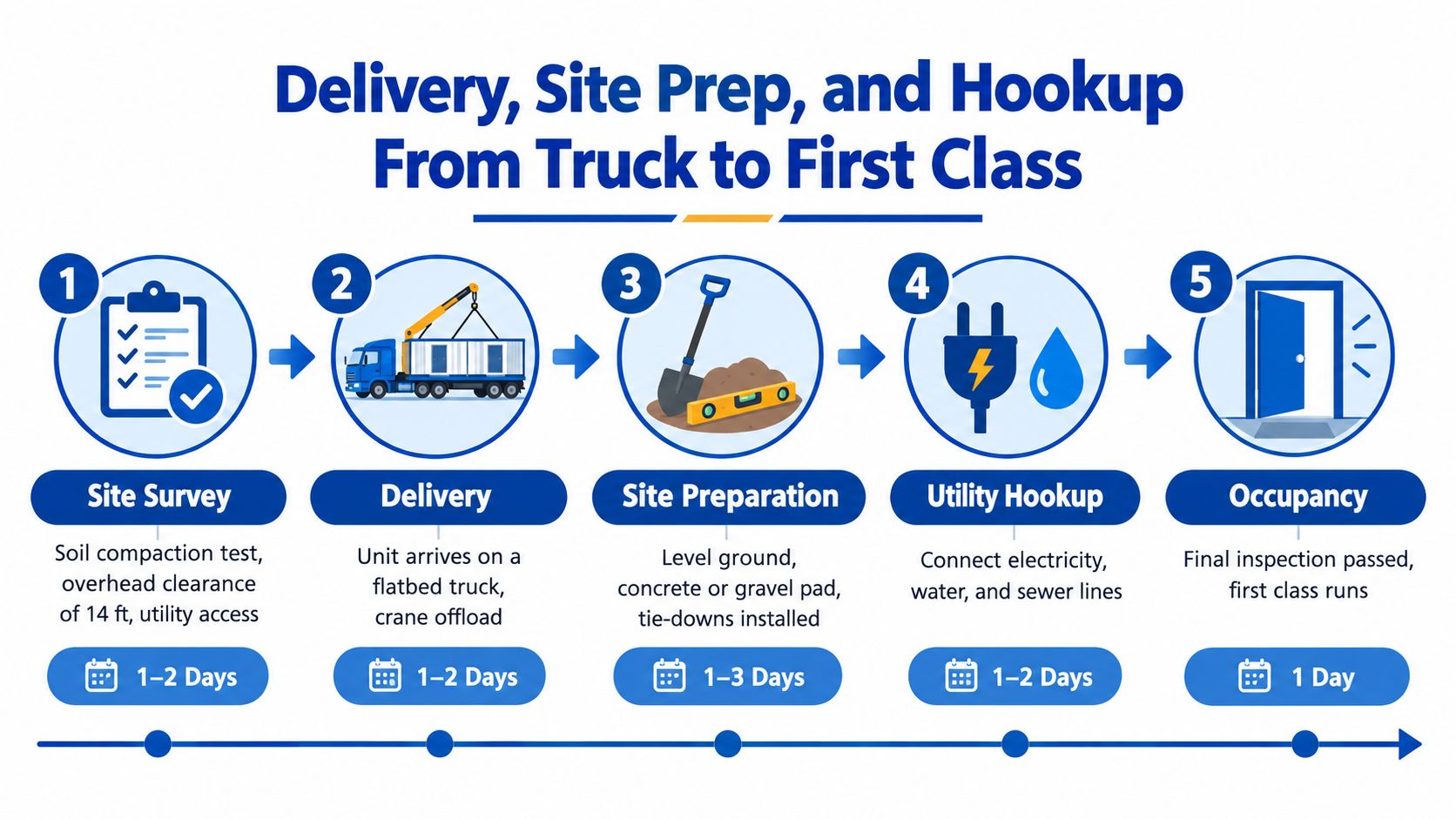
A clean installation sequence matters because every missed handoff delays occupancy.
The siting rules districts shouldn't improvise
Independent guidance on school portables recommends placing a portable classroom at least 12.2 meters, or 40 feet, from the main building, maintaining hard-surface pedestrian paths, avoiding routes near parking or access roads, and preserving emergency-vehicle access, according to the school portable siting case study and guidance document.
That one recommendation carries a lot of operational consequences. A legal setback can create a long exposed walk. A path that works in dry weather may fail in winter. A convenient pad location may cut across pickup traffic or reduce playground utility.
The sequence that actually drives occupancy
Districts should think in this order:
- Site survey first. Access route, utility location, grade, drainage, and pedestrian path all need confirmation before delivery is scheduled.
- Delivery method second. The route has to match the unit and the site conditions.
- Pad and anchoring next. If the base isn't ready, the building becomes a parked problem.
- Utility hookup after placement. Electrical, water, sewer, data, and HVAC checks should be lined up in advance.
- Inspection before occupancy. Final approval isn't paperwork theater. It determines whether students can legally enter.
A closer look at the process helps facilities teams pressure-test the schedule before a purchase order goes out. Modular building installation steps give a useful reference point for how delivery, setup, and site work fit together.
This walkthrough is worth sharing with project staff and principals before the move-in plan gets locked.
Code trouble usually starts outside the trailer
The frequent mistakes are boring, which is why they keep happening. Ramp geometry gets addressed late. Exterior stairs fight the walkway alignment. Egress paths are technically present but operationally messy. Snow, mud, and service vehicle conflict get treated like minor details until they start affecting occupancy.
A portable classroom can be ready to teach before the campus is ready to use it.
Districts that sequence the site, delivery, utilities, and inspections as one project avoid most avoidable delays. Districts that buy the unit first and “figure out the rest” usually pay for that optimism.
ADA, Accessibility, and Furnishing Packages That Actually Work
A portable isn't automatically occupancy-ready just because it's in decent condition. That assumption causes late scrambling, especially when the room is assigned to a program with accessibility needs or younger students who need a different furniture setup.
The district should separate three decisions that often get bundled together too casually: building accessibility, path-of-travel accessibility, and furnishing scope. They aren't the same thing, and failure in any one of them can derail opening.
Accessibility is a package, not a checkbox
Public school policies in multiple jurisdictions can restrict portables to instructional use only, excluding admin, storage, planning, or meeting space unless an exception is granted, and portable units may also trigger building standards, maintenance, and insurance obligations for lessees, according to the Waterloo Catholic District School Board portable policy guidance.
That policy angle matters because districts often assume a trailer can absorb whatever support function the main building temporarily loses. It can't, at least not automatically. If the district wants to use a unit for counseling, staff workroom overflow, testing support, or another non-instructional purpose, approvals need to be checked before the lease is signed.
What districts should insist on
A functional accessibility review should cover:
- Door hardware and clearances: Staff shouldn't assume a standard school portable arrives aligned with current campus expectations.
- Ramp and landing layout: A compliant unit still fails in practice if the exterior route is awkward or unsafe.
- Switches, controls, and interior reach ranges: Small misses here create real barriers.
- Restroom assumptions: If the unit lacks restrooms, the travel path to existing facilities matters.
Furnishings deserve the same discipline. A bare shell may work if the district has a strong summer move team and matching inventory ready to deploy. It's a poor choice when opening week is already overloaded by staffing, technology setup, and curriculum moves.
When turnkey furnishing makes sense
Turnkey furnishing packages earn their keep when the timeline is compressed and labor is the bottleneck. That's especially true for elementary campuses, special programs, and any move happening while the main building is under renovation.
A sensible package should include instruction-ready basics, teacher workspace, writable surfaces, and storage matched to the actual program. If the district still has to hunt down furniture from three surplus rooms and a warehouse after delivery, it didn't buy readiness. It bought another task list.
A Final Readiness Checklist Before You Sign the Lease
Most classroom trailer rental problems can be caught before procurement. The district just has to review the decision in the right order.
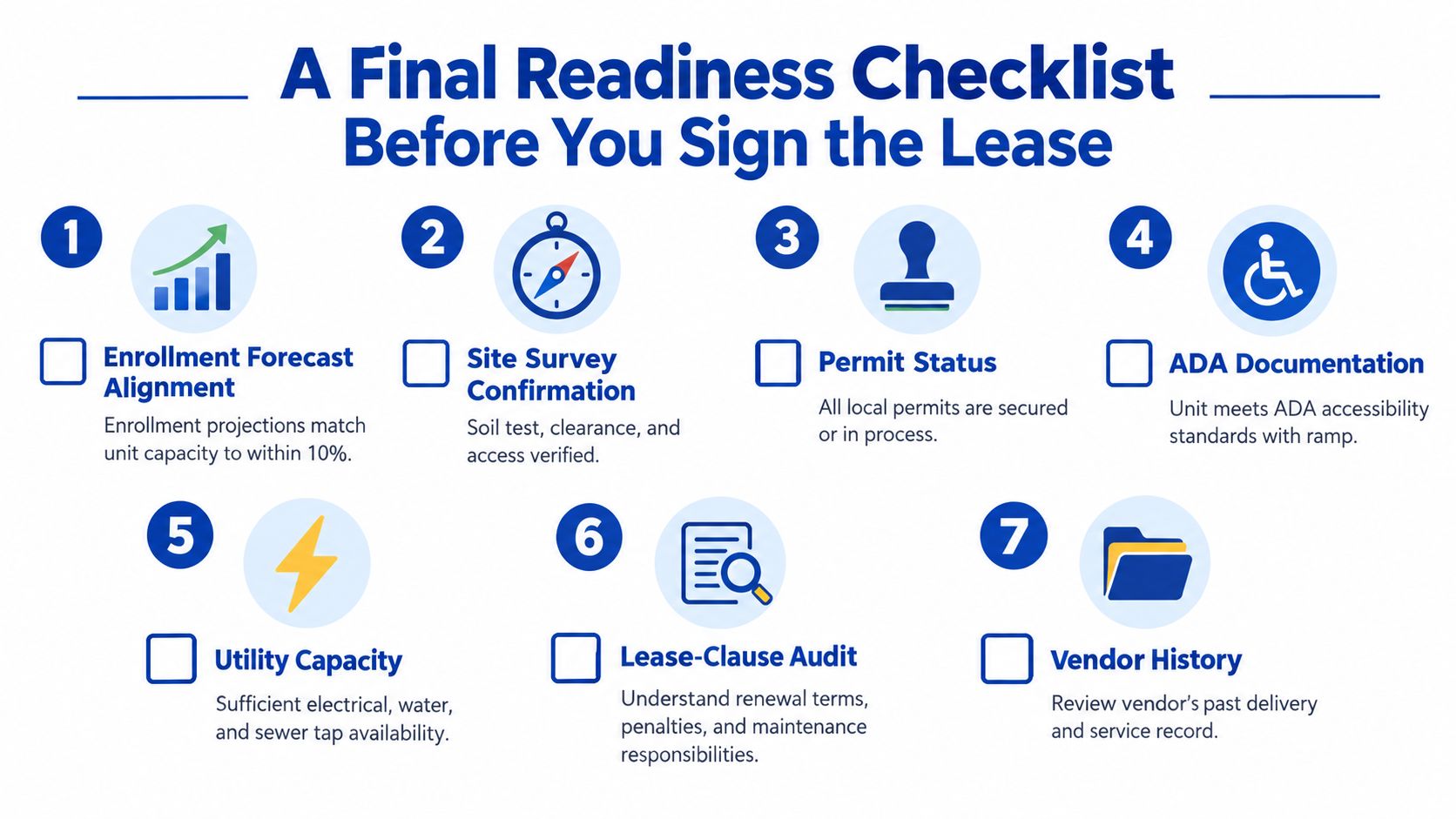
First, validate the demand. If enrollment, swing-space need, or program growth isn't grounded in a current forecast, the district is guessing. Second, validate the site. A unit that fits on paper may fail once paths, setbacks, supervision, and utilities are mapped.
The pre-sign audit that matters
Use this sequence:
- Forecast the need: Match the unit to a real instructional or operational demand.
- Confirm the site: Verify access, paths, setbacks, and utility readiness.
- Check use restrictions: Don't assume non-instructional uses are allowed.
- Review ADA documentation: Interior features and exterior travel path both matter.
- Audit the contract: Renewal terms, maintenance duties, and removal obligations should be clear.
- Vet the vendor's delivery discipline: Ask how setup, coordination, and service are handled.
- Inspect the transport reality: Trailer movement and staging affect schedule more than many districts realize.
For teams that want a practical transport and readiness reference before equipment starts moving, the 2026 DOT trailer inspection guide is a useful checklist for the hauling and safety side of trailer deployment.
Decision rule: If the need is drifting from temporary classroom use into long-duration support space, the district should stop forcing a portable solution and reconsider the facility strategy.
A portable is the right tool when the need is clear, instructional, and operationally supportable. It's the wrong tool when site work becomes cumbersome, approvals for alternate uses get messy, or the district is really trying to solve a long-term planning problem with a short-term lease.
Pacific Mobile Structures, Inc. provides relocatable classrooms, modular buildings, delivery, setup, and related site support for education projects that need usable space on a real timeline. Districts weighing classroom trailer rental against broader modular options can review available solutions and project support at Pacific Mobile Structures, Inc..