Site work, transportation, and utility connections can add 25%–50% or more to a portable classroom's quoted unit price, so a $130,000 building often becomes a $180,000+ project. The total cost of portable classrooms is the delivered, installed, permitted, connected, and operational cost, not the factory price alone.
That distinction drives nearly every procurement decision. A district can receive a seemingly attractive unit quote and still face a much larger capital request after foundations, grading, utility extensions, ramps, inspections, furniture, commissioning, and site restoration are included. Historical cost analysis made the same point decades ago. A portable building could be far cheaper than permanent construction as a structure, while site preparation and connections consumed a substantial share of the final budget historical portable classroom cost comparison.
The practical question isn't “How much does a portable classroom cost?” It's, “What will this classroom cost at this site, ready for students, and how much will it cost to operate and remove?”
Table of Contents
- Why the Sticker Price Is Not the Real Cost
- The Line-Item Anatomy of a Portable Classroom Budget
- Purchase Versus Lease and the Time Horizon That Drives the Choice
- How Region, Scale, and Site Conditions Reshape Unit Economics
- Reading Bids Like a Procurement Pro
- Lifecycle Cost and Why the Cheapest Quote Often Costs More
- Cutting the Bill With Cooperatives, Used Units, and Smart Procurement
- A Practical Budget Playbook for Your Next Classroom
Why the Sticker Price Is Not the Real Cost
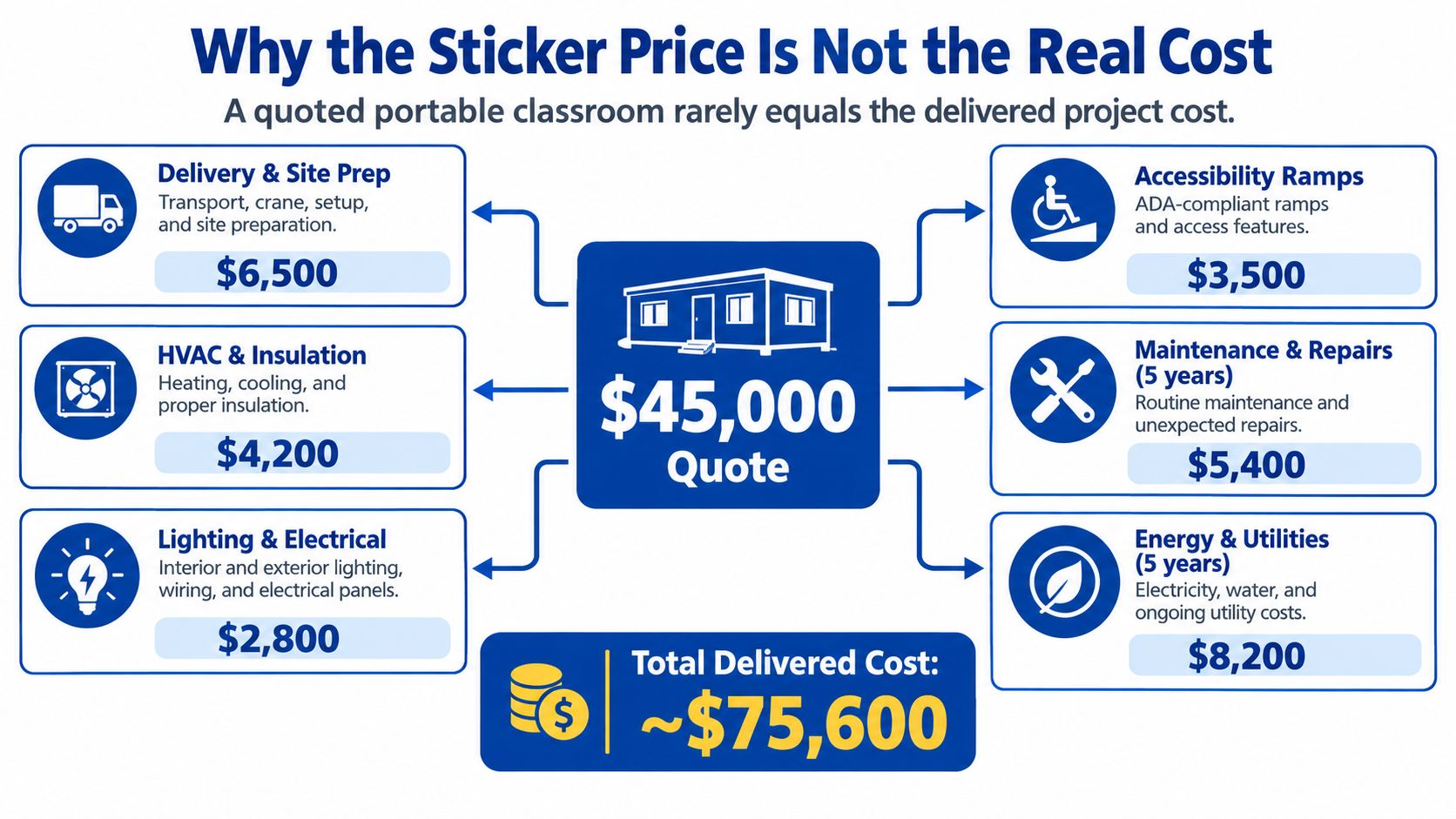
A superintendent once received a quote for a portable classroom priced at roughly $90,000. The number looked manageable against the district's available capital budget. The problem appeared when the facilities team asked what the quote excluded.
The unit price covered the building, but not the foundation system, grading, electrical service, water and sewer connections, accessible entry, permits, delivery, final set, campus fire-alarm tie-in, or commissioning. Each item seemed reasonable in isolation. Together, they changed the project from a building purchase into a site-development project.
That situation is common because vendors and districts often use the word “classroom” to describe different scopes. One proposal may mean a factory-built shell. Another may mean a delivered and installed building. A third may include furniture, data, ramps, utility connections, and occupancy approvals. Those proposals aren't comparable until the scope is normalized.
Practical rule: Treat the portable as one line in the capital budget, not as the capital budget itself.
The cost structure has been visible in historical data for decades. A 1964 comparison estimated an 864-square-foot portable building at $7,390, compared with $13,573.44 for permanent construction at a state benchmark of $15.71 per square foot, making the portable approximately 45.6% cheaper on the building-cost comparison historical cost survey. Yet the same survey recorded portable-classroom costs ranging from $5 to $40 per square foot, with site preparation ranging from $100 to $6,000 per unit and transportation from $160 to $1,000 per unit.
The lesson remains relevant: a low building price doesn't guarantee a low project price. Utility work could represent more than half of the total relocation cost and could equal 30% to 50% of the building's own cost in the historical survey portable classroom relocation cost analysis.
The modern budgeting approach is therefore straightforward. Separate the building, delivery, site, utilities, compliance, contents, and lifecycle categories. A district that does so can compare bids fairly, reserve the right contingency, and explain the request to its board without relying on an unrealistic sticker price.
The Line-Item Anatomy of a Portable Classroom Budget
A portable classroom budget gets distorted when the district treats the unit price as the project price. Current market guidance shows a 960-square-foot portable classroom at about $130,000 to $200,000 before installation, and the installed total can rise by roughly 25% to 50% or more once delivery, foundations, permits, utility connections, ramps, and site work are added portable classroom installed cost guidance. That gap is where budgets usually fail.
| Cost Component | Typical Range | Notes |
|---|---|---|
| Building unit | $130,000–$200,000 before installation | A 960-square-foot unit with its specified systems and finishes |
| Foundation preparation | $2,000–$10,000 | Depends on soil, grading, engineered support, and anchoring |
| Utility connections | $3,000–$15,000 | Electrical, water, sewer, gas, and related tie-ins |
| Accessibility ramps | $8,000–$20,000 | Ramps, landings, paths, handrails, and entry transitions |
| Delivery and installation | Site-specific | Transport, crane or set, leveling, anchoring, and setup |
| Permits and inspections | Site-specific | Building, fire, accessibility, utility, and occupancy approvals |
| Furniture and equipment | Site-specific | Desks, chairs, storage, teaching equipment, and technology |
| Commissioning | Site-specific | HVAC checks, lighting verification, life-safety testing, and turnover |
Start with the building. Then budget every item required to turn that box into occupied teaching space.
The unit cost itself still swings widely. In a facilities analysis, a basic mid-range portable was listed at $40,000 to $55,000, with some units available for $26,500, while a fully equipped 960-square-foot classroom with water, air conditioning, and modern wiring was estimated at $115,000 to $177,000 for purchase and installation portable classroom facilities analysis. The difference usually comes from scope, not markup. Restrooms, stronger HVAC, better insulation, upgraded finishes, fire protection, casework, and campus-standard wiring all move the number.
Site and foundation costs
Foundation preparation deserves its own review because allowances are often too generic. One campus may need only blocking, anchoring, and minor leveling. Another may require grade beams, drainage corrections, soil improvement, or a fully engineered support system because the bearing conditions are poor or the pad area does not drain.
Districts should involve a trusted foundation contractor by Atlanta Concrete Solutions early, particularly where the site has settlement risk, poor drainage, or uncertain bearing conditions, and use their pre-construction questions to test any generic foundation allowance. That step can expose a weak bid before it becomes a change order.
Site work is where a portable stops behaving like a simple equipment purchase and starts behaving like a small capital project. Clearing, grading, paving, stormwater controls, walks, curbs, fencing, striping, and restoration can stay manageable on an existing pad with nearby services. Put the same classroom on raw ground at the edge of campus and the civil package can change the entire budget.
Utilities and readiness
Utilities need separate numbers for power, water, sewer, gas, data, fire alarm, and security. The shortest run on a map is not always the least expensive field solution. Capacity upgrades, trench conflicts, after-hours shutdowns, patching, and panel work often cost more than the connection itself.
It also helps to compare the portable scope against a broader modular construction cost framework for delivered project budgeting. The useful comparison is the cost of a compliant, connected classroom with a defined service life.
Finish the estimate with ramps, furniture, teaching technology, commissioning, inspections, and occupancy documentation. Those costs do not disappear when they are left off the first budget. They reappear later as change orders, operating expenses, or rushed purchases.
Purchase Versus Lease and the Time Horizon That Drives the Choice
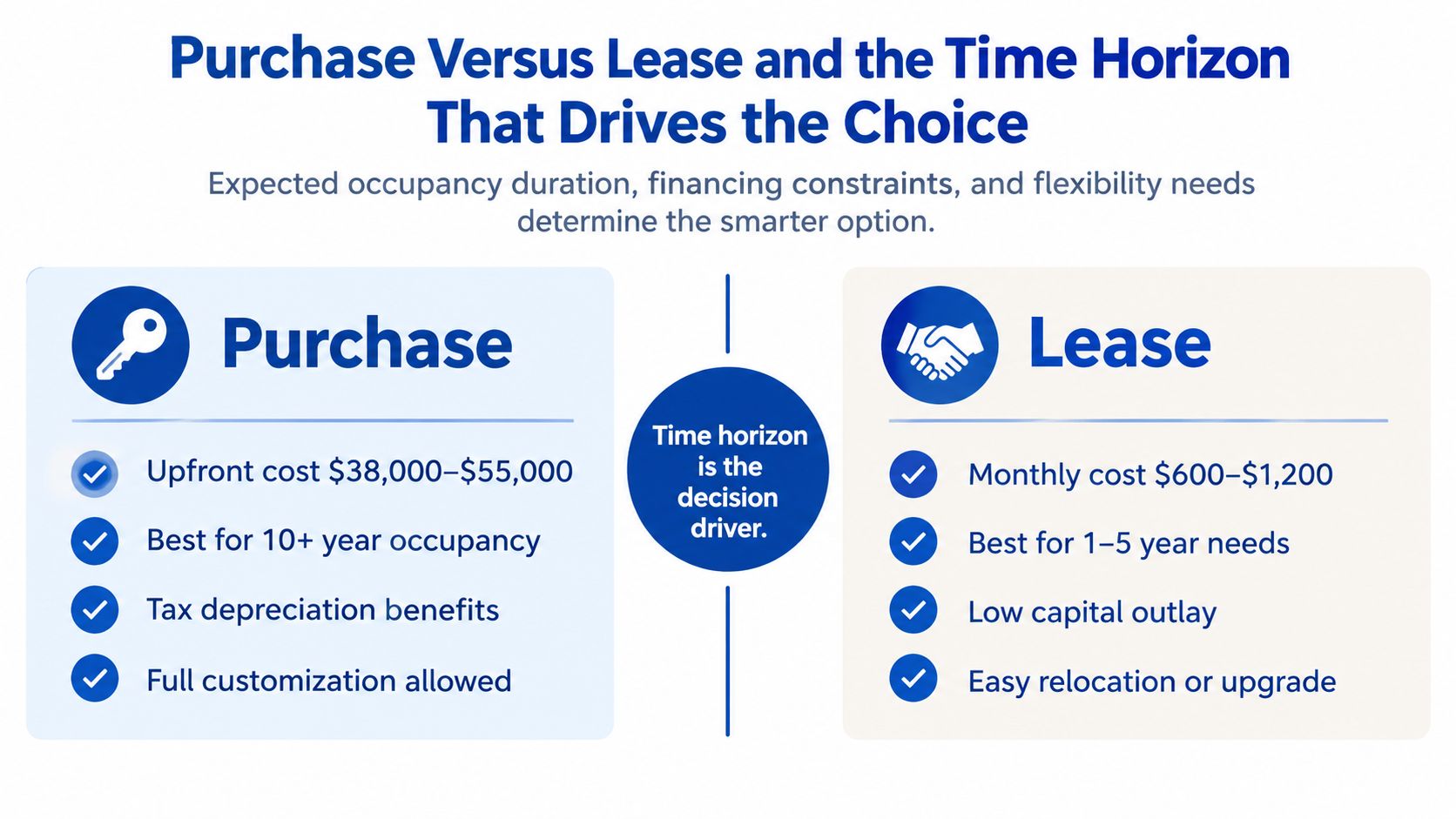
A portable classroom used for two years is a different budget decision from one used for ten. The right choice turns on occupancy horizon first, then on cash flow, relocation plans, maintenance capacity, and what happens at the end of the term.
Earlier lease analysis cited annual rent of about $7,000 per unit. That figure is old, but the budgeting lesson still holds. Rent can look manageable in a single-year budget while becoming expensive over a longer occupancy period. Purchase, by contrast, concentrates cost upfront and puts the district on the hook for the full delivered project, not just the box.
Purchase favors control
Buying gives the district more control over layout, finish selections, installed equipment, maintenance standards, and future reassignment to another campus. It also creates the possibility of residual value if the unit still fits program needs later. That control has a price. The owner carries financing, preventive maintenance, insurance, repair exposure, storage or relocation planning, and removal when the building is no longer useful.
I usually tell districts to purchase when three conditions line up. The enrollment need appears durable. The site can support a long service life without major rework. The district can fund the installed project and the follow-on ownership costs. If any of those are weak, ownership gets harder to justify.
Leasing favors flexibility
Leasing works better when the need is temporary, the timeline is clear, or the district wants to avoid tying up capital during a larger bond or renovation cycle. Many modular classrooms for rent programs can also simplify timing because delivery, pickup, and standard term options are already structured.
The mistake is comparing only monthly rent to purchase price. A real lease review checks who pays for transport, crane or set costs, foundations, ramps, utility tie-ins, repairs, insurance, restoration, and extension periods. I have seen a low headline rate lose its appeal once those line items are priced correctly.
Lease-to-own contracts need the same discipline. A district comparing alternatives can examine Suburban Furniture lease-to-own options to see how end-of-term ownership, early payoff, and maintenance responsibility are handled in consumer lease-to-own contracts, then apply the same questions to a public modular lease with counsel reviewing title, procurement, and end-of-term terms.
The right comparison is total cost over the period the district expects to use the classroom.
For a short, defined need, model rent, delivery, setup, removal, extension risk, and site restoration. For a longer horizon, model purchase, financing, maintenance, utilities, relocation potential, and residual value. That side-by-side view is what usually settles the debate.
How Region, Scale, and Site Conditions Reshape Unit Economics
A national portable classroom range is useful for orientation, but it won't predict a district's final number. Labor markets, climate, transportation distance, building codes, soil conditions, utility availability, and campus scale all change the economics.
A prepared site with existing power, water, sewer, paving, and an accessible route usually favors a portable solution. The building can arrive at a site that already supports its operation. An undeveloped parcel creates a different project, with grading, drainage, foundations, trenching, service extensions, and potentially engineered access.
Climate also changes the value equation. Hot and cold regions place heavier demands on insulation, HVAC capacity, controls, and ventilation. A standard unit may appear economical at purchase but require more energy and maintenance during occupancy. Wind, seismic, snow, and flood requirements can affect anchoring, structural design, elevation, and foundation work.
Scale changes the negotiation
One unit creates a mobilization event. A campus program can distribute transportation, design, engineering, supervision, and utility planning across multiple buildings. That doesn't mean every large order produces an automatic discount. It means the district has more opportunities to standardize layouts, consolidate delivery, coordinate site work, and avoid repeated design decisions.
A single classroom on an existing pad may favor a portable because the district can use established infrastructure. A group of classrooms on a difficult site may still work, but the district should compare the combined site-development cost with a permanent addition. A multi-unit plan also needs circulation, fire separation, accessible routes, security, staff areas, and campus integration, not just more boxes.
Rules that predict cost direction
- Existing serviced site: Usually reduces uncertainty because utilities and access are already established.
- Undeveloped or constrained site: Increases civil, foundation, drainage, and utility risk.
- Extreme climate: Raises the importance of envelope, HVAC, controls, and commissioning.
- Remote location: Can increase transport, crew travel, crane planning, and service response costs.
- Multi-unit campus: Creates coordination opportunities but may require shared corridors, upgraded infrastructure, and broader life-safety work.
Portable classrooms tend to work best when speed and flexibility have meaningful value and the site can support them without disproportionate civil work. Permanent construction deserves closer comparison when the district needs a long-lived facility, major infrastructure upgrades, or extensive campus integration regardless of the chosen building type.
Reading Bids Like a Procurement Pro
A bid is only useful when its scope is visible. The first task is to identify whether the proposal covers a factory price, delivered price, or installed, code-compliant price. Those are different commercial products, and a district shouldn't compare them in one spreadsheet column.
Start with scope normalization
Every bidder should receive the same site information, classroom requirements, utility assumptions, schedule, and compliance expectations. The request should ask for a line-item turnkey estimate that separates the unit, transportation, crane or set, foundation, utility work, accessibility, permits, code compliance, commissioning, furniture, and site restoration portable classroom budgeting guidance.
The proposal should also identify exclusions. Rock excavation, unsuitable soil, utility-capacity upgrades, prevailing-wage requirements, after-hours campus work, fire-alarm modifications, temporary fencing, and restoration can otherwise become change orders.
Demand written answers
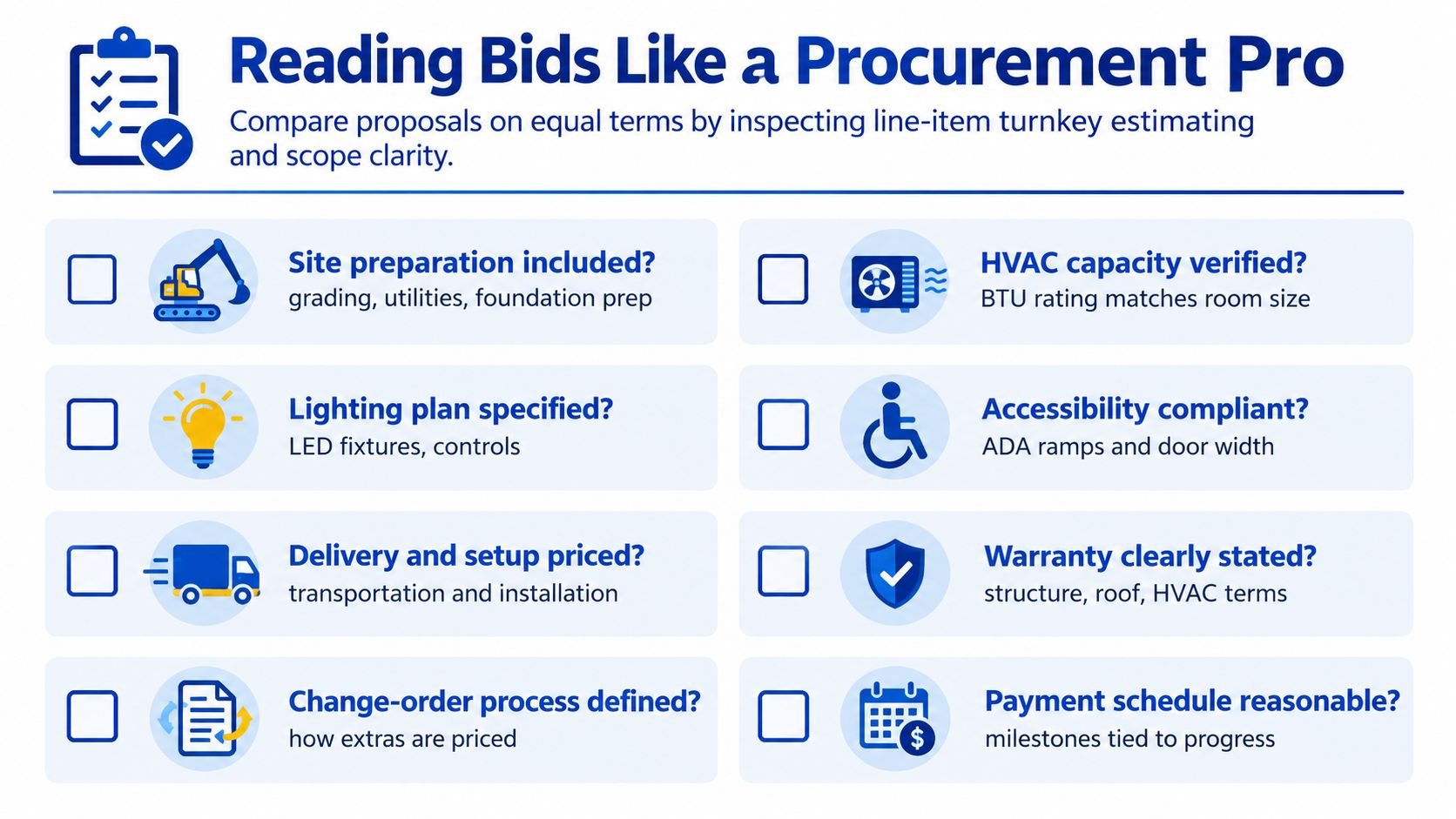
Use the following questions before recommending an award:
- Site preparation: Is grading, drainage, utility trenching, foundation preparation, and paving included?
- HVAC capacity: Does the specified system match the room size, climate, ventilation, and electrical service?
- Accessibility: Are ramps, landings, handrails, door clearances, paths, and transitions included?
- Delivery and set: Does the price cover transport, crane work, leveling, anchoring, and final setup?
- Compliance: Who handles permits, inspections, fire alarm, life safety, and occupancy approval?
- Warranty: Which party covers the structure, roof, HVAC, plumbing, electrical systems, and workmanship?
- Change orders: What labor rates, markups, allowances, and approval procedures apply?
- Payment schedule: Are milestones tied to measurable progress rather than unsupported front-loading?
A good bid makes assumptions easy to find. A weak bid relies on phrases such as “by others,” “allowance,” or “site conditions excluded” without defining the financial exposure.
The procurement team should also request references for projects with comparable site complexity, not merely comparable floor area. A classroom on a serviced campus doesn't prove that a contractor can manage utility extensions, difficult foundations, or occupied-school logistics.
Lifecycle Cost and Why the Cheapest Quote Often Costs More
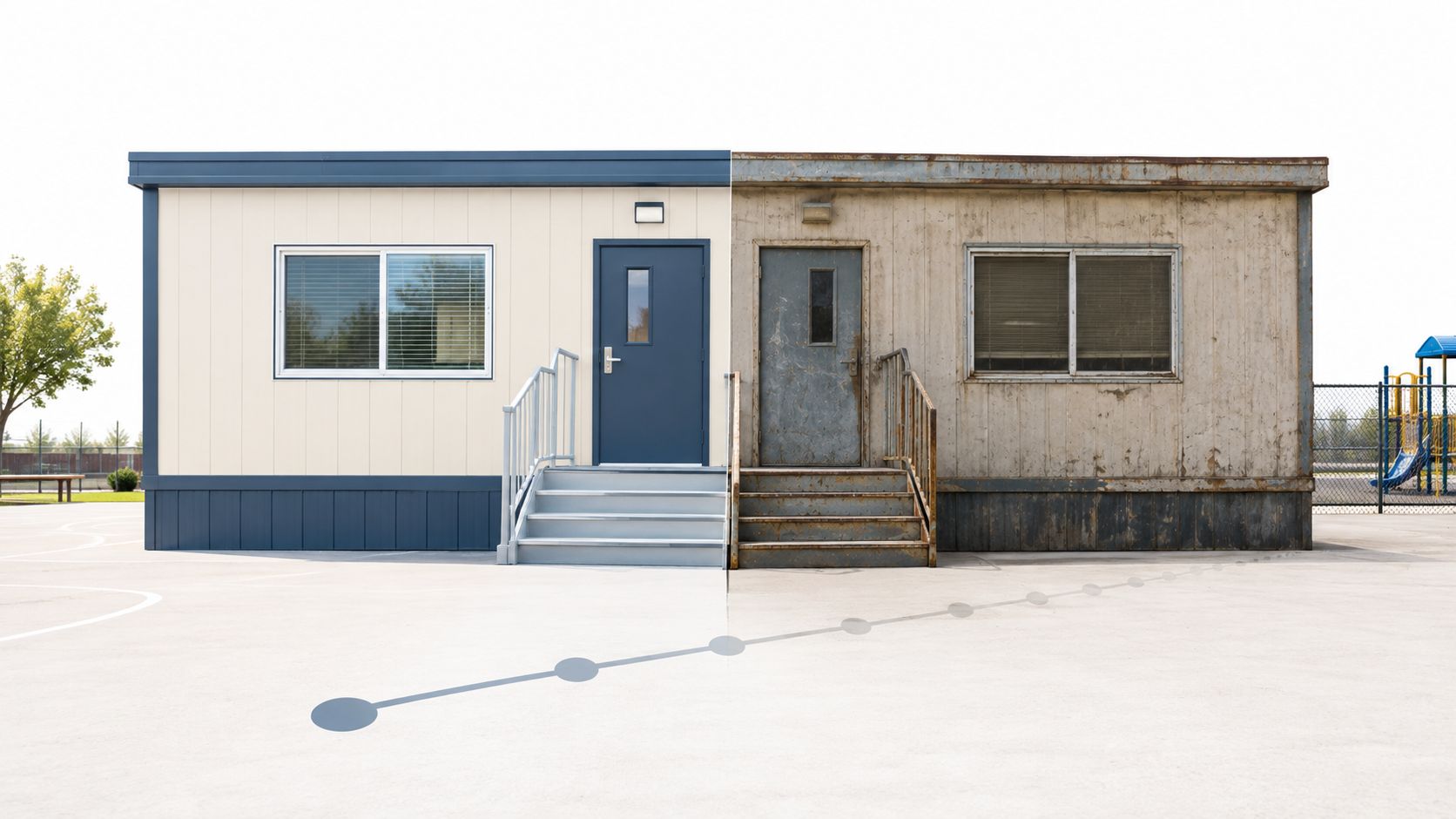
A portable classroom keeps costing money long after delivery. The actual budget sits in power use, service calls, repairs, insurance, inspections, relocation, and removal, and those line items are where a cheap unit often loses its price advantage.
In one monitored Florida classroom, average school-year electricity use reached 31.4 kWh per day. Space conditioning accounted for 57% of consumption and lighting for 41%. The same assessment estimated that better lighting and HVAC controls could cut annual use by 876 kWh and 1,643 kWh portable classroom energy-efficiency assessment.
Evaluate upgrades by deployment length
That matters because operating cost depends on how long the unit stays in service. One study on higher-performance relocatable classrooms cited efficiency upgrade costs of about $8,500 to $11,000 and annual savings of roughly $1,825. For a district planning to keep the classroom in place for years, that changes the buying decision. For a short deployment, lower upfront cost may still win relocatable classroom energy-performance research.
The main point is straightforward. A district should price the unit it will operate, not the unit that looks cheapest on bid day.
Maintenance deserves the same treatment. Since space conditioning represented 57% of electricity use in the Florida assessment, routine filter changes, coil cleaning, and control calibration affect the largest operating cost line directly. Deferred maintenance also tends to show up elsewhere, in roof leaks, plumbing repairs, electrical faults, worn flooring, and accessibility corrections that rarely appear in the original quote.
Relocation is another budget trap. Moving a classroom can mean disconnecting utilities, transporting the unit, preparing new foundations, reconnecting services, passing inspections, and restoring the original location. Districts that treat relocation as a minor line item usually end up revising the budget later.
The long-run upside of better-performing units can be substantial. Researchers reported measured energy savings of about 34% in New York, 46% in North Carolina, and 81% in Florida compared with standard units. The same paper also cited an earlier Florida estimate of roughly 250 million kWh annually in portable-classroom electricity use, with costs near $20 million per year relocatable classroom energy-performance research.
A usable lifecycle worksheet should list purchase or rent, site work, utilities, annual maintenance, energy, insurance, relocation, and removal, then assign each risk to an owner. If the district owns the building but not the site, end-of-term obligations can look very different from a fully leased solution.
Cutting the Bill With Cooperatives, Used Units, and Smart Procurement
Cost reduction works when it removes duplicated effort or matches the asset to the need. It fails when a district cuts the building specification but leaves site risk, utility upgrades, and compliance obligations unresolved.
Cooperative purchasing can reduce administrative work and shorten the path to a qualified supplier when the contract fits the district's requirements. The district still needs to confirm scope, geographic coverage, prevailing-wage treatment, installation responsibility, and whether the cooperative price includes the site package. A resource on cooperative purchasing contracts can help procurement teams understand how this route may fit into a modular project.
Use existing and reconditioned inventory carefully
A used unit can lower acquisition cost, particularly when the district needs a standard classroom and can accept an existing layout. The inspection must cover the roof, floor system, envelope, HVAC, plumbing, electrical equipment, moisture history, fire and life-safety features, accessibility, and documentation. A cheap unit that requires extensive refurbishment or transport isn't a bargain.
Reconditioned inventory can work well when the seller provides a clear scope and warranty. Districts should require photographs, inspection records, repair history, code status, and a list of items that remain the buyer's responsibility.
Let scale and timing do useful work
Multi-unit orders can reduce repeated mobilization and allow the district to standardize classroom layouts, finishes, furniture, and utility planning. The savings come from coordination, not from assuming that a larger order automatically receives a discount. Off-season procurement can also improve selection, but early planning matters more than chasing a calendar date when school opening deadlines are fixed.
Three practical levers deserve attention:
- Standardize the design: Avoid custom finishes and layouts unless they solve an actual instructional or compliance need.
- Bundle the site scope: Coordinate foundations, utilities, ramps, and restoration instead of awarding disconnected packages with overlapping mobilization.
- Compare used, leased, and new units: Match condition and ownership to the occupancy horizon, then compare the complete installed scope.
A Practical Budget Playbook for Your Next Classroom
A budget owner can make the next decision with three scenarios.
A single unit on a prepared, serviced site may support a portable solution because the district already has access, paving, utilities, and an accessible route. The estimate should still separate the unit from delivery, set, inspections, furniture, and commissioning.
A multi-unit campus needs a broader project budget. Shared infrastructure, corridors, fire and security systems, circulation, accessibility, and campus operations may matter more than the price of each individual module.
A swing-space project during renovation should compare lease and purchase against the exact occupancy horizon. Removal, restoration, and schedule certainty can outweigh a lower acquisition price.
Five actions should happen before the next board request:
- Define how long the district expects to occupy the space.
- Request a turnkey, line-item bid with explicit exclusions.
- Compare lease and purchase using the same delivery, setup, utility, maintenance, and removal scope.
- Stress-test foundations, utilities, accessibility, climate performance, and schedule risk.
- Check whether a cooperative contract can simplify a compliant procurement.
The most reliable answer to the cost of portable classrooms is a site-specific project budget, not a national sticker-price average. Districts that price the building, site, operation, and exit together make better decisions and avoid the budget shock that follows an incomplete quote.
Pacific Mobile Structures, Inc. offers leased and purchased portable classrooms, permanent and relocatable modular buildings, turnkey delivery and setup, furniture packages, site components, and cooperative purchasing support. Visit Pacific Mobile Structures, Inc. to request a classroom solution based on the district's site, timeline, occupancy horizon, and procurement requirements.