A lift can clear the top of a building and still fail the job. That's the mistake behind most bad orders on boom lift sizes. The headline height gets the platform into the air, but outreach, capacity at the working radius, and overhead clearance decide whether the crew can do the work from a safe setup position.
Table of Contents
- Quick Reference to Boom Lift Sizes by Category
- Articulating and Telescopic Models in Detail
- Working Height, Outreach and Capacity Terms Explained
- How to Measure Your Site Before Choosing a Size
- Matching Size to Construction, Maintenance and Modular Work
- Safety Rules That Change the Size You Need
- Why a Taller Lift Is Not Always the Right Lift
- Confirm the Lift Plan Before Delivery Day
Quick Reference to Boom Lift Sizes by Category
The table is organized by the constraint that can rule out a lift: height, outreach, or capacity. Use each row as a starting point, then check the specific machine's load chart before choosing a model.
| Category or model | Height rating | Horizontal outreach | Capacity |
|---|---|---|---|
| Compact articulating | Working height 35 ft 2 in (10.72 m) | Check the model's load chart | Check the model's load chart |
| Large articulating | Working height 67 ft 11 in (20.70 m) | 40 ft 5 in (12.32 m) | Check the model's load chart |
| Representative articulating | Use the model's stated platform or working height | Check the model's load chart | Check the model's load chart |
| JLG 600AJ (Riwal listing) | Working height 20.46 m | 12.75 m maximum reach | 230 kg platform capacity |
| Representative telescopic | Platform height 74 ft 8 in | Check the model's load chart | 1,000 lb |
| 66-foot-class telescopic | Confirm the model's working height | Check the model's load chart | Check the model's load chart |
| Large telescopic | Working height up to 186 ft (56.86 m) | About 90 ft (27.43 m) | Check the model's load chart |
How to Read Each Column
Height ratings use two different reference points. Platform height measures to the platform floor; working height includes an allowance above it. The MEC 66 RJ boom sell sheet shows how ratings vary across models. Compare like with like before deciding a machine is tall enough.
Outreach is the horizontal distance from the machine's setup position to the work area. A lift may reach the required height but still fall short of a façade or an obstacle. Capacity is the combined load of workers, tools, attachments, and materials. Check the model's load chart for the permitted capacity at the boom position and radius you plan to use.
Choose the row by the constraint most likely to fail, not by the largest height number.
For façade crews comparing access methods, high-rise systems from South Mountain Window Cleaning provide context on equipment used when a boom cannot be positioned beside the building. Use the table to narrow the options, then confirm clearances and the load chart for the exact model.
Articulating and Telescopic Models in Detail
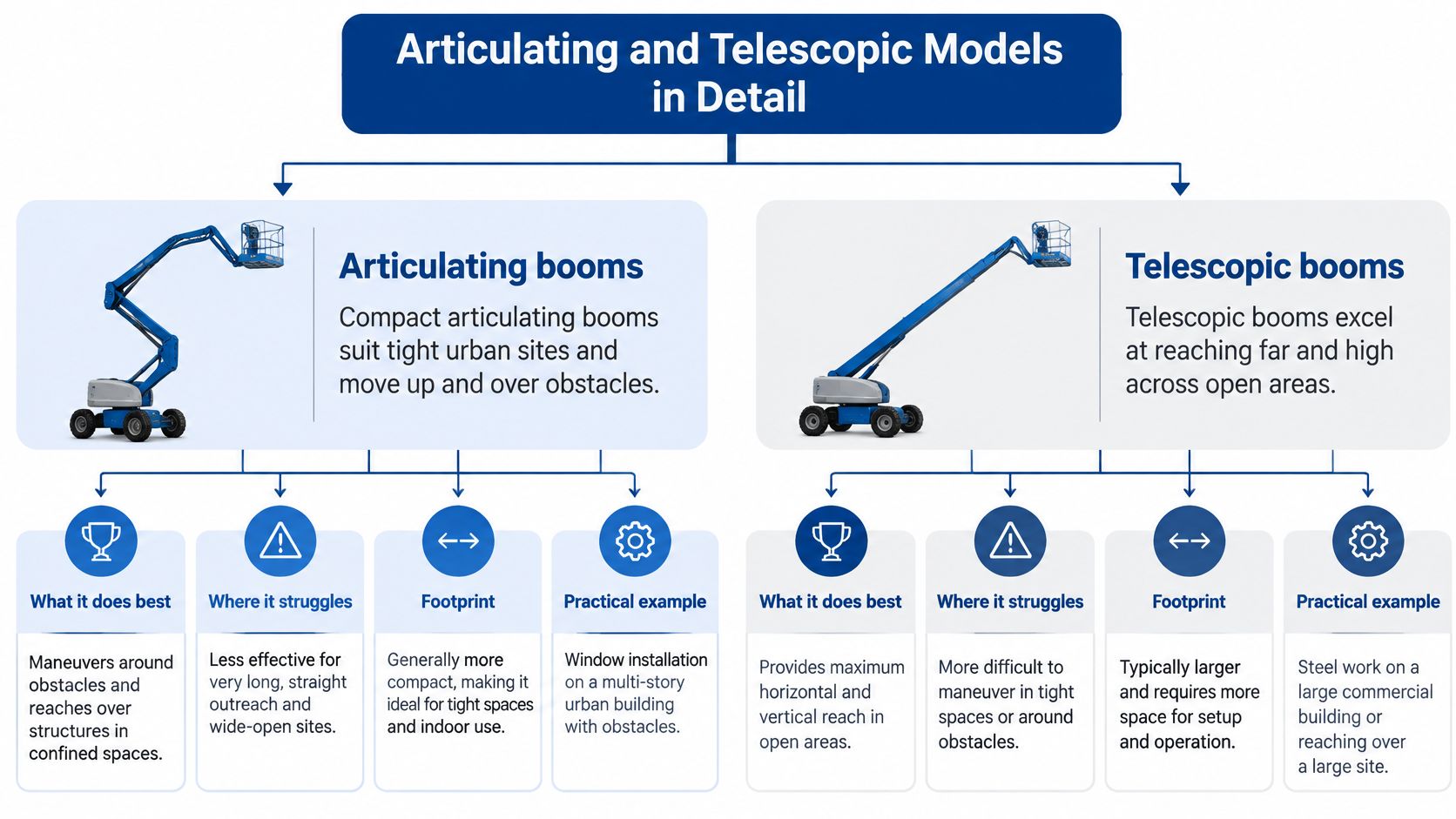
Both categories are mobile elevating work platforms, but they solve different access problems. Comparing them on the same four points prevents a buyer from choosing straight-line reach for a job that needs the boom to bend.
Articulating Booms
- What it does best: The jointed arm moves up and over rooflines, canopies, pipe racks, and installed equipment, then reaches down or across on the far side. Compact models suit tight urban, institutional, and indoor-adjacent areas where the chassis can't park under the work.
- Where it struggles: Straight-line outreach for a given chassis is usually less direct than a telescopic boom, and working around several obstacles takes more repositioning of the arms.
- Footprint: Compact units fit tighter staging areas. Large articulating machines need more transport length, turning room, and ground support as their reach grows.
- Practical example: A school crew repairing a façade behind a covered walkway sets up in the drive lane, raises the first arm over the canopy, and works on the wall without placing the chassis on landscaping.
Telescopic Booms
- What it does best: The boom extends in a straight line, giving strong reach across open ground and a clear path to high work points with few obstructions. Pacific Mobile's telescopic boom lift guide is useful when comparing that straight reach with site access needs.
- Where it struggles: It can't bend around a parapet or canopy in the way an articulating arm can. The operator needs a direct line from the setup point to the work point.
- Footprint: Reach carries a physical cost. The Haag Global overview of ANSI aerial platform changes notes a 150-foot boom lift is approximately 40 feet long, 10 feet tall, and more than 16 feet wide when its axles are extended. That size creates transportation, ground-bearing, turning-radius, and staging requirements before delivery.
- Practical example: On an open modular construction site, a telescopic machine stands back from partly built walls and reaches across to the roof edge without entering the foundation area.
Terminology matters when spec sheets and training documents use different titles. ANSI A92.20 addresses design requirements, while A92.22 and A92.24 cover safe use and training-related provisions. The standards use mobile elevating work platform as the broader equipment category, so that term and boom lift may appear side by side.
Category rule: Choose the boom shape that clears the obstacle between the setup point and the work point, then compare sizes inside that category.
Working Height, Outreach and Capacity Terms Explained
Spec sheets cause confusion because several ratings sound interchangeable. They aren't. Each term answers a different site question, and using the wrong one creates a shortfall that only appears after delivery.
The Height Terms
Platform height is the vertical distance from the ground to the platform floor. That's where the worker stands. Working height adds an allowance above the platform for the worker's reach, so it's the figure for comparing against the highest point the worker must touch, fasten, inspect, or repair.
Say a crew must work at a roof edge. The team measures to the work point, checks the machine's working height, and still confirms that the platform can sit at a comfortable level below the task. A worker at full stretch all shift isn't a sound plan, even if the working-height arithmetic passes.
The Reach Terms
Horizontal outreach is the horizontal distance the platform can reach from the machine. The maximum value applies only in the boom positions shown in the manufacturer's range diagram. It shouldn't be assumed at maximum height.
Up-and-over clearance describes the obstacle height the boom can clear while reaching beyond it. This is the governing number for parapets, canopies, fences, and equipment between the chassis and the work. An articulating boom may solve that geometry where a straight boom can't.
The Capacity Terms
Platform capacity covers every occupant plus tools, attachments, and materials. Unrestricted capacity applies across the permitted unrestricted envelope. Restricted capacity may allow a different load only inside a limited envelope. As the boom extends or the working radius grows, the allowable load can fall.
Occupant limits govern separately from weight. A two-person rating can't be exceeded because three lighter workers together weigh less than the listed load limit. Weight and headcount both have to pass.
Search results may use aerial lift and mobile elevating work platform for overlapping equipment categories. The model designation and load chart settle what a particular machine is, not the search label.
For a 66-foot-class telescopic example, working height answers whether the crew can reach the top of the work area. Outreach answers whether the platform can get to the roof edge from firm ground. Both have to pass together.
Spec-sheet test: Can it reach high enough, far enough at that height, and carry the full load at that radius? If any answer is unclear, the size isn't confirmed.
How to Measure Your Site Before Choosing a Size
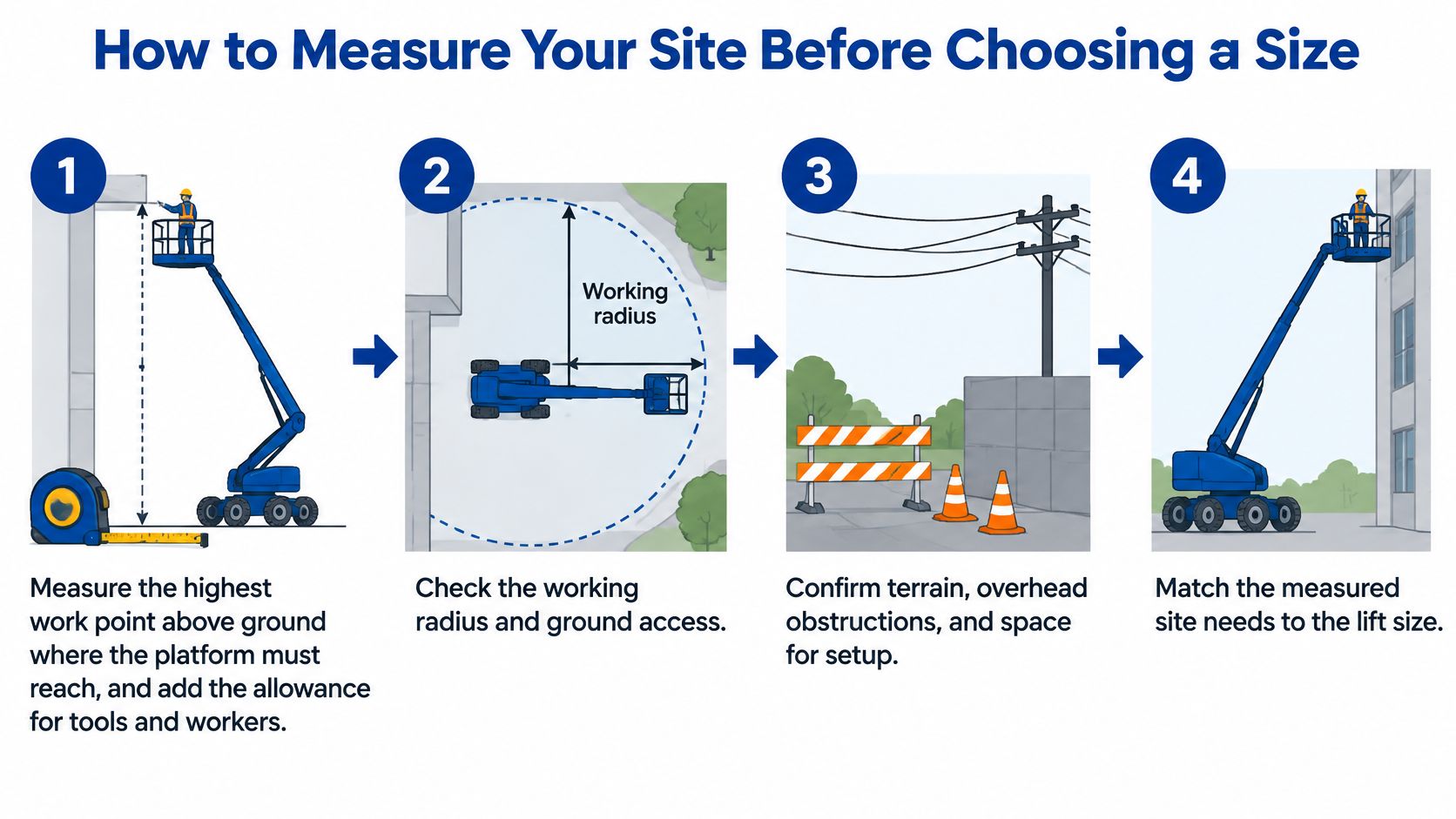
Measure the site before calling for a model. A tape, a laser measure, a site plan, and a scale for tools and materials prevent most sizing errors.
Seven Measurements in Order
- Highest work point: Measure from the setup surface to the highest point the worker must reach, because this figure is compared with working height, not platform height.
- Farthest horizontal offset: Measure from the nearest stable setup position to the farthest work point, because outreach at the required elevation governs the model.
- Obstructions: Record the height and depth of rooflines, canopies, trees, installed equipment, and overhead conductors between setup and work, because up-and-over clearance may govern over maximum outreach.
- Access route: Measure gate width, door width, overhead clearance, and the delivery truck's turning path, because a lift that can't enter has no useful reach.
- Ground at setup: Check slope, bearing capacity, trenches, covers, and unsupported edges, because the chassis and outriggers need support through the full load cycle. Delivery requires a firm or compact, level site that's accessible by truck or delivery equipment.
- Total platform load: Add workers, tools, attachments, and materials, because every pound in the platform counts against capacity.
- Load-chart position: Plot height, offset, and load on the manufacturer's chart for the exact model, because headline capacity can vary by boom position and machine configuration.
The JLG 860SJ HC3 telescopic boom lift page shows why the comparison can't stop at platform height. A practical review compares maximum platform height, working height, horizontal outreach, articulation or telescoping range, platform capacity, machine width, machine height, transport length, turning radius, ground clearance, and operating weight. The same reference context includes a representative telescopic model reaching a 74 ft 8 in platform height and providing 1,000 lb capacity.
Worked Example
Say a modular classroom roofline sits 24 ft above grade and the furthest fastener line is set back 30 ft from firm pavement. Height alone suggests a compact machine could work. The offset changes the answer, because the platform must clear the eave and still reach the fasteners while carrying the crew and tools.
That example is where up-and-over clearance and capacity at radius become the governing ratings. A machine passing height by a wide margin can still fail the offset. Send the rental provider the height, offset, obstacle dimensions, total load, and access measurements rather than asking for a nominal size class.
Matching Size to Construction, Maintenance and Modular Work
Jobs fail on different constraints. Construction often fails on ground support or long offsets. Maintenance in an occupied building often fails on width, tail swing, or access hours before height becomes the problem.
| Job | Typical reach need | Likely size class | Main check |
|---|---|---|---|
| Construction site work | Outreach across open ground and over materials | Telescopic or large articulating | Ground bearing and delivery route |
| Façade or roofline maintenance | Outreach past the building edge | Articulating with proven outreach | Clearance to eaves and overhead conductors |
| Interior ceiling or fixture work | Height with tight width | Compact articulating | Doorway width and floor loading |
| Modular unit or panel installation | Lift over partly built walls and roof | Mid-size articulating, or telescopic for long offsets | Level setup and load chart at working radius |
| Maintenance near classrooms or clinics | Height beside occupied walkways and entrances | Compact articulating | Access hours and tail swing |
Where the Table Surprises Buyers
Modular installation looks like a height job from a distance. On site, the crew often works over walls, roof sections, stored panels, and unfinished ground, so outreach and a level setup govern. Pacific Mobile's modular building installation guidance helps planners sequence the building work that the lift must support.
Capacity surprises buyers on mid-size articulating machines. The Riwal listing for the JLG 600AJ states a 20.46-meter working height, 12.75-meter maximum reach, and 230-kilogram platform capacity. Once two workers, drills, fasteners, and a panel section are counted, that capacity leaves limited room. Materials may need a separate lifting method instead of being carried in the platform.
For property maintenance teams comparing façade access options, the window washing equipment guide for property managers adds context on alternatives when repeated window work, roof access, or building geometry makes boom positioning difficult.
Interior ceiling work reverses the usual priority. A compact articulating machine may be right even with modest height because it fits the doorway, limits floor loading, and keeps tail swing away from finished walls. Maintenance near classrooms or clinics adds scheduling and pedestrian controls. The smallest machine that reaches safely may be easier to isolate from occupants.
Choose the class that clears the hardest obstacle in the job, then confirm capacity and footprint before ordering.
Safety Rules That Change the Size You Need
A size that fits dimensionally can still be disqualified by safety rules. Treat each rule as a sizing input, not paperwork to complete after the rental arrives.
Rules That Push the Setup Farther Back
The OSHA aerial lifts fact sheet identifies 29 CFR 1926.453 for construction and 29 CFR 1910.67 for general industry. It requires boom and basket load limits specified by the manufacturer to be observed, daily testing of lift controls, firm standing on the basket floor, and personal fall protection attached to the boom or basket.
Clearance from energized overhead lines directly affects outreach. Site teams should maintain at least 10 ft (3 m) clearance unless a more stringent electrical-safety rule applies. If that clearance moves the chassis farther from the work, a machine with more outreach may be required. If no safe setup preserves clearance, the job method must change.
Ground and Load Rules
The chassis can't be positioned on unstable ground, excessive slopes, trenches, or unsupported surfaces to make a short boom reach. Outriggers must be used where the manufacturer requires them, and the ground beneath wheels or outrigger pads must support the load. Moving to the nearest firm surface can increase the offset and change the required size.
Load planning has the same effect. The capacity calculation must include every occupant, tool, attachment, and material load. A crew that adds a material hoist attachment, extra batteries, or stored panels after selecting the lift can erase the margin that made the size acceptable.
Pre-task planning should document:
- Access dimensions: Gate, door, turning, and overhead measurements for the selected machine.
- Exclusion zones: Ground areas kept clear below and around the work.
- Rescue procedure: The method and equipment for lowering or recovering occupants.
- Weather limits: The manufacturer's wind and weather restrictions for the exact model.
- Operator authorization: The trained, authorized person assigned to operate the lift.
Disqualification test: If the lift can reach the work only by violating a load, ground, clearance, or fall-protection rule, it's the wrong size regardless of its height rating.
Those checks matter on schools, healthcare sites, temporary offices, and modular installations because pedestrians, entrances, utilities, and partly finished ground limit where the machine can stand. Size selection and the safety plan are the same decision.
Why a Taller Lift Is Not Always the Right Lift
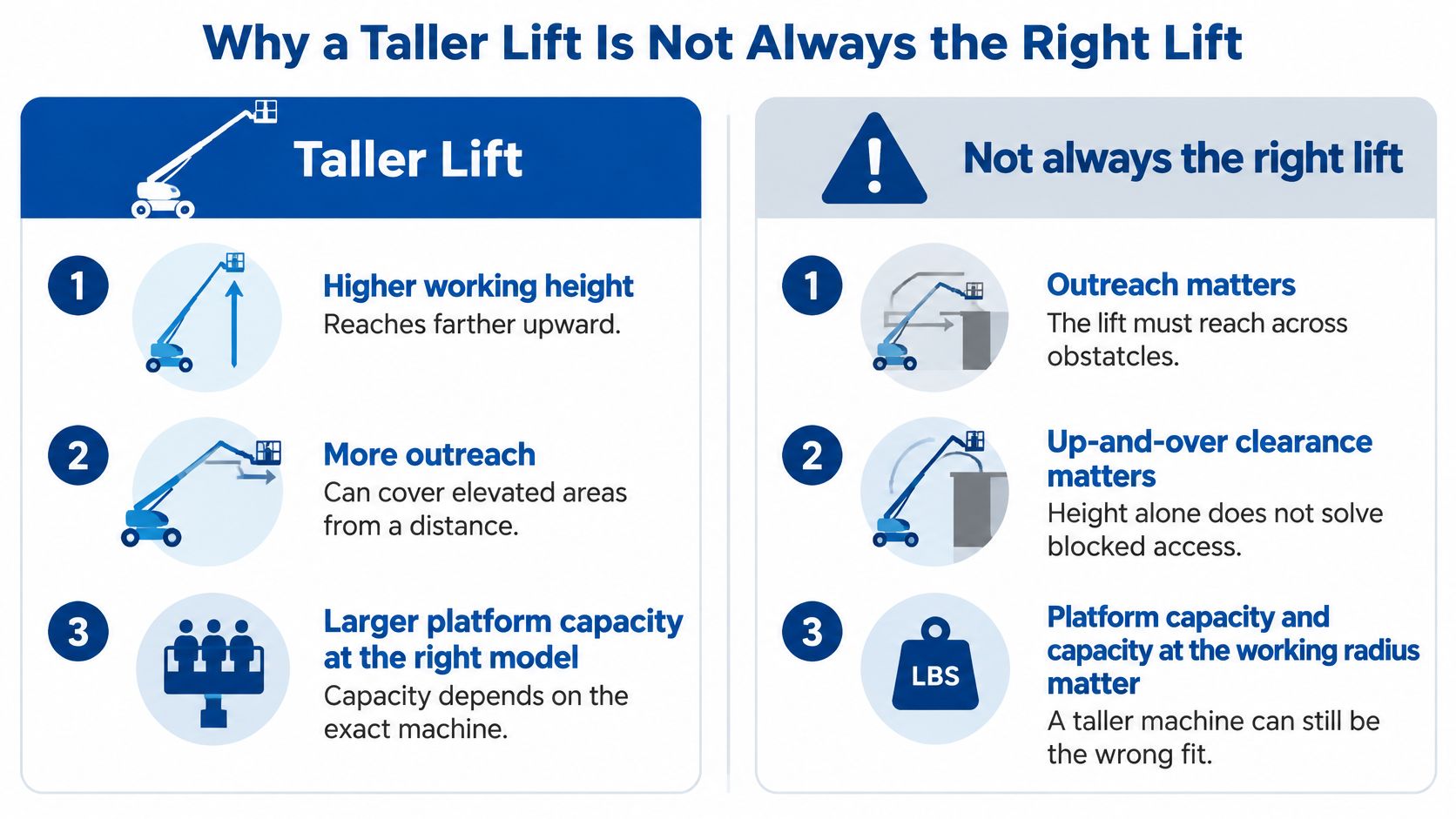
The common assumption sounds cautious. Rent taller, keep extra height in reserve, and avoid coming up short. That logic fails when the limiting dimension runs sideways or the allowable load drops at the required radius.
One Canopy Shows the Problem
Say the work point is on a façade behind a canopy. The platform must rise above the canopy edge, clear its depth, and then position beside the wall. A taller straight boom may clear the top but meet the canopy at the wrong angle. An articulating boom with less maximum height may bend over the canopy and place the platform correctly.
The JLG guide to specing equipment by application supports evaluating horizontal outreach, up-and-over clearance, platform capacity, and capacity at the actual working radius together. It also warns that a lift rated for a particular load may have a lower allowable capacity at extended outreach. Those checks matter around rooflines, façades, canopies, trees, and installed equipment.
The Trade-Offs Run Both Ways
Larger machines bring a longer chassis, larger operating footprint, heavier transport demands, and higher ground loading. They need wider turning paths and more staging room. On a finished school or clinic site, those needs can block entrances or force the setup onto weaker surfaces.
Compact machines fit tighter access routes and occupied sites. They give up reach and may need the chassis closer to the building, which isn't always possible. Neither direction is safer by default. Safety comes from matching the working envelope to the measured points and staying inside the load chart.
Elevation also changes the geometry. The same horizontal offset at a low roof edge and at a high façade can fall in different parts of the range diagram. That is why a single maximum outreach number can't confirm both jobs.
Bigger isn't automatically safer or more capable. Size the lift to the hardest point to reach on the site, not the highest point on the site.
Map the highest point, furthest horizontal point, obstruction clearance, workers, tools, and materials. Then test those coordinates against the exact model's load chart. A taller machine earns its place only when that test says so.
Confirm the Lift Plan Before Delivery Day
A lift plan is ready for delivery only when the machine's documents, site measurements, and access route agree. Confirm each item before dispatch, while there is still time to adjust the plan.
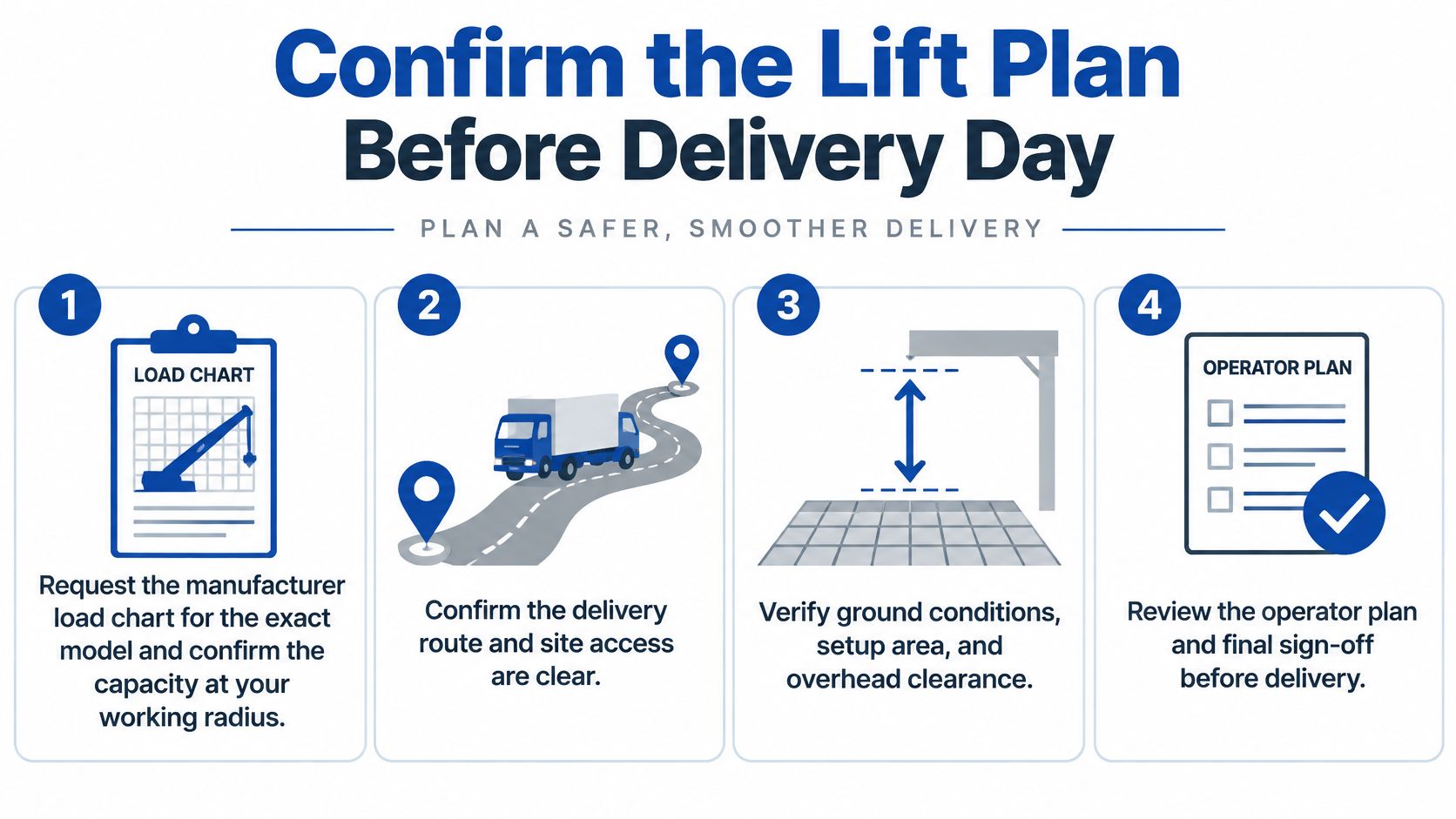
- Request the load chart and range diagram: Get the documents for the exact model. Check that its capacity covers the planned height, radius, workers, tools, and materials.
- Review the operating manual: Confirm that the planned setup is allowed for the ground conditions, slope, and outrigger arrangement.
- Send measurements in writing: Provide the working height, horizontal offset, obstacle dimensions, total load, and access-route measurements to the equipment provider.
- Confirm delivery access: Check truck access, turning space, overhead clearance, and a firm, level setup area. For support space on a jobsite, see construction site trailer options.
- Document the operator plan: Assign operator authorization, fall protection, exclusion zones, rescue procedures, weather limits, and overhead-line clearance.
Façade crews planning repeated elevation work can also review choosing the right window cleaning lift for related access considerations.
For modular buildings that a lift will help install, customers seeking a specific building size should contact their local sales representation at Pacific Mobile Structures, Inc.
A lift is ready for delivery when the load chart, measurements, and route all fit the plan. If they do not, revise the model or work method before dispatch.
For modular classrooms, clinics, offices, and construction support space, Pacific Mobile Structures, Inc. provides relocatable and permanent modular buildings, mobile offices, and storage solutions. Share the building size, site constraints, and installation schedule with the local team so the building and site access plans can be coordinated.