A school district has moved boxed student records into a storage container beside a renovation site. The records are secure, but the procurement team still has an uncomfortable question: will summer heat, winter cold, damp pallets, or condensation damage the contents before the project ends? A thermostat on the wall won't answer it.
That question appears across healthcare, government, construction, education, and commercial operations. A climate controlled storage container can reduce environmental exposure, but the label alone says very little. Buyers need to separate temperature, relative humidity, dew point, ventilation, insulation, and monitoring before approving a specification.
Table of Contents
- Why Buyers Start Looking for Climate-Controlled Storage
- What Climate Control Actually Means in a Container
- Climate-Controlled vs Standard Storage Containers
- Temperature, Humidity, and Ventilation Specifications That Matter
- The Condensation Problem Most Climate Setups Miss
- Matching Use Cases to the Right Level of Control
- Monitoring and Documentation That Prove the System Works
- Choosing the Right Container for Your Site
Why Buyers Start Looking for Climate-Controlled Storage
The search often begins with a failure, not a facilities plan. A contractor opens a container and finds warped finish materials. A school discovers that paper records smell damp after sitting through a wet season. A clinic needs temporary space for supplies while a permanent room is renovated. A government department has to protect archives at a temporary site without bringing every box back into the main building.
Those situations create a risk-management decision. The question isn't only whether a container has air conditioning. It's whether the selected environment matches the contents, the site, the loading pattern, and the evidence the organization may need later.
A standard container can provide secure, weather-resistant space for many durable goods. That may be sufficient for tools, packaged construction materials, outdoor equipment, and other contents that tolerate normal temperature swings. The calculation changes for electronics, documents, furnishings, pharmaceuticals, instruments, and materials exposed to moisture.
Practical rule: A buyer should specify the condition that must be maintained, not the feature name printed in a brochure.
The trigger is usually a change in operating conditions
Storage often moves outside the warehouse during construction, emergency relocation, classroom replacement, clinic expansion, or a compressed project schedule. Once the container sits on a jobsite, it faces solar heating, door openings, weather changes, wet cargo, and uneven air circulation. Those factors can matter as much as the nominal HVAC capacity.
The secure storage container options from Pacific Mobile Structures can help buyers address the physical security side of this transition. Environmental protection requires a separate conversation about insulation, conditioning, moisture control, and records.
A vague concern needs a written requirement
“Keep it climate controlled” isn't a usable acceptance criterion. A procurement team should identify the contents, the acceptable temperature and RH range, the dew-point limit, the alarm response, the required records, and the consequences of an excursion.
That approach prevents two expensive mistakes. The first is paying for conditioning that adds no meaningful protection. The second is selecting a temperature-only unit for contents that need humidity management and condensation control.
What Climate Control Actually Means in a Container
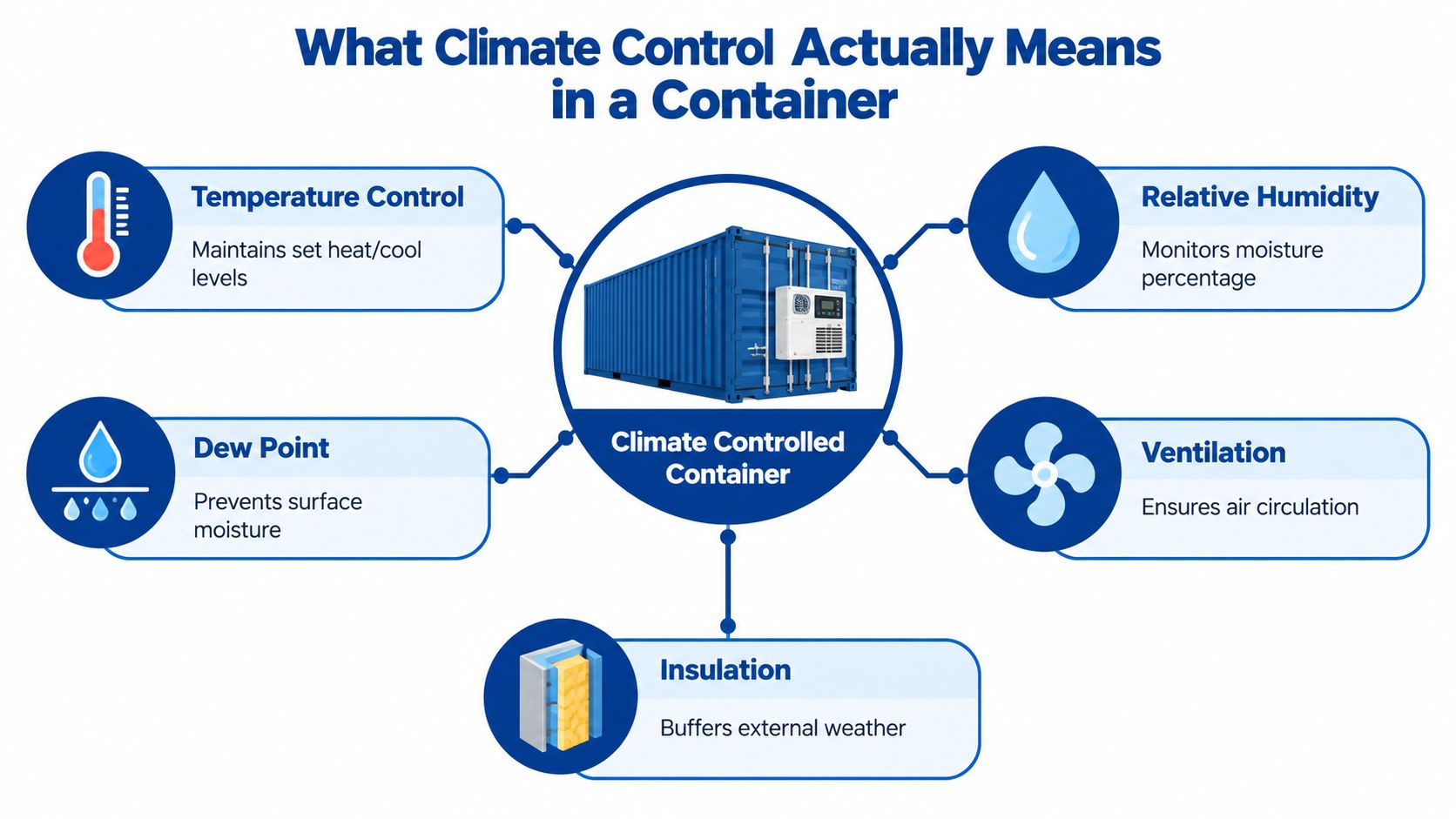
Climate control is a set of environmental controls, not a single device. Temperature control manages heat and cooling. Relative humidity, or RH, describes the moisture percentage in the air. Dew point indicates when that moisture can condense on a colder surface. Ventilation moves air, while insulation slows heat transfer through the container envelope.
A unit may include heating and cooling without actively removing moisture. That distinction matters because cooling can lower air temperature while leaving a moisture problem unresolved. Public guidance also distinguishes temperature-controlled storage from broader climate control, and buyers should request the actual RH target in writing rather than infer it from the product name.
Five terms belong on the specification
- Temperature: The air must remain within the range required by the contents, including during door openings and outdoor changes.
- Relative humidity: RH control limits the moisture available for mold, corrosion, swelling, and material degradation. One industry guide recommends keeping RH below 50%, while also explaining that moisture control must be expressly provided, not assumed, in a climate-controlled service. See the climate control guidance from the Self Storage Association.
- Dew point: This is the condensation test. A container can show an acceptable temperature while a cold wall, floor, or metal surface reaches the dew point.
- Ventilation: Fresh-air exchange may remove odors or contaminants, but uncontrolled ventilation can bring humid outdoor air into the unit. Air movement must support the environmental target.
- Insulation: Insulated walls, roof, and doors buffer external weather and reduce HVAC load. Insulation doesn't dehumidify the air or prove that the interior is uniform.
ASHRAE provides a useful way to think about environmental envelopes. Its storage guidance includes non-operational conditions near -40–60°C and 5–93% RH, with a maximum dew point of 33°C and non-condensing air. Tighter operational conditions for Class A2 equipment are 10–35°C, 20–80% RH, and a 21°C maximum dew point. These broad and tight ranges serve different applications, so a buyer shouldn't copy them into every container purchase.
Teams comparing how to choose the right storage unit should apply the same discipline to a container. The useful question is not “Is it climate controlled?” It is “Which environmental variables does the supplier control, within what range, and with what evidence?”
Climate-Controlled vs Standard Storage Containers
A standard dry container wins on simplicity, deployment speed, and low operating complexity. A conditioned container wins when environmental exposure threatens the contents or the project cannot tolerate replacement, rework, or a disputed loss.
| Attribute | Standard Container | Climate-Controlled Container |
|---|---|---|
| Insulation | Basic weather barrier, with limited thermal buffering | Added insulation helps moderate exterior heat and cold |
| HVAC or dehumidification | Usually absent | May include heating, cooling, dehumidification, or a combination |
| Ventilation | Passive vents or limited airflow | Designed airflow, with fresh-air strategy determined by the application |
| Monitoring | Often limited to a basic inspection | Continuous temperature and RH logging can support alarms and records |
| Power | Minimal or no ongoing power requirement | Requires dependable electrical service and operating controls |
| Deployment | Fast to position and load | Requires equipment selection, setup, commissioning, and power coordination |
| Cost | Lower acquisition and operating burden | Higher cost, justified when contents or compliance needs demand control |
Where the standard container is the right answer
A standard unit is appropriate for heavy-duty contents that don't depend on a narrow environmental envelope. Examples include packaged masonry accessories, tools, outdoor furniture, non-sensitive fixtures, and sealed materials that arrive dry and can tolerate site conditions.
It also makes sense when the unit is used for short-duration overflow and the local exposure is manageable. The buyer still needs to inspect seals, drainage, flooring, and cargo condition. A dry container isn't a wet container, but it isn't an indoor warehouse either.
Conditioning becomes worthwhile when the contents include paper records, electronics, wood, textiles, instruments, or supplies vulnerable to moisture. It can also be justified when a project location has pronounced heat, cold, or humidity exposure, or when repeated replacement would cost more than environmental protection.
Buyers should inspect the physical condition as well as the environmental package. Pacific Mobile Structures' container grading information is relevant when evaluating the base unit, because a sound enclosure supports conditioning more effectively than one with compromised doors, seals, or panels.
What the upgrade still won't solve
HVAC doesn't automatically correct wet pallets, damp packaging, trapped moisture, or poor sensor placement. It also can't guarantee uniform conditions if the container has dead zones, excessive door opening, inadequate insulation, or an undersized system.
The strongest procurement packages treat the unit as a system. The enclosure, HVAC, dehumidifier, ventilation controls, power supply, monitoring hardware, loading procedure, and maintenance plan all contribute to performance.
Temperature, Humidity, and Ventilation Specifications That Matter
Procurement language should make the environmental envelope measurable. A supplier should be asked to state the target temperature, allowable RH, maximum dew point, humidity rate of change, ventilation behavior, alarm thresholds, and backup-power expectations. “Comfortable inside” isn't a performance specification.
ASHRAE's storage guidance gives buyers a defensible framework, but different contents require different limits. Non-operational data-storage equipment can have a broad permitted envelope, approximately -40–60°C and 5–93% RH, subject to a 33°C maximum dew point and non-condensing air. Class A2 operational conditions are tighter, 10–35°C, 20–80% RH, with a 21°C maximum dew point. These figures come from the ASHRAE storage guidance.
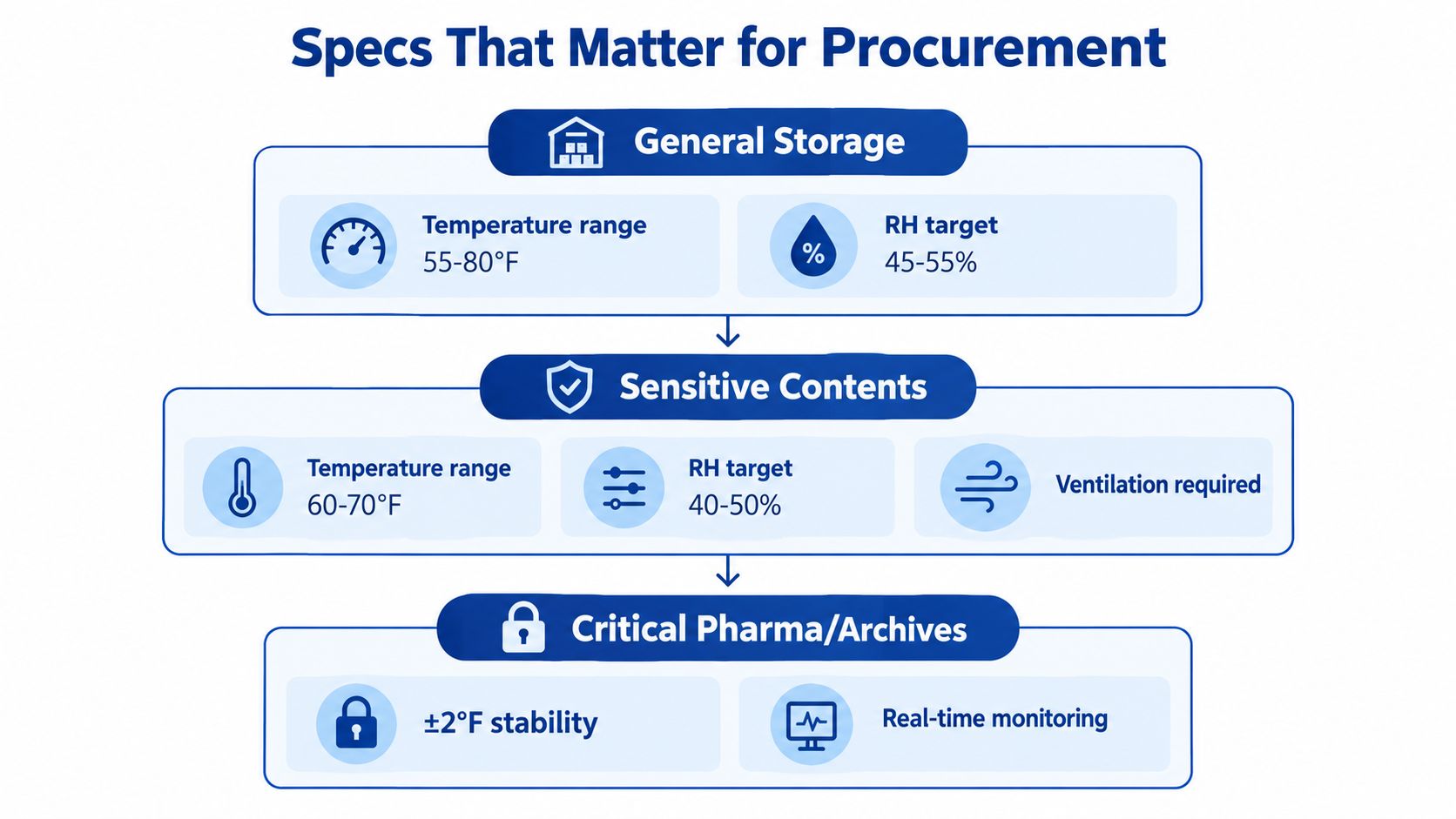
A practical specification has layers
General protected storage may need temperature buffering and moisture reduction rather than validated pharmaceutical control. A written requirement can define the acceptable seasonal range, an RH ceiling, and a response process for alarms.
Sensitive contents need tighter RH and dew-point control. Electronics, paper, wood, and instruments should prompt questions about condensation surfaces, humidity rate of change, and air distribution. ASHRAE identifies a humidity change below 5 percentage points RH per hour as useful guidance for tape media and related equipment.
Critical or regulated contents require documented validation, not a marketing promise. Pharmaceutical archives, controlled records, and high-value IT equipment may need mapped conditions, calibrated sensors, alarm escalation, backup power, and documented excursion handling.
Ventilation requires restraint
Fresh air isn't automatically beneficial. If outside air is warm and humid, an open vent can increase the latent moisture load. If the container holds materials that release vapors or requires air exchange for safety, ventilation needs to be engineered around those conditions.
The HVAC system also needs enough capacity for solar exposure, cargo heat, door openings, and the container's insulation level. Buyers should request the design assumptions, not just the equipment model. A plain-language humidity guide from Covenant Aire Solutions can help non-specialists understand why temperature and moisture must be considered separately.
The Condensation Problem Most Climate Setups Miss
Condensation often starts before the HVAC system runs. Cargo can bring moisture from damp pallets, wet packaging, shrink-wrap, porous materials, or trapped headspace air. Solar exposure can heat the steel shell, then rapid cooling can drive moisture onto colder internal surfaces.
A climate-controlled storage container cannot remove an unknown moisture load just because its thermostat reaches the requested temperature. Dehumidification capacity, airflow, surface temperature, and the condition of the incoming cargo all matter.
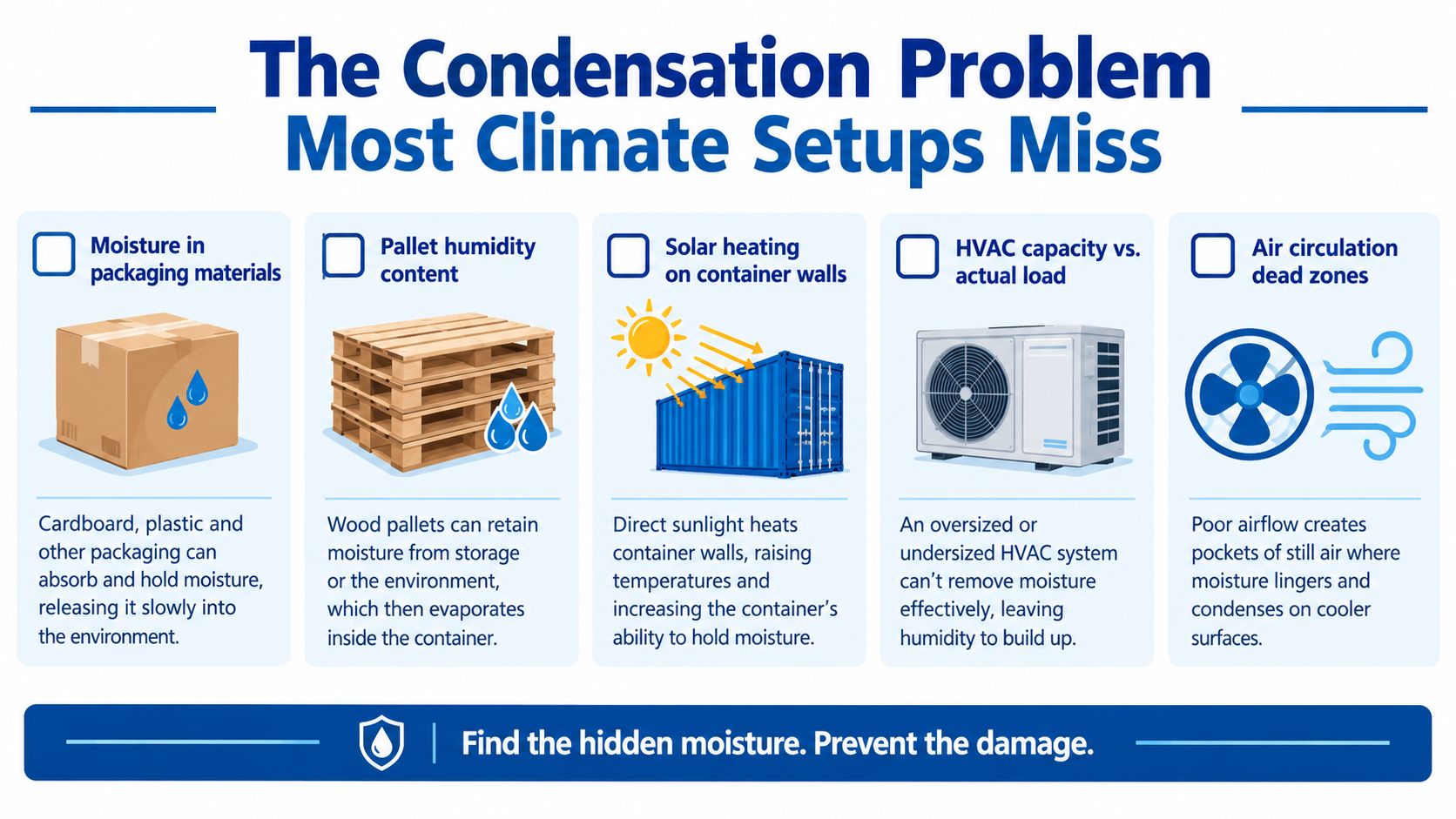
Inspect the moisture sources before changing the equipment
Research on container condensation models identifies initial product moisture, headspace volume, solar exposure, coating color, and local weather as important variables. The research found that light-colored coatings can reduce condensation probability compared with dark coatings, although field validation remains necessary. That makes the container finish a risk factor, not a substitute for moisture control.
A loading inspection should cover:
- Cargo condition: Reject or isolate damp materials before they enter the unit.
- Pallet dryness: Wood can introduce moisture even when the cartons look dry.
- Packaging design: Vapor barriers and shrink-wrap can protect contents, but they can also trap moisture if the load enters wet.
- Seals and drainage: Inspect doors, roof joints, floor condition, and site drainage for water entry.
- Air circulation: Check corners, floor level, door areas, and spaces near the evaporator for stagnant zones.
- Moisture equipment: Size desiccant or dehumidification for the actual load, not the container volume alone.
Uncontrolled ventilation deserves special attention. It can remove moisture under some conditions, but it can also pull humid outdoor air into the container and worsen the problem. A moisture-risk review should calculate dew point, consider solar heating, and establish when ventilation runs.
The following video provides a visual introduction to condensation risk:
For broader practical guidance, buyers can review these humidity and mold prevention strategies, then convert the relevant controls into a loading and inspection checklist.
Matching Use Cases to the Right Level of Control
The right unit depends on the consequence of exposure. A school archive, a pallet of concrete accessories, and a pharmaceutical shipment shouldn't receive the same environmental specification just because all three sit inside containers.
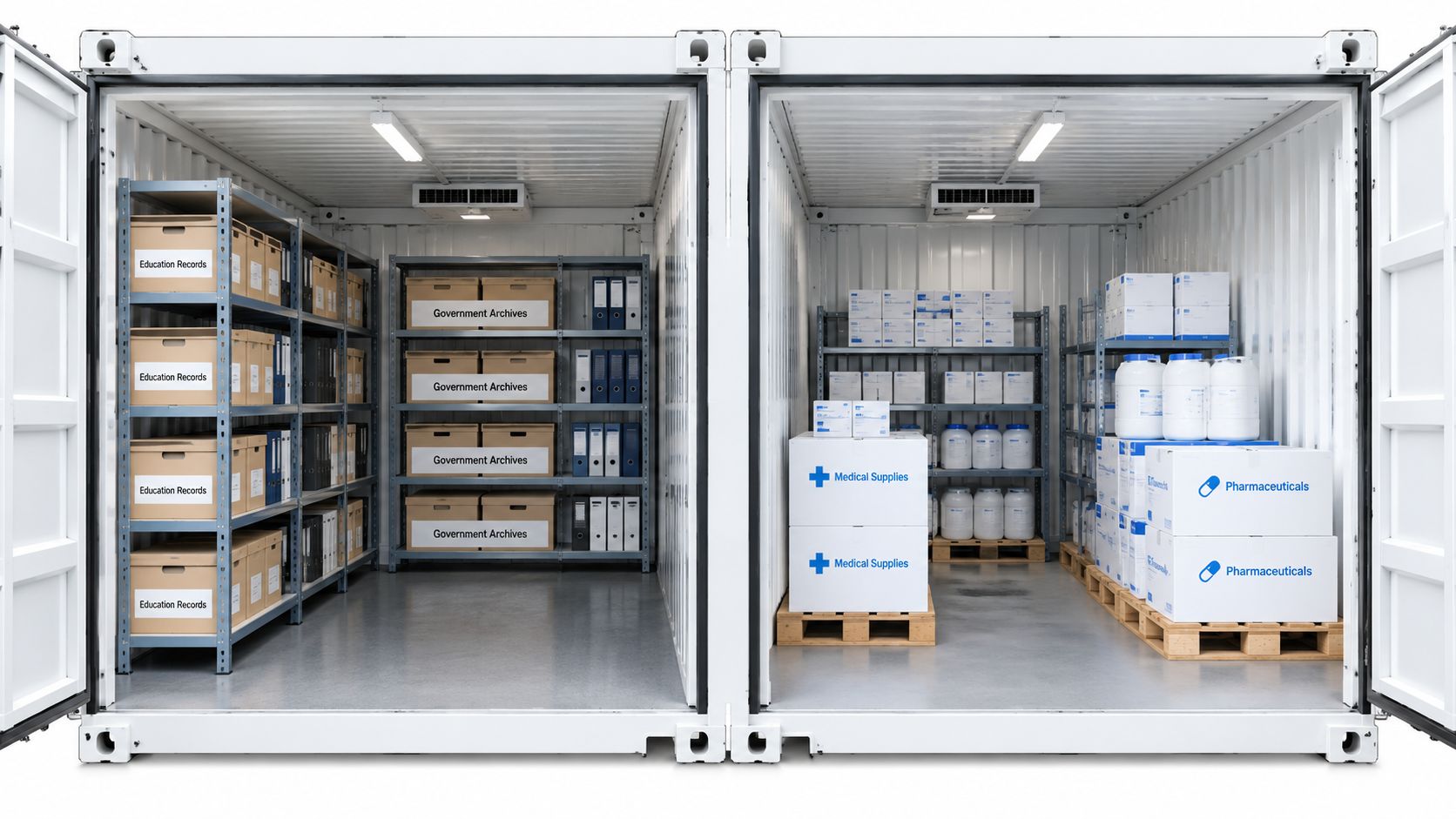
Education and government records
Paper records, testing materials, and archives need protection from moisture and large environmental swings. A conditioned unit with RH monitoring is the sensible baseline. Government buyers should add downloadable records and alarm escalation when the stored material has retention, audit, or legal significance.
A standard unit may work for duplicate records or short-term boxes that are dry, sealed, and not especially valuable. It shouldn't be selected just because the contents are boxed. Cardboard protects against handling damage, not against a humid internal environment.
Healthcare and pharmaceuticals
Healthcare supplies vary widely. Durable packaged goods may need basic temperature buffering, while pharmaceuticals and validated medical materials require a documented environmental envelope. A supplier should be given the product's storage requirement before the container is selected.
For regulated materials, the package should include mapped sensors, alarm response, calibration, backup power, and an excursion procedure. A thermostat-only container is not a validated storage system.
Construction and industrial materials
Construction materials often fall into the protected-storage tier. Tools, hardware, fixtures, and sturdy packaged materials may perform well in a standard container if the unit stays dry and the loading team controls moisture.
The recommendation changes for finish materials, wood products, adhesives, electronics, and components with manufacturer-defined environmental limits. Conditioning can reduce exposure, but dry loading, sealed packaging, and airflow still determine whether the system works.
IT and data-center support
Small IT deployments and data-center support equipment need more than a comfortable temperature. Buyers should evaluate dew point, RH stability, non-condensing air, sensor mapping, alarms, and power continuity. ASHRAE's environmental classes provide a useful reference, but the equipment manufacturer's requirements control the final specification.
A practical tiering model is clear:
- Protected storage: A standard dry container for tolerant, low-consequence contents.
- Conditioned storage: Insulation, heating or cooling, and explicit moisture management for sensitive materials.
- Validated storage: Mapped conditions, calibrated monitoring, alarms, backup power, and documented acceptance criteria for regulated or high-value contents.
Monitoring and Documentation That Prove the System Works
A climate-controlled container without monitoring is only partly specified. The equipment may run while one corner stays damp, the floor remains cold, or the door area experiences repeated excursions. A single controller reading can hide stratification and hot spots.
Sensor placement should reflect the risk, not the installer's convenience. Mapping should include locations near doors, corners, the floor, and evaporator discharge. Additional points may be needed around dense cargo or known airflow obstructions.
Build monitoring into the purchase order
Warehouse mapping guidance indicates that one temperature or temperature/RH sample every 15 minutes is generally adequate for evaluating trends. Typical mapping tolerances are approximately ±2°F and ±2% RH, while refrigerated or tighter-tolerance applications should use instruments accurate to about ±0.5°F. These benchmarks are described in the temperature and humidity mapping guidance from Dickson.
The monitoring package should include:
- Continuous logging: Records should be retained for the full storage period and downloadable without specialist software.
- Configurable alarms: High and low temperature, high and low RH, power loss, and communication failure should trigger defined notifications.
- Representative sensors: Placement should cover the points most likely to expose a problem.
- Annual calibration: The guidance recommends calibration at least every 12 months through an A2LA-accredited, NIST-traceable, ISO/IEC 17025-compliant provider.
- Excursion records: The team should document duration, contents affected, corrective action, and disposition.
NIST testing found no appreciable temperature-measurement drift or significant calibration difference after data loggers were stored for 13 months in conditioned or unconditioned environments. That supports annual verification as a reasonable baseline, while critical applications may demand tighter controls.
Good records protect more than the contents. They help schools, clinics, agencies, and contractors answer whether an exposure occurred, when it happened, and what action followed.
Choosing the Right Container for Your Site
The decision can be made with four questions.
- What are the contents' limits? Identify manufacturer requirements, moisture sensitivity, replacement difficulty, and regulatory status.
- What does the site add? Assess heat, cold, humidity, solar exposure, flooding risk, door traffic, and power reliability.
- What evidence is required? Decide whether a visual inspection is enough or whether the buyer needs mapped data, alarms, calibration certificates, and downloadable logs.
- What is the consequence of failure? Compare the environmental package with the value of the inventory, schedule impact, compliance exposure, and cost of replacement.
A shipping container storage unit is a reasonable starting point for tolerant contents in a manageable environment. A conditioned unit is the stronger choice for moderate-value or moisture-sensitive materials and harsher sites. Regulated, high-value, or tightly specified contents need validated monitoring rather than a generic climate-control label.
The next action is simple. Write the contents, environmental limits, monitoring requirements, power assumptions, and acceptance test on one page before requesting quotes. That document will expose whether a standard container is enough or whether the project needs a fully conditioned system.
Pacific Mobile Structures, Inc. provides storage containers for short- and long-term use, with insulation and HVAC modifications available for applications that require a more controlled environment. Visit Pacific Mobile Structures, Inc. to discuss the contents, site conditions, monitoring needs, delivery, and setup requirements before selecting a container.