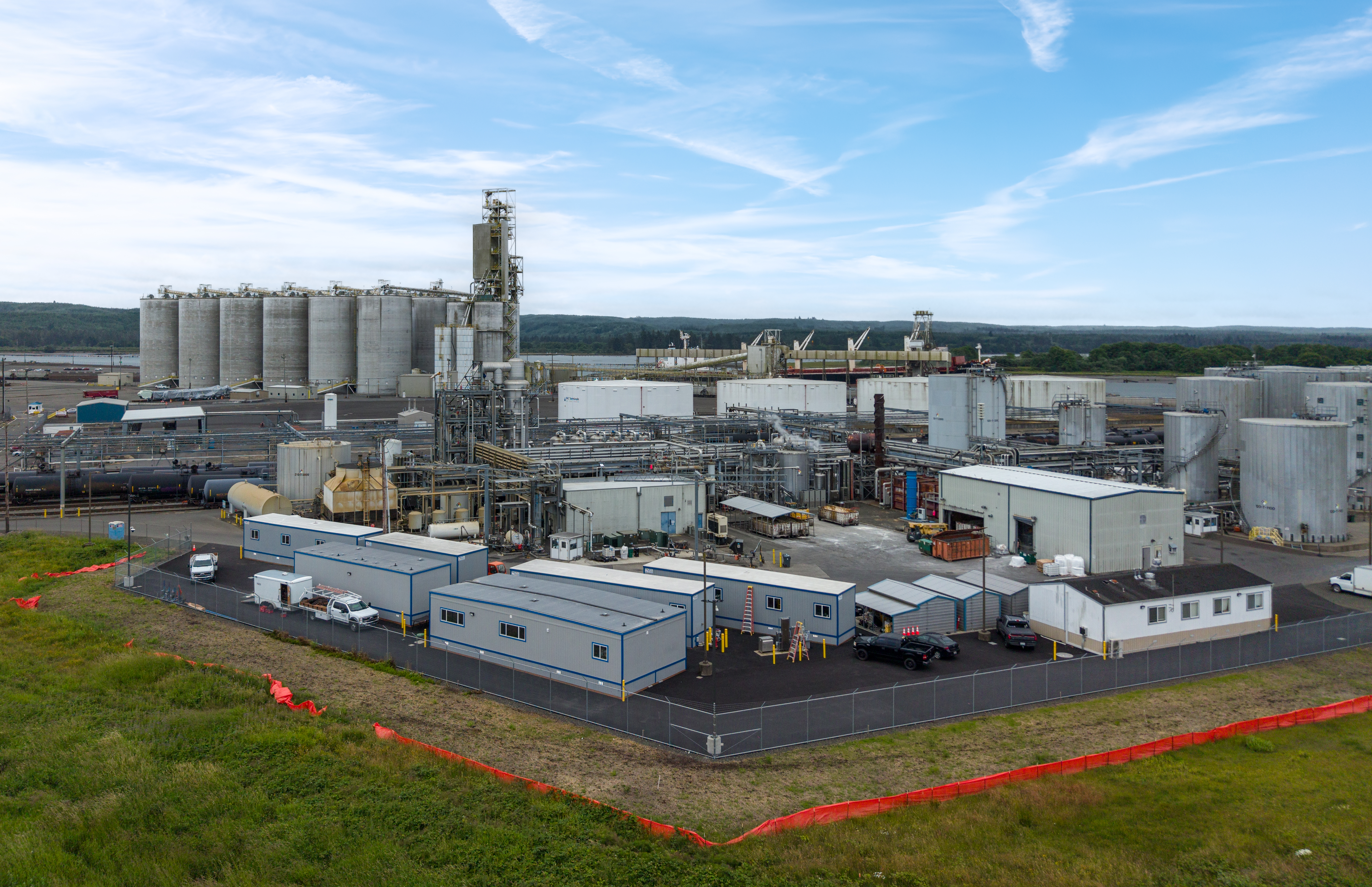
A school district needs classrooms before the next term. A clinic needs swing space while its existing facility is renovated. A contractor needs an office and secure storage before crews mobilize. In each case, a portable building can solve the capacity problem quickly, but the monthly rental figure rarely determines the true cost.
Portable building rent should be treated as a procurement decision with four moving parts: the required duration, site readiness, total landed cost, and end-of-term obligations. A low monthly quote can become expensive after delivery, foundations, utility work, permits, maintenance, removal, and renewal increases are added.
The practical process is straightforward. Define the space, verify that the site can receive and operate the unit, price every cost category, and put acceptance, renewal, relocation, and restoration terms in writing before signing. The sections below provide a decision framework a facilities director, administrator, healthcare operator, municipality, or construction manager can use this week.
Table of Contents
- Why Portable Building Rent Is a Strategic Decision
- Lease vs Purchase Choosing the Right Path
- Preparing Your Site Before Delivery
- Calculating the Landed Cost
- Inspection, Reconditioning, and Acceptance
- Procurement Options Including Cooperatives
- Putting It All Together
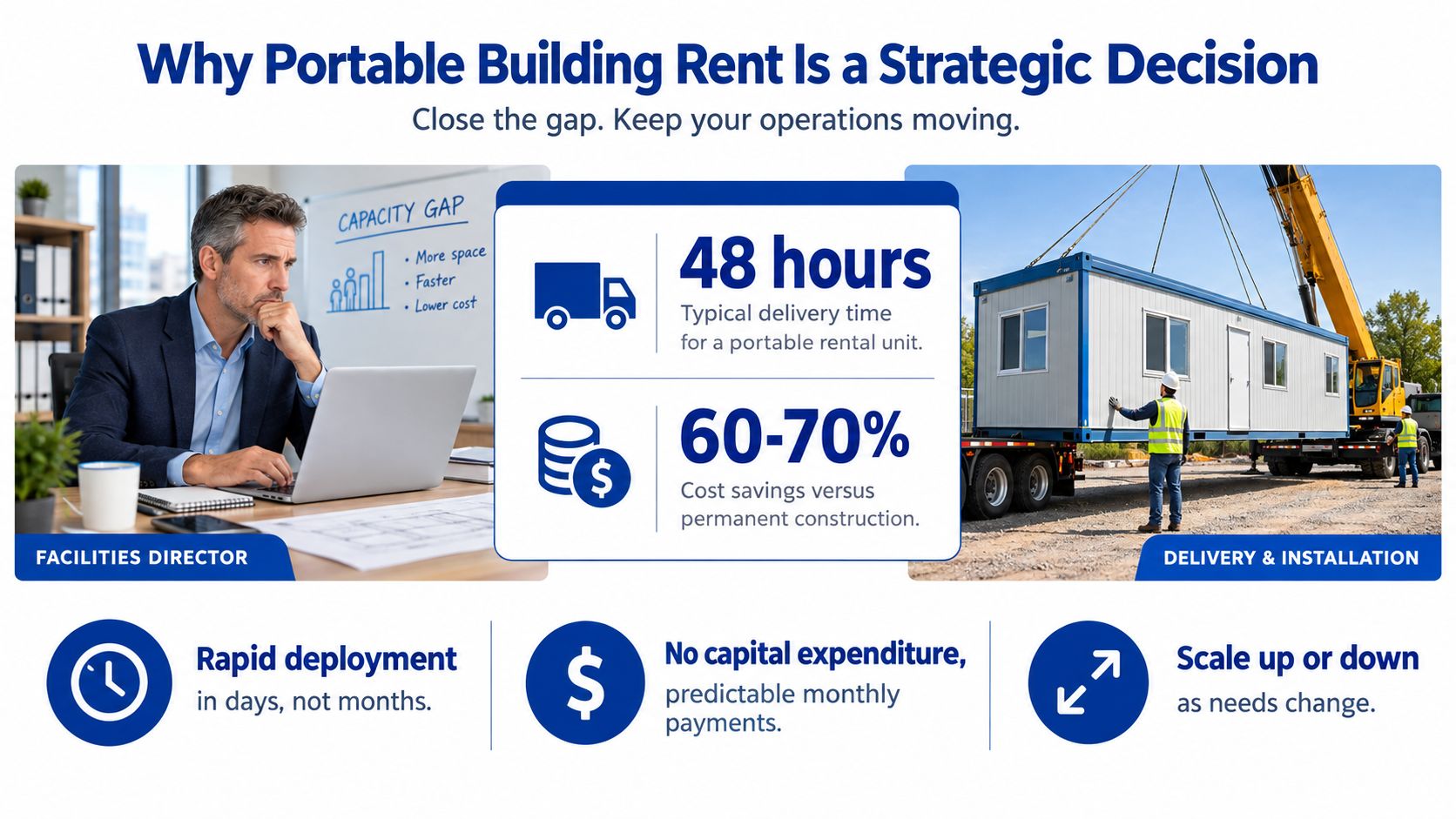
Why Portable Building Rent Is a Strategic Decision
A portable building isn't a product delivered to a site. It becomes part of an operating plan. Schools use relocatable classrooms to handle enrollment pressure, healthcare providers use temporary space to maintain services during construction, and commercial or government teams use mobile offices when permanent space can't be delivered on the required schedule.
The North American rental fleet already operates at substantial scale. Data reported by the Modular Building Institute's utilization analysis covered 247,162 rental units, approximately 80% of industry-owned assets. At the end of the analysis period, 157,259 units were leased, producing a reported lease rate of 74.96%. The same dataset found that a relocatable building moved an average of seven times during its useful life and had an average service life of 10.1 years.
Start with the operating requirement
Before requesting quotes, the facilities team should write down:
- Use: Classroom, office, clinic, storage, laboratory support, break space, or another defined activity.
- Duration: Expected occupancy period, likely extension period, and earliest realistic return date.
- Capacity: Required rooms, occupants, circulation, restrooms, storage, furnishings, and technology.
- Compliance: Applicable building, fire, accessibility, electrical, plumbing, and occupancy requirements.
- Location: Intended placement, access route, utility connection points, drainage, and emergency access.
That information changes the quote. A construction office trailer may need a different layout and utility package than a classroom or healthcare unit. Teams evaluating a project-specific workspace can review construction office trailer options alongside other unit types, but the specification must follow the use case rather than the available inventory.
Treat speed as a planning advantage, not a guarantee
Factory-built construction has gained broader acceptance. A U.S. Department of Energy national-laboratory report citing Modular Building Institute data states that modular construction rose from 2.1% of new-construction starts in 2015 to 6.64% in 2023. The MBI's 2023 analysis estimated $14.576 billion in modular-building construction project value and identified 255 North American manufacturing companies generating some revenue from commercial modular construction. The MBI industry analysis connects this growth with recurring demand for faster deployment, standardized production, and flexible capacity.
Rental makes strategic sense when the organization values reversible capacity. It can avoid committing to permanent construction for a temporary need, but only if the site and contract support that flexibility.
Decision rule: Never approve portable building rent from the monthly rate alone. Approve the solution only after the team can explain the occupancy period, landed cost, site-readiness status, and exit plan.
Lease vs Purchase Choosing the Right Path
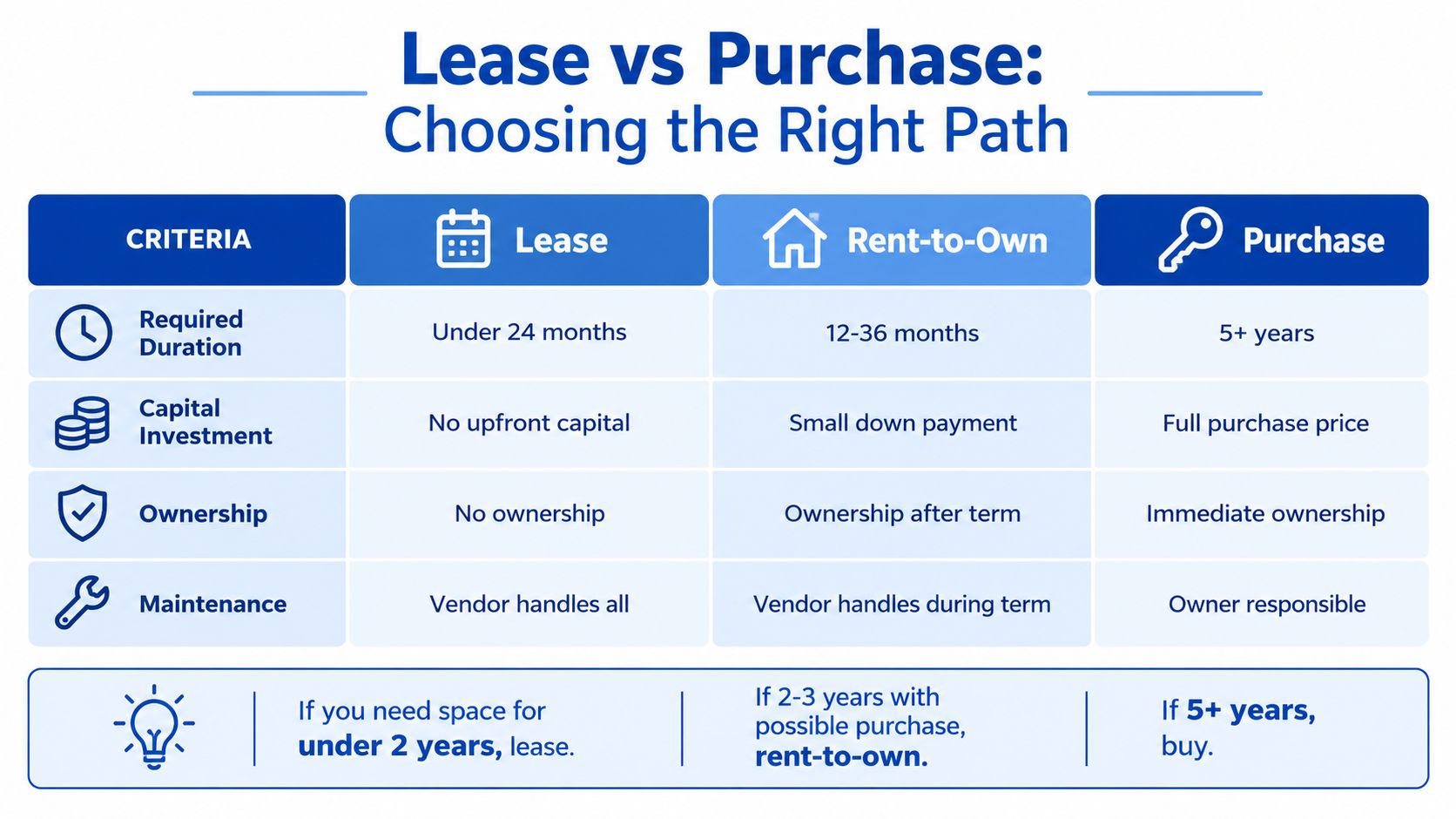
The right choice depends less on the building itself than on how long the organization will need it and what it wants to own afterward. Lease, rent-to-own, and purchase each solve a different procurement problem.
Lease for temporary or uncertain demand
A lease is usually the cleanest option for short-term swing space, emergency capacity, a construction project, or a need with an uncertain end date. The organization preserves capital and retains the ability to return or relocate the unit according to the contract.
The trade-off is that lease payments don't create ownership. The customer may also remain responsible for delivery, foundations, ramps, utility connections, insurance, maintenance, removal, and restoration unless the agreement assigns those items to the vendor. A short initial term can create room for flexibility, but it can also expose the customer to renewal pricing if extension terms aren't negotiated in advance.
Rent-to-own for a defined capacity gap
Rent-to-own can fit an organization that expects to need the building for several years but wants to spread acquisition costs or retain an ownership path. The agreement must state when ownership transfers, whether an early purchase option exists, how payments are credited, and who handles maintenance during the rental period.
This option requires careful comparison with a conventional purchase. A lower periodic payment doesn't automatically mean a lower total cost. The procurement team should compare the complete payment schedule, delivery, site work, insurance, maintenance, relocation, and final ownership terms.
Purchase for long-term or permanent use
Purchase generally fits a building expected to remain in service for five or more years, or a location where the organization wants control over the asset. Ownership can make sense when the unit will be reused, moved between sites, or integrated into a longer-term facilities plan.
Ownership shifts responsibility to the buyer. The buyer may need to fund maintenance, code upgrades, insurance, future relocation, and eventual disposal. A purchased unit also doesn't eliminate site costs. Foundations, utility work, accessibility elements, permits, and restoration still need separate review.
Practical rule: Lease when the need is short or uncertain. Consider rent-to-own for a defined multi-year gap with a credible ownership plan. Purchase when the building will serve a long-term requirement and the organization is prepared to own every lifecycle obligation.
The contract should also distinguish delivery and placement from installation and commissioning. A vendor may transport a unit to the site without including foundations, utility hookups, stairs, ramps, inspections, or occupancy approval. Those distinctions affect every option and should be priced before the decision is made.
Preparing Your Site Before Delivery
Most serious delays happen after the building is ready, not while it is being manufactured. A finished unit can sit unusable if the pad isn't prepared, the delivery route is blocked, the permit hasn't been issued, or the electrical service can't support the intended load.
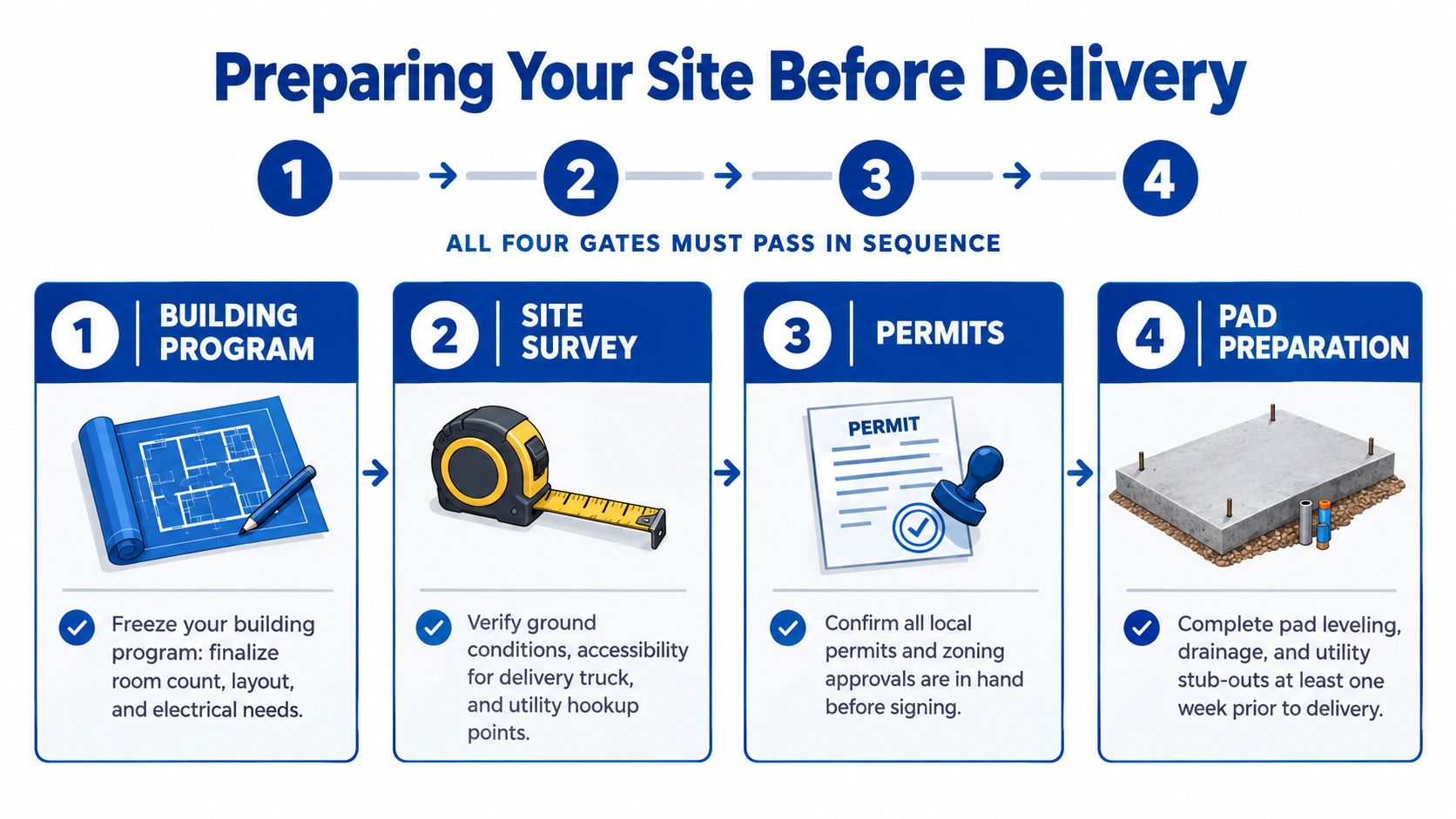
The site-readiness process should operate as a gated approval. Each gate needs an owner, a completion date, and evidence that the requirement has passed.
Gate one freezes the program and code basis
The team should first finalize the room count, floor plan, occupancy, accessibility approach, electrical loads, plumbing requirements, ventilation, fire protection, and intended activities. A unit approved as an office may not be suitable for classroom, clinical, laboratory, food-service, or storage use without modifications.
The code basis must be confirmed with the authority having jurisdiction. The responsible facilities lead should document zoning, setbacks, occupancy classification, egress, fire access, accessibility, and any school, healthcare, or municipal requirements that apply.
Gate two verifies physical access
A site survey should answer practical delivery questions:
- Route: Can the transport vehicle reach the site without restricted turns, low clearances, weak bridges, or blocked approaches?
- Turning radius: Is there enough space to position the unit without removing fences, trees, signs, or parked vehicles?
- Crane work: Does placement require a crane, and can the crane be positioned safely on suitable ground?
- Ground conditions: Can the site support the pad, delivery equipment, foundation system, drainage, and finished building?
- Weather exposure: Will water, mud, snow, heat, or wind affect access, placement, or daily operation?
The installation team should record photographs, measurements, utility locations, and any temporary access work. For electrical scope, a licensed contractor can help assess service capacity and required equipment. A resource on commercial electrical panel installation can help the facilities team frame questions about panels, meters, and commercial power connections.
Gate three confirms utilities and permits
Electrical, water, sewer, data, fire alarm, and other services must have identified connection points and adequate capacity. The customer should not assume that a nearby service is available, compatible, or included in the rental quote.
Permits should be obtained before delivery is scheduled. The permit package may require site plans, foundation details, accessibility information, utility drawings, fire review, and engineering documents. Assign each approval to a named person and keep the permit record with the project file.
Gate four prepares the pad and acceptance path
The pad should be level, drained, accessible, and ready for the specified foundation system. Utility stub-outs, stairs, ramps, walkways, fire access, and accessible routes should be complete before the delivery window. The team managing modular building installation should receive the same approved site plan used by the permit and construction teams.
A finished building is not an operational building. The site passes only when the unit can be delivered, connected, inspected, accessed, and occupied.
Calculating the Landed Cost
A low monthly quote can become the expensive option once delivery, site work, operation, and removal are included. Build the worksheet around the building's full occupancy cycle, not the rent line alone. The peer-reviewed modular whole-life cost research includes fabrication, transportation, assembly, on-site structural work, operations, and end-of-life costs in modular whole-life cost. Your comparison should follow the same logic.
Build the worksheet before comparing vendors
| Category | Typical Line Items | Paid By |
|---|---|---|
| Recurring occupancy | Base rent, renewal adjustment, utilities, insurance, maintenance, taxes where applicable | Customer, vendor, or shared |
| One-time setup | Delivery, transport, crane, foundation, leveling, stairs, ramps, permits, utility connections, commissioning | Customer, vendor, or shared |
| Operating period | Repairs, preventive maintenance, cleaning, inspections, security, utilities, insurance, compliance updates | Customer, vendor, or shared |
| End of term | Relocation, removal, disconnection, hauling, pad removal, site restoration, damage repair | Customer, vendor, or shared |
Annualize every cost across the expected occupancy period. Delivery has a greater effect on a short rental than on a long one. A modest renewal increase can become a major cost if the temporary need continues beyond the original term.
Use Exayard construction estimating software to organize vendor allowances, site-work assumptions, and scenario comparisons. Keep each assumption visible, then confirm it with the vendor, permit team, and site survey. Estimating software supports the comparison. It does not replace those checks.
Test the scenarios that change the decision
Run four cases before accepting a quote:
- Early return: The unit leaves before the planned end date. Price removal, restoration, minimum rent, and notice requirements.
- Extension: The need continues. Confirm the renewal rate, notice deadline, maintenance terms, and any required reinspection.
- Relocation: The building moves to another site. Include disconnection, transport, crane work, new foundations, permits, and reconnection.
- Site delay: The unit is ready but the site is not. Establish whether rent begins at delivery, installation, commissioning, or occupancy.
Track charges that continue while the unit remains unused. Base rent, insurance, minimum service charges, and some maintenance obligations may still be payable when staff cannot occupy the space. Put the rent commencement date in the contract, along with responsibility for delays caused by the vendor or the site.
Schedule compression has value, but it does not guarantee equal savings. The same Concordia study indicates that modular delivery can compress construction schedules by roughly 30% to 50%, while design, materials, logistics, and factory costs can offset reductions. Measure the value of earlier occupancy in the worksheet, and never treat speed as free.
Inspection, Reconditioning, and Acceptance
Reconditioning is a normal part of rental-fleet management. A unit may be cleaned, repaired, repainted, tested, and modified before delivery. The customer should ask what the vendor inspects, what documentation is provided, and how defects are handled after arrival.
Establish milestones before the truck is scheduled
The inspection process should have four distinct checkpoints:
- Factory design review: Confirm the approved floor plan, finishes, equipment, accessibility features, electrical schedule, plumbing, and fire-life-safety provisions.
- Pre-delivery inspection: Verify that the rental unit matches the order, operates correctly, and has completed documented repairs or reconditioning.
- Site acceptance: Walk the exterior and interior with the vendor, record damage, check level and placement, and confirm stairs, ramps, doors, windows, and finishes.
- Commissioning: Test utilities, HVAC, lighting, plumbing, alarms, emergency systems, accessibility features, and any specialized equipment before occupancy approval.
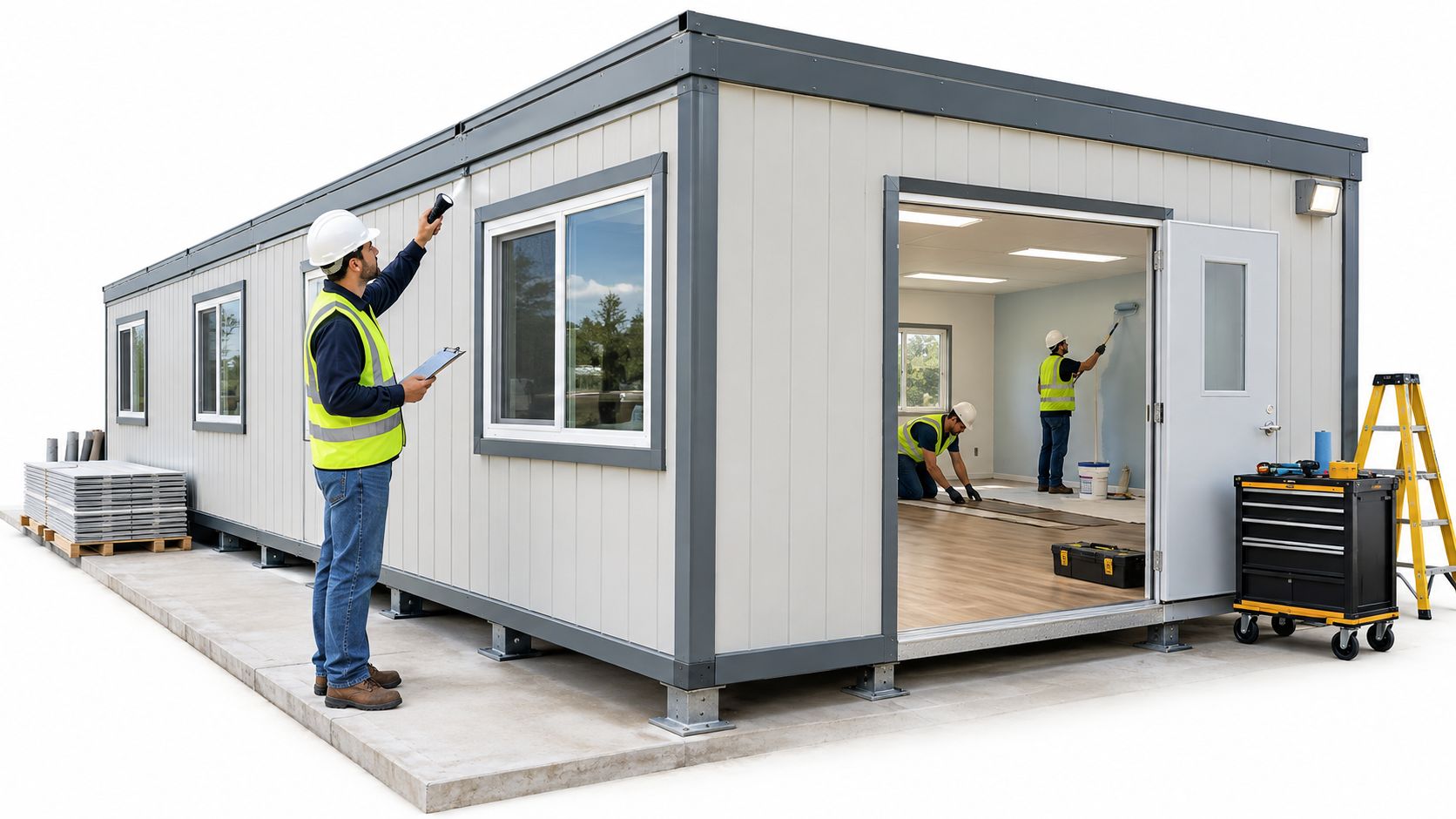
The acceptance form should list measurable criteria, not a general statement that the building looks acceptable. It should identify the date, unit number, open defects, responsible party, correction deadline, and whether the defect prevents occupancy.
Protect the first days of operation
The first operating period deserves a written defect procedure. The agreement should state:
- Response time: How quickly the vendor must acknowledge and investigate a service request.
- Correction time: When the vendor must repair a noncritical defect and what applies to a safety or occupancy issue.
- Temporary remedy: Whether the customer receives a replacement unit, rent credit, temporary equipment, or another remedy if the building can't be used.
- Warranty scope: Which components are covered, for how long, and whether vendor or customer maintenance affects coverage.
- Documentation: How photographs, inspection reports, service tickets, and commissioning records become part of the project file.
The risk model covering modular construction identified 50 modular-construction risks, surveyed 48 experienced professionals, and mapped risks against cost-performance data from 56 projects. For a rental buyer, the practical lesson is simple: assign ownership to logistics, design changes, procurement, site readiness, and regulatory issues before delivery.
Procurement Options Including Cooperatives
Procurement route affects both speed and accountability. A private contractor may obtain competitive quotes directly, while a school district or municipality may need a compliant purchasing method that reduces administrative work.
Direct RFP or standalone lease
A direct RFP fits a buyer with unusual specifications, a private organization, or a project requiring a custom scope. The RFP should request a base rental price and separate line items for delivery, site work, utility connections, furnishings, maintenance, removal, and restoration.
This route gives the buyer control over specifications and evaluation criteria. It also places responsibility on the buyer to write a complete scope, verify insurance and licensing, compare exclusions, and document the award process.
Cooperative purchasing
Cooperative contracts can suit public agencies and schools that want an established purchasing path. Agreements such as KCDA and TIPS can reduce the need for a separate bid when the organization's rules permit cooperative use. The procurement team should still verify contract scope, pricing, geographic coverage, required quotes, vendor responsiveness, and project-specific terms.
A cooperative contract doesn't remove site risk or guarantee that every service is included. The buyer still needs a statement of work covering installation, utilities, accessibility, inspections, commissioning, maintenance, and removal. Guidance on cooperative purchasing contracts can help public-sector teams identify the questions to ask before issuing an order.
Used and rental-fleet inventory
Used units can fit budget-sensitive, short-term needs when the building meets the required code, condition, layout, and accessibility standard. Fleet inventory may also support faster deployment than a custom build, but availability and regional logistics determine whether the apparent speed is real.
The vendor should disclose reconditioning scope, remaining service limitations, prior modifications, inspection records, delivery distance, and replacement policy. Vendor fleet size matters, but so does turnkey capability. A company that can provide stairs, ramps, utility connections, furnishings, and site coordination may produce a more realistic landed cost than a supplier offering the building alone.
Putting It All Together
Before signing, the procurement lead should require four approvals: a frozen building program, a passed site-readiness gate, a completed landed-cost worksheet, and contract language covering acceptance, defects, renewal, removal, and restoration. Renewal increases and end-of-term obligations deserve special attention because both can turn a low initial quote into an expensive commitment.
The message to send internally is simple: “Please evaluate the portable building against total occupancy cost, not base rent. Confirm the site, utilities, permits, acceptance criteria, renewal pricing, removal responsibility, and restoration standard before approval.”
The cheapest monthly rate is rarely the cheapest solution. Request a quote that separates every setup, operating, and exit cost, then compare it against the actual duration and site conditions.
Pacific Mobile Structures, Inc. provides mobile office rentals, storage containers, and modular buildings with delivery, setup, and site-related services for education, healthcare, government, construction, and commercial users. Review the available options and request a project-specific conversation through Pacific Mobile Structures, Inc..