A school district can have classrooms ready on paper and still be stuck waiting on a full bid cycle while enrollment climbs. A healthcare system can know it needs clinical space before flu season or a renovation, then lose weeks to specification drafts, approvals, and evaluation meetings. That's where cooperative purchasing contracts matter, not as a loophole, but as a practical way to keep public projects moving without treating compliance like an afterthought.
Navigating Cooperative Purchasing Contracts
- Why Public Buyers Are Turning to Cooperative Purchasing
- How Cooperative Purchasing Contracts Work
- The Growth of Cooperative Procurement in the Public Sector
- Key Benefits of Using Cooperative Contracts for Modular Buildings
- Procuring Modular Buildings Through KCDA and TIPS Contracts
- Compliance Requirements and Common Misconceptions
- Making the Right Procurement Decision for Your Organization
Why Public Buyers Are Turning to Cooperative Purchasing
A facilities manager can feel the pressure long before the purchase order is signed. A district needs swing space before the next semester starts, a county office has outgrown its footprint, or a clinic needs temporary treatment rooms while permanent work is underway. Traditional procurement can handle those needs, but the timeline is often the problem, since the buyer still has to write scope language, solicit bids, review responses, and get approvals through the usual chain.
Cooperative purchasing contracts ease that pressure by letting public entities buy through a competitively awarded contract that already exists. Much of the administrative work has already been done, but the buying agency still has to stay inside a documented procurement framework. That is why cooperative contracts have moved into regular use across public procurement. A recent NIGP best-practice summary describes their broad adoption and notes that many government entities use them to some degree (NIGP best-practice summary).
That pattern matters for school districts, universities, healthcare systems, and local governments. They still need defensible pricing, but they do not always need a separate solicitation for every repeat category. For teams managing vendor networks across multiple sites, cooperative buying can also improve vendor management processes by standardizing how contracts are sourced and ordered.
The main value is speed without losing contract discipline. In practice, buyers still need to check whether the cooperative contract fits the local scope, whether governing-body approval is required, and whether a separate addenda or local justification must be attached before use. Those steps are easy to miss, and they are often what separates a clean buy from a compliance problem.
For a useful buyer-side primer on how cooperative purchasing contracts are used in practice, Pacific Mobile's overview is a helpful companion read.
How Cooperative Purchasing Contracts Work
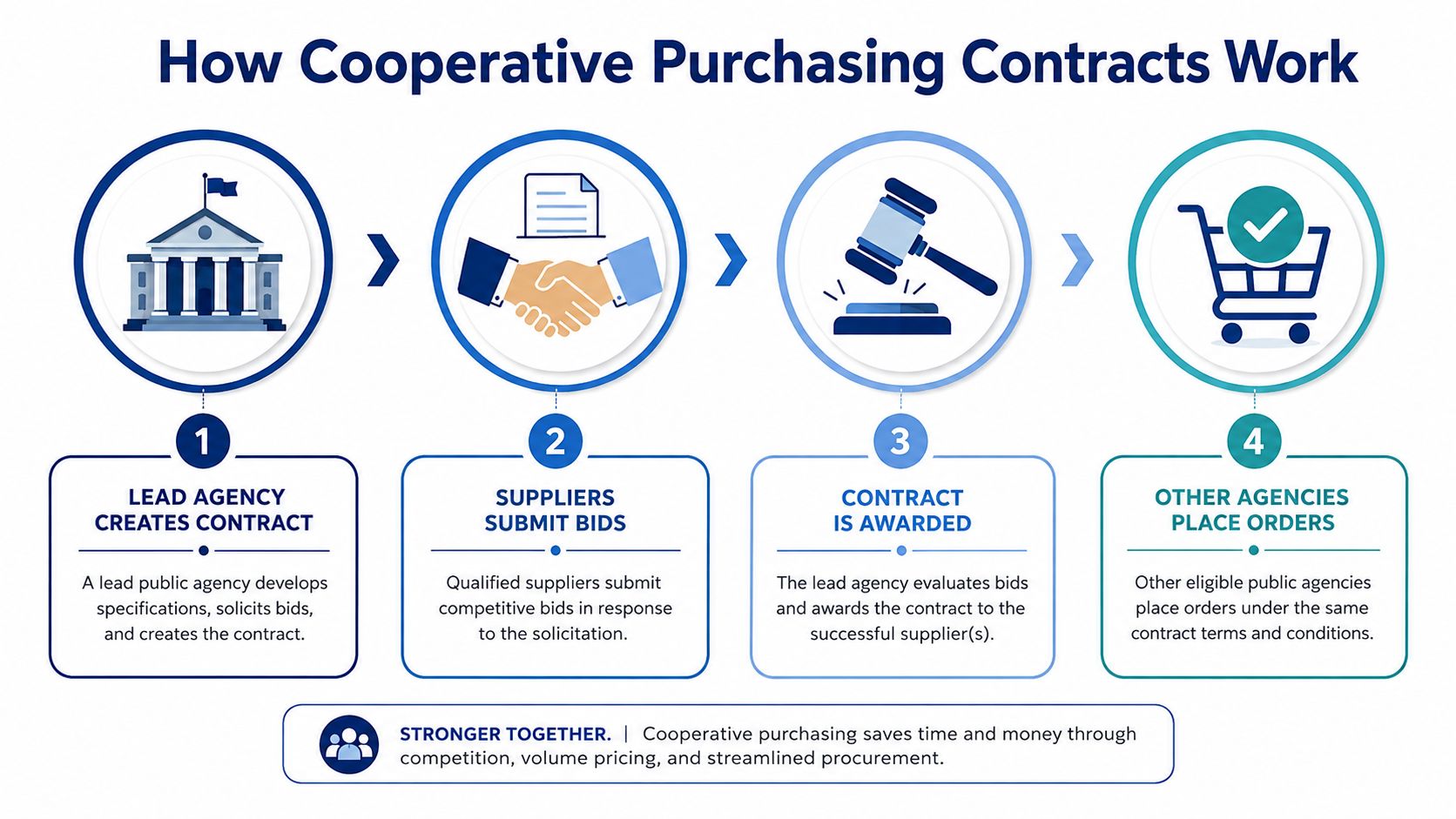
The structure is straightforward once the jargon is stripped away. A lead agency runs a competitive solicitation, evaluates suppliers, and awards a master agreement. Other public entities then buy under that same agreement, a process often called piggybacking. The contract sets pricing, compliance terms, ordering rules, and scope, so the buying agency is not starting from zero each time.
The lead agency does the hard part once
The lead agency model is what makes the whole system work. One public buyer runs the solicitation, publishes the terms, receives vendor responses, and awards the contract in a way that other eligible agencies can use. That means the lead agency's process has to be solid from the start, because every participating buyer relies on it later.
Practical rule: if the lead solicitation is weak, vague, or poorly scoped, every downstream buyer inherits that weakness.
Cooperative purchasing differs from traditional procurement. In a standard bid, each agency owns the whole cycle. In a cooperative model, the agency still has to confirm eligibility, scope, and authority, but it skips duplicate specification and evaluation work because the master agreement already exists.
The contract governs the transaction, not just the price
A cooperative contract is more than a discount schedule. It controls ordering methods, documentation expectations, approved products or services, and the terms vendors must honor. That is why contract review matters before anyone places an order. Buyers need to know whether the category they need is covered, whether addenda are allowed, and whether local governance steps come first.
For modular buyers, that contract structure turns a broad category into a workable purchase path. It also matters for vendors, because the awarded supplier is not negotiating a fresh deal with every district or agency. The award already defines the boundaries. In practice, suppliers such as Pacific Mobile Structures, Inc. point public buyers to cooperative programs like KCDA and TIPS because those contracts can shorten the path to award while still leaving local approval, justification, or addenda requirements in place when the buyer's own rules call for them.
The Growth of Cooperative Procurement in the Public Sector
A district that needs a classroom fast, or a county agency trying to replace space during renovations, rarely has time to run a full solicitation from scratch. Cooperative purchasing grew because public buyers needed a lawful way to use an existing award without rebuilding the entire procurement file each time.
From niche workaround to institutional tool
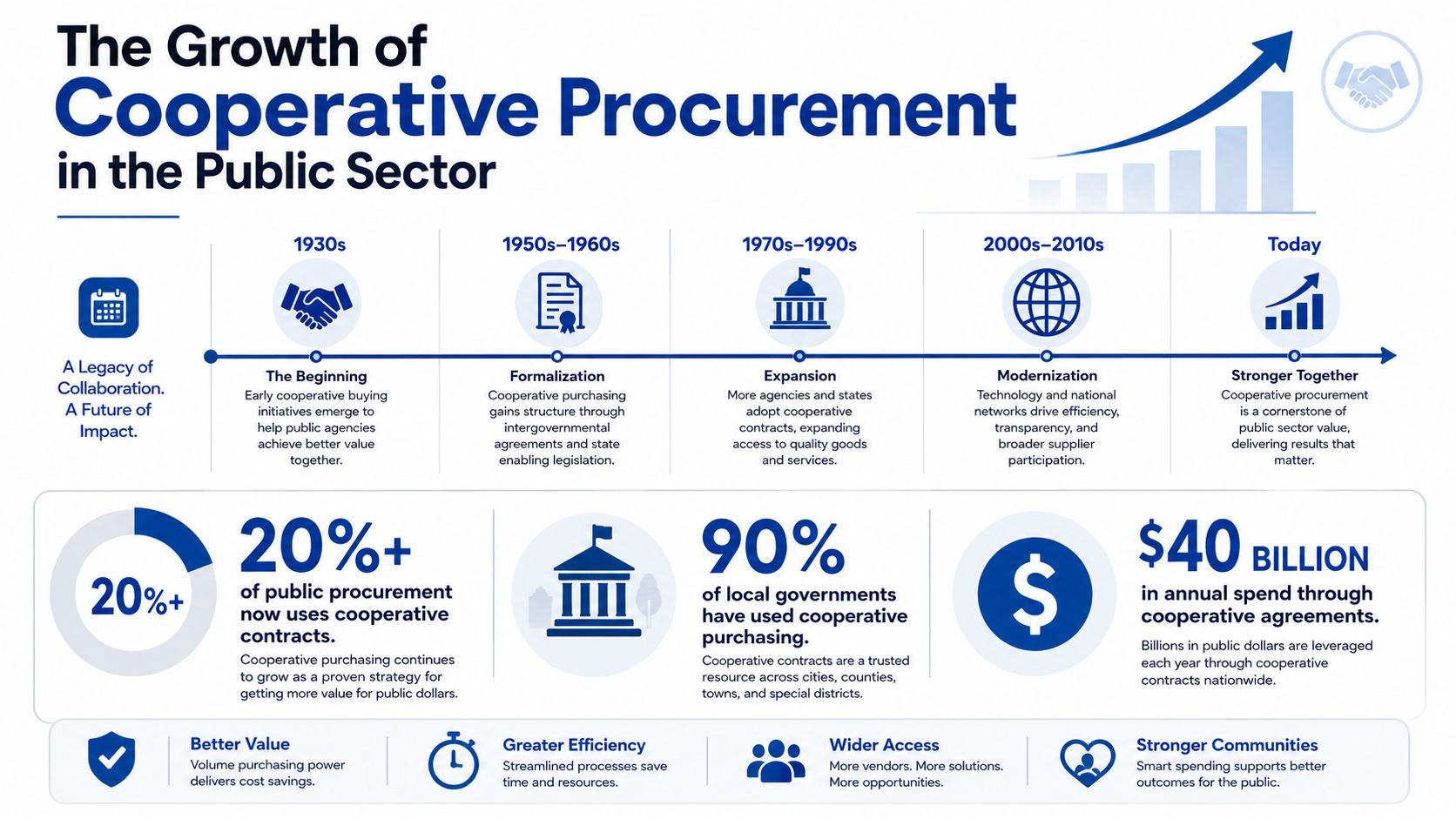
The older history goes back farther than many guides mention. An academic survey traces cooperative buying discussions to the 1920s, and even points to earlier references in ancient Egypt and Babylon. That background matters because it shows the model is not a new shortcut, it is a long-running response to the same problem, how to pool demand without repeating work.
The modern shift is more practical than dramatic. Public procurement teams now use cooperative contracts as part of routine buying, especially when they need speed, documentation, and a defined scope. In the field, the contract still has to fit the buyer's own rules. Local justification, governing-body approval, or a separate addendum may still be required before anyone can place an order. That is why some agencies pair the cooperative award with local review and use Pacific Mobile's Oregon and Idaho cooperative purchasing guidance as a reference point when checking what still needs to be approved.
For teams that manage approvals digitally, Closer Innovation Labs Corp. contract tools fit the same workflow discussion. The issue is not just finding a contract. It is making sure the routing, signatures, and supporting records line up with the agency's own procurement file.
Why the scale matters
The growth also shows up in state purchasing practice. The NASPO survey summary reports broad authority for cooperative contracting among participating states and routine use of NASPO ValuePoint contracts. That kind of adoption explains why cooperative purchasing has moved from an exception used for a hard-to-source buy to a standard channel that many public buyers now check first.
Key Benefits of Using Cooperative Contracts for Modular Buildings
Modular buildings are a practical test for cooperative purchasing because the need is often urgent. A district may need a SAGE classroom quickly, a clinic may need swing space during renovations, and an agency may need offices or storage without waiting through a full procurement cycle. Cooperative contracts help by pooling demand, shortening ordering decisions, and reducing repetitive drafting.
What buyers gain
The first gain is time. When pricing, terms, and scope are already in place, the buyer spends less time rewriting the same specification language. That matters for modular buildings, because project schedules usually depend on site work, utility coordination, and permit sequencing as much as the purchase itself.
Cooperative purchasing works best when the purchase is already well understood, but the agency doesn't want to burn weeks recreating the same solicitation.
The second gain is stronger purchasing power. Public guidance frames cooperative value as combining demand to secure volume-purchase advantages, delivery and supply-chain advantages, best practices, and lower administrative time and expense (public procurement guidance). For modular projects, that can support steadier pricing and a cleaner path from request to award.
The third gain is internal capacity. Procurement teams are often thin, especially in districts, municipalities, and smaller healthcare systems. Cooperative buying lets those teams spend more time on project controls, approvals, and stakeholder communication instead of running another bid from scratch. In regulated settings, that also leaves more room to document whether the purchase was authorized, scoped, and contractually valid.
Where the model fits best
- Education: urgent classrooms, swing space, or administrative overflow.
- Healthcare: temporary clinical space, triage expansion, or back-of-house support areas.
- Government: office trailers, relocatable departments, and site-based support spaces.
- Commercial or industrial users: temporary offices, project support units, and storage needs.
The main trade-off is flexibility. Cooperative contracts reduce friction, but they can also narrow customization options because the agreement has to work for multiple buyers. That is the trade-off for speed and standardization.
Procuring Modular Buildings Through KCDA and TIPS Contracts
A buyer sourcing modular buildings through a cooperative should start with contract fit, not the sales pitch. KCDA and TIPS are both used by public entities, and Pacific Mobile Structures references KCDA cooperative purchasing contracts for modular buildings and furniture solutions as part of its cooperative purchasing work. The first check is whether the cooperative category covers the building type, accessory package, and delivery model the project needs.

A workable procurement sequence
A clean purchase usually follows a short internal path. The agency first confirms whether local law and policy allow use of the cooperative. It then verifies the contract scope, pulls the award documents and participation forms, and checks that the modular unit, furniture, or site service lines match the project. After approvals are in place, the buyer issues the order or signs the participating contract document, then coordinates delivery, set, site prep, and any utility work with the project team and supplier.
That sequence sounds simple, but the documentation step is where many agencies create trouble for themselves. If finance, legal, or audit staff later ask how the purchase was justified, a thin file can turn into a compliance problem.
The video below is useful for teams that want a visual walk-through of modular purchasing and deployment decisions.
What to prepare before the order
A cooperative purchase works better when the buyer assembles a short internal packet first. That packet should show who approved the purchase, which cooperative contract was used, what category it covered, and why the product matched the agency's need. If furnishings, appliances, or site accessories are part of the order, each line should be checked on its own so the contract scope still fits the full purchase.
In practice, that file also helps answer the question many guides skip, whether the cooperative contract is enough on its own or whether the agency still needs local justification, governing-body approval, or a separate addendum before moving ahead. Those steps can still be required even when the cooperative itself is valid.
The practical benefit is speed. A buyer can move from need identification to purchase with fewer stops than a full bid cycle requires, which matters when the schedule is driven by enrollment, patient flow, or a facility replacement timeline.
Compliance Requirements and Common Misconceptions
A cooperative contract can speed a purchase, but it does not override local authority. Buyers still need to confirm that the contract is available to their agency and that the file supports use under local rules. Public guidance also notes that cooperative purchasing can reduce administrative burden while still requiring formal contract authority, mutual commitment, and, in some jurisdictions, local justification or governing-body approval before use (cooperative contracts guidance).
What still needs checking
A cooperative contract may be valid and still not be usable until internal steps are complete. Some jurisdictions require an agency-specific business case, board approval, or a separate addendum. Others want proof that the lead solicitation was competitively run and that the purchasing entity is eligible under local rules.
The contract can be competitively awarded and still fail your local test if your own authority, policy, or board rules were not followed.
That is why “cooperative” and “compliant” are not interchangeable terms. A buyer has to confirm the legal authority, the contract's scope, and the participation mechanism. If the cooperative allows access by other entities but the local jurisdiction still needs a resolution, membership form, or signature routing, those steps have to happen before the order goes out.
Common misconceptions that cause problems
- Any cooperative works everywhere. Local statutes and policies can differ, so one agency's approval path does not automatically carry over.
- Piggybacking removes documentation needs. The order may be faster, but the file still needs proof of authority, scope, and approval.
- A contract with a good price is enough. Price helps, but buyers also need defensibility, especially in education, healthcare, and government facilities.
- Addenda are optional clutter. If the cooperative requires a participation form or local addendum, skipping it can create audit risk.
The compliance gap many primers miss is simple. A cooperative contract can be a valid tool and still require a local packet, a governing-body signoff, or a separate participation form before anyone places the order. Procurement staff should treat that review as part of the purchase, not as an afterthought.
Making the Right Procurement Decision for Your Organization
A good cooperative decision starts with five questions. Is the agency eligible to use the contract? Does the contract cover the product or service needed? Did the lead agency run a proper competitive process? Does local law still require approval or justification? Will the contract support the project timeline without creating a separate compliance burden?
If those answers line up, cooperative purchasing is often the better path for urgent facilities work and repeat categories. It shines when the need is clear, the scope is standard, and the agency wants fewer duplicate procurement steps. It's less useful when the project is highly customized or when the local approval process is as long as a regular bid anyway.
For teams managing the administrative side, procurement software can make the process easier to track. A tool like Software for Government contracting can help route approvals, store contract files, and keep the audit trail cleaner when cooperative purchases move quickly.
The most disciplined buyers don't ask whether cooperative purchasing is faster. They ask whether it is faster, defensible, and allowed. That's the test, and it's the one that keeps public projects moving without creating headaches later.
Pacific Mobile Structures, Inc. supplies mobile offices, storage containers, and modular buildings for education, healthcare, government, and commercial use, including cooperative purchasing pathways that can fit urgent space needs. If a project needs a relocatable classroom, a modular office, or a turnkey building solution under a cooperative contract, visit Pacific Mobile Structures, Inc. to review available options and request a conversation with the team.