In 2026, a used 20 ft one-trip container typically runs about $1,800 to $3,000, and a new 40 ft unit about $3,500 to $6,000, before delivery, modifications and site work. That is the box at the depot, not the box on a prepared pad with a door, power and a desk inside.
The gap between those two numbers is where most budgets go wrong. A single ocean move can cost more than the steel box itself. Drewry's World Container Index was reported at $4,526 per 40-foot container on 20 August 2026, with Shanghai to New York at about $9,507 and Shanghai to Los Angeles at about $6,802. The container did not change. The freight did.
That is the first lesson in the cost of shipping a container: the headline box price is only one layer. A delivered, usable unit also carries transport, placement, site preparation, modifications and, for imported boxes, port charges that begin when free time expires. The sections below separate those layers and end with a worked budget that includes the lines most price guides leave out.
Table of Contents
- Container Prices by Size and Condition
- What Pushes a Container's Price Up or Down
- Renting Versus Buying and What Your Quote Must Include
- Modification and Site Preparation Costs
- Delivery Fees and Hidden Charges Buyers Miss
- Estimating Your Total Project Budget Step by Step
Container Prices by Size and Condition
Start with the steel. The table gives a working range for standard dry cargo units in good condition, before delivery, modifications, taxes and site work. Read the condition column as carefully as the size column, because grade moves the price almost as much as length.
| Size | New (typical range) | Used, one-trip (typical range) |
|---|---|---|
| 10 ft standard | $1,800-$2,800 | $1,200-$2,000 |
| 20 ft standard | $2,500-$4,500 | $1,800-$3,000 |
| 40 ft standard | $3,500-$6,000 | $2,500-$4,000 |
| 40 ft high cube | $3,900-$6,900 | $2,800-$4,500 |
These are typical 2026 US asking prices for a standard dry cargo unit in good condition. Delivery, modifications and taxes sit outside the number, and so does every yard of gravel or concrete under the box. A 45 ft high cube is less common, so a buyer should treat it as a quoted unit rather than a catalog price.
The Three Used Grades
Used inventory is not one product. One-trip units have carried cargo once, usually show light wear and keep clean floors and straight doors. Cargo-worthy units may have patched dents and surface rust, but the doors seal and the structure is sound. As-is units cost less because they often have rust, roof damage or door problems, and many fail a wind and watertight check.
That check matters. A box that leaks will ruin insulation, office furniture and electrical work after the first hard rain. A buyer who needs dry storage for tools can accept a cargo-worthy unit. A buyer building a site office should start with one-trip condition or budget for repairs.
Cost per Square Foot
Comparing boxes by sticker price hides the value question. A 20 ft box holds about 160 sq ft of floor, so new units run roughly $16 to $28 per square foot and used units roughly $11 to $19. A 40 ft box holds about 320 sq ft, which works out to roughly $11 to $19 new and $8 to $13 used.
The larger box usually wins on floor area per dollar, but it also weighs more and needs more room for delivery and placement. A buyer with a tight site may pay more in handling than the 40 ft saves on steel. The practical move is to match size and condition to the job, then review the differences between grades in this guide to container grades before asking for quotes.
What Pushes a Container's Price Up or Down
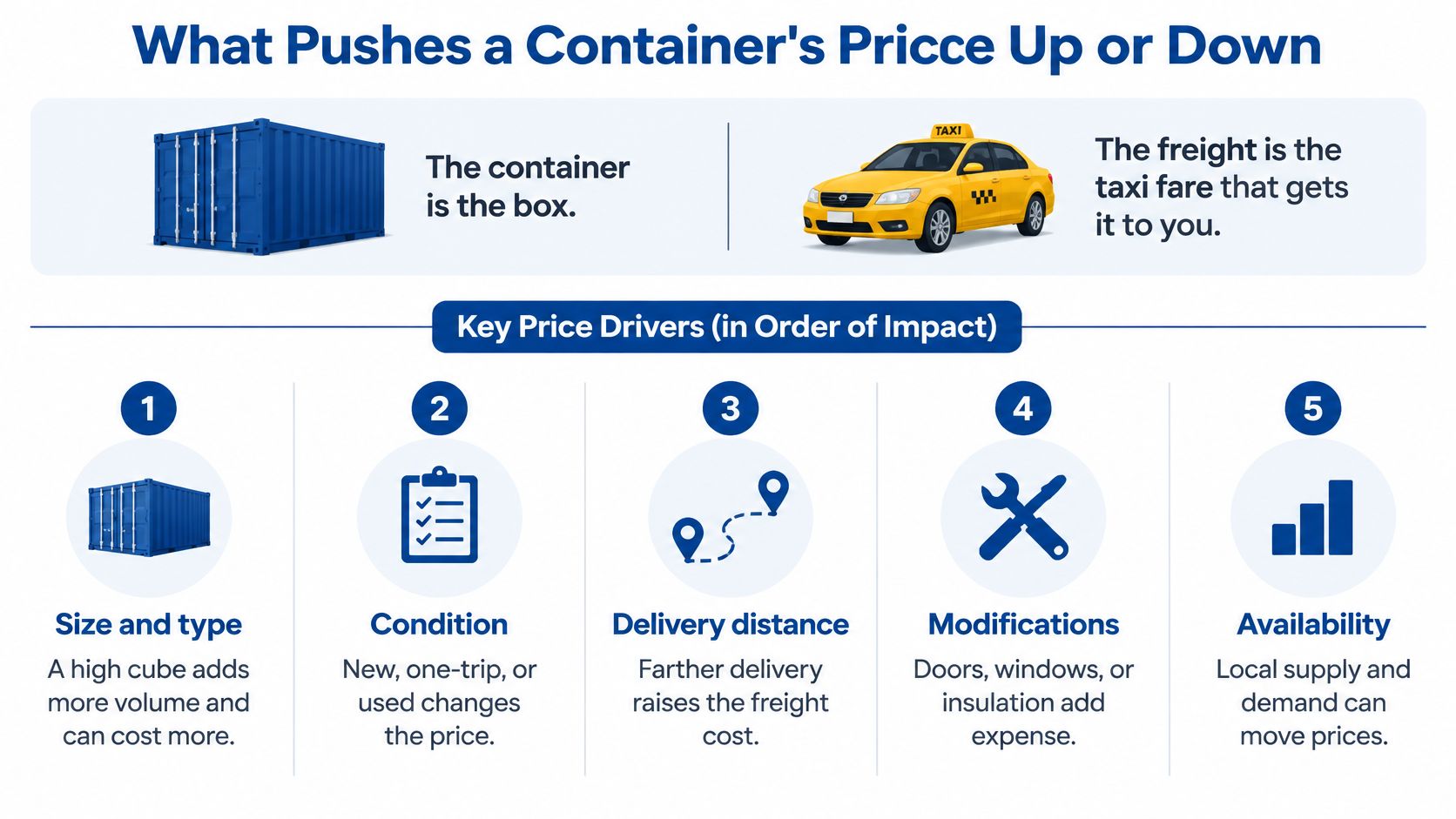
Think of the container as the box and the freight as the taxi fare that gets it to the site. The box has a factory price. The fare depends on distance, traffic, fuel and the hour of the day. A buyer who compares only box prices is comparing the cost of the box, not the cost of getting it into service.
The Five Drivers in Order of Impact
- Size and type. A high cube adds roughly 10 to 15 percent over a standard box of the same length because it carries more volume and is less plentiful. A 40 ft unit costs more than a 20 ft unit in both steel and handling.
- Condition and grade. One-trip units sit at the top, cargo-worthy units in the middle and as-is units at the bottom. The spread between grades can exceed the spread between a 20 ft and a 40 ft box.
- Steel and build quality. Corrugated wall gauge, corten steel and door hardware separate a box that lasts twenty years from one that needs patching in five. Thin walls and poor coatings show up first at the roof and bottom rails.
- Location. Regional supply, port proximity and local demand can move the same unit by hundreds of dollars. A port city with surplus inventory prices lower than an inland market that has to truck every box in.
- Timing and shipping. For an imported box, ocean freight can dominate the entire invoice. That line is the least stable of the five and the one buyers most often forecast from an old quote.
The instability is not subtle. UNCTAD's Review of Maritime Transport 2022 reported that the Shanghai to New York spot cost for a 40-foot-equivalent unit (FEU) was $2,325 in September 2019, before the COVID-19 disruption, and reached $11,778 by September 2021, an increase of approximately 407%. The rate is a gate-in/gate-out figure that includes terminal-handling and ocean-transport charges and surcharges, but excludes pre-carriage, on-carriage, customs clearance and some freight-forwarder fees. A quoted ocean rate is one component, not the delivered price.
Practical rule: Quote the box and the freight separately, and never forecast freight from an old price.
Two Forces the Usual List Misses
Equipment availability changes the quote even when the box, route and date look identical. Container News, citing Sea-Intelligence data, reported that empty repositioning represented about 30% of global container shipping work measured in TEU-miles in 2026, up from 24% before the pandemic. A container can be physically available but commercially unavailable at the depot a buyer wants, and a nearby inland depot can still cost more once an empty move is added.
Freight also reverses fast. UNCTAD's Review of Maritime Transport 2023 overview reported that the Shanghai Containerized Freight Index reached 5,067 points in January 2022, about five times its January 2019 level, then fell by more than 80% to 967 points by June 2023. A cheaper month is not a new normal. It is a new quote with a new validity date.
Renting Versus Buying and What Your Quote Must Include
The rent-or-buy decision starts with duration, not price. The table sets the two paths side by side for a 20 ft and a 40 ft unit, with a rough break-even so a project team can see when ownership overtakes rental.
| Option | Monthly cost | Upfront cost | Rough break-even |
|---|---|---|---|
| Rent 20 ft | $100-$200 per month | Delivery and setup fee | Not applicable |
| Rent 40 ft | $150-$300 per month | Delivery and setup fee | Not applicable |
| Buy used 20 ft | None | $1,800-$3,000 | About 12-20 months of rent at $150 a month |
| Buy new 40 ft | None | $3,500-$6,000 | About 23-40 months of rent at $150 a month |
The Break-Even Math
A used 20 ft unit at $2,400 against rent at $150 a month breaks even after about 16 months. After that point, the buyer owns an asset that can be sold, moved or reused on another site. Before that point, rent usually wins because it keeps capital free and pushes removal and maintenance onto the provider.
Ownership carries resale risk. A box with a man door, a window and spray foam may be worth less to the next buyer than a clean dry box, because the next buyer may not want a door in that spot. Heavy modification can therefore lower resale value even when it raises usefulness on the current site.
Rental test: If the need ends before the break-even month, rent. If it runs past it, buy.
What Every Quote Must State
Pacific Mobile Structures, Inc. both sells and rents storage containers and delivers and sets them to the customer's specifications. A rental quote and a purchase quote should still be read line by line. The checklist below applies to either path.
- Size and condition. State 20 ft or 40 ft, the grade, and whether the unit must pass a wind and watertight check.
- Delivered price including placement. Ask whether trucking, crane or forklift work and set-down are inside the number.
- Exclusions. List chassis, permits, site preparation, utility connection and sales tax.
- Validity period. Freight and equipment availability move, so a quote without an expiry is not a budget number.
- Free time for unloading. Confirm the window and the hourly charge after it.
- Late-delivery terms. Ask who pays if the site is not ready or the truck waits.
- Post-occupancy deliveries. Confirm whether a later drop carries an extra charge.
A team that wants the rental path can review storage containers for rent before requesting a quote. Rental terms also change the effective monthly rate. Access package prices are based on rentals of 3 months or more, and shorter rental periods incur additional fees at Pacific Mobile Structures, Inc. Individual consumers renting only a container are not required to maintain property insurance.
For a finished site office rather than a bare box, its ground-level container offices are ISO certified and equipped with heat and AC. Request three written quotes for the same specification with the delivery address stated. A line-by-line comparison is also the fastest way to uncover the true cost of offers, because a low monthly rent and a low purchase price can hide different delivery, setup and removal terms.
Modification and Site Preparation Costs
A bare box is a storage unit. A finished office is a small building project, and the table shows where the small building project starts. The ranges cover common work on a 20 ft unit and the factors that move each line.
| Modification or site work | Typical cost | What moves the price |
|---|---|---|
| Man door cut and framed | $300-$1,000 | Door type, framing and locking hardware |
| Large roll-up door | $800-$2,500 | Opening size and reinforcement |
| Window cut and framed (each) | $500-$1,500 | Window size and frame material |
| Insulation, 20 ft unit | $1,500-$4,000 | Climate zone and insulation type |
| Electrical and lighting, 20 ft unit | $1,000-$3,000 | Panel size and distance to power |
| HVAC unit, installed | $1,500-$5,000 | Capacity and climate control needs |
| Interior finish, 20 ft unit | $1,500-$5,000 | Flooring, wall lining and paint |
| Gravel pad for placement | $500-$2,000 | Site size, grading and drainage |
| Concrete piers or poured pad | $1,500-$5,000 | Soil condition and load requirements |
Where the Wide Ranges Come From
A simple door cut in a mild climate costs little because the opening needs framing, a threshold and locks, and the wall closes up quickly. A door in a cold region also needs insulation, a thermal break and careful sealing, which adds labor and materials. The same logic applies to windows, electrical and HVAC.
Power is the second swing. A 20 ft office with a small panel and a short run to an existing service may land near the low end. A unit that needs a larger panel, buried conduit or a new meter can double the electrical line. HVAC follows capacity and climate, not floor area alone.
Site Preparation Is the Quiet Line Item
A level gravel pad is the cheapest reliable base, and it works for many storage and site-office uses. Concrete piers or a poured pad cost more but resist settling and keep the bottom rails out of standing water. Sloped land needs grading or drainage, and soft soil may need a deeper base before a truck can set the box.
Many jurisdictions require permits and inspections for habitable conversions, and some require engineered drawings for wind loads. Modifications are where budgets grow fastest, so price them in writing before ordering the box.
A buyer who spends the modification budget after the container arrives has no leverage over either price or schedule.
Delivery Fees and Hidden Charges Buyers Miss
Delivery is the first charge that surprises a first-time buyer, and it is rarely one line. A short local move is one price. A long haul, a crane lift and a port delay are three different prices that can arrive on the same invoice.
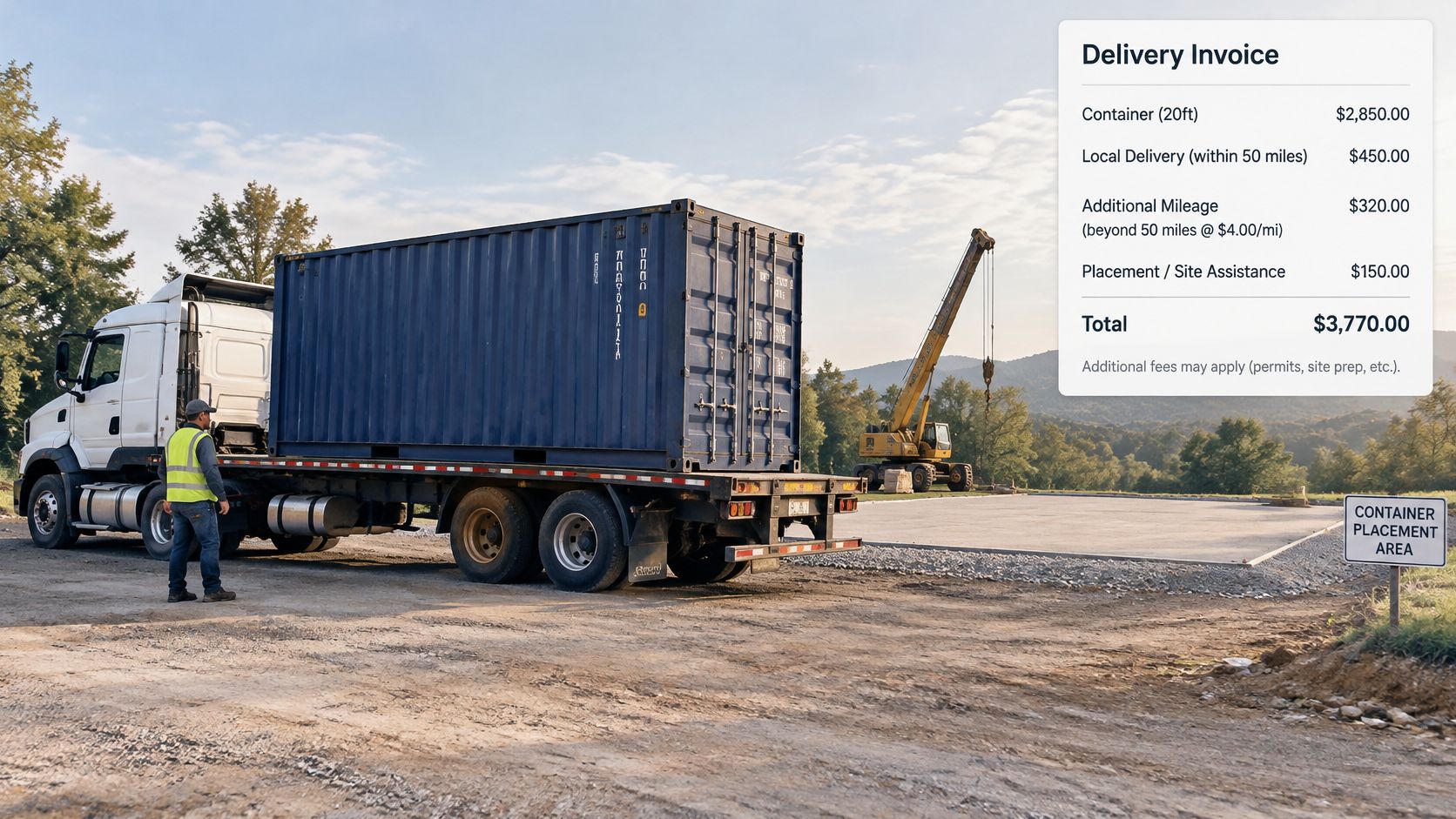
Local delivery within about 50 miles on a flatbed or tilt-bed truck commonly runs $150 to $500, and longer hauls are usually priced per mile. Crane or forklift placement adds several hundred dollars when the site has no drive-on access. Permits and inspection fees vary by city and county, and post-occupancy deliveries may incur additional delivery charges at Pacific Mobile Structures, Inc. A buyer who wants the unit placed and ready for storage can compare what a portable storage container delivery includes before signing.
For imported units, the invoice can keep growing after the ship berths. 2026 US port demurrage and detention data shows why a cheap ocean quote can lose its advantage.
Why a Cheap Ocean Quote Can Cost More
Free time is the number of days a container can sit at the terminal or on site before charges begin. Demurrage applies while cargo is still inside the terminal. Detention applies when equipment is held outside after unloading. The two are different charges with different clocks, and a buyer who confuses them will misread the invoice.
| Charge | Trigger | Typical rate |
|---|---|---|
| Demurrage | Right after free time | $175-$225 per day |
| Demurrage | After 21 days | $750-$1,100 per day |
| Detention | After 11 days | $275-$375 per day |
| Combined carrier demurrage, terminal storage and chassis | Port and tariff bracket | $329-$841 per day |
The same 2026 US port data shows demurrage commonly ranging from $175 to $225 per day right after free time, escalating to $750 to $1,100 per day after 21 days, while detention can reach $275 to $375 per day after 11 days. Combined carrier demurrage, terminal storage and chassis exposure is placed at roughly $329 to $841 per day depending on port and tariff bracket.
A cheap ocean quote with short free time can cost more overall than a higher quote with a longer window and a workable appointment. If customs or site readiness delays pickup by 7 days beyond free time, demurrage at about $200 per day adds roughly $1,400 before trucking. That is the scenario to budget for, not the best-case one.
The video below covers the delivery step, which helps a site team see why access and placement belong in the quote.
Three Questions for Every Supplier
- What is included. Ask for the container, transport, placement, unloading and any crane work as separate lines.
- What is extra. Ask about permits, site prep, chassis, customs, storage, detention and sales tax, then write the answers into the quote.
- What happens if delivery runs late. Confirm who pays for a missed appointment, a waiting truck or a site that is not ready.
Sales tax and county use fees belong on separate lines too. A delivered price that ignores them is not a delivered price.
Estimating Your Total Project Budget Step by Step
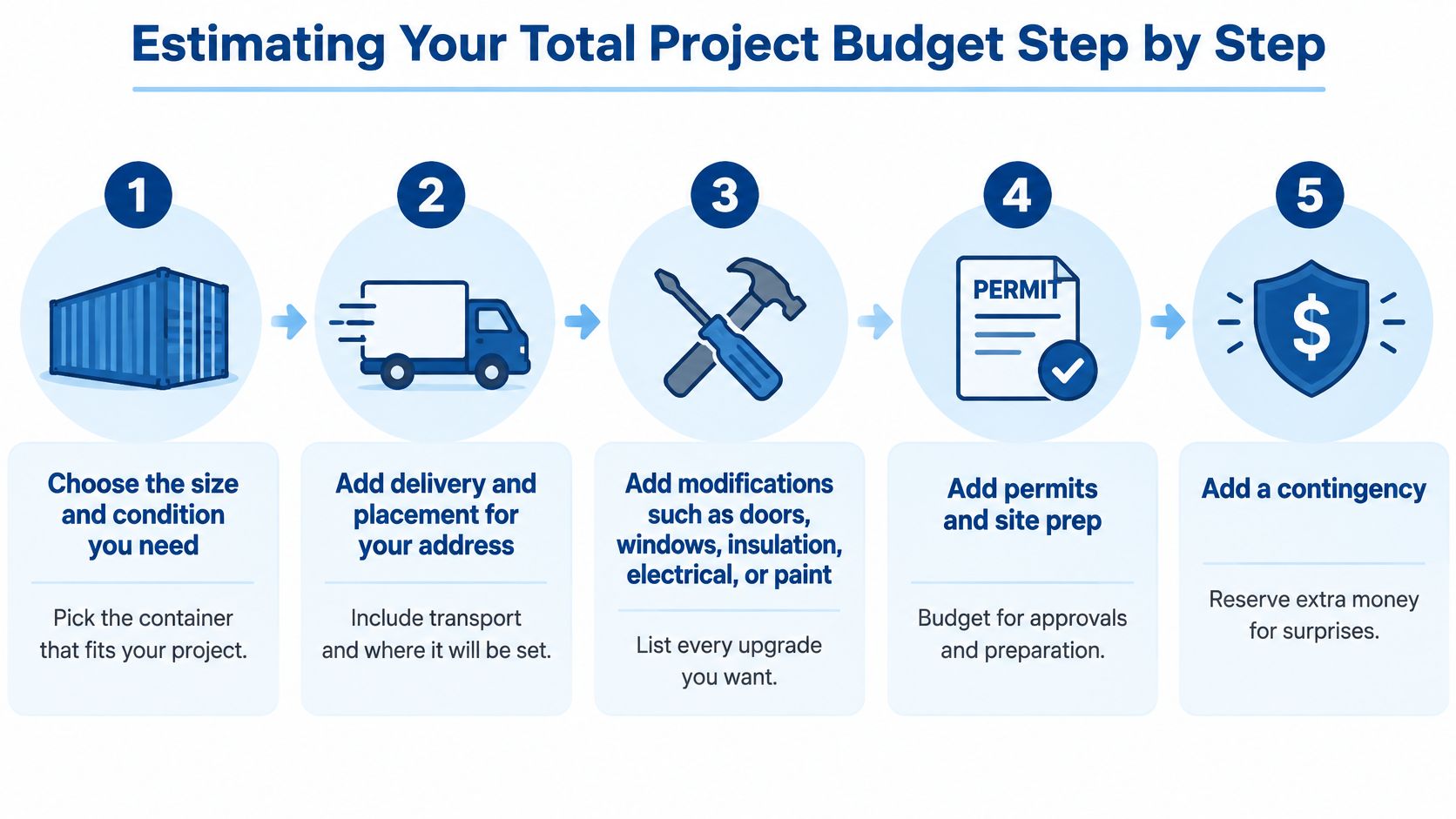
Build the budget in order, so each line has a real number behind it. A buyer who starts with modifications and works backward usually misses delivery, site work and contingency.
- Choose the size and condition the project needs.
- Add delivery and placement for the exact site address.
- Add modifications such as doors, windows, insulation, electrical and HVAC.
- Add site preparation and permit or inspection fees.
- Add a 10 percent contingency for surprises.
- Compare the total against the cost of renting for the same period.
Line-haul pricing should be quoted for the exact lane and booking window rather than pulled from an old average. UNCTAD's Review of Maritime Transport 2025 overview reported that the Shanghai Containerized Freight Index averaged 2,496 points in 2024, a 149% increase from 2023, and that global container-shipping ton-miles rose 17% in 2024. A budget built on a previous year's freight number is a budget built on the wrong lane and the wrong month.
A Worked All-in Budget
Use a used 20 ft unit converted to a small site office as the example. Start with the container at $2,400, add delivery at $350, then add a door, window and insulation at $3,200. Electrical and HVAC come to $2,800, interior finish to $1,500, the gravel pad to $900 and the permit to $400.
That gives a subtotal of $11,550. A 10 percent contingency adds $1,155, for a total of $12,705. The steel box is less than one fifth of the project. The rest is the work that turns it into a usable room.
Budget check: If a line cannot be matched to a written quote, it is still an estimate.
What the Example Leaves Out
The example excludes utility connection fees, ongoing insurance, furniture and sales tax. It also assumes a site with truck access and a level area, which is not true of every lot. A sloped site, a soft base or a long power run can push the total higher before any interior work begins.
Check the result by matching each line to a written quote rather than an estimate in someone's head. Then send the size, condition, site address and timeline to suppliers and ask for an all-in delivered quote. That turns the first line of the budget into a real number and makes the rest of the project easier to price.
Pacific Mobile Structures, Inc. sells and rents storage containers, ground-level office containers and modular buildings, and delivers and sets units to a project's specifications. A team that has sized the box and mapped the site work can ask for a delivered quote that separates the container, transport, placement and any post-occupancy delivery charges. Visit Pacific Mobile Structures, Inc. to start that quote with the site address and timeline in hand.