A high-cube container is the same footprint with one change in height. Under ISO 668, a series-1 standard unit is typically 8 ft 6 in (2.591 m) tall on the outside, while the high-cube version is 9 ft 6 in (2.896 m). That is an increase of exactly 1 ft (0.305 m), about 11.8% in external height. ISO 1496 covers the internal and door dimensions that sit inside that shell. The extra foot produces roughly 12% more geometric volume when length and width stay fixed, and usable capacity runs a little lower because walls, roof, floor, and doors take space. It does not, by itself, raise the allowable gross mass.
That split is the whole high cube vs standard container decision. Volume and headroom help bulky, light goods and ground-level offices. Clearance, chassis height, and payload still decide whether the taller box can be ordered, hauled, and set. A unit that cannot pass the lowest wire, or that hits its weight rating half empty, is the more expensive choice even when the cube looks generous on paper.
Table of Contents
- Standard and High Cube Dimensions Side by Side
- Where Extra Headroom Pays Off in Storage and Conversions
- Payload Limits and the Right Box for Each Load
- Delivery Clearance, Route Limits and Site Access
- Cost and Timing Beyond the Container Price
- Confirm the Route and Load Before You Order
Standard and High Cube Dimensions Side by Side
A 40-foot dry high cube holds about 76.4 m³ inside, against roughly 67 to 68 m³ for a standard-height 40-foot dry unit, according to DHL's cargo container size guide, with length and width held constant. That gap is about 12 to 13% more internal volume for one extra foot of external height.
| Specification | Standard 40 ft | High Cube 40 ft |
|---|---|---|
| External height | 8 ft 6 in (2.591 m) | 9 ft 6 in (2.896 m) |
| External length | 40 ft | 40 ft |
| External width | 8 ft | 8 ft |
| Internal height | about 2.39 m | about 2.70 m |
| Internal volume | about 67 to 68 m³ | about 76.4 m³ |
| Max gross mass | 30,480 kg | 30,480 kg |
| Typical max payload | about 27,650 to 28,690 kg | about 26,700 to 27,700 kg |
Read the rows as a stack. External height is the figure a route survey and a chassis deck have to clear. Internal height is what racking, a ceiling grid, ducts, and tall equipment see. The high-cube interior lands near 2.70 m once a standard interior of about 2.39 m is raised by that same 0.305 m. Internal volume sits below the outside box because wall corrugation, the floor, the roof, and the door gear consume space.
A 20-foot unit follows the same height split. Its cubic totals do not.
What the rating plate still controls
Gross mass on the common rating stays 30,480 kg for both heights. The high cube's heavier shell takes part of that budget as tare, so typical payload sits in the lower band in the table, not above the standard range. Design, carrier rules, and road limits still move the plate figure from unit to unit.
A light, bulky load can fill the extra cube before it reaches weight. A dense load hits the plate while the taller box is still half empty. A refused move, or a second trip after a clearance miss, costs more than the unused foot of height ever saved.
Practical rule: Read the rating plate, then measure the internal height the goods or the fit-out need, before treating either size as the default.
Buyers lining up floor area against stored goods can use the UK container storage size guide from Admiral's Yard Self Storage to see how length choices change the footprint, then match that footprint to the height row that fits the load. Door opening, tare, axle limits, and the lift plan belong on the same check.
Where Extra Headroom Pays Off in Storage and Conversions
The extra foot only pays when something occupies it. Empty air above short cartons is a cost, not a feature.
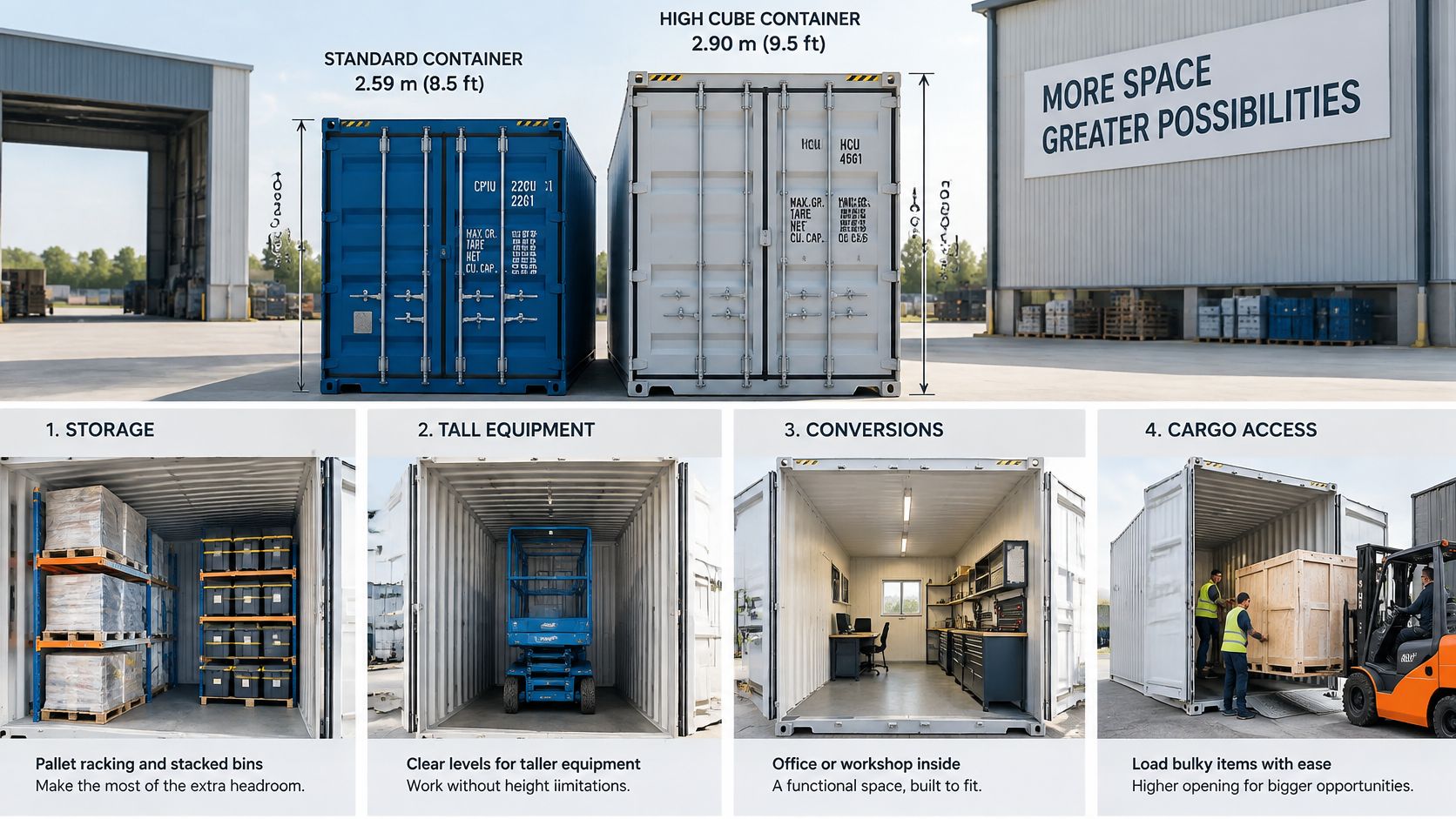
A racked storeroom
Say a contractor keeps pallet racking along both walls of a 40-foot box, with a clear aisle down the middle. Beam levels are fixed by pallet height plus a few inches of lift clearance. On a standard interior, three levels fit and the fourth clips the roof rails. The high cube adds that fourth beam line without narrowing the aisle or pushing racking into the doorway. Stacked bins and a tall compressor follow the same pattern. The floor area does not grow. The number of clear levels does. Containers cover short-term or long-term storage when the job is to secure equipment and supplies, so the rack layout should match how long the goods stay and how often a forklift enters.
A ground-level office
A standard shell lined with insulation, a ceiling, ducts, and lights often leaves the occupied room near seven feet. Desks fit. People stand up into the services. A high cube keeps a comfortable walking height while the duct and the light track stay above the desk line. Partition layouts, a ramp at the door, and furnishings are easier to draw when the envelope has not already spent the vertical room.
Pacific Mobile Structures, Inc. supplies ground-level office containers as onsite rooms that are ISO certified, equipped with heat and air conditioning, and built with fully welded, weather-resistant steel corrugated exteriors. That package is a working room, not a bare freight box, and the starting height still decides whether the lined ceiling feels usable.
A short walk-through of how the two heights sit on a site makes the clearance difference easier to judge before anyone specs insulation.
When the standard box is enough
Plain dry storage of short cartons, archived files, or bagged fittings rarely needs the upper foot. The standard unit offers the same floor and usually sites with less trouble and a lower bill. Three questions settle it. What goes inside? How tall is the tallest item or service run, including racking and ductwork? Which fittings must clear the ceiling after the lining goes in?
Payload Limits and the Right Box for Each Load
Divide planned cargo weight by internal volume. The result, in kilograms per cubic metre, shows which limit arrives first.
Take a worked case with a round payload of 27,000 kg, inside the published band of about 27,650 to 28,690 kg for comparable 40-foot units. Spread across roughly 67 to 68 m³, that mass reaches the weight limit near 400 kg per cubic metre. Spread across about 76.4 m³, the same mass reaches it nearer 350 kg per cubic metre. Anything denser than those marks fills the weight allowance before the cube is full, so the standard unit is the better buy. Lighter cargo hits the walls and the roof first, and the high cube earns its place.
The trade-off is structural, not a rating upgrade. The high cube adds cubic space without adding gross mass, and the taller shell weighs slightly more, so allowable cargo is marginally lower when maximum gross weight stays fixed. Research and Markets ties growing high-cube demand to lightweight, bulky cargo such as e-commerce parcels and electronics, and one forecast estimates a 5.43% CAGR for 40-foot high-cube units through 2031. That is a projection, not a promise that every market is short of boxes. The same reporting noted soft equipment prices in late 2025, so availability and price still move by region.
| Load type | Usually limited by | Better fit |
|---|---|---|
| Lightweight, bulky goods such as packaging, furniture or insulation | Volume | High cube |
| Tall racking or shelving storage | Internal height | High cube |
| Dense materials such as aggregate, masonry or machinery | Gross weight | Standard |
| Full tool kits and construction supplies | Gross weight, often | Standard, unless headroom is needed |
| Rail shipment through restricted tunnels or bridges | Rail loading gauge | Standard, unless the route is verified |
| Mixed loads close to both limits | Both, check each | Calculate volume and gross mass before choosing |
Packaging, furniture, and insulation are the volume cases. Masonry, aggregate, machinery, and a full kit of construction supplies usually hit gross weight while floor space remains. Paper products and tools behave the same way. Tall racking is a height case even when the pallets are light. Axle ratings and road rules can stop the load before the container plate does, which is why a legal highway weight can undercut the ISO figure on a given route.
The extra foot buys volume and headroom, not payload. Choose standard when weight, route, or budget is the binding constraint. Choose high cube when headroom or volume drives the use and the route has been verified.
Write down the heaviest realistic load and its density before comparing sizes. A mixed load needs both numbers on the same page, because winning on cube and losing on weight still fails the shipment.
Delivery Clearance, Route Limits and Site Access
A box can be the right size and still never arrive. Once it sits on a chassis, the extra foot becomes a vehicle-height problem, not a storage feature.
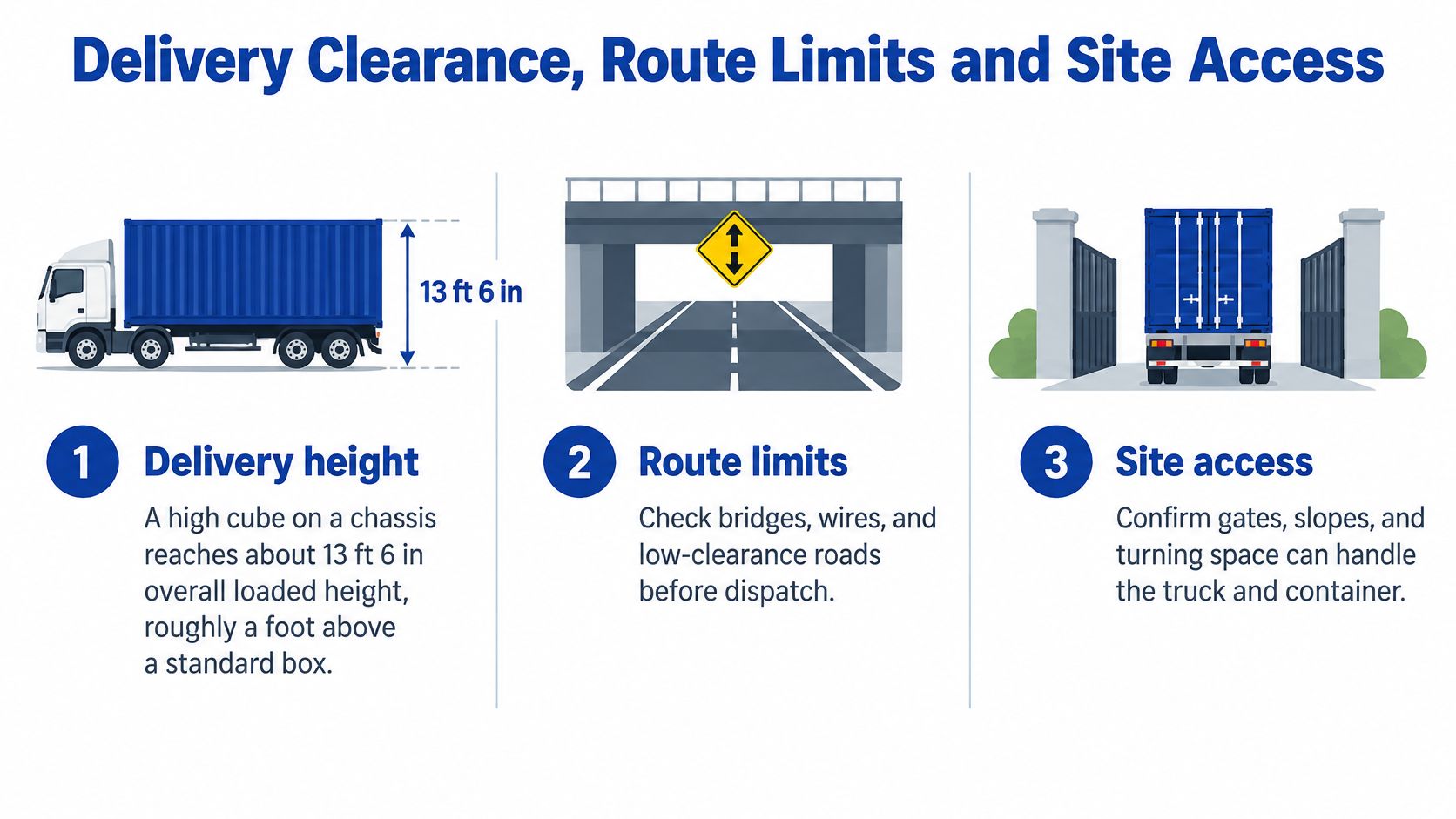
Total Connection's high-cube notes put a high cube's overall loaded vehicle height at about 13 ft 6 in. Bridges, tunnels, utility lines, loading canopies, and local road limits have to be checked before dispatch, not after the order. The result is not a fixed "high cube versus standard" gap. Chassis design, the tractor, the jurisdiction, and truck versus rail all change the number. Rail adds its own loading gauge: deck height, bridges, and tunnels.
The second filter is the site
Gate width, turning radius, door swing, and the wire above the set-down spot fail standard units too. Delivery needs a firm or compact, level site that a truck or the delivery equipment can reach. A soft shoulder or a cross-slope can stop a nominally legal box at the last fifty feet. Schools, clinics, construction yards, and municipal yards feel a failed delivery hardest, because the miss stacks crane time, off-site storage, a second dispatch, and a crew that cannot start.
A standard container is not automatically the safer choice. A verified high cube can be the better operational pick, while a standard unit can still fail on turning radius, overhead utilities, or the geometry of the gate.
Before the truck is booked, the carrier needs six facts.
- Origin and destination: The path, not just the two addresses.
- Transport mode: Truck, rail, or a handoff between them.
- Chassis type: Deck height changes the loaded total.
- Lowest overhead point: A measured clearance, not a guess from a map.
- Turning room: At the gate and at the placement spot.
- Set-down surface: Firm, compact, and level enough for the delivery equipment.
Teams that want the box on a jobsite for a defined season, rather than as a permanent structure, can line the route check up against storage containers for rent and match the rental term to the access the site has.
Cost and Timing Beyond the Container Price
The sticker price is the first line people compare, and it is the least complete one. A high cube can carry a market premium, and that premium is not stable from one week to the next. Quotes for both heights should be pulled on the same day, against the same condition and the same delivery window. A week-old number is not a comparison.
Transport often moves the bill more than the size difference does. Permits, an escort where the loaded height requires one, the chassis, and the miles all sit outside the box price. Placement adds the lift, a level pad or prepared base, utility ties for an office, and any work to open the gate or drop a wire. Miss one of those and the "cheaper" unit becomes the costly one on delivery day.
A running total for both sizes
Build the same sum twice.
- Unit price: Purchase or lease for that exact height and length.
- Transport: Miles, chassis, permits, and any escort.
- Lift: Crane or tilt gear for the set.
- Site preparation: Pad, access repairs, and utility connections.
- Insurance: Only the cover the use requires.
- Contingency: A buffer for a missed route or a failed placement.
An individual consumer renting only a container is not required to maintain property insurance. A converted office that staff or the public occupy can be a different cover question, and that difference belongs in the sum rather than as an afterthought. In-stock standard plan buildings are typically delivered within one to two business days, but only when the wanted size is in stock rather than built to order. Confirm stock before treating that window as a promise.
People pricing a staffed, drive-up alternative instead of a delivered jobsite box can find drive-up container storage near Nottingham and see how access fees differ from haulage and a set. For a purchased or leased freight box, the useful price check is what conex containers cost once transport and placement are added, not the unit line alone. Compare the two full totals. The lower sticker with the failed route is not the lower cost.
Confirm the Route and Load Before You Order
The order should follow the checks, not the other way around.
- Read the plate on the unit being bought or rented. Tare, gross rating, and door clearance have to match the load and the tallest piece. A grade note helps too. Worn corners and a patched floor change handling even when the external height is right, and the guide to container grades is the place to separate a freight-worn shell from a unit meant to be occupied.
- Request delivered quotes for both heights on the same worksheet. Same date, same origin, same chassis assumption, same lift. A quote that excludes the escort or the pad is not comparable to one that includes them.
- Confirm the exact size with local sales. Customers who need a specific building size should contact their local sales representation, because that is how sizes get arranged. Ask which high-cube and standard units are in stock and whether they can be set on the site already measured.
- Decide buy or rent, then name the size on the order. Storage containers can be bought or rented from Pacific Mobile Structures, Inc., and they are delivered and set on-site to the customer's specifications. Renting fits a term with a known end. Buying fits a box that stays for years as storage or as the shell of a ground-level office. Either way, the order names one height, not "whichever is taller."
The binding choice is still density, headroom, and a route that has been measured. A taller box that cannot be delivered, or that reaches its weight limit with space left over, is not the better specification.
Pacific Mobile Structures, Inc. sells and rents storage containers and ground-level office containers, and sets them on site to the customer's specifications for schools, clinics, public agencies, and jobsites. A standard or high-cube choice only works when payload, headroom, and the delivery route have been checked against that site. Visit Pacific Mobile Structures, Inc. to confirm which sizes are available and how they can be placed.