A facilities director gets the enrollment projection in early June. Two new grades' worth of students, eight modular classrooms needed before the first bell in August. The district's purchasing office drafts a standalone solicitation and the calendar comes back ugly. Advertise, evaluate, hold the protest window, take it to the board, execute a contract. Someone at the table says the district can use BuyBoard, and half the room relaxes.
The half that relaxes has it half right. A cooperative contract removes the solicitation step, and that's usually the longest block of time in the calendar. It does not remove the rest. Membership gives a district access to a competitively awarded contract. It does not give the district authority to buy, and it never confirms that the awarded scope covers eight classrooms with steps, ramps, utility hookups and a prepared pad.
That gap between access and authority is where cooperative purchases stall, get rebid, or end up in an audit finding. The mechanics are learnable, and they come down to four things: what the contract is, what its terms say, what the fee does to a total cost comparison, and which local rules still apply after the cooperative has done its part.
Table of Contents
- What BuyBoard Is and Why Public Buyers Use It
- Membership Rules and Contract Terms at a Glance
- How to Buy Through a BuyBoard Contract, Step by Step
- Total Cost, Fees and Rebates Against a Standalone Bid
- Compliance Checks Beyond the Cooperative Contract
- Confirm Scope and Make the Call Before You Order
What BuyBoard Is and Why Public Buyers Use It
Eight weeks is the kind of deadline that pushes a district toward a contract someone else already competed.

BuyBoard, formally the Local Government Purchasing Cooperative, exists to increase the purchasing power of public entities and simplify procurement through a shared purchasing system. Membership has grown to more than 5,500 governmental organizations, including school districts, cities, counties, community colleges, universities, education service centers, municipal utility districts and nonprofits, and it costs nothing to join, according to BuyBoard's own program description.
The model is group buying, and it works the way a warehouse club works for a household. One buyer writing a bid for eight classrooms gets whatever pricing eight classrooms deserve. Five thousand public entities buying classrooms, furniture, vehicles and services through one competed contract get pricing built on that volume. The solicitation gets written once, advertised once, evaluated once and awarded once, and every member then orders against the result instead of repeating the work.
Two sentences fix the core idea. BuyBoard does not sell classrooms, offices or storage units to anybody. It runs the competitive solicitation, holds the awarded contracts, and lets eligible members place orders against them with documentation that supports Texas procurement requirements and audit needs.
That's a meaningful distinction for a first-time buyer, because it changes what membership means. Joining gets you into the room where contracts live. It doesn't hand you a credit line, a pre-approved purchase, or a substitute for your own rules. The cooperative competed the vendor's pricing and terms. It never saw your board policy, your grant conditions or your site plan.
Public-sector buyers who already work with federal vehicles will recognize the structure, and a comparison of GSA Schedules and GWACs is a useful primer on the difference between a pre-competed contract and an actual purchasing authority.
For modular buildings specifically, the model shows up in how vendors publish their awarded scope. The cooperative purchasing contracts that cover modular construction explain what's typically inside the award and what a buyer still has to price separately, which matters when the deadline is eight weeks out.
Membership Rules and Contract Terms at a Glance
Before ordering anything, scan the terms that shape cost and timing. Everything below comes from the cooperative's own published documentation, and each row answers a question facilities staff ask in the first five minutes.
| Term | Value | What It Means |
|---|---|---|
| Membership cost | Free | Eligible public entities join without a membership fee |
| Membership agreement | Interlocal Participation Agreement | Membership takes effect after authorized signatures |
| Membership size | More than 5,500 governmental organizations in 2025, per BuyBoard's facts page | A large shared buyer base supports broad competition |
| Vendor service fee | 2% of each vendor purchase order | Invoiced monthly to vendors, not members |
| Vehicle purchases | Separate flat fees | Vehicle orders are not charged the 2% percentage fee |
| Standard contract term | One year | Contract prices are set for a one-year period |
| Extension | Two years by mutual agreement | Contracts can run up to three years in total |
| Volume purchases | Automated request for quote | Members can ask selected vendors for prices on multiple units |
The fee row is the one to slow down on
The charge is billed to the vendor, monthly, as a percentage of each purchase order that travels through the cooperative. Members don't receive an invoice for it. That doesn't make it free money for the buyer, because a vendor running a business will recover it somewhere. Some fold it into unit pricing, some show it as a separate line, and some absorb it on small orders and price it in on large ones. The only wrong move is assuming it disappears.
Ask the vendor directly, in writing, how the fee is reflected in the quote being prepared. A one-sentence answer settles it, and it prevents an awkward conversation when a business office compares two documents that were never meant to match.
Contract length decides whether the price holds
A one-year standard term with a mutually agreed two-year extension means a contract can run up to three years, which is plenty for a single classroom order and tight for a multi-phase campus plan. If installation is scheduled for year two of a project, confirm the extension is in place before the price is committed to a board item. A quoted price that depends on an extension nobody executed isn't a price, it's a hope.
What matters most on a fixed deadline: the active contract term. Scope can be negotiated with a vendor in days, but a contract that lapsed between award cycles has to be re-sourced, and that restarts the clock.
How to Buy Through a BuyBoard Contract, Step by Step
Competition happens before the buyer shows up. The Texas Association of School Boards runs the solicitation through its cooperative purchasing division, evaluates electronic proposals against published criteria with a scoring matrix, and presents award recommendations to the cooperative's board, according to BuyBoard's joining and purchasing guidance. Solicitations are advertised in 11 Texas newspapers once weekly for two weeks. By the time a vendor appears in the catalog, someone has compared that vendor's pricing and terms against its competitors on the record.
That's the origin of the shortcut. What follows is the buyer's half of the work.
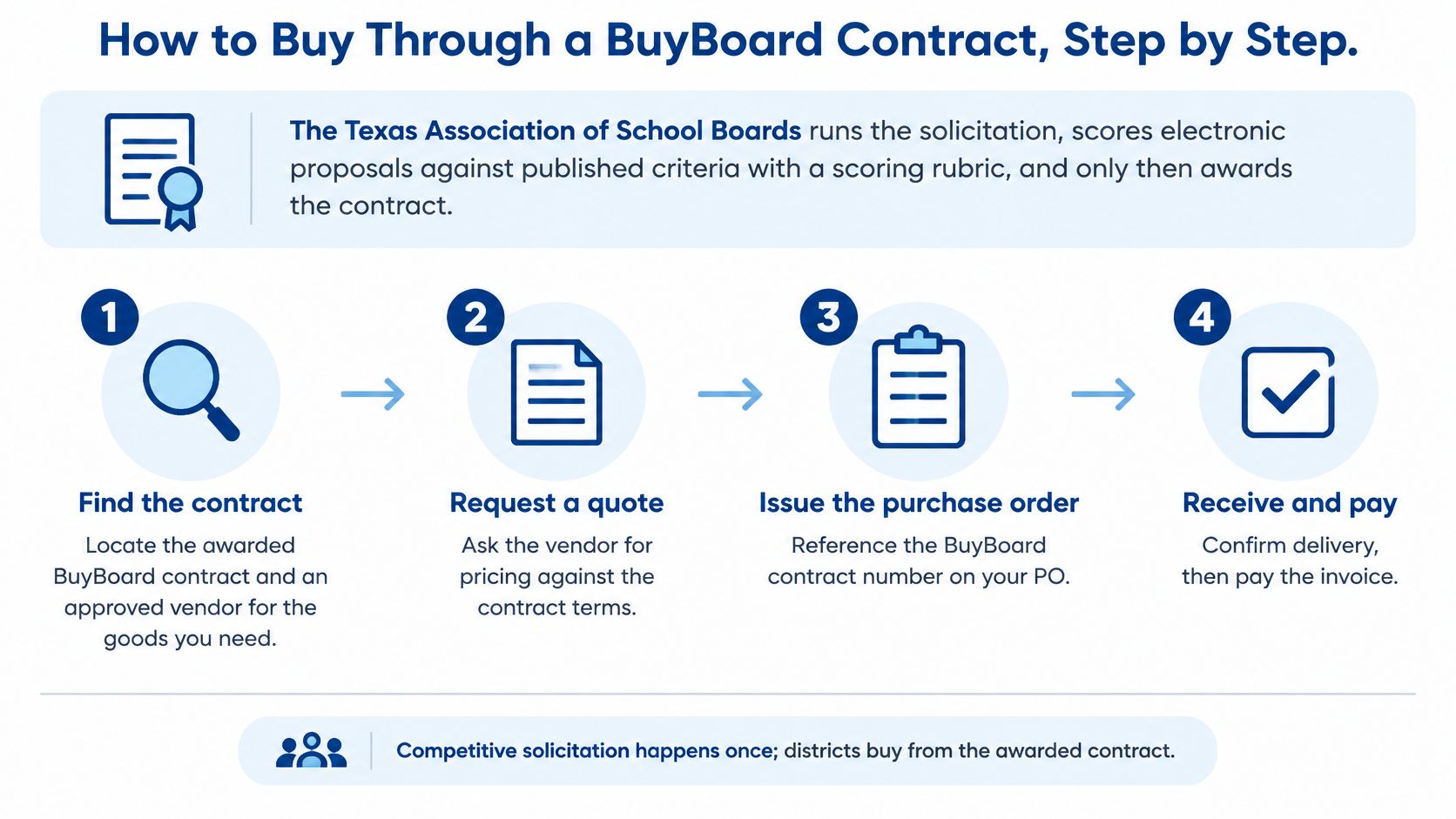
- Confirm eligibility and local authority. Verify that your entity type qualifies, then check that your procurement manual and governing body allow cooperative purchasing at all. A charter school, a housing authority and a county hospital can land in three different answers, and no cooperative can settle that question for you.
- Sign the Interlocal Participation Agreement. Membership requires an approved agreement signed by authorized representatives, and it becomes effective only after those signatures. Someone in a hurry will try to place an order while the paperwork sits in a routing queue. The order will be held.
- Find the contract and read its scope. Search the awarded contracts by category and open the awarded contract document, not the catalog summary. What you need is the description of goods, the vendor's awarded pricing structure and any exclusions written into the contract. This is the step where a modular buyer discovers whether installation is inside the award or outside it.
- Request a quote from the vendor. Give the vendor the same specifications you would have put in a bid: building size, configuration, delivery address, site conditions, utilities, steps or ramps, and a target occupancy date. Where several classrooms or offices are needed, the automated request-for-quote function lets a member solicit prices from selected vendors and keep price discovery alive inside the cooperative framework.
- Compare the line-item quote to the awarded scope. The question isn't whether the total looks reasonable. It's whether every line in the quote traces back to something the vendor was awarded. Items outside the award need their own competitive pricing.
- Issue a purchase order that cites the contract. Put the cooperative contract reference and the awarded vendor on the PO. That single detail is what lets an auditor or a grant monitor trace a $300,000 purchase back to a competed award instead of taking your word for it.
What a clean purchase file contains: the signed participation agreement, a printed copy of the awarded contract page showing vendor and scope, the vendor's line-item quote, the purchase order citing the contract number, and a one-paragraph scope note listing what the quote includes and what the district is buying separately.
Keep those five items together from the start. Reconstructing them eighteen months later, when the building is occupied and the project manager has moved on, costs more time than assembling them on day one.
Total Cost, Fees and Rebates Against a Standalone Bid
Two quotes can carry identical unit prices and still land tens of thousands of dollars apart once freight, foundations and utility hookups arrive. That's the comparison a facilities buyer has to make, and it's the one a headline contract price hides.
Where the headline price stops
A cooperative award sets pricing for the goods and terms the vendor competed. It can't anticipate your site. A usable quote separates the cost elements so each one can be checked against a standalone bid:
- Base unit: the building itself, at the awarded size and configuration
- Customization: doors, windows, partitions, data drops, finishes beyond the standard plan
- Transportation: delivery mileage, permits, pilot cars, crane or offload charges
- Foundations and site preparation: piers, gravel, concrete, grading, drainage
- Access: steps, ramps, decks and any accessibility features the site requires
- Utility connections: electrical, water, sewer, gas and trenching to the building
- Commissioning: inspection, testing, fire alarm and any jurisdiction sign-offs
- Furniture and equipment: desks, tables, chairs, appliances, whiteboards
- Ongoing service: maintenance agreements, repairs and relocation later on
Say a district needs three classrooms and collects two quotes. Quote A adds freight per mile and bills the crane separately, and its unit price looks low until delivery is added. Quote B builds delivery into the unit price and excludes the gravel pad, which the district then buys from a site contractor. Same three buildings, two completely different cost structures. The only way to judge them is to force both onto the same nine lines.
That's also where the cooperative's service fee belongs. BuyBoard reports a 2% service fee on each vendor purchase order transmitted through the cooperative, invoiced monthly to vendors, with vehicle purchases carrying separate flat fees, per BuyBoard's FAQ. The member never sees that invoice, but the vendor does, and on a high-value order of modular classrooms, medical units, turnkey installation or a multi-site deployment, it's large enough that a vendor will price for it. Ask how, then put it in the vendor's column of your comparison.
Duration matters just as much. Standard contracts are valid for one year, with a mutually agreed two-year extension, so many run up to three years. A price quoted in month ten of a term may need re-confirmation before an installation scheduled six months out, and a phased campus plan should name who confirms the extension and when.
What a rebate does and doesn't do
Rebates are the part of cooperative purchasing that gets quoted in board presentations, and the numbers are real. For fiscal year 2024–2025, BuyBoard reported $15.4 million in rebates distributed to 1,359 members, according to its rebate reporting page. In October 2024 the cooperative announced a $13 million rebate across 1,375 members, including public schools, colleges, universities and local governmental entities, and stated that cumulative rebates had passed $100 million since the program began in 2006, as reported in BuyBoard's rebate announcement.
Divide $13 million by 1,375 members and you get roughly $9,455 per participating member, but that's an average and nothing more. Actual amounts follow each member's qualifying purchasing activity and the cooperative's allocation rules, so a district that bought two storage containers and a district that built a wing will not receive similar checks.
Budget rule: a rebate arrives after the buying is finished and the fiscal year has closed. It never reduces the price of the order in front of you, so keep it out of the project budget and treat any payment as a later credit.
The comparison rule that survives all of this is simple. Put every option on identical line items before judging which route costs less. If the awarded scope can't cover an element, such as a particular foundation type or a site-built ramp, price that element as its own standalone solicitation and compare it separately. Bundling an out-of-scope item into a cooperative order to avoid paperwork is how a clean procurement becomes a finding.
Compliance Checks Beyond the Cooperative Contract
Here's the assumption worth challenging directly: a signed participation agreement and an active contract mean the procurement is handled. They don't. Cooperative purchasing reduces the solicitation burden and leaves the remaining work to shift from competitive bidding toward contract validation, scope definition and project-specific approvals. That work doesn't disappear, it changes address.
Agency rules come first, and neutral procurement guidance on BuyBoard purchasing makes the point plainly: compare cooperative purchasing against your own procurement manual and internal procedures, and review the lead agency's solicitation and award process to confirm it aligns with local rules. That review is the actual compliance step, and it takes an afternoon rather than a quarter.
| Requirement | When It Applies | What to Confirm |
|---|---|---|
| Statutory authority | Every purchase | Your agency's enabling law allows cooperative contracts |
| Interlocal agreement | Before the first order | The participation agreement is signed and effective |
| Contract number and PO language | Every purchase order | The PO cites the BuyBoard contract and awarded vendor |
| Quote thresholds | Based on purchase size | Your local rules for quotes and approvals |
| Protest rights | Vendor disputes | Your policy for handling award or performance disputes |
| Funding-source restrictions | Grant- or bond-funded projects | Funds may be limited to specific uses |
| Prevailing wage | Public construction work | Whether installation triggers wage rules |
| Building permits and accessibility | Site-installed buildings | Local permits and accessibility standards apply |
| Bonding and insurance | Installation and site work | Coverage meets your agency's requirements |
| Governing-board approval | Purchases above board limits | The board authorizes the award or spending |
| Records retention | Every purchase | Documents are kept for the required period |
The order to run the checks
Start with authority, because everything downstream is wasted effort if the answer is no. A district counsel or city attorney confirms the enabling language, and the purchasing manager confirms the participation agreement is executed rather than pending.
Move to money. A grant-funded classroom project may restrict which contract vehicles can be used, and a bond-funded one may carry its own reporting conditions. A healthcare authority buying a modular clinic usually adds licensing and life-safety review on top of everything else.
Then the physical project. Prevailing wage questions, building permits, accessibility standards, environmental review for certain site work, bonding and insurance for installation crews all attach to the building and the site, not to the contract vehicle. A cooperative award says nothing about whether your installer is insured to your risk manager's satisfaction.
Finish with governance and records. If the amount crosses the board's spending limit, the authorization has to exist before the order ships, and the file has to be retained for the period your records schedule names.
Where contract review earns its keep: the awarded contract language and your internal procedures have to agree, and mismatches hide in scope exclusions, insurance endorsements and delivery terms. A tool such as this AI contract review aid can surface those conflicts while there's still time to ask the vendor a question.
Districts comparing vehicles also need to know that the cooperative they use changes the paperwork, not the physics. Buyers who work across state lines or multiple cooperatives can see how a KCDA cooperative purchasing contract for modular buildings and furniture is structured compared with what they already know.
Confirm Scope and Make the Call Before You Order
A cooperative contract is a pre-approved route. It shows which vendors and terms are vetted. Joining BuyBoard does not give a facilities manager authority to buy. Your procurement policy and board limit supply that authority, and the awarded contract must match the building, delivery and installation needed. Run this check before ordering.
- Check the contract is live. Confirm the award is inside its one-year term or an executed extension, and note the expiration date.
- Match the scope line by line. The awarded scope has to name the building type, freight, installation, utilities and site work. Anything outside it gets priced separately.
- Get the quote in writing, itemized. Compare it with the standalone estimate on identical lines, with the vendor fee shown separately.
- Confirm approval. If the amount crosses the board's limit, record the authorization before the order ships.
- Check the file. Keep the signed agreement, contract reference, quote, purchase order with contract language, and scope note.
Then call the awarded vendor's sales representative. Confirm the building size and configuration, and ask whether an item not listed online can be special ordered. A district needing a specific size should raise it early with local sales representation, because it changes the quote and delivery timeline.
Buyers comparing states can see how these agreements operate elsewhere through this look at taking advantage of cooperative purchasing agreements in Oregon and Idaho, since authority, scope and local approval follow the same sequence wherever the contract was awarded.
Pacific Mobile Structures, Inc. builds modular classrooms, offices, storage units and permanent modular facilities for schools, healthcare providers, government agencies and commercial clients, and participates in purchasing cooperatives such as KCDA and TIPS. Its team can walk through the awarded scope, confirm what installation and delivery include, and flag items that need separate pricing. Visit Pacific Mobile Structures, Inc. to review building options.