Portable storage rented for an average of $286 a month in 2025, up 7.5% on 2024, according to a Dataintelo market analysis drawing on WillScot figures. That's the number every renter compares, and it decides almost nothing about what the job finally costs.
Two other numbers decide it. A standard 20 foot box holds about 33.2 cubic meters, or 1,172 cubic feet, nominally, and no renter ever loads that much because shelving, pallets, aisles and a doorway stand between the brochure figure and what fits. The second is the price of getting the unit onto your ground, placed where a forklift or a person can reach it, and hauled away at the end.
Get capacity and placed cost right and a 20 foot storage container rental is the cheapest secure space a site can buy. Get either wrong and you're paying warehouse rates for a box you can only half use.
Table of Contents
- 20 Foot Container Dimensions and Usable Capacity
- What Goods a 20 Foot Container Suits Best
- Delivery Access and Site Placement Checklist
- Monthly Rent Benchmarks and Delivered Costs
- How to Inspect a Container Before You Sign
- Rent or Buy for Your Project Length
- Confirm Delivery Terms Before You Order
20 Foot Container Dimensions and Usable Capacity
A 20 foot storage container is a steel box roughly 20 feet long, 8 feet wide and 8 feet 6 inches high on the outside, built to the ISO intermodal pattern that ports, truckers and crane operators handle every day. DHL's container size guide puts the standard external dimensions at approximately 6.058 m by 2.438 m by 2.591 m, a footprint of about 160 square feet once it's set down.
Inside, the same guide gives about 5.898 m by 2.352 m by 2.393 m, and a tare weight near 2,250 kg against a maximum gross mass of 30,480 kg. Those are the figures a rental quote is built on, and the ones a site sketch should be drawn around. The table below is the lookup sheet; everything after it explains where the numbers leak.
| Measure | Standard figure | What it means for a rental |
|---|---|---|
| External length and width | about 6.06 m x 2.44 m (20 ft x 8 ft) | footprint of about 160 sq ft at the site |
| External height | about 2.59 m (8 ft 6 in) | overhead clearance needed along the delivery route |
| Internal length, width, height | about 5.90 m x 2.35 m x 2.39 m | working space inside the box |
| Door opening | about 2.33 m wide x 2.26 m high | largest item must pass through this opening |
| Nominal usable volume | about 33.2 cubic m (1,172 cubic ft) | falls once shelving and aisles are added |
| Tare weight | about 2,250 kg | empty weight used in delivery planning |
| Maximum gross mass | about 30,480 kg | structural and transport limit, not a storage target |
Why 1,172 cubic feet rarely fits
Cubic feet assume the box is empty and you're pouring something in. Real loads arrive on pallets, in crates, on shelving units and in stacks that need clearance from the walls so air can move and so you can see water stains before mould sets in. A 1.2 m aisle down one side of a 2.35 m interior eats roughly a fifth of the floor, and more if you want to open a pallet where it sits.
The doorway is the hardest limit in the whole structure. Measure the largest item diagonally across its longest face and check that diagonal against the door, not against the interior. A mower, a prefabricated counter, a long bench or a loaded pallet that clears the walls will still stop dead at the frame.
The measurement that saves a second rental: if the largest item and the aisle you need pass the door and sit inside the interior, a 20 footer is enough. If either fails, price a 40 foot unit or two 20 footers placed side by side.
Where the payload rating actually applies
The rated payload sits near 28,230 kg, and it is a transport limit rather than a storage target. Nobody stores 28 tonnes of records or tools in a parked container, and a floor loaded to that figure point-loads the deck in ways the frame wasn't designed for on static ground. Spread heavy items across the floor, keep the mass over the cross members, and treat the plate on the unit as the authority over any figure in a quote.
The 20 foot format also happens to be the reference unit of global freight, the TEU, which is why these boxes are abundant, cheap to move and compatible with every sideloader and tilt-bed in the region. A 40 footer counts as two TEU of nominal length. That matters to a renter only because availability and handling costs are lower on the size the world standardized.
What Goods a 20 Foot Container Suits Best
Renters ask whether a 20 footer is big enough before they've written down what's going in it. Sort the contents first and the size answer usually falls out on its own.
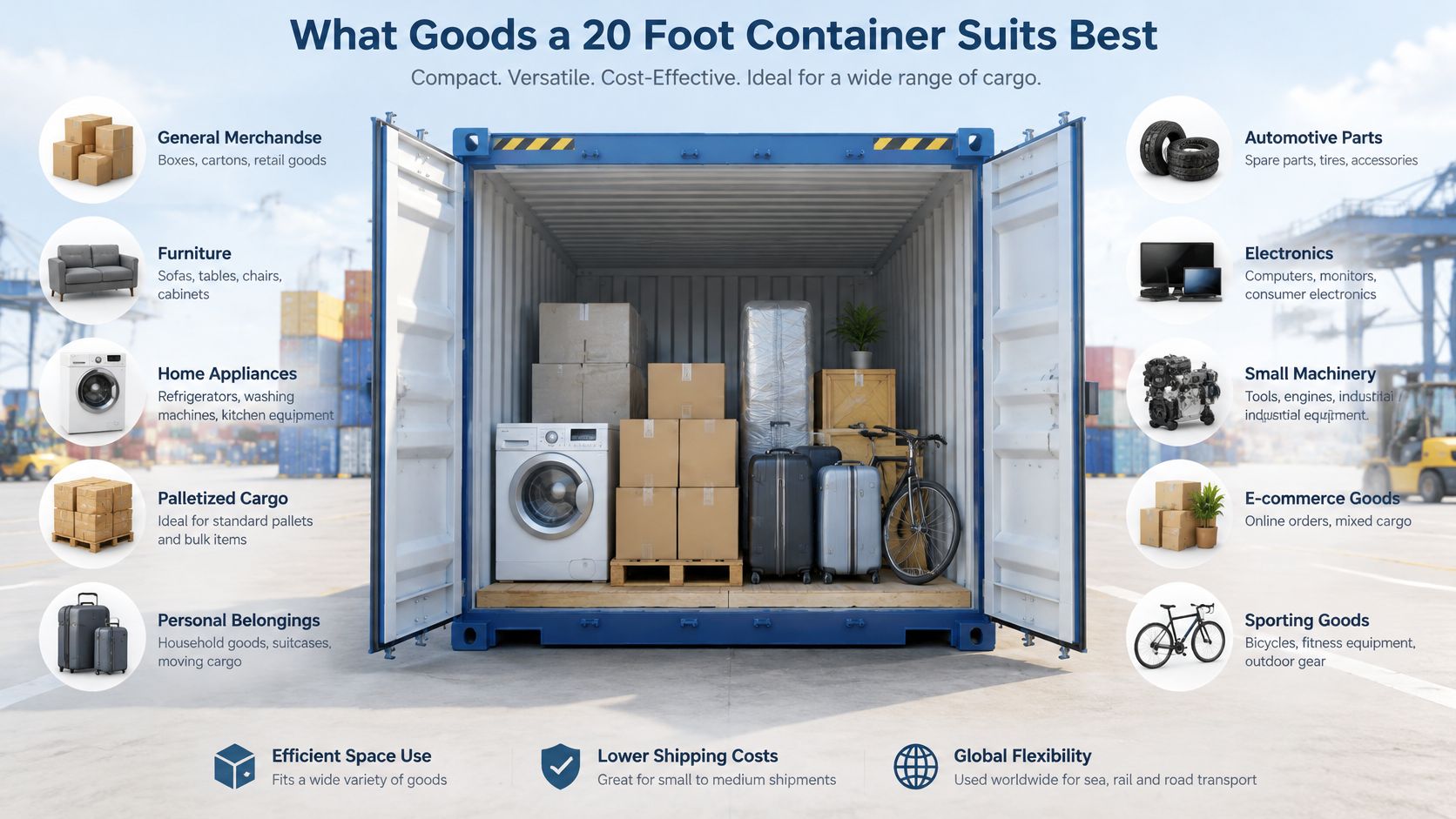
Durable, low-sensitivity goods are the natural fit. Lumber, scaffold fittings, steel stock, hand tools, job-site equipment, spare furniture, bricks, pipe. These tolerate a steel shell that swings with the weather, because there's nothing in them that moisture can ruin. Load them tight, leave a walkway if you'll be in and out, and stop worrying about the box.
Goods you retrieve constantly need a different layout. Fast-moving site materials, maintenance parts, seasonal stock and school supplies all fail on access before they fail on volume. Bolt shelving to the side rails, keep pallets off the floor on timber or plastic dunnage, and preserve one clear aisle to the back wall so a pick doesn't turn into a full unload. A half-filled box with an aisle outperforms a packed one you have to reverse-engineer every Monday.
Moisture-sensitive and high-value goods need protection the standard unit doesn't provide on its own. Electronics, medical supplies, archived paper, instruments and anything with a warranty don't care that the steel is weather-resistant; they care that relative humidity swings with the outside air. One 2026 industry outlook projects 20 foot units will be the fastest-growing size segment in the United States through 2031, at a 5.09% compound annual growth rate (Mordor Intelligence), which means more of these boxes are being asked to hold things that a bare steel shell wasn't designed to protect.
The moisture controls that actually work
- Ventilation: open the doors on a dry day and let the box breathe before loading, then keep vents clear rather than sealed.
- Desiccants: calcium chloride or silica containers sized to the volume, checked and replaced on a schedule, not left in a corner for a year.
- Raised pallets: nothing porous sits directly on a steel floor that condenses overnight.
- Moisture monitoring: a cheap hygrometer inside tells you whether the controls are working before the stock does.
- Insulation or a climate-controlled unit: the honest answer when the contents are worth more than the difference in rent.
That last line is the test worth running before ordering. If humidity damage would cost more than the rent gap between a standard box and a protected one, specify the protection up front. Buyers who skip this step usually discover the problem at the far end of a claim.
Delivery Access and Site Placement Checklist
Delivery is binary. Either a truck reaches a firm, level, accessible spot and sets the box down, or the order doesn't happen, and no amount of rent negotiation fixes a gate that's 20 cm too narrow. DHL's general-purpose container specification is blunt about the arithmetic: the unit's external width is about 2.44 m and its length about 6.06 m, and that excludes the clearance the delivery vehicle and the off-loading manoeuvre need on top.
| Site factor | What to confirm | Why it matters |
|---|---|---|
| Ground surface | firm, level and compact | the box must sit stable and not sink or tilt |
| Truck access | road and gate width suitable for the delivery vehicle | delivery stops if the truck cannot reach the spot |
| Turning and unloading space | room to manoeuvre and off-load beside the box | the box needs about 6.06 m x 2.44 m before clearance |
| Overhead clearance | no power lines or branches in the drop path | lift and tilt operations need height |
| Door opening | the doors land facing clear ground, not a wall or fence | contents must be reached without moving other units |
| Placement distance | distance from the depot to the work site | longer hauls increase mileage cost |
| Permits | local approval for public land or restricted lots | rules vary by municipality |
The three blockers that cancel the most deliveries
Overhead obstructions. A tilt-bed raises and slides; a crane lifts vertically. Sagging service drops, low branches and building overhangs stop the operation at the last metre, after the truck has already been dispatched. Walk the route with your eyes up, not just down.
Soft or sloped ground. A loaded trailer plus a 2,250 kg box concentrates serious weight on a small contact patch. Fresh fill, saturated turf, gravel over clay and anything on a visible gradient will either refuse the drop or leave you with a unit that settles out of level. Delivery requires a firm or compact, level site that is accessible by truck or delivery equipment, and that's a physical constraint rather than a preference.
A door facing the wrong way. Position decides usability. Land the doors against a fence and every visit means moving pallets out of the way, or hiring a second unit to stage them.
Site the container so the doors open onto hardstanding you can walk a pallet truck across, even if that means paying for a longer hose reel or a few extra metres of cable.
What to send the provider before you order
Photograph the placement spot from the road, sketch the site with gate width and the truck route marked, and note the distance from the gate to the target position. Mention any slope, drain, manhole cover or overhead wire. Add how you'll reach the sill: if the doors land high above grade, steps and ramps are sold as storage container accessories and are far easier to arrange with the order than after the driver has left.
Monthly Rent Benchmarks and Delivered Costs
The advertised monthly rent is a real number and an incomplete one. Benchmark it, then set it aside and price the rest of the job, because the gap between the rate on the website and the invoice is where budgets break.
| Source and year | Reported figure | What it covers |
|---|---|---|
| SiteBox estimate, 2025 | $100-$250 per month | 20 foot container rent, excluding transport, fuel and other charges |
| SiteBox Storage report, 2024 | $150-$400 per month | standard 20 foot containers, typical rental range |
| Dataintelo market analysis citing WillScot, 2025 | $286 average per month | portable storage in general, up 7.5% from 2024 |
| SiteBox Storage report, 2024 | 42.6 days average | typical rental length for storage containers |
Read the first row carefully. SiteBox's 2025 estimate of $100 to $250 per month explicitly leaves out transportation, fuel and other charges, which is precisely where a constrained site spends its money. The same company's 2024 report put standard 20 foot containers at $150 to $400 per month, a range wide enough to show how much condition, region and demand move the rate. The $286 average covers portable storage in general, so treat it as a sense check rather than a quote for your address.
Two budget lines, not one
Monthly rent is the line that repeats. Everything else is a one-time mobilization cost, and it's the line that surprises people:
- Delivery and mileage, priced from the depot to your gate, not from the nearest city on the map.
- Handling method, because a tilt-bed, a crane and a sideloader don't cost the same to dispatch.
- Ground preparation, from a few tonnes of compacted stone to timber cribbing under the corners.
- Access hardware, meaning steps, ramps and a lock worth the name.
- Permits and taxes, which vary by municipality and by whether the box sits on private or public land.
- Pickup at the end, plus damage liability if the unit comes back with a bowed roof or a door that won't seal.
The contrarian buying rule
A container that's already within 40 minutes of your site at a slightly higher monthly rate usually beats a nominally cheaper unit that has to be repositioned across a region. Leschaco's sea freight market update describes equipment shortages, missed cutoffs and higher end-to-end logistics costs, with rerouting around the Cape of Good Hope adding roughly two weeks to some Asia to Europe and U.S. East Coast transit routes. Freight volatility reaches storage yards as repositioning cost and thin local stock, so proximity has a price worth paying.
The same arithmetic runs in other industries. Telecom network maintenance crews staging spare hardware for a season of tower work care far less about the monthly rate than about whether the box lands within reach of the equipment it feeds.
Work the total this way. Start with the published rental rates for the size you want, then ask for an itemized delivered figure. One-time mobilization plus monthly rent multiplied by expected months is the number to compare, and it's the only one worth writing in a budget.
How to Inspect a Container Before You Sign
Water intrusion, a door that won't seal and a handling failure trace back to four or five visible points, and all of them can be checked in twenty minutes while the truck is still there. Accept nothing on the strength of a photo.
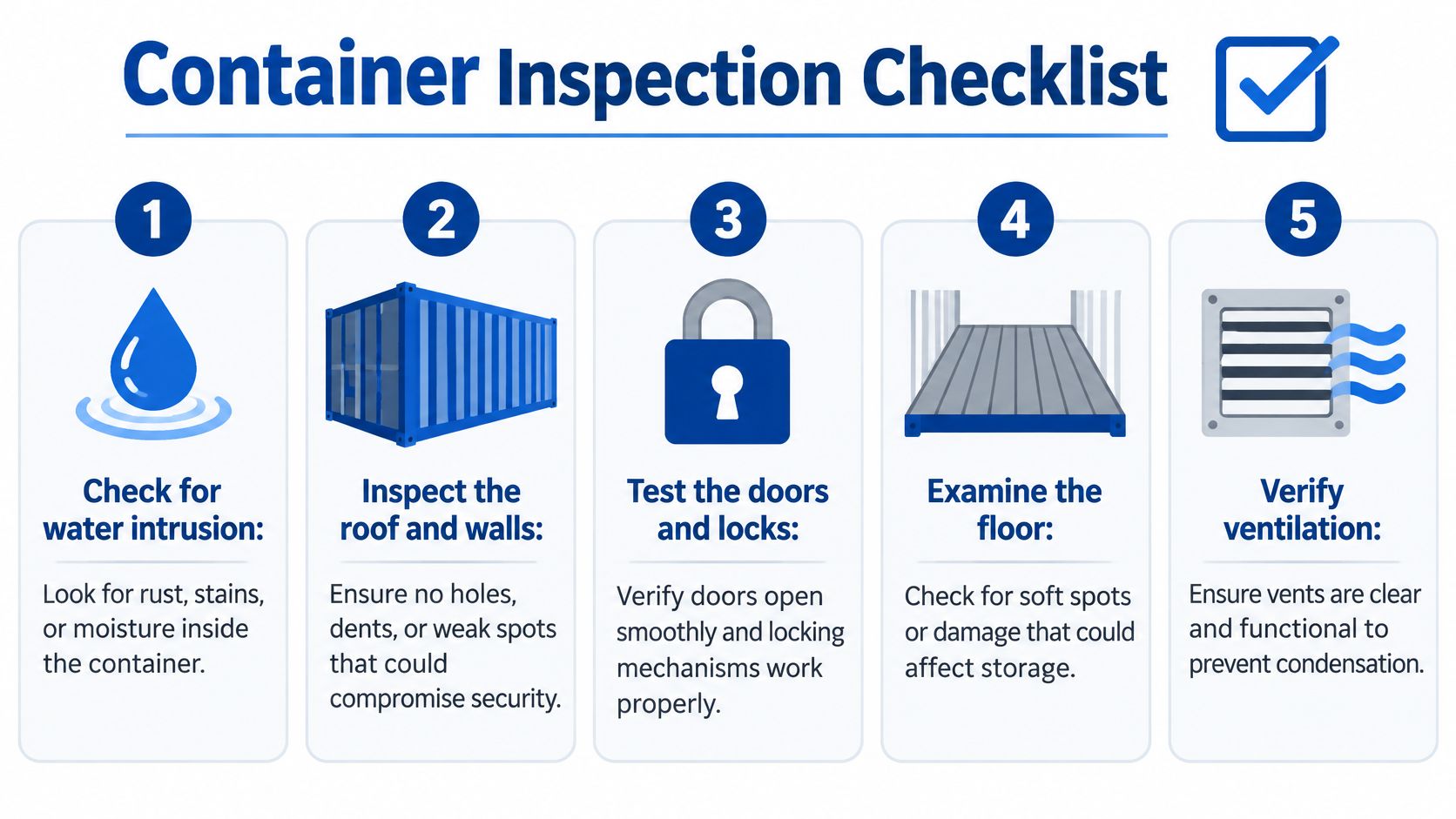
- Photograph everything before the driver leaves. Four sides, the roof, the floor, both door leaves and the identification plate. Dated photos are the only defence you have against a damage claim six months later.
- Check the roof and side rails for deformation. Standing on the roof to look is normal practice; rails that sag or panels that oilcan hold water and will leak at the seam.
- Inspect corner posts and corner fittings for impact damage. These castings carry the whole load during lifting. A cracked or distorted fitting is a handling hazard, not a cosmetic issue.
- Test both doors and the locking bars. They should swing freely, latch without force, and leave the gasket under continuous compression all the way round, with no light visible at the seal.
- Walk the floor. Soft spots, delamination, holes and water staining tell you what the roof has been doing for years.
- Read the identification plate. Maximum gross mass and tare are stamped there, and those markings control over any figure in the brochure.
- Agree the modification rule in writing. Walls, roof and corner fittings don't get drilled, welded or cut without the lessor's written approval, and that includes bolting shelving to a structural member.
The Health and Safety Executive's container guidance sets a usefully conservative benchmark for what counts as damage. Cracks or breaks in structural members, bends or dents exceeding 19 mm, and rusted-out metal are treated as unacceptable, while superficial oxidation and minor dents can pass if they don't impair serviceability or weather-tightness. Apply that standard to a rental and you'll reject the units that leak.
A lessor's reconditioning programme helps but doesn't replace your own check. Pacific Mobile Structures, Inc. delivers rental buildings freshly reconditioned and passing a multi-point inspection, which sets the baseline rather than the finish line.
Write every defect on the delivery paperwork before signing, and keep it specific: "door gasket compressed flat on the right leaf" beats "door issue". The discipline is the same one behind quality checks for Kalamazoo kitchen remodels, where what gets written down is what gets fixed. Condition grades vary widely across fleets, and a guide to container grades is worth reading before you argue about whether a unit should have been rejected at the gate.
Rent or Buy for Your Project Length
Duration decides this, not preference. Below a season, renting keeps capital free and puts the removal problem on someone else. Past a year or so, ownership usually wins, because the money spent on rent buys nothing you can sell.

Picture a contractor storing tools, fasteners and fit-out materials beside a nine-month job. Rental keeps the cash in the business, the unit arrives when the site is ready and leaves before the landscaping goes in. Buying would mean owning a box, insuring it, moving it to the next site and eventually selling it. For nine months, that's three problems for one benefit.
A school district clearing spare desks, records and old AV kit over a summer break sits squarely in rental territory. The work has a hard end date, the delivery has to dodge buses and summer maintenance crews, and the building has to be empty before term starts. A short rental with a fixed pickup date fits that shape better than a purchase that leaves a container parked behind the gym for a decade.
A family storing household goods through a six-week move is the smallest version of the same calculation. Delivery and pickup are the largest share of the bill, damage liability is the main risk, and condition at the door matters more than the rate.
What ownership actually buys
Buying suits long, open-ended storage where the box will sit for years and the owner can handle the maintenance: annual rust inspection and touch-up, roof sealing, lock replacement, and a plan for resale at the end. The comparison isn't the purchase price against one month's rent. It's the full rent-plus-mobilization total for your expected months, plus the cost of moving the container to and from your site, against the purchase price of a used unit and the recovery you can expect when you sell it.
Two costs get forgotten. Moving a container requires a tilt-bed or crane at both ends, and that bill lands twice if the unit travels between sites. Ownership also means the unit is your problem when the ground it sits on is sold, reconfigured or paved.
The decision question: how many months will you actually use the space, and what would it cost to move the container twice? Answer both before comparing a single monthly rate to a purchase price.
Confirm Delivery Terms Before You Order
Everything that goes wrong after delivery goes wrong because a term was assumed rather than written. Get these six items confirmed in the quote or the agreement, in writing, before the unit is scheduled:
- The monthly rate and whether rent is prorated for a partial month at either end.
- The notice period for pickup, because a container you can't get collected is a container you keep paying for.
- Delivery, placement and pickup fees, itemized, including mileage and any crane or tilt-bed surcharge.
- Damage liability, spelled out to the level of a dented panel versus a torn door gasket.
- Insurance and who carries what. Individual consumers renting only a container aren't required by Pacific Mobile Structures, Inc. to maintain property insurance, and that's not the same as cover for the contents, so confirm your own policy extends to a container on site.
- The condition report, signed by both parties at delivery, with your photos attached.
Ask for the notice period rather than guessing it. Pacific Mobile Structures, Inc. prorates rent and asks for two weeks' notice to schedule a pickup, so the end date belongs in your project calendar from day one, not discovered in the final week.
The company sells or rents containers for short-term or long-term storage and delivers them, setting each unit on site to your specifications, which means the delivered quote and the placement plan can be requested together rather than in two conversations.
This week: send the interior measurements of your largest item, two site photos and the access notes, request an itemized delivered price, and sign nothing until the inspection is documented on the paperwork.
Pacific Mobile Structures, Inc. rents and sells storage containers, delivers them and sets them in place to your specifications, and prorates rent with two weeks' notice before a scheduled pickup. Bring the sizing numbers from your largest item, the site photos and the access notes, and ask for the delivered, placed and removed figure rather than the monthly rate on its own. Visit Pacific Mobile Structures, Inc. to get that number for your site.