A construction crew has just received a delivery of lumber, tools, electrical supplies, and finish materials, but the jobsite no longer has a dry, secure place to put them. Leaving everything under tarps creates exposure and disorganization, while sending materials to an off-site warehouse adds travel time and slows the next phase of work. A portable storage container can turn an unused part of the site into a controlled extension of the operation.
That same need appears in schools storing classroom equipment, healthcare facilities protecting records and supplies, government departments managing temporary space, and businesses holding inventory during renovations. The right unit does more than provide capacity. It can help control access, preserve sensitive contents, support movement between locations, and reduce the friction created by repeated handling.
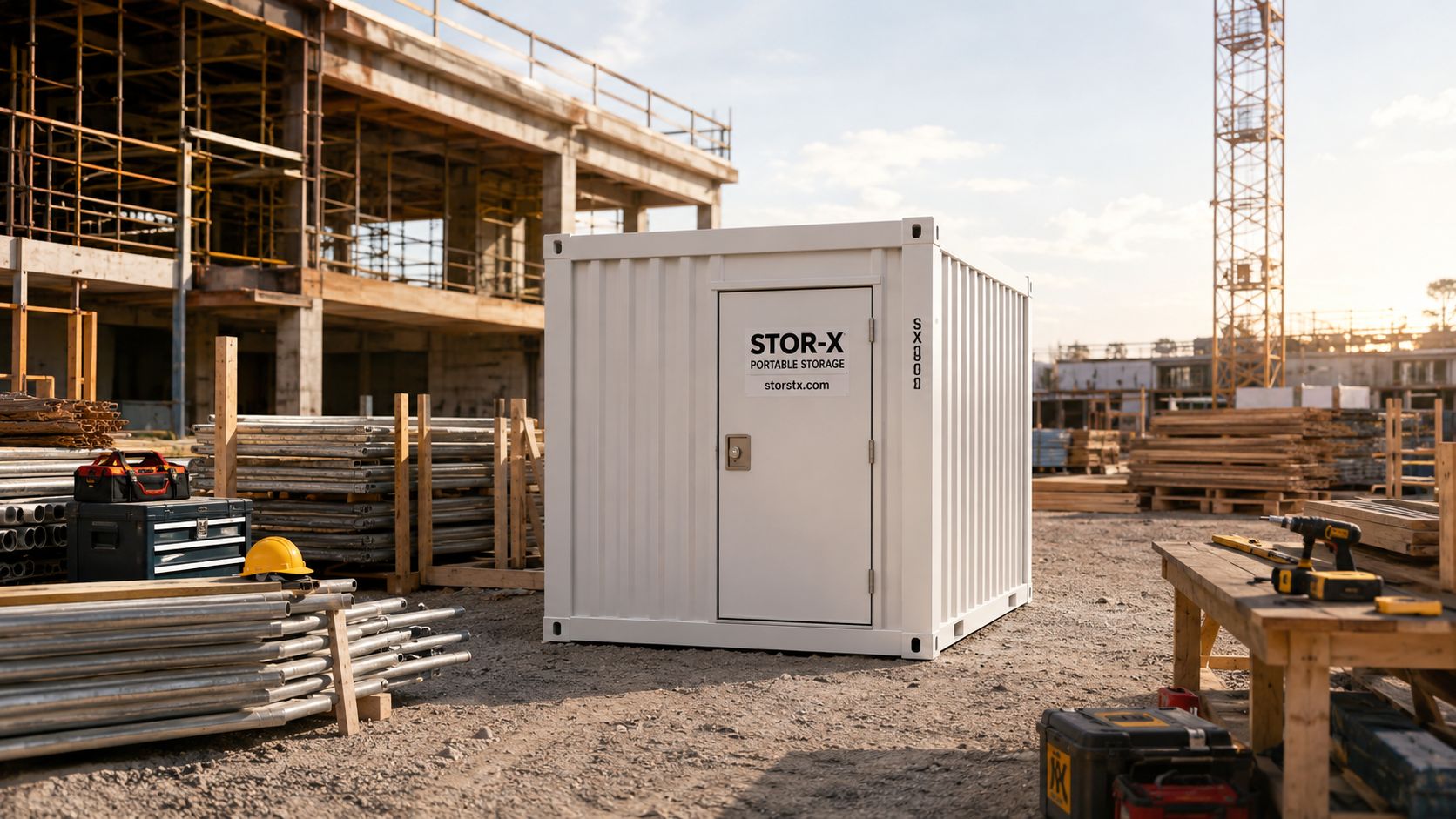
Table of Contents
- Introduction to Portable Storage Containers on Busy Job Sites
- How Portable Storage Containers Work and Why Standardization Matters
- Types of Portable Storage Containers and Their Best Uses
- Security Features That Keep Your Materials and Records Safe
- Transportability Site Prep and Delivery Made Simple
- How to Choose the Right Portable Storage Container for Your Project
- Getting the Most Value From Your Portable Storage Investment
Introduction to Portable Storage Containers on Busy Job Sites
A superintendent who sees materials piling up has more than a space problem. The team also has to consider theft, weather exposure, inventory visibility, worker travel, and the timing of future deliveries. A container placed at ground level keeps supplies close to the people using them, while its steel construction and lockable doors create a more deliberate boundary than an open storage area.
The word “portable” matters because the unit can be delivered, collected, or repositioned as the project changes. It isn't a permanent building, but it also isn't merely a lightweight box that moves whenever convenient. Delivery equipment, access conditions, ground stability, container condition, and the intended contents all affect whether the unit works smoothly.
Site organization also affects security. A container placed behind temporary fencing may be harder for unauthorized visitors to reach, but fencing itself needs thoughtful placement, access control, and visibility. Teams planning the broader work area can use these temporary site fencing tips alongside the container plan.
The problems a container can solve
A portable storage container is useful when an operation needs:
- Near-point-of-use storage: Crews can keep tools, materials, and supplies near the work instead of sending workers to another facility.
- A controlled access point: Managers can decide who holds keys, codes, or smart-lock permissions.
- Flexible capacity: The unit can support a temporary surge without requiring permanent construction.
- A clearer inventory layout: Materials can be arranged by trade, work phase, or delivery sequence.
- A movable operating asset: The container can follow a project or support more than one location over time.
The best choice depends on risk, not just volume. Basic steel storage may suit ordinary construction materials. Sensitive records, medical supplies, and electronics may require stronger access controls or environmental monitoring. This guide builds that decision from the container's standardized design through security, delivery, and total operating cost.
How Portable Storage Containers Work and Why Standardization Matters
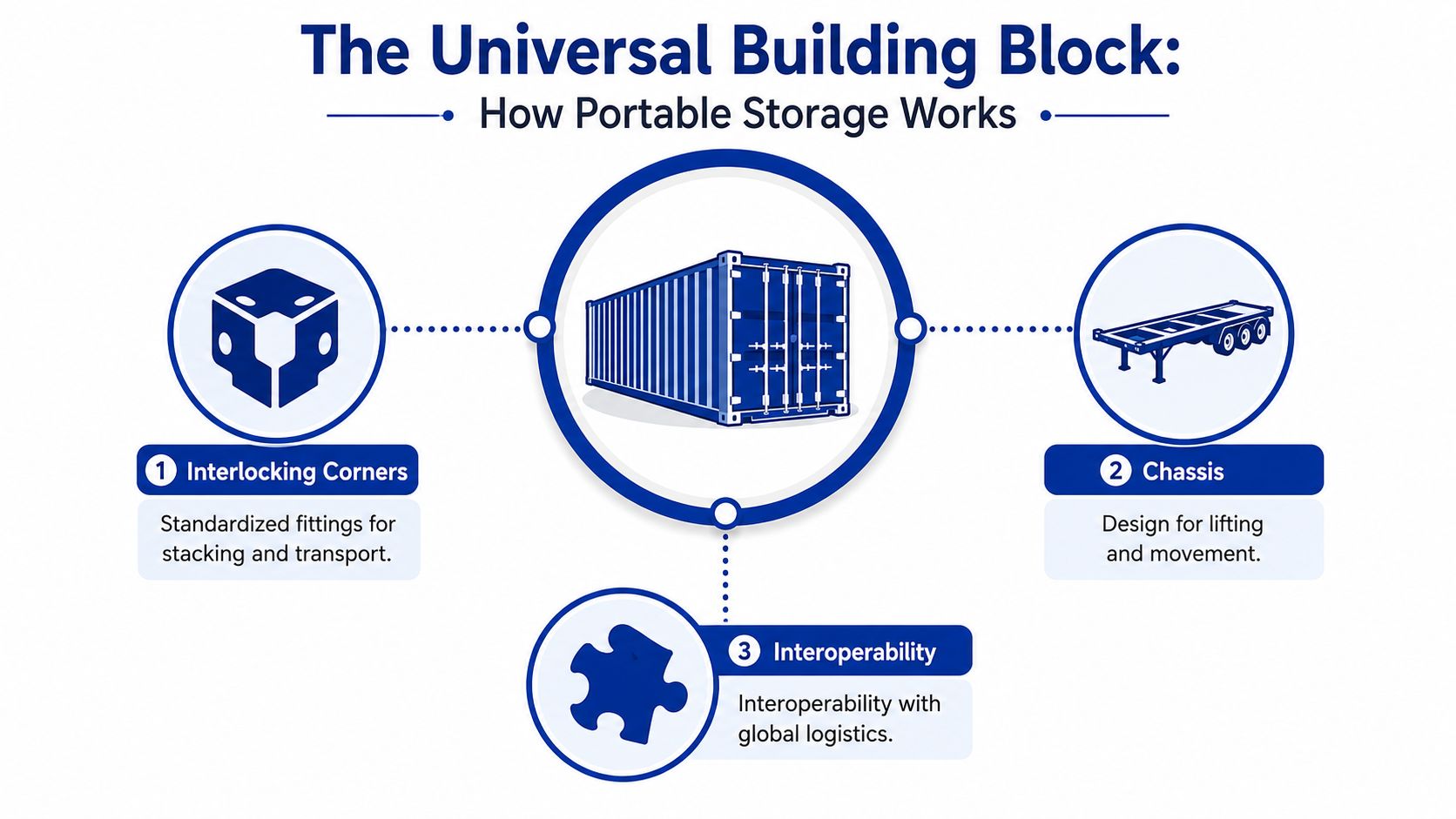
A modern portable storage container works like a universal building block. Its usefulness comes from a combination of strong construction, predictable dimensions, and fittings that let specialized equipment lift and secure it. The concept became commercially significant on April 26, 1956, when the SS Ideal X sailed from Newark to Houston with 58 containers, a voyage widely treated as the beginning of containerized shipping. The Maritime Executive describes that breakthrough and its effect on handling economics.
The fittings do the heavy work
At each corner, corner castings provide standardized connection points. Lifting equipment can engage those castings, and twistlocks can hold units in place during stacking or transfer. The container doesn't need to be unpacked every time it moves from a truck to a railcar or a ship. That reduces rehandling, which helps limit damage and delays.
ISO standardization followed in the 1960s, and 20-foot and 40-foot units became the dominant global sizes. The International Organization for Standardization's freight container classification provides the technical context for the dimensions and equipment interfaces used in intermodal transport.
The 20-foot equivalent unit, or TEU, is a baseline measurement. One 20-foot container represents one TEU, while a 40-foot container represents two TEUs. TEU is a planning language used to describe capacity, not a promise about the exact usable interior space of a particular storage unit.
Why the history still matters to local buyers
Standardization changed more than ocean shipping. A historical account reports manual loading costs of $5.86 per ton in 1956, compared with $0.16 per ton after standard containerization. Those figures, reported by The Maritime Executive's history of the shipping container, illustrate why a standardized unit became an operational asset rather than a simple enclosure.
The same system now supports enormous international movement. One industry source estimates that about 90% of world trade by volume travels by sea, with around 60% of sea-borne cargo carried in large steel containers, and approximately $14 trillion in goods spending time inside containers each year. Container Group explains the ISO 668 framework and the container's role in global commerce.
For a jobsite, the practical lesson is simple. A container designed around shared lifting and stacking points is easier for providers to move, place, and retrieve than a custom enclosure with no compatible handling system. CSC plating on applicable units also signals that the container meets recognized structural requirements for international carriage, rather than being an improvised steel room.
A short visual explanation can help first-time buyers connect the fittings, handling equipment, and intermodal system:
Types of Portable Storage Containers and Their Best Uses
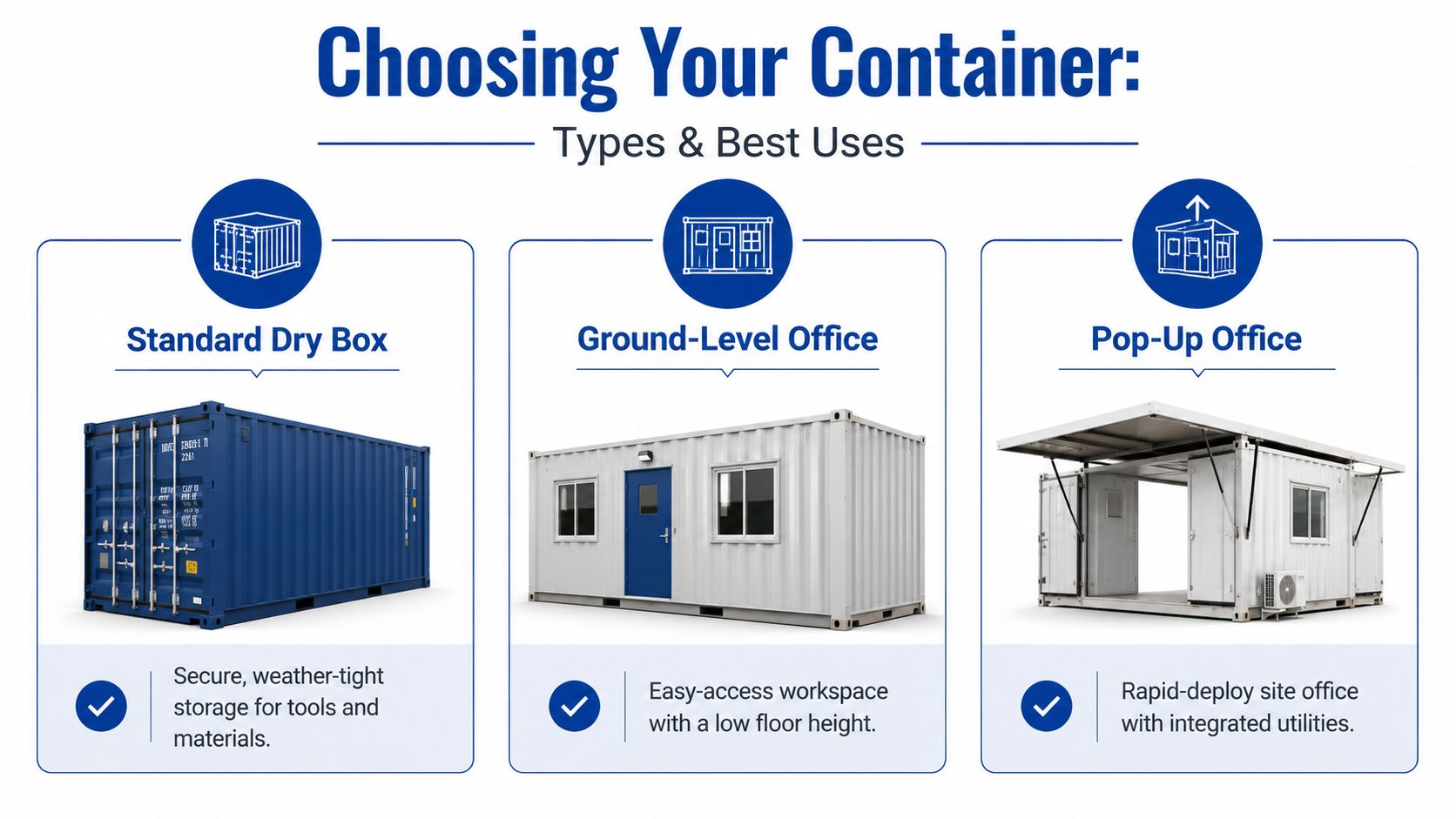
Container selection becomes easier when the unit is matched to the work rather than chosen by floor area alone. A standard dry container, a ground-level office, and a pop-up office may all be portable, but they serve different operating patterns.
Standard dry storage
The standard dry container is the straightforward choice for tools, building materials, equipment, boxed inventory, and supplies that don't need a finished workspace. It offers a weather-resistant steel shell, ground-level access, and a compact footprint that can be organized with shelving, pallets, bins, or tool cabinets.
Construction teams often use this type for materials assigned to a specific phase. A school may use one for furniture during a renovation. A commercial site may hold seasonal inventory close to the point of sale. The key limitation is environmental control. A sealed steel interior can still experience condensation as temperatures change, so contents that are sensitive to humidity may require ventilation, desiccants, or a climate-monitored design.
Ground-level office containers
A ground-level office container is designed for easier entry and regular human use. It may include doors, windows, insulation, electrical service, lighting, or heating and cooling, depending on the configuration. The low floor height reduces the barrier between the site surface and the workspace, which helps when staff need to enter frequently during the day.
This format suits a construction supervisor, facilities team, school administration group, or field coordinator who needs both proximity and a more usable interior than a bare storage box. It can also support document review and planning without requiring workers to leave the site.
Office and storage combinations
An office and storage combination unit separates working space from equipment or supply space. That separation matters when a project needs a secure place for tools but also needs a clean area for meetings, records, or daily administration.
A pop-up office can be useful when speed and integrated utilities matter more than maximum storage volume. Modified or specialty units may add insulation, power, HVAC, shelving, ramps, or other features. Those additions improve function, but they also introduce more components to inspect and maintain. Buyers comparing conditions, grades, and modifications can use this guide to container grades before committing to a unit.
Security Features That Keep Your Materials and Records Safe
Security should be specified according to the consequence of loss. A container holding common building materials doesn't face the same exposure as one holding controlled records, medical supplies, sensitive electronics, or high-value tools. The question isn't whether a unit has a lock. The question is whether its physical and digital controls match the asset inside.
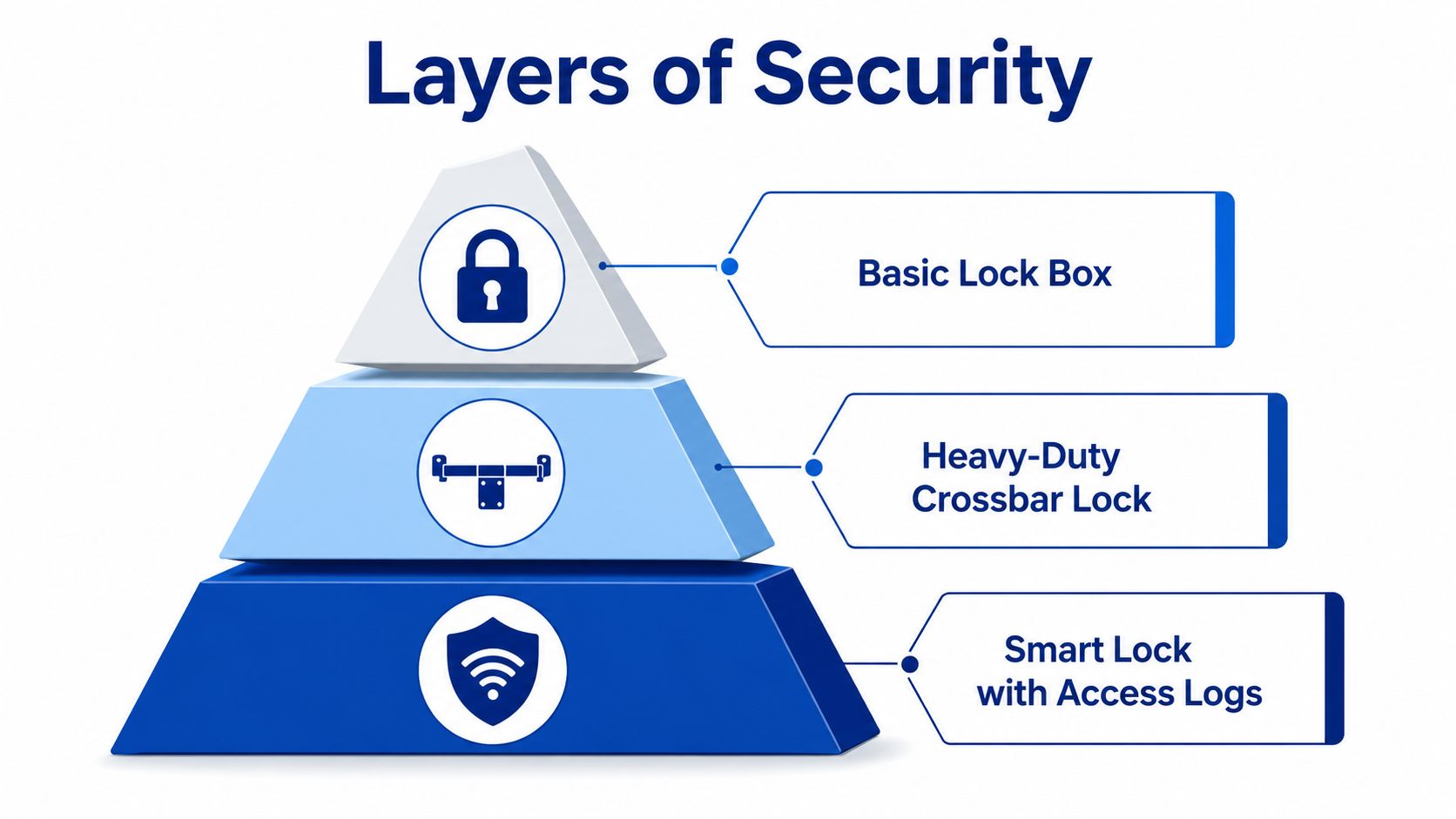
Three practical security levels
A basic lock box shields a padlock from direct access by covering the shackle and making cutting or prying more difficult. This may be sufficient for lower-risk materials when the unit also sits in a visible, well-lit area with controlled site entry.
A heavy-duty crossbar lock adds another layer by reinforcing the doors and securing them across the opening. It can make forced entry more time-consuming and can complement a protected padlock.
A smart lock with access logs changes the management model. Instead of relying only on a shared key, an organization can assign permissions, remove access when a worker changes roles, and review entry activity. IoT-enabled containers may also support monitoring and alerts, depending on the provider and configuration.
The security and container add-ons guide can help buyers compare physical protection and accessory options without treating every project as a high-security deployment.
Sensitive information needs controlled storage
Government guidance treats portable data-storage devices as a physical security issue, not only an information-technology issue. Protected A or B information may require a locked device or an appropriate security container, while Protected C or classified information requires an approved security container, as described in Canadian government guidance for portable data.
That principle applies broadly. A records manager should ask who can enter, how access is revoked, whether activity is logged, and how the container is positioned relative to public areas. A healthcare team should also consider chain of custody, environmental stability, and the consequences of an unrecorded opening.
Practical rule: Choose the security layer by the cost and sensitivity of the contents, not by the container's appearance.
Placement still matters. Lighting, visibility, fencing, cameras, alarms, and a clear inventory process can reinforce the hardware. No lock eliminates every risk, but layered controls can reduce casual access and make unauthorized entry easier to detect.
Transportability Site Prep and Delivery Made Simple
Delivery succeeds when the site is prepared before the truck arrives. The provider needs a clear route, a suitable placement surface, and enough room to use the chosen handling method. Standardized lifting points make the container movable, but they don't remove the physical constraints of a real property.
Start with the route
The site manager should walk the entire path from the public road to the intended location. The review should identify:
- Access width and turning space: Check gates, corners, retaining walls, parked vehicles, and neighboring structures.
- Overhead hazards: Look for branches, roof overhangs, and power lines that could interfere with the truck or lifted unit.
- Ground strength: Soft soil can rut under heavy equipment, especially after rain. Firm ground, gravel, or concrete is generally easier to work with.
- Placement level: Doors operate more reliably when the container rests on a stable, reasonably level surface.
- Underground services: Confirm the location of utility lines, pipes, septic systems, and other buried infrastructure before placement.
A 20-foot unit may fit a route that can't accommodate a 40-foot unit. A high-cube configuration requires the same footprint as a comparable standard unit, but its added height makes overhead review more important.
Choose the delivery method early
A tilt-bed or roll-off truck is often suitable when the site provides a clear approach and a straight placement path. A side-loader can work when the truck can reach the side of the intended position. A crane may be necessary when the unit must pass over an obstruction or land in a confined area, but that adds coordination around crane positioning, ground stability, and overhead clearance.
The container should be placed with future access in mind. A door facing a fence, parked equipment, or a building wall may turn a usable unit into a daily bottleneck. The placement plan should also account for loading paths, emergency access, drainage, and any required steps or ramps.
Confirm the commercial details
Permits, zoning rules, property restrictions, rental minimums, pickup notice, relocation terms, and failed-delivery charges can all affect the final cost. Requirements vary by municipality and site type, so the project team should check with the property owner and local authority rather than assuming a temporary placement is exempt.
Providers offering storage containers for rent may also explain delivery methods, available sizes, and site requirements before scheduling. A written site review is preferable to discovering a clearance problem when the truck is already waiting.
How to Choose the Right Portable Storage Container for Your Project
The right portable storage container balances duration, risk, access, environment, and movement. A low monthly price can lose its advantage if the unit has to be relocated repeatedly, if retrieval is slow, or if unprotected contents suffer damage. Conversely, a high-specification unit may add unnecessary cost when the contents are ordinary and the project is short.
Start with the operating question: what will be stored, who will access it, and how costly would a failure be? Then consider how often the unit will move and whether the site can support delivery without special handling.
A risk-based comparison
| Container Tier | Best For | Key Features | Cost Tradeoff |
|---|---|---|---|
| Basic steel | General tools, materials, and low-sensitivity inventory | Weather-resistant shell, standard doors, basic lockable access | Usually the simplest upfront option, but it may require separate security or moisture controls |
| Secured | Valuable tools, controlled records, and higher-theft-risk contents | Lock box, crossbar protection, stronger access procedures, possible alarms | Adds hardware and management cost, which can be justified when loss or unauthorized access would disrupt operations |
| Smart climate-monitored | Medical supplies, sensitive electronics, regulated records, and environmentally vulnerable assets | Smart locks, entry records, temperature or humidity monitoring, climate control where specified | Higher ongoing cost, but monitoring can support chain of custody and help identify environmental problems before damage occurs |
Calculate total cost instead of rent alone
Pricing varies with move distance, rental duration, and availability. Consumer guidance from U-Haul's portable storage explanation notes that local portable-container moves can range from about $100 to $500, while long-distance moves can reach roughly $1,000 to $12,000. Those figures are market guidance from that source, not a universal quote.
A project estimate should also include:
- Site work: Gravel, leveling, ramps, steps, fencing changes, or utility connections.
- Movement: Initial delivery, retrieval, inter-site transfers, and possible crane handling.
- Reconfiguration: Shelving, partitions, office finishes, climate systems, and smart access hardware.
- Delay exposure: The operational cost of waiting for a swap, pickup, or replacement unit.
- Content risk: Spoilage, moisture damage, theft, record loss, or equipment downtime.
A long-term user should compare rental, purchase, and lease structures. A multi-site organization may also investigate cooperative purchasing to simplify procurement, especially when several departments need related units. The decision isn't “rent or buy” in isolation. It's how the container will integrate with the operation throughout its useful period.
Getting the Most Value From Your Portable Storage Investment
A portable storage container delivers value when it reduces work around storage, not merely when it holds more items. The team should label zones, keep frequently used materials near the doors, maintain a simple inventory, and reserve climate-sensitive contents for units designed to control the environment. A placement review after the first delivery can reveal access problems before they become routine delays.
The operational model should also match the project's risk. Basic steel works for ordinary materials. Stronger physical controls suit valuable tools and controlled records. Smart locks, environmental sensors, and climate management become more defensible when the organization needs auditability, chain of custody, or early warning of conditions that could damage contents.
Before ordering, the responsible manager should document the contents, access list, delivery route, placement surface, expected moves, retrieval timing, and required features. That short specification gives providers enough information to recommend a unit based on the actual operation rather than a generic size.
Pacific Mobile Structures, Inc. offers storage containers for rent and purchase, ground-level office containers, accessories, and turnkey delivery and setup for organizations that need on-site storage or temporary space. Its services can include inspected units, security options, site coordination, and solutions for sectors such as education, healthcare, government, construction, and commercial operations.
Pacific Mobile Structures, Inc. can help match a portable storage container with the project's access, security, site, and environmental requirements, then coordinate delivery and setup. Visit Pacific Mobile Structures, Inc. to review storage containers, office-container options, and modular support for the next project.