What makes a storage container accessory suitable: the fact that it fits through the door, or the way it transfers weight and force into the container? A shelf can fit neatly yet overload its attachment points. A ramp can reach the threshold yet be unsuitable for the equipment crossing it.
Choosing storage container accessories starts with the contents, the container and the site, not a catalogue of extras. Each accessory needs a compatible connection, a suitable capacity and a clear inspection routine.
Table of Contents
- Storage Container Accessories at a Glance
- Check Your Container and Site First
- Locks, Hasps and Security Hardware
- Shelving, Racking and Interior Load Control
- Ramps, Steps and Access Accessories
- Ventilation and Moisture Control Packages
- Lifting, Stacking and Tie-Down Hardware
- Confirm Your Accessory Package Before You Order
Storage Container Accessories at a Glance
Common storage container accessories by function
| Accessory | What It Does | Typical Use | Check Before Buying |
|---|---|---|---|
| Hasp and padlock kit | Secures the container door | Short-term job-site storage | Hasp fits door thickness and lock is rated for outdoor use |
| Lockbar or lockbox | Adds a second barrier against forced entry | Tools and high-value equipment | Hardware fixings and door alignment |
| Shelving and racking | Keeps stock off the floor and limits shifting | Parts, supplies, records | Rated load per shelf and floor or wall anchoring |
| Blocking and load bars | Stops cargo sliding during moves | Transport and site relocation | Rated capacity and attachment points |
| Ramps and steps | Provides access for people and equipment | Office, classroom or clinic entry | Slope, width, surface and landing |
| Awnings | Provides shade and weather cover at the door | Office and entrance areas | Wind load and mounting method |
| Roof vents and louvers | Allows passive air exchange | Ordinary dry goods | Placement and sealing against humid air |
| Desiccant or dehumidifier | Reduces moisture in the container | Moisture-sensitive goods | Sizing for container volume and humidity load |
| Corner protectors | Guards vulnerable edges and corner areas | Frequent handling and stacking | Fit to corner geometry without obstructing connections |
| Tie-downs and chains | Secures the load during transport | Road moves and hook-lift handling | Working-load limit and compatible end fittings |
| Lifting hooks and spreaders | Lifts the container | Crane or lifting-equipment handling | Rating for container length, mass and lifting configuration |
| Twistlocks and stacking fittings | Secures containers in a stack | Multi-high storage | Compatibility with ISO corner fittings |
These families address different jobs: security controls entry, interior hardware restrains contents, access equipment supports movement, climate accessories manage the storage environment, and handling hardware connects the container to lifting or securing systems. An accessory is a load-path and compatibility decision, not an extra feature.
The distinction matters because a product can look substantial without being suitable for its intended connection. A heavy chain with an incompatible hook isn't a complete restraint system. Likewise, a strong shelf doesn't establish that the container surface supporting it can carry the shelf's loaded weight.
Read compatibility before appearance
The International Organization for Standardization's container history explains how standardized dimensions, corner fittings and securing interfaces underpin interoperable container equipment. That interoperability applies to defined interfaces, not to every accessory advertised for a shipping container.
Accessories aren't automatically interchangeable across container lengths, modifications or connection geometries. A component engaging a standard corner casting presents a different selection problem from a bracket attached to an interior structural member.
Manufacturer documentation should identify:
- Capacity: The load permitted under the stated operating conditions.
- Connection: The fitting, bracket, fastener or anchor arrangement required.
- Configuration: The orientation and installation method covered by the rating.
- Limitations: Restrictions on movement, exposure, loading or modification.
A marketing description such as heavy-duty doesn't replace those details. The table works best as a shortlist: identify the function needed, then evaluate the corresponding accessory against its actual operating conditions.
Check Your Container and Site First
Before ordering hardware, the purchaser needs a clear description of the container and its intended use. Contents, handling method, site, then accessory is the useful decision order.
The ISO corner-fitting standard defines dimensional, functional and strength requirements for those connections. The practical implication is that apparent fit isn't enough to establish suitability for a loaded connection.
Establish the starting conditions
- Confirm length and classification. Record the container identification, dimensions and available certification. Length-specific equipment must match the unit, while corner-fitting compatibility needs its own check.
- Identify the load path. Determine where the accessory transfers force. Structural lifting loads belong at approved interfaces; an interior bracket needs an attachment detail suitable for its smaller, local load.
- Assess the site. Note ground bearing conditions, settlement, drainage, snow exposure and humidity. Measure approach space for delivery equipment and the operating route for pallet jacks or forklifts.
- Collect the documents. Request rated capacities, attachment drawings, corrosion-protection details, inspection instructions and service information in writing.
- Check condition. Examine the floor, door frame, seals and accessible structural connections. Worn or damaged components need assessment before an accessory conceals them.
Practical rule: A stronger accessory doesn't make a damaged supporting structure stronger.
A school supply store and a contractor's tool container may need similar shelving but different access, security and moisture-control arrangements. Public access also changes the design problem compared with staff-only retrieval.
Record changes before installation
Photographs and a simple condition record help distinguish existing damage from installation problems. Any proposed drilling, welding or cutting should be checked against the container's intended future use, including whether it will travel again.
Detailed corner-casting inspection and lifting checks belong in the handling procedure, not in an installer's visual guess.
Locks, Hasps and Security Hardware
A lock protects only the connection around it. A substantial padlock on a bent hasp or cracked weld leaves a weak point that replacing the lock won't correct.
Hasp and padlock kits suit straightforward door control. The hasp must close without forcing the door out of alignment, and its fixing arrangement must suit the door construction. The lock body and shackle need outdoor exposure ratings, with corrosion-resistant hardware selected for coastal or persistently damp sites.
Match the barrier to the vulnerable point
A lockbar adds a barrier across the door or locking arrangement, depending on its design. Its usefulness rests on secure mounting and proper engagement, not merely its weight. Loose fixings or excessive clearance can leave room for force.
A lockbox shields the padlock from direct access by cutting or prying tools. It doesn't make the whole container resistant to every form of forced entry, and an unsuitable enclosure can leave insufficient room to operate the key or remove the lock.
For projects comparing secure storage container arrangements, the useful specification describes the complete door assembly rather than the padlock alone.
| Hardware | Main purpose | Failure point to inspect |
|---|---|---|
| Hasp and padlock | Controls ordinary unauthorized access | Bent hasp, exposed fixings or unsuitable lock |
| Lockbar | Adds a door-level obstruction | Loose mounts or incomplete engagement |
| Lockbox | Restricts access to the padlock | Weak attachment or excessive tool clearance |
Make access control manageable
Keyed-alike locks can simplify access within a site, but a lost key can affect every matching lock. A combination lock avoids circulating physical keys, although the code needs changing when access permissions change. A named facilities or site supervisor should control both systems.
Inspect the hinge side, door seals and locking rods as well. A door that needs excessive force to close may indicate alignment or support problems, not a need for a larger lock.
Window guards on container offices are a separate security category from cargo-door hardware. Tamper-resistant window fixings don't replace a suitable storage-door lock.
The acceptance checklist should cover lock rating, hasp fixings, door alignment and inspection responsibility. Include a recurring visual check and an additional check after impact, attempted entry or relocation.
Shelving, Racking and Interior Load Control
A tidy container isn't necessarily a restrained container. Boxes can be neatly arranged while shelves remain unsecured, and a partition can divide stock without being designed to hold it during movement.
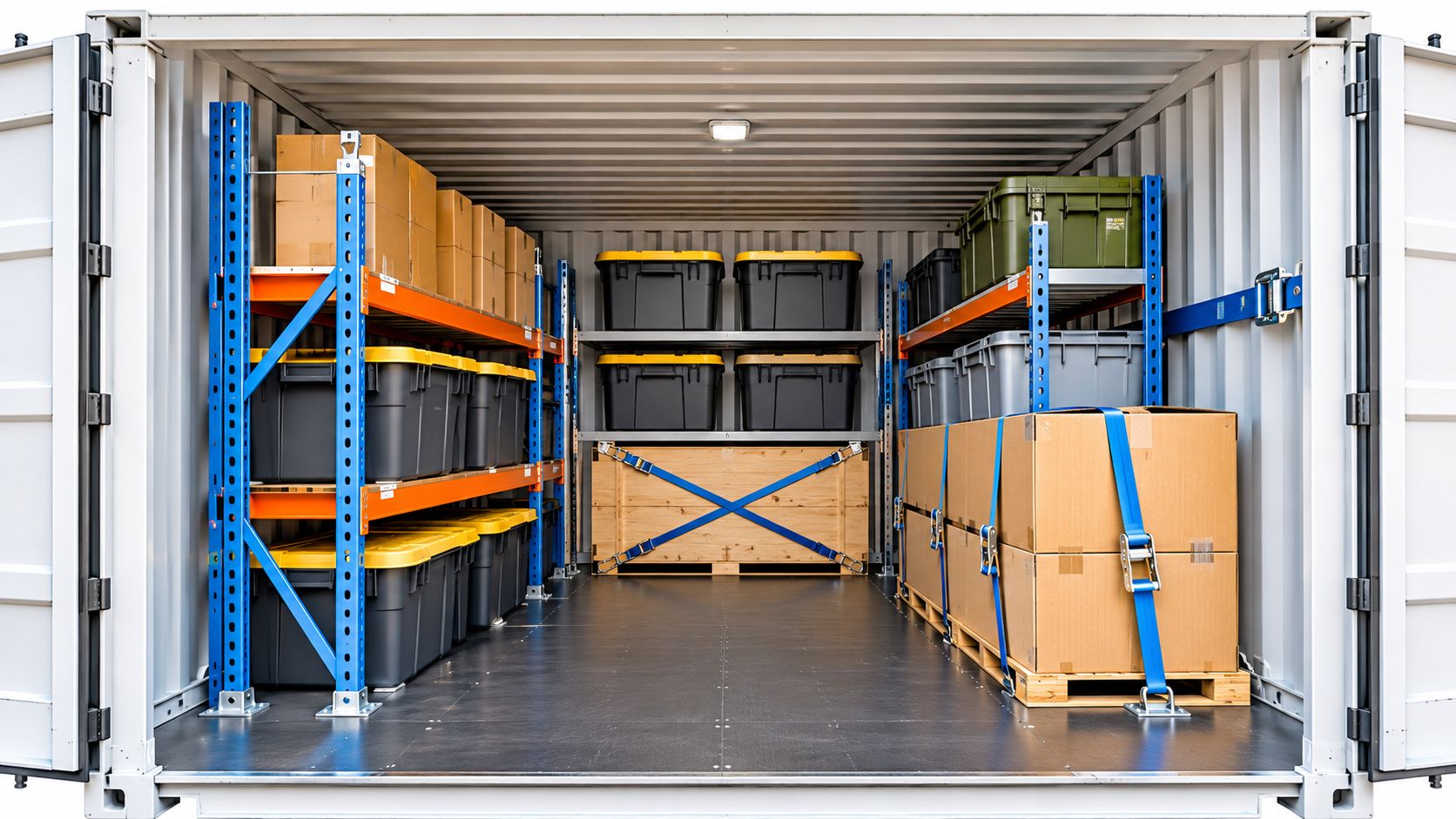
Shelving carries stored weight; restraint equipment controls movement. Some systems perform both jobs, but only when their documentation covers the installation and operating conditions.
Build a layout around retrieval and support
Start with heavy items low and near the container's centre, while checking the floor's permitted loading and how individual feet or supports concentrate weight. A dense machine component resting on narrow rack legs presents a different floor load from cartons spread across a broad shelf.
Place shelving along the rear and sides where practical, then preserve a clear retrieval aisle to the door. Frequently handled supplies should remain accessible without moving unstable stacks or climbing onto shelving.
- Shelf capacity: Check the rating for the installed shelf span and loading pattern, not just the rack frame.
- Anchorage: Use approved floor anchors, structural attachment points or a container-specific bracket system. Thin wall sheet alone isn't a suitable assumption.
- Top storage: Keep bulky or heavy goods below positions that make safe retrieval difficult.
- Partitions: Specify whether they merely separate areas or also resist cargo movement.
Tall shelving that sways during retrieval needs correction before use. Approved bracing, suitable anchors and a lower storage height can address the problem; loading the bottom shelf more heavily isn't a substitute for an engineered attachment.
Separate cargo restraint from container restraint
Load bars, blocking and rated tie-downs can prevent contents from sliding, but they need compatible attachment points. A compression bar used against unsuitable surfaces can slip or damage the container.
The federal securement rule for roll-on/roll-off and hook-lift containers requires forward blocking and front and rear restraint, with rear securing mechanisms positioned no more than 2 m (6 ft 7 in) from the rear. Those requirements concern the container's external securement in that application, not a universal shelving layout.
A partition isn't a cargo barrier unless its design and attachment are rated for that job.
For relocation, the transport plan must address both the container and everything inside it. Shelving suitable for stationary use may need unloading before travel, even when its contents appear secure.
Before each move, inspect shelf connections, anchors, blocking, load bars and restraint fittings. Remove damaged parts from service, and confirm that stored goods cannot obstruct the doors or fall toward the person opening them.
Ramps, Steps and Access Accessories
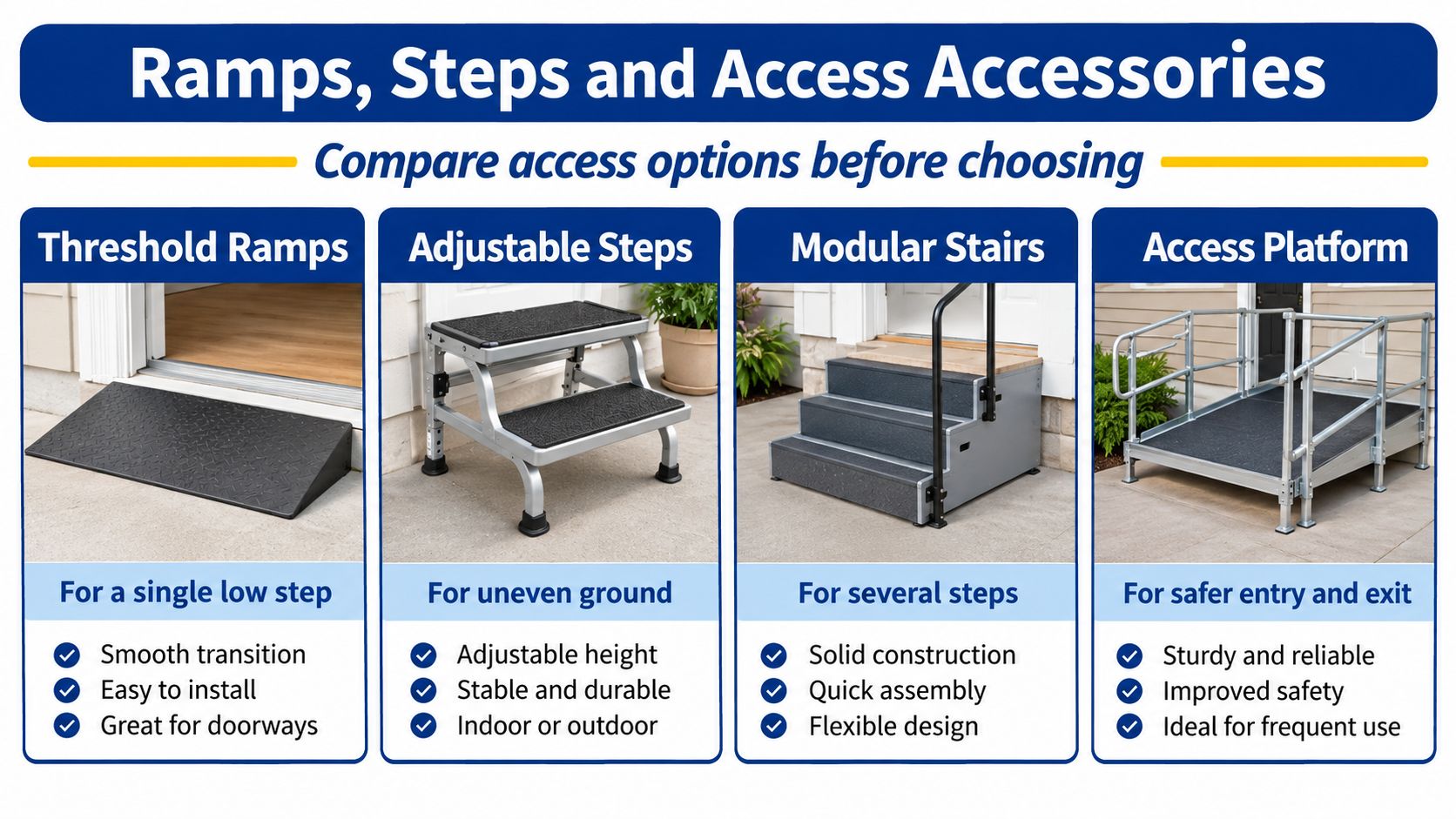
| Option | Best For | Slope or Rise Limit |
|---|---|---|
| Threshold ramp | Single low step; intended pedestrian or wheeled users as rated | Accessible-route slope limit shown below |
| Adjustable steps | Uneven ground; ambulant users | Manufacturer's adjustment range and applicable stair requirements |
| Modular stairs | Several steps; ambulant users | Engineered stair configuration and applicable code |
| Switchback ramp | Longer rise with landings; mobility-aid users | Accessible-route slope limit shown below |
The ADA National Network's temporary-event accessibility guide gives a general accessible-route maximum running slope of 1:12, with continuous, slip-resistant ramp surfaces. Selection must also address landings, transitions, edge protection and the applicable accessibility requirements, rather than treating slope alone as proof of compliance.
Choose for the user and the load
A threshold ramp bridges a low doorway transition. It needs a stable bearing surface and a transition that won't catch small wheels. A product intended for pedestrian access isn't automatically suitable for a loaded pallet jack.
Adjustable steps accommodate an approved range of site elevations. Their feet still need firm support, and adjustment doesn't make steps accessible to wheelchair users.
Modular stairs suit greater height differences where ambulant access is appropriate. Landings, handrails and the installed stair geometry must work together.
A switchback ramp uses changes of direction and landings to accommodate a longer accessible route. It requires enough site area for turning and approach, not enough room beside the container.
An access platform creates space at the doorway, but it doesn't replace the ramp or stair route leading to it. The door swing must also leave a usable standing or manoeuvring area.
Check the whole route
Equipment ramps need documented capacity for the combined equipment and cargo load, including how wheel loads reach the ramp. Surface texture must suit the expected footwear or wheels without creating an awkward threshold transition.
Purchasers evaluating ramps for containers should record the actual installed rise, approach conditions and user types before selecting a system. U.S. ADA guidance doesn't replace local code review, particularly at schools, clinics and public facilities.
- Ground support: Check for soft soil, washout and settlement beneath bearing points.
- Weather exposure: Provide drainage and an inspection plan for mud, snow or ice.
- Attachments: Verify that the ramp cannot shift away from the threshold.
- Inspection log: Record surface wear, loose fixings, handrail defects and grade changes.
Where maintenance also involves portable ladders, Yasu Trading Co. LLC's guide on how to inspect ladders safely offers a separate equipment-check reference. Ladders aren't a substitute for a properly planned container entrance.
Ventilation and Moisture Control Packages
More airflow isn't always better moisture control. Vents can admit humid outside air, and warm, damp air inside a container can condense when surfaces cool.
The correct package depends on the goods' limits, incoming moisture and local climate. A container holding damp construction materials needs a different approach from one holding dry paper records.
Match the package to the cargo
| Cargo or Use | Accessory Package | What to Monitor |
|---|---|---|
| Ordinary tools and building materials | Passive vents where outside conditions suit drying, plus sealed door gaps | Visible condensation and rust on tools |
| Electronics and paper records | Sealed openings, correctly sized desiccant and a designed vapor barrier | Relative humidity at cargo height against the goods' limit |
| Pharmaceuticals and medical supplies | Dehumidifier or active climate control matched to product requirements | Temperature and humidity logs against stated product limits |
| Humid climate with long storage gaps | Roof insulation, vapor barrier and desiccant | Humidity trend and readings that trigger desiccant replacement or added control |
Begin with a clean, dry container and dry cargo wherever practical. Repair leaks and unintended gaps before adding moisture-control equipment. Otherwise, new moisture can enter faster than the selected system removes it.
An HZ CONTAINERS climate guidance report reports approximately 25–30% relative humidity with sealed vents and correctly sized desiccants, while describing climate-controlled units at roughly 55–85°F with controlled humidity. These are reported operating examples, not guaranteed outcomes or suitable storage limits for every product.
Selection check: The product's storage specification sets the target, not the accessory supplier's best reported result.
Monitor the goods' environment
Place a temperature and humidity sensor at representative cargo height, away from direct contact with metal walls and away from the immediate discharge of a dehumidifier. Additional monitoring may be appropriate where partitions or dense packing create different conditions.
Check readings more frequently during commissioning, after loading damp goods and during substantial weather changes. A remote logger is useful when the container remains closed for long periods.
- Sustained high humidity: Check for leaks, wet packaging and exhausted desiccant before increasing capacity.
- Recurring condensation: Review insulation, thermal bridges and incoming moisture.
- Product-limit excursions: Move sensitive goods or introduce active control rather than waiting for visible damage.
Roof insulation can reduce rapid surface-temperature changes. A vapor barrier needs a coherent installation detail so moisture isn't trapped in an unintended location.
A dehumidifier adds power, drainage and maintenance requirements. Where goods need controlled temperature as well as humidity, evaluating a climate-controlled storage container is more appropriate than continuing to add passive accessories.
Lifting, Stacking and Tie-Down Hardware
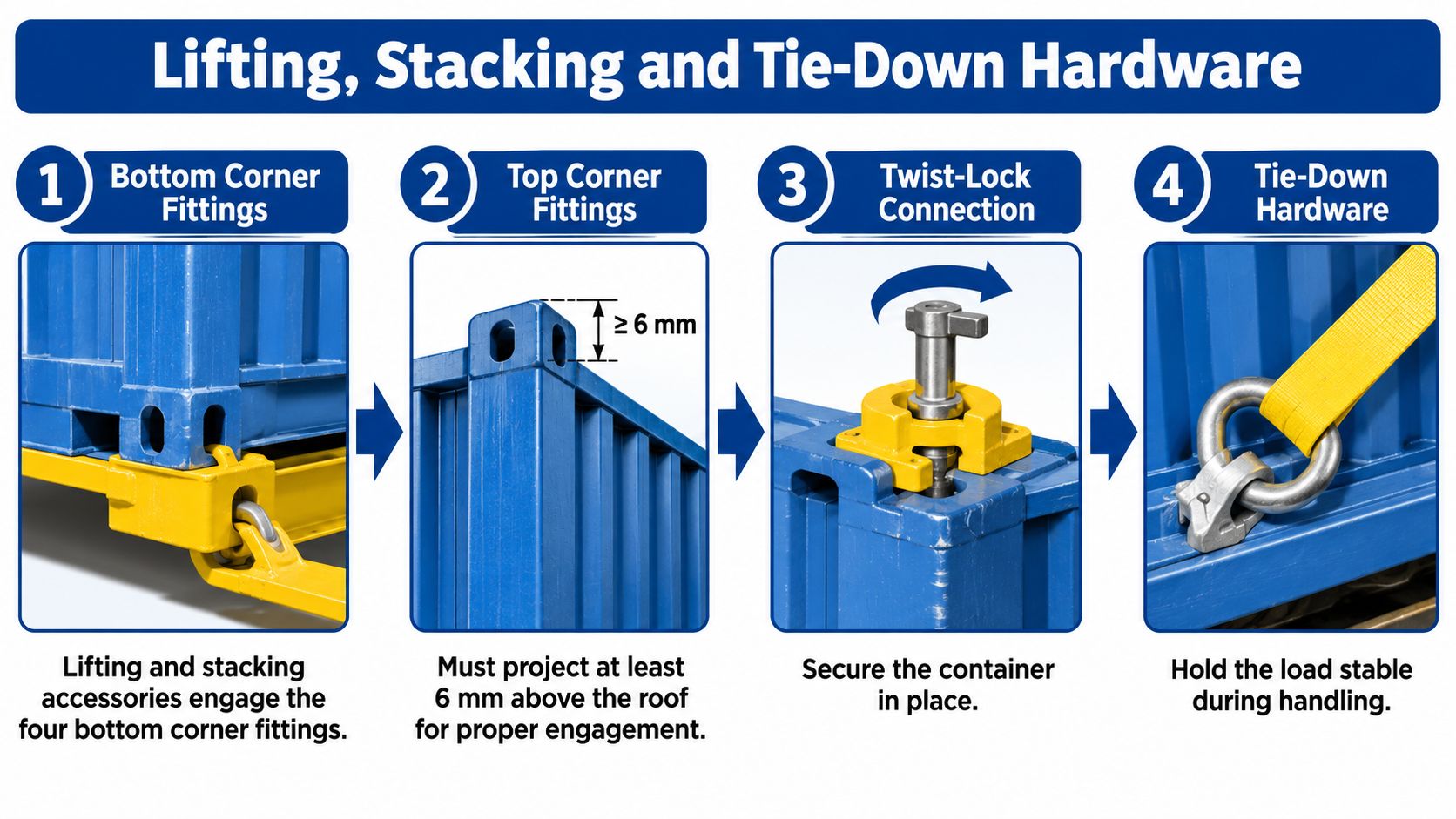
Lifting accessories must engage the container's approved lifting interfaces. Bottom-corner lifting, top lifting and stacking involve different configurations, even though each uses the corner-fitting system.
The BSI listing for the general-purpose container specification and testing standard identifies the framework covering bottom-corner lifting and top corner fittings projecting at least 6 mm above the roof; the accompanying handling requirements summarized for bottom-fitting lifts specify minimum bridle-leg angles of 45° for 20-foot, 37° for 30-foot and 30° for 40-foot containers.
Minimum bridle-leg angle when lifting from bottom fittings
| Container Length | Minimum Bridle-Leg Angle |
|---|---|
| 20-foot | 45° |
| 30-foot | 37° |
| 40-foot | 30° |
These are configuration-specific minimums, not a complete lift plan. The lifting team must establish the correct angle reference, approved arrangement and applicable operating requirements before rigging.
Complete the pre-lift checks
- Confirm certification and mass. Establish the container's permitted capacity and actual loaded mass so the lift doesn't depend on an estimate of contents.
- Inspect corner castings. Look for deformation, cracking and excessive peening, meaning battered or displaced metal around contact areas. Damage can prevent full engagement.
- Verify accessory ratings. Check the working-load limit for the actual lifting configuration, including the spreader, hooks, slings and connecting components.
- Check sling geometry. Confirm that sling lengths and angles match the approved procedure. An altered angle changes the forces in the rigging.
- Use approved lifting points only. Roof panels, sidewalls and improvised welded attachments aren't substitutes for designated interfaces.
- Verify engagement during a controlled initial lift. The competent lifting team should check seating and balance under its procedure, with personnel clear of the suspended load.
A device suitable for a shorter container isn't automatically suitable for a longer one. Adjustable spreaders also need confirmation that their selected position is locked and covered by the equipment rating.
Distinguish lifting from securing
Twistlocks, latchlocks, stacking fittings and lashing rods perform different connection or restraint functions. Similar-looking parts must not be substituted without checking their intended position, direction of loading and locking action.
Stacking also requires suitable support conditions and a verified arrangement. Accessories alone don't establish that the ground, foundations or modified containers can carry the proposed stack.
For palletized contents, Storage & Removal Boxes Ltd.’s Pallet Strapping Rolls & Banding Tools provides a reference for unitizing goods on pallets. Pallet banding isn't container lifting equipment and doesn't replace transport-rated restraints.
Cracked fittings, bent hooks, damaged threads and worn locks belong out of service pending competent assessment. Forcing a damaged connection into place doesn't restore its capacity or establish reliable engagement.
Confirm Your Accessory Package Before You Order
What needs to be specified before an accessory package is ordered? Start with the contents, how they will be handled, site conditions, and the accessories needed for security, storage, access, and moisture control. A complete request helps clarify what is included, what requires installation, and who is responsible for inspection and maintenance.
The quote should separate the container, fitted accessories, delivery, setup, and ongoing inspection responsibilities. That makes a purchase-and-install option easier to compare with a rental and site installation.
Bring a complete order checklist
- Contents: Identify the weight, retrieval needs, security exposure, and moisture sensitivity of stored items.
- Handling: State whether the container will stay in place or move while loaded.
- Site: Provide ground conditions, access measurements, and information about intended users.
- Accessories: List security, interior, access, climate, and handling requirements.
- Documents: Request capacity ratings, installation details, inspection instructions, and maintenance responsibilities.
Pacific Mobile Structures, Inc. offers storage containers for purchase or rent, delivered and set on-site to the customer's specifications. The company can also supply, deliver, and set up custom walls or partitions, accessibility ramps or steps, furniture, and accessories on-site so the space is ready for work on day one.
Specify which accessories should arrive fitted and which need site installation. For rental equipment, identify removable items separately from alterations that require approval. Before accepting the order, list safety-critical components and request their rated capacities and inspection documents. Resolve missing compatibility details before delivery.
Project teams can discuss the container, access arrangements, and supporting accessories as a coordinated package with Pacific Mobile Structures, Inc..