
You're likely staring at a short list of portable classrooms, a tight deadline, and a finance office that wants a number by Friday. That's the wrong moment to shop like it's a furniture sale. A used modular classroom for sale is a secondary asset with moving parts, paperwork, removal risk, and code re-inspection, and the sticker price is usually the least important number on the page.
Table of Contents
- Why the Cheapest Used Modular Classroom Is Rarely the Best Deal
- Physical Inspection Checklist That Actually Predicts Cost
- The Hidden Cost Stack Behind Every Resale
- Used As-Is, Refurbished, or New Modular
- Code Compliance and Re-Inspection at the Destination Site
- Procurement Pathways for Schools and Public Agencies
- Your Next Step on a Used Modular Classroom Purchase
Why the Cheapest Used Modular Classroom Is Rarely the Best Deal
A district calls about a low-priced used modular classroom for sale, and the first instinct is predictable. The building looks usable in photos, the seller sounds eager, and the quote seems easy to defend. Then the details come out. The unit has no clean title, a lien is still attached, the floor tile raises asbestos questions, and the width pushes past the new site's setback limits.
That's how these deals go sideways. A used modular classroom behaves more like a used commercial vehicle than a chair or desk. The headline price only covers the shell. The actual deal includes transport, foundation work, electrical and plumbing tie-ins, local review, and whatever code upgrades the receiving authority requires. In public-sector education settings, modular buildings often cycle through long asset lives because they're acquired, relocated, and redeployed after initial use, which is why paperwork and ownership clarity matter so much in the resale channel (California's relocatable classroom policy history).
Start with ownership, not price
The first question is simple, who owns the unit and who has the legal right to sell it. If the seller can't produce clean title, a release from any lienholder, and a chain of paperwork that matches the unit being offered, the deal isn't cheap, it's broken. The seller should also be able to explain removal authority without vague language.
Practical rule: if the paperwork is fuzzy, the rest of the deal will be, too.
Dealer reputation comes next. A serious seller can point to prior school clients, prove business identity, and show enough operational history to make the transaction feel boring. That boring feeling is good. Missing serial plates, photos taken from one flattering angle, and broad phrases like “as-is where-is” or “buyer to remove” are not signs of a bargain, they're signs the buyer is being asked to assume hidden risk.
Vet the listing like a transaction, not an ad
Photos tell a buyer almost nothing if they're cropped, low-angle, or taken after cosmetic touch-ups. Dimensions should be cross-checked against manufacturer records whenever possible, and a phone call often surfaces more truth than a casual site visit. Sellers who hesitate to discuss access, disconnects, or removal timing usually know those issues will cost money.
The strongest screening filter is blunt. Walk away if any of these show up:
- No proof of title or authority: the seller can't show who owns the unit.
- No serial or manufacturer trace: the listing can't be tied to a specific building.
- No removal clarity: the seller won't state who handles disconnect, transport, and site restoration.
Physical Inspection Checklist That Actually Predicts Cost
A serious inspection isn't about spotting scuffs. It's about finding the defects that turn into invoices. Roof seams, ceiling stains, soft perimeter spots, HVAC age, failed window gaskets, and ADA threshold issues all point to different cost buckets, and some of them are deal-killers.
Read the building like a cost model
Roof problems are the first trap. A patch is one thing, a full re-roof is another, and the difference matters because water intrusion spreads into insulation, wall cavities, and floor systems. Soft spots near the edges usually mean the subfloor has already taken on moisture, which can turn a “light refurb” into a much bigger rebuild. HVAC age matters for the same reason. A unit that technically runs can still fail destination code or drain the budget once it's tied into the new site.
Cosmetic damage is usually manageable. Structural damage is not. A scratched interior panel is annoying, a compromised floor system is expensive, and a unit that can't be made to meet the destination code may be scrap regardless of how clean it looks on arrival. The inspection needs to separate what can be touched up from what changes the whole economics of the deal.
A buyer should insist on tools that turn guesswork into evidence. A moisture meter, an infrared camera, and a plug-load test tell a far better story than a walk-through with a flashlight. If the seller won't allow those checks, the seller is asking the buyer to price risk blind. For teams that want clean field notes during this stage, automated defect logging for haulage is a useful model for how damage and defects should be recorded before the unit moves.
Don't confuse inspection with compliance
Inspection findings and code status are different issues. A building can look decent and still fail on the destination side because the state or local authority wants different electrical, fire, mechanical, plumbing, or accessibility conditions. That's why the receipt of a neat-looking building should never end the conversation.
If the unit survives inspection, document everything before money moves. Use the inspection data to decide whether the unit belongs in the used market, the refurbished market, or the scrap pile. Buyers who want a starting point for inventory types can compare it against the used products inventory page and then test whether the specific unit fits the site and scope.
The Hidden Cost Stack Behind Every Resale

The listed price is only the top layer of the bill. The number comes from five stacked costs, purchase, dismantle, transport, site work, and reinstallation. A buyer who budgets only for the unit itself is almost guaranteed to underfund the project.
Every layer adds friction
Purchase price is the easy part, it's the number on the listing. Dismantle is where labor, crane time, disconnection work, and removal planning begin to show up. Transport adds permits, escorts, and mileage-related expense, and it gets worse fast when the unit is wide, long, or split into multiple sections. Site work is the hidden absorber, because grading, foundation preparation, utility hookups, and access fixes can overwhelm the original savings. Reinstallation closes the loop with crew time, sealing, leveling, and final assembly.
The biggest mistake is treating transport as a small line item. It's not. Double-wide units, narrow roads, tight campuses, and poor crane access all compound the logistics stack. A quote that looks clean from a seller on one side of the state can become a problem once the destination site is measured.
Budget rule: if the move, site work, and reinstallation aren't already priced, the “cheap” classroom isn't priced at all.
There's also a difference between buying inventory and buying a process. A product resale platform can help centralize inventory discovery, but the buyer still has to price the physical move and the code work correctly. That's where bad deals hide, under optimistic assumptions about what happens after the unit is sold.
The safest procurement mindset is simple. Treat the headline price as only one component of total acquisition cost. Then ask what has to happen before the unit can legally and practically open on day one. If that answer isn't clear, the quote should be treated as incomplete, not competitive.
Used As-Is, Refurbished, or New Modular
The right choice comes down to the bottleneck in front of you, cash, time, or compliance. Used as-is gives you the fastest path and the most uncertainty. Refurbished stock sits in the middle, with mechanical and cosmetic work already handled. New modular is the cleanest answer when the site needs current code alignment, warranty confidence, and a longer planning horizon.
Match the purchase to your primary constraint
If the district needs space immediately and can tolerate some repairs, used as-is is the blunt instrument. It gets space on campus faster, but the buyer inherits the most hidden risk. If the schedule is still tight but the campus can't absorb major surprises, refurbished is usually the better compromise. That is the zone where the roof, HVAC, finishes, and basic systems are already brought back into serviceable condition.
New modular is the right choice when predictability matters more than the upfront number. The site gets a building designed and certified for current requirements, which cuts the odds of discovery-driven change orders later. That matters when enrollment growth is steady, grant timing is fixed, or the campus cannot afford another round of disruption.
| Option | Typical Cost per SF | Lead Time | Code Status | Expected Service Life |
|---|---|---|---|---|
| Used As-Is | Lowest upfront | Fastest | Requires destination review and possible upgrades | Shortest, depends on condition |
| Refurbished | Mid-range | Moderate | Usually closer to current expectations | Longer than as-is |
| New Modular | Highest upfront | Longest | Built for current certification | Longest |
A school that already has aging portable stock on campus should not default to the oldest available unit just because the quote looks small. Energy retrofits, code updates, and relocation complexity can erase the illusion of savings. Pacific Mobile Structures, Inc. sells, leases, and custom-builds modular buildings, including education-oriented units, so it is one of the routes buyers may compare alongside other used and new options.
The right question is not “what's cheapest today?” It is “what stays cheapest after the building is usable?”
Code Compliance and Re-Inspection at the Destination Site
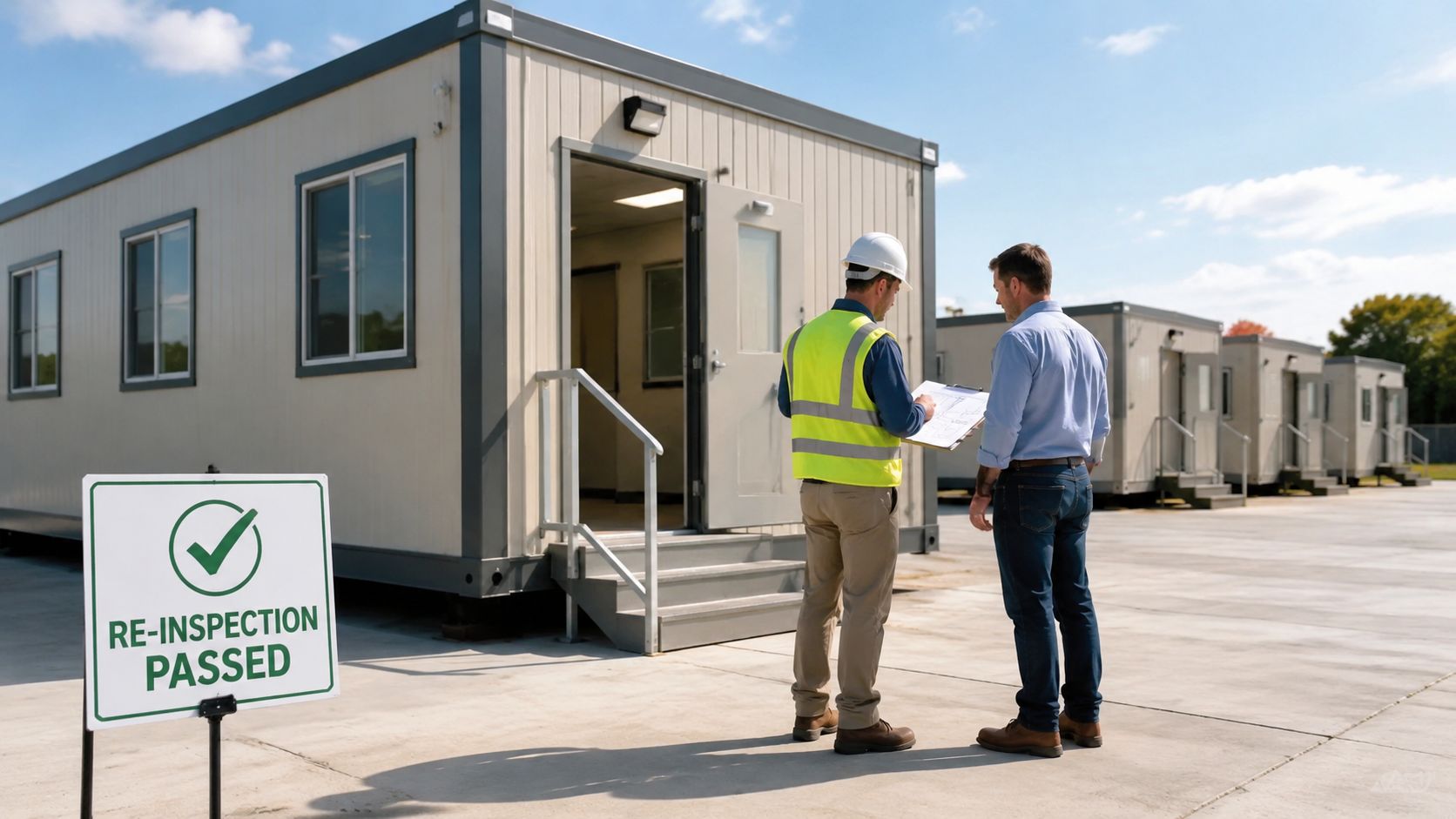
A used classroom that passed inspection somewhere else still has to survive the destination authority's review. That's where a lot of good-looking deals stall. The buyer needs to identify the Authority Having Jurisdiction early, because the state, local building department, fire marshal, and school facilities staff may each have a say.
The destination site controls the outcome
In Michigan, a used modular classroom typically must be inspected before relocation and then re-inspected or accepted at the destination against the applicable building, electrical, mechanical, plumbing, and school fire-safety codes, with inspection allowed at the original site, new site, or repair site under the state rule (Michigan administrative code). That is the right mindset everywhere, even where the exact rule language differs. The unit doesn't just travel physically, it travels into a new compliance environment.
That means plan review comes before movement, not after. Site conditions, accessibility, fire alarm tie-ins, sprinkler requirements, and utility routing all need a review path. A unit that fits one jurisdiction can fail in another because the receiving site changes the code picture. The buyer who waits until after purchase to ask those questions is already behind.
Once the jurisdiction is identified, the rest becomes orderly. Ask who signs off on the building envelope, who handles fire-safety recertification, and whether the destination wants the unit treated as rehabilitation or as a current-code relocation. Those details determine schedule more than the seller's brochure does.
For buyers who want to understand the permitting side before the unit leaves the origin site, this modular permitting guide is a practical place to start. It reinforces the same point: permits are a sequence, not a single approval.
Procurement Pathways for Schools and Public Agencies
Public buyers don't all acquire used modular classrooms the same way. Some need speed, some need governance, and some need the lowest administrative friction. The right channel depends on how standardized the need is and how much control the agency wants over removal and condition.
Cooperative, direct, and surplus each solve different problems
Cooperative purchasing works best when the spec is standard and time is tight. Buyers use an existing contract structure instead of launching a fresh RFP cycle, which can simplify procurement and keep the process moving. Direct sourcing from dealers or school districts works better when the buyer wants to negotiate a package deal, manage removal terms, or buy multiple units with known site conditions. Government surplus auctions can surface low-cost retired inventory, but those deals often come with relocation obligations, first-right-of-refusal language, or limited seller support.
Practical rule: the lower the upfront price, the more carefully the buyer should inspect the disposal conditions.
Public agencies also need to confirm procurement authority. Competitive bidding thresholds, piggybacking permissions, and surplus disposal rules can all affect whether a deal is executable. That's why district counsel or procurement staff should review the path before commitment, not after the winning bid. Buyers who need a comparison of cooperative structures can review how cooperative purchasing contracts work and then confirm whether the contract covers the exact building type and scope.
The strongest procurement habit is to verify ownership, insurance, and warranty terms before a PO or bid award. Sellers sometimes advertise inventory they don't fully control, and that creates delays when the transaction reaches logistics. The buyer should know whether the seller is offering title transfer, removal coordination, or just an address and a promise.
| Pathway | Best For | Typical Lead Time | Key Caveat |
|---|---|---|---|
| Cooperative Contract | Fast, standardized public buys | Short | Scope must match contract terms |
| Direct Dealer or District Sale | Negotiated deals and multi-unit lots | Variable | Buyer often carries more removal risk |
| Government Surplus | Lowest-cost retired inventory | Variable to long | Disposal rules and relocation obligations can be restrictive |
Your Next Step on a Used Modular Classroom Purchase
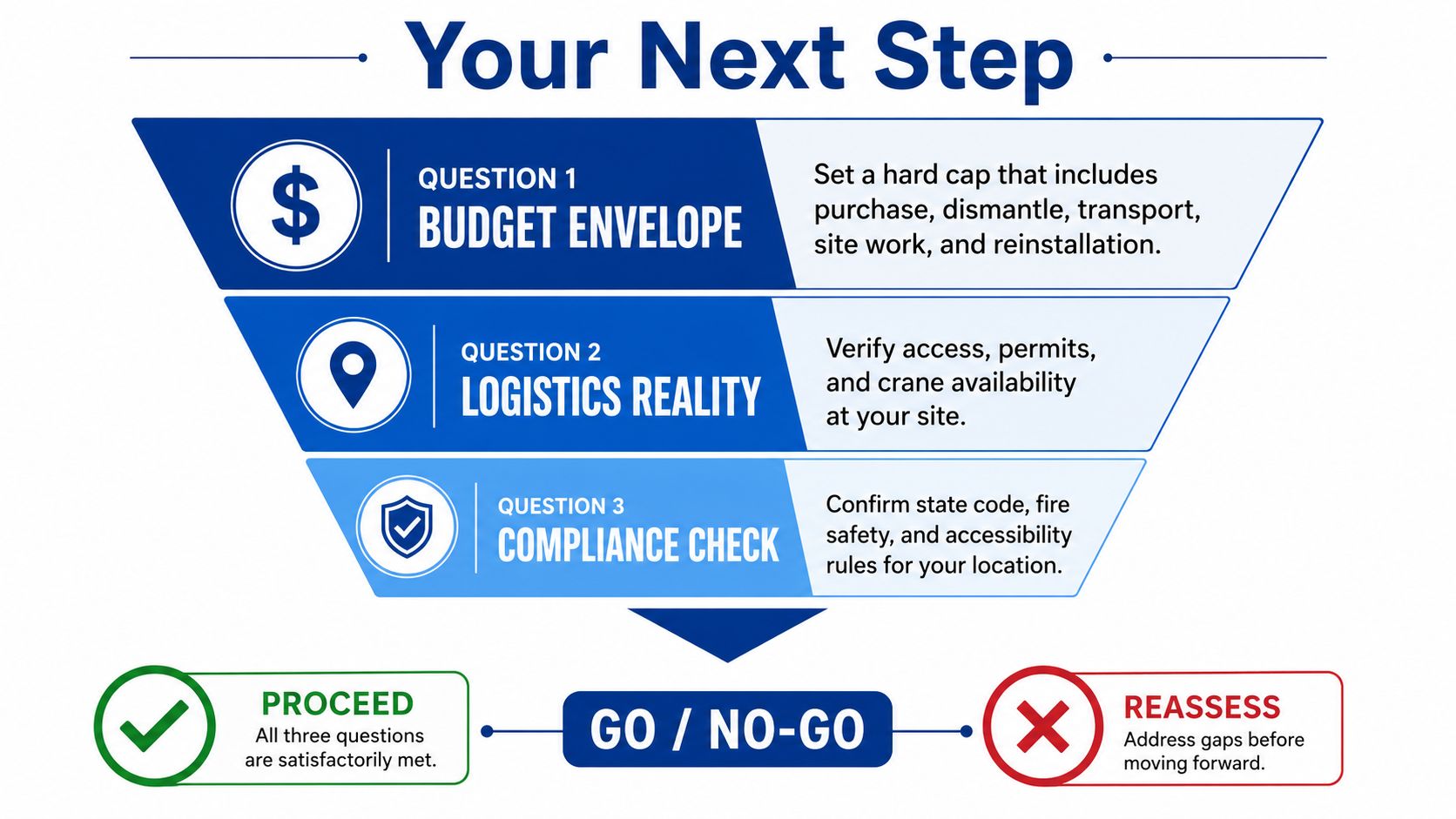
Three questions decide almost every deal. First, what's the hard budget envelope after purchase, dismantle, transport, site work, and reinstallation are all included. Second, how fast does the space have to be usable. Third, what does the destination authority require on code, fire safety, and accessibility.
If the need is urgent and the budget is tight, a cooperative-contract refurbished unit is usually the least painful path. If compliance is strict and the timeline allows a little more planning, factory-refurbished stock gives the buyer a cleaner landing. If the project is long-horizon and enrollment is predictable, new modular construction usually delivers the least drama over the life of the building.
The next move is not to chase more listings. It's to ask for dealer financials, prior project references, a physical walkthrough with the inspection checklist in hand, and a preliminary code opinion from the authority having jurisdiction. Transport scope should be locked before any signature. Paperwork, logistics, and reinspection routinely outweigh the sticker price.
Pacific Mobile Structures, Inc. supplies mobile offices, modular buildings, and education-oriented modular space through sale, lease, and custom-build options. If the next project needs a clear path from inventory to installation, visit Pacific Mobile Structures, Inc. and compare the available modular options against the site, schedule, and compliance requirements.