Modular data center cost is best framed per megawatt of critical IT load, with conventional enterprise and hyperscale construction at approximately $10 million to $12 million per MW and edge facilities at $8 million to $9 million per MW. Headline module quotes usually exclude site work, utility interconnection, and tenant IT, so a “cheap” container can still become an expensive project.
A buyer comparing three vendor proposals often sees three different products disguised as one category. One quote may cover a container with cooling and power equipment, another may include a commissioned facility, and a third may assume the customer will handle foundations, fiber, generators, and utility work. Comparing those totals without normalizing scope is how a project budget becomes unreliable before construction starts.
The practical question isn't just, “What does a modular data center cost?” It's, “Cost for what capacity, under what resilience standard, with which cooling system, at which site, and with which exclusions?”
Table of Contents
- What Modular Data Center Cost Really Covers
- CapEx Versus OpEx in a Modular Build
- Per-Megawatt and Per-Rack Pricing Ranges
- Site Preparation and Utility Hookup Costs
- How Modular Compares to Conventional Construction
- When AI Density Erases the Modular Advantage
- Financing, Leasing, and Phased Capacity Options
- Planning a Realistic Modular Data Center Budget
What Modular Data Center Cost Really Covers
A buyer gets a quote for a “modular data center” and assumes it reflects the project. It often reflects only the box. That gap is where budgets fail.
Square-foot pricing does not help much here. It says nothing about usable critical IT load, electrical redundancy, or whether the cooling system can support the racks you plan to run. A smaller high-density deployment can demand more expensive power and cooling infrastructure than a larger low-density facility.
Per-rack pricing creates the same confusion. One rack may support standard enterprise workloads. Another may carry dense GPU systems with very different electrical distribution, heat rejection, coolant systems, switchgear, monitoring, and service requirements. The footprint may match. The cost basis does not.
Use cost per megawatt of critical IT load as the primary lens. It keeps the discussion tied to usable capacity and the systems that make the site operable, including power distribution, cooling, redundancy, security, and commissioning. Data Center Dynamics cites industry benchmarks on that basis across conventional, edge, and AI-oriented facilities.
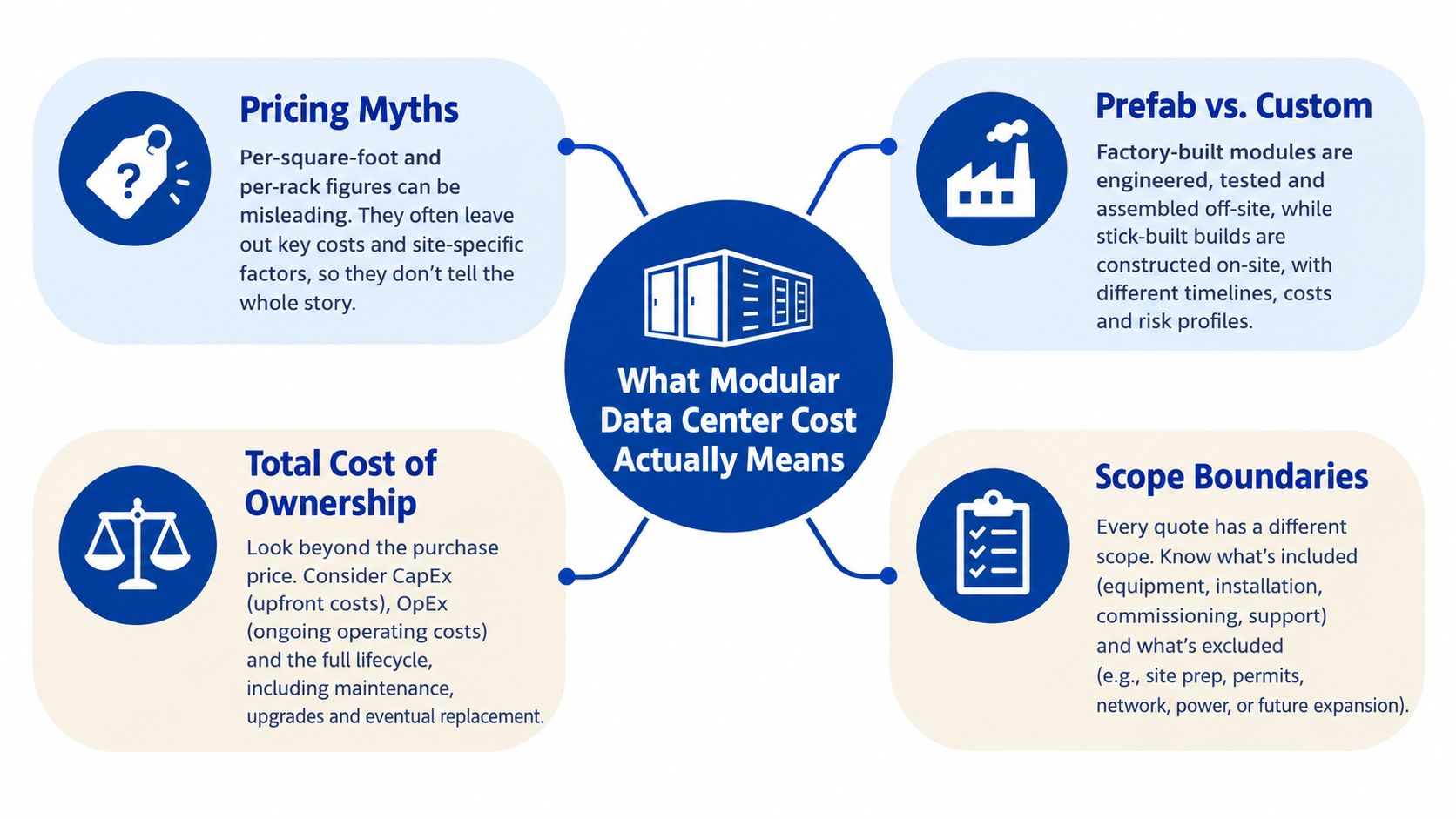
Four cost lenses for every quote
Separate every proposal into four numbers, or do not compare it at all:
- Module price: the factory-built enclosure, integrated power and cooling equipment, controls, and whatever factory integration is included.
- Installed cost: the module plus transport, craning, foundations, site development, utility work, permits, installation, testing, and commissioning.
- Lifecycle cost: installed cost plus energy, cooling operations, maintenance, staffing, equipment refresh, expansion, relocation, and end-of-life work.
- Financing cost: interest, lease charges, carrying costs during construction, and the business effect of bringing capacity online sooner or later.
This separation matters because modular can save money in fabrication time, site disruption, and deployment speed. It does not automatically save money on grid upgrades, foundations, utility interconnection, or high-density cooling. In AI-heavy environments, those downstream requirements can erase the apparent advantage of a low module price.
Ask every vendor for a scope matrix. It should spell out capacity, redundancy, cooling architecture, site assumptions, utility responsibility, commissioning boundaries, and tenant IT exclusions.
Practical rule: A modular quote with no clear MW basis and no exclusions is a component price, not a project budget.
CapEx Versus OpEx in a Modular Build
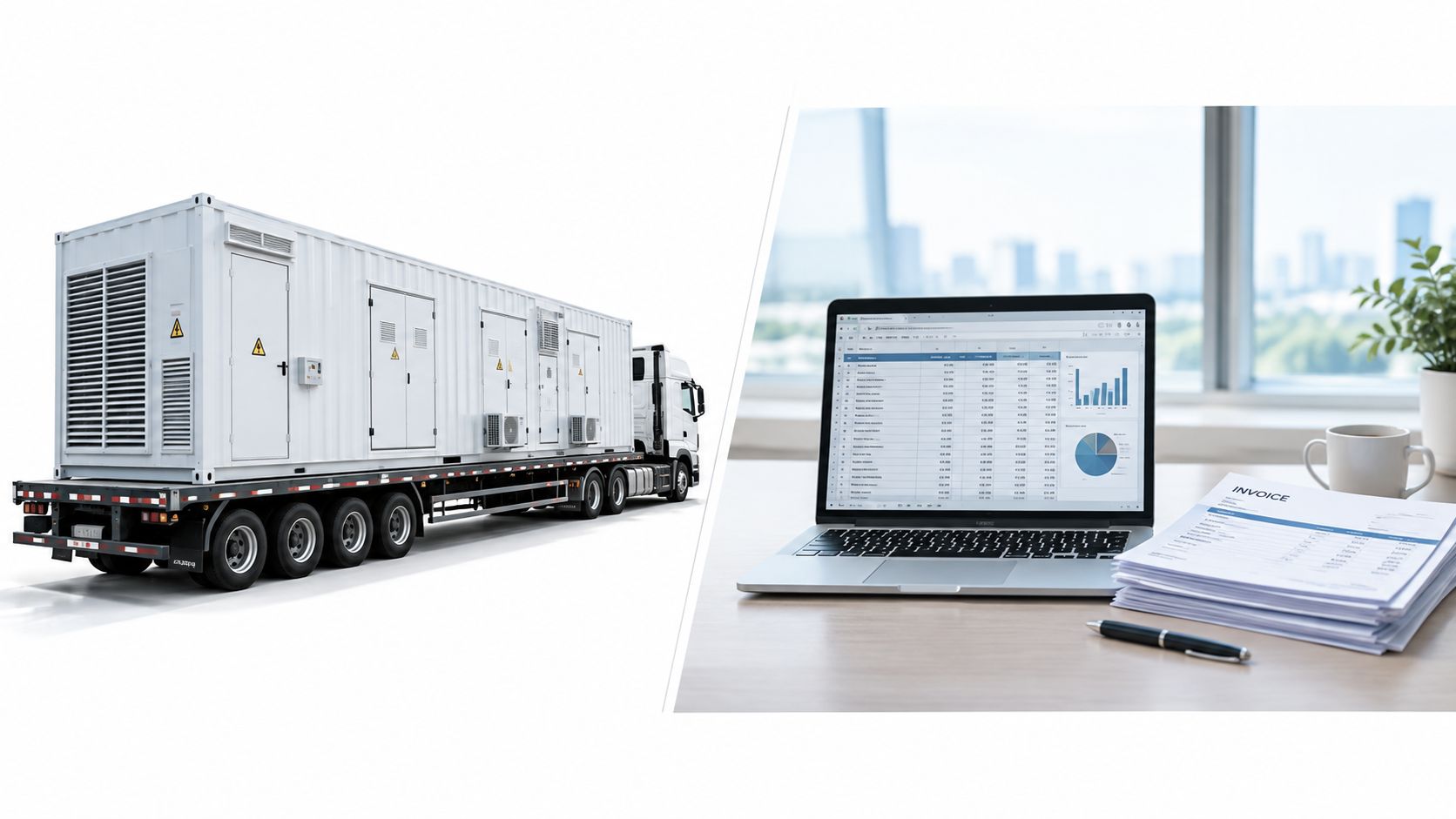
Most cost disputes begin when capital expenditure and operating expenditure are mixed together. CapEx covers the upfront investment, including modules, foundations, site work, electrical infrastructure, cooling equipment, transportation, installation, and commissioning. OpEx covers the recurring cost of running the facility, including electricity, cooling operations, maintenance, staffing, inspections, repairs, and eventual equipment replacement.
Factory fabrication usually moves more labor and integration into CapEx. That can improve predictability because controlled manufacturing reduces some on-site coordination and rework. It doesn't make the expense disappear. The project still pays for engineering, factory testing, delivery, lifting, site connections, and commissioning.
OpEx depends heavily on the selected architecture. A well-integrated containment or liquid-cooling design may reduce operational burden for a suitable workload, while a relocatable unit can preserve future flexibility but create additional transport, redeployment, and asset-management requirements. A permanent modular campus may behave financially much like a conventional facility once it is installed and operated.
Where the accounting changes the decision
A lease can reduce the initial capital requirement, but it replaces that upfront investment with recurring payments and contract obligations. A purchase can provide more control over the asset, but it concentrates capital before the workload generates value. Neither structure is automatically cheaper.
Phased delivery changes the timing of both CapEx and OpEx. Instead of funding an entire forecasted campus, an operator can commission capacity in repeatable blocks as demand becomes firm. That approach is especially relevant when demand is uncertain, when a temporary facility is needed during a replacement project, or when distributed capacity must reach several locations.
Utility tariffs also belong in the OpEx model. The same cooling and electrical design can produce very different operating economics depending on power availability, demand charges, backup-generation requirements, and the site's ability to support the intended load.
A serious business case should therefore show:
- Initial capital: What must be paid before energization?
- Recurring operations: What will power, cooling, maintenance, and staffing require?
- Expansion exposure: What changes when another module or workload arrives?
- Asset flexibility: Can the equipment be relocated, repurposed, or sold?
- Contract structure: Who carries performance, schedule, and utility risks?
A low CapEx proposal can become expensive if it leaves the owner with inefficient operations, difficult maintenance, or an oversized first phase. The right comparison is not the cheapest module. It's the most defensible combination of capital timing, operating performance, and future options.
Per-Megawatt and Per-Rack Pricing Ranges
A modular quote gets buyers in trouble when they treat the module price as the project price. Budget on an installed-capacity basis first, then use rack counts as a secondary check. That is the only way to compare a prefabricated build, a conventional build, and an AI-ready design without hiding major scope gaps.
Current construction benchmarks put conventional enterprise and hyperscale projects around $10 million to $12 million per MW, while edge facilities commonly sit around $8 million to $9 million per MW. A separate U.S. shell-and-core benchmark is about $10.7 million per MW in 2025, with a projected $11.3 million per MW in 2026, according to Data Center Dynamics. Those figures are useful, but only if the scope is aligned. Many buyers compare one vendor's building package to another vendor's installed facility cost and assume the lower number is a saving. It usually is not.
AI pushes the range higher, fast. Facilities designed for liquid cooling, higher-voltage distribution, and very dense GPU racks can exceed $20 million per MW. At that point, the cost driver is not whether the plant is modular. The cost driver is the power and cooling intensity needed to support the workload.
A prefabricated example shows why headline claims need context. A 440-kilowatt Tier III prefabricated design was priced at about $5.39 million, or roughly $12.3 million per MW, and came in about 2% below the traditional alternative in ModuLedge's modular data center cost analysis. That is a good reminder that modular does not guarantee cheaper first cost. It can be close to cost-neutral on capital while still improving delivery speed and allowing phased deployment.
Budgeting ranges by project type
| Tier / Workload | Per-MW range | Typical IT load | Common exclusions |
|---|---|---|---|
| Edge facility | $8 million to $9 million | Distributed or smaller critical loads | Land, utility interconnection, tenant IT, site work |
| Conventional enterprise or hyperscale | $10 million to $12 million | Standard enterprise or large-scale IT capacity | Land, servers, networking, financing, fit-out |
| 440-kW Tier III prefabricated reference | About $12.3 million per MW equivalent | 440 kW | Scope-dependent site and tenant costs |
| Shell-and-core U.S. benchmark | About $10.7 million per MW in 2025, projected at $11.3 million per MW in 2026 | Critical IT load basis | Tenant IT and several external project costs |
| AI-optimized facility | Can exceed $20 million per MW | Dense GPU and liquid-cooled workloads | Land, utility work, GPUs, networking, tenant fit-out |
Per-rack pricing still has a role. Use it to test whether a proposal looks internally consistent. Divide the stated facility cost by planned rack count, then check whether the quote includes the same electrical topology, cooling method, redundancy level, commissioning scope, and IT fit-out as the alternative. If those items differ, cost per rack becomes a sales shortcut, not a budgeting tool.
Scale also distorts simple comparisons. A 100-MW hyperscale facility could require about $1.1 billion to $2.2 billion for construction alone, before tenant IT equipment, based on the ranges above and the higher AI bracket. Treat that as a construction example, not a turnkey price. Land, utility interconnection, financing, servers, GPUs, networking, and tenant fit-out can sit outside the quoted construction number, and those items often decide whether the project is affordable.
Site Preparation and Utility Hookup Costs
A modular quote looks clean on paper. Then the site starts billing you back.
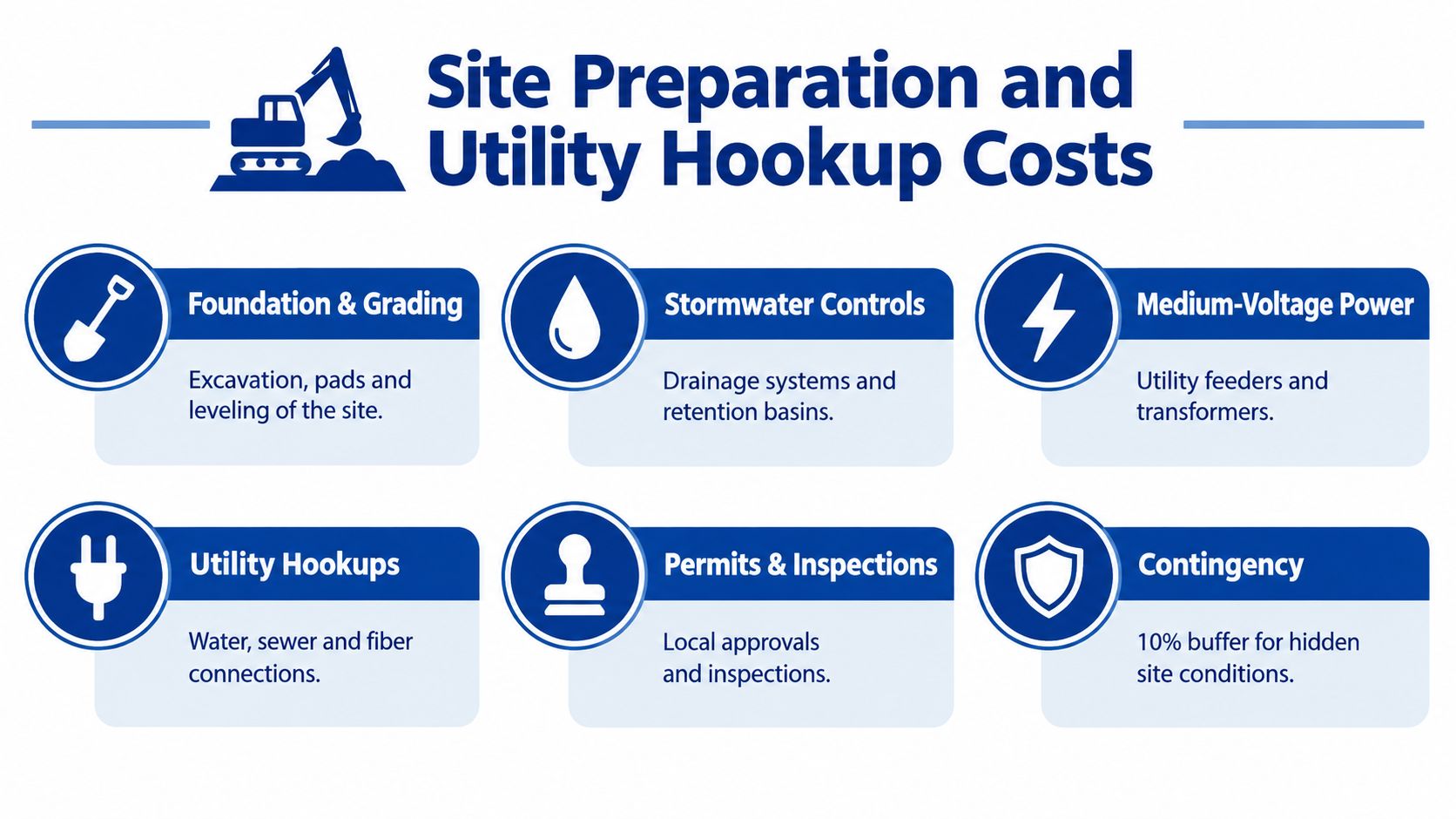
The enclosure may arrive factory-finished, but the project still needs a buildable pad, utility access, drainage, permits, delivery logistics, and full commissioning. This is where buyers get misled by module pricing. The module price is visible. The installed cost sits in the civil, electrical, and utility scope around it.
Expect the outside-the-box scope to include:
- Foundation and grading: Excavation, leveling, engineered pads, retaining work, and load-bearing preparation.
- Stormwater controls: Drainage, retention, erosion controls, and local environmental requirements.
- Medium-voltage service: Utility feeders, transformers, switchgear, protective systems, and metering.
- Redundant feeds and generation: Separate utility paths, generators, fuel systems, synchronization, and testing.
- Fiber and communications: Entrance pathways, carrier coordination, diverse routes, and network-room connections.
- Logistics: Route surveys, permits, escorts, cranes, staging, delivery sequencing, and temporary access.
- Security and noise controls: Fencing, gates, monitoring, acoustic treatment, and site lighting.
- Permits and commissioning: Inspections, integrated systems testing, documentation, training, and handover.
Those items are not side costs. They often decide whether modular saves money. Analysts at Turner & Townsend on AI data-center construction report that factory integration, crating, and specialized power or cooling assemblies can add 20% to 30% per MW to modular projects, depending on design and scope. The same analysis also notes that transmission and substation expansion can take five to ten years where permitting, environmental review, and construction delays apply. If firm power is late, the speed of factory fabrication does not rescue the schedule.
Power can control the entire schedule
A site can be construction-ready and still unusable. That is the budget trap. Buyers focus on when the module can ship, while the actual gate is utility energization, carrier entry, approvals, and integrated testing.
Before signing a letter of intent, get written answers to a short list of questions:
- What utility capacity is available today?
- What interconnection work remains?
- Who pays for feeders, substations, transformers, and studies?
- Is the schedule based on a firm utility date or an assumption?
- Are fiber, water, sewer, and stormwater approvals included?
- Does the price include delivery, lifting, installation, testing, and commissioning?
- Which site conditions trigger a change order?
A site-specific proposal from Pacific Mobile Structures' modular data center solutions team is useful only if those scope boundaries are explicit. Evaluate whether the entire path from factory completion to energized, commissioned IT load has been priced, not just the enclosure.
How Modular Compares to Conventional Construction
You approve a modular build because the factory timeline looks faster, then the installed price lands close to a conventional project. That surprises buyers who treated modular as a cheaper building type instead of a different delivery model.
For like-for-like scope, modular often lands near cost parity on initial capital cost. As noted earlier, one 440-kilowatt Tier III comparison priced the prefabricated option at approximately $5.39 million, or about $12.3 million per MW, with only about 2% lower capital expenditure than the traditional alternative. Read that result correctly. The module price did not create a dramatic savings gap. The value came from how the project was delivered and when capacity could be put into service.
That distinction matters.
Factory production can reduce field labor exposure, weather delays, site coordination friction, and rework. It also lets enclosure fabrication run alongside portions of site development. Those are real advantages. They are strongest when the design is settled early, procurement is disciplined, and the utility path is already credible. If those conditions are missing, modular loses much of its edge and starts behaving like an expensive shortcut that still waits on the same external constraints.
The comparison that matters
| Decision factor | Modular construction | Conventional construction |
|---|---|---|
| Initial CapEx | Can be near cost parity at comparable scope | Can be competitive where site and labor conditions are favorable |
| Schedule | Repeatable factory work can shorten deployment | More work remains exposed to site sequencing |
| Quality control | Factory environment supports standardized inspections | Quality depends more heavily on field coordination |
| Capacity growth | Repeatable blocks support phased additions | Larger initial build may be required |
| Relocation | Relocatable designs preserve optionality | Permanent construction is less portable |
| Dense AI workloads | Specialized cooling can reduce the price advantage | Custom integration may suit complex high-density sites |
| Weak utility site | Manufacturing can proceed, but energization still waits | The same utility constraint remains |
The practical buying question is simple. Are you purchasing lower total installed cost, or are you purchasing schedule, phasing, and deployment control? In many projects, modular wins on the second set of benefits.
Treat modular as a schedule and flexibility purchase when those benefits carry measurable business value. Faster occupancy, phased expansion, temporary capacity avoidance, and relocation options can justify the premium. A permanent, highly customized campus with strong local trades, mature utility service, and intricate cooling integration may still pencil out better as conventional construction.
Budget discipline matters here too. Teams comparing delivery methods should separate equipment and hard construction from design, permitting, legal, inspection, insurance, and financing allowances. A practical guide to how to budget soft construction costs helps structure that comparison so a cheaper-looking module price does not hide a more expensive installed project.
When AI Density Erases the Modular Advantage
You approve a modular build because the module price looks efficient. Then the workload shifts to AI, rack densities spike, liquid cooling enters the design, and the cheap-looking package stops looking cheap. That is the point many buyers miss. Modular can still help on delivery and phasing, but AI density often wipes out the cost edge that looked attractive in the first pass.
The reason is simple. The module is only one line in the budget. The installed facility has to support the heat load, power path, controls, commissioning, and service model required by dense AI.
Facilities have moved from roughly 3 to 4 kW per rack to 100 to 120 kW per rack, and the electrical and cooling upgrades tied to that shift can raise capital expenditure by about 20% to 40%, according to Turner & Townsend reporting on AI-driven construction costs. The same reporting says U.S. AI facilities carry a 7% to 10% construction premium over conventional facilities with similar IT capacity.
That changes the economics fast.
Liquid cooling is not a bolt-on option. It brings coolant distribution, heat rejection, leak detection, operating procedures, and equipment choices that must match the intended GPU environment. Higher-capacity switchgear, transformers, busways, and controls also have to be designed as part of the same system. A modular enclosure may arrive faster, but speed of delivery does not remove the cost of specialized thermal and electrical infrastructure.
For standard enterprise workloads, modular often saves money by reducing site labor exposure and making capacity additions more repeatable. For dense AI workloads, modular still offers schedule, factory quality control, and deployment consistency. Those benefits remain real. They just compete against more expensive cooling systems, heavier electrical distribution, tougher commissioning, and more specialized maintenance.
Model two paths before you buy:
- Conventional enterprise design: Air-cooled or mixed cooling, moderate rack density, standardized electrical distribution, familiar maintenance.
- AI or HPC design: Liquid cooling, high-density electrical distribution, advanced heat rejection, specialized controls, GPU-specific service requirements.
Use modular construction for resilient AI infrastructure where speed, repeatability, and resilience matter. Do not treat that as proof of lower total installed cost.
Decision test: If the goal is the lowest upfront spend, AI density can break the modular case. If the goal is fast, phased capacity with tighter deployment control, modular can still be the right answer.
Financing, Leasing, and Phased Capacity Options
A modular data center can change the timing of expenditure, not just the physical layout. That matters when demand is uncertain, when an operator must preserve cash, or when revenue depends on bringing capacity online before a permanent campus is complete.
An operating lease can convert a large upfront purchase into recurring payments, subject to accounting treatment and contract terms. A sale-leaseback can release capital from an owned asset, although it creates a continuing lease obligation and requires careful review of control, maintenance, and residual-value terms.
Milestone payments provide another useful structure. The contract can tie invoices to design approval, factory acceptance, delivery, installation, energization, and integrated systems testing. That approach gives the buyer clearer visibility into what has been paid for and what risk remains.
Match the capital structure to the demand profile
| Situation | Structure worth evaluating | Why it can fit |
|---|---|---|
| Demand is uncertain | Lease or staged purchase | Limits commitment before utilization is clear |
| Capacity must arrive quickly | Milestone-based procurement | Links payments to measurable delivery events |
| Multiple sites need expansion | Phased modules | Keeps deployment aligned with local demand |
| A permanent facility is being replaced | Temporary or relocatable capacity | Supports continuity during construction |
| Capital is available but timing is uneven | Purchase in repeatable blocks | Avoids funding unused capacity too early |
Phased capacity is often the strongest financial argument for modular delivery. It lets operators add blocks as demand develops instead of building the full forecast immediately. The approach still requires a master plan for utility capacity, network routing, security, maintenance access, and future expansion, otherwise later modules can become expensive retrofits.
Lease-versus-buy analysis should include payments, residual value, maintenance responsibility, insurance, transport, relocation, and decommissioning. The lowest monthly payment isn't automatically the lowest lifecycle cost. A contract that leaves the owner responsible for major cooling or generator replacement may shift risk without reducing it.
The right structure depends on who can carry schedule, utilization, equipment, and residual-value risk most efficiently. That is a financing decision as much as a hardware decision.
Planning a Realistic Modular Data Center Budget
A credible budget starts with a workload and ends with a lifecycle model. The planning horizon should cover 10 to 15 years, including initial capital, energy, staffing, maintenance, replacement cycles, expansion, downtime exposure, relocation, and decommissioning. Those categories are part of total cost of ownership, not optional detail.
The budget should contain separate lines for the following:
- Critical IT capacity: State the MW basis and planned rack density.
- Resilience: Identify the redundancy tier and what “availability” includes.
- Cooling: Specify air, liquid, or hybrid architecture and future upgrade limits.
- External works: Price foundations, grading, drainage, security, logistics, and permits.
- Utility delivery: Document interconnection scope, firm dates, feeders, transformers, and generation.
- Commissioning: Include factory testing, site acceptance, integrated systems testing, documentation, and training.
- Tenant IT: Exclude or include servers, GPUs, networking, storage, and fit-out explicitly.
- Future exit: Define relocation, resale, decommissioning, and site restoration assumptions.
The Pacific Mobile Structures guide to modular construction cost can support the early scoping conversation, but no generic guide should replace a site-specific estimate. Vendors should receive the same workload, resilience, utility, cooling, and commissioning brief so their proposals can be compared on equivalent terms.
The most important first step is a scope-normalized budget, not a search for the lowest advertised module price. Once every proposal shows module cost, installed cost, lifecycle cost, financing cost, and exclusions separately, the buyer can decide whether modular wins on money, speed, flexibility, or all three.
Pacific Mobile Structures, Inc. provides relocatable and permanent modular construction services, including turnkey delivery and setup for specialized facilities. Teams evaluating modular data center cost can visit Pacific Mobile Structures, Inc. to discuss project scope, site requirements, phased capacity, and a quote built around the actual installation rather than the module alone.