People often talk about a reefer as if the high and the smoke were one event. What if the slowed reaction comes from the drug, while the cough comes from everything the flame adds?
Smoking a reefer means burning dried cannabis flower and inhaling the smoke. Heat frees delta-9-THC. The smoke also carries particles the lungs have to filter. Mixing those two effects makes it hard to judge a method, a job, or a self-treatment plan.
The split matters on sites with lifts, classrooms, clinics, and shared modular offices. Impairment and indoor smoke create different problems, and they don't clear on the same clock.
Table of Contents
- What Smoking a Reefer Means Today
- How Smoking Compares With Other Ways to Use Cannabis
- What Smoking Does to Your Body and Mind
- Lung and Heart Risks Researchers Are Tracking
- Legal Limits and Where Smoking Creates Problems
- When Using Cannabis to Self-Treat Needs Attention
- Safer Alternatives and Harm Reduction
- Deciding What to Do Next About Smoking
What Smoking a Reefer Means Today
Smoking a reefer is a colloquial way to describe smoking cannabis, usually by burning dried flower and breathing in the smoke. A reefer is typically a rolled cannabis cigarette or a similar rolled preparation. Marijuana, cannabis, and weed are broader terms. They can cover smoked flower, vapor, and edible products.
The phrase isn't a legal definition or a medical diagnosis. Slang shifts by country. One city's reefer is another's joint, and neither nickname states the dose, the paper, or whether tobacco is in the wrap.
The practice is global. The United Nations Office on Drugs and Crime reported that approximately 3.8% of the world's population aged 15–64 used cannabis in the previous year in 2014. That share had stayed broadly stable since 1998, while population growth raised the total number of users. In 2014, approximately three-quarters of worldwide cannabis-herb seizures occurred in the Americas, Africa accounted for 14%, and Europe 5%. The same office documented high regional prevalence in 2011, including 12.4% in West and Central Africa, 10.9% in Australia and New Zealand, and 10.7% in North America.
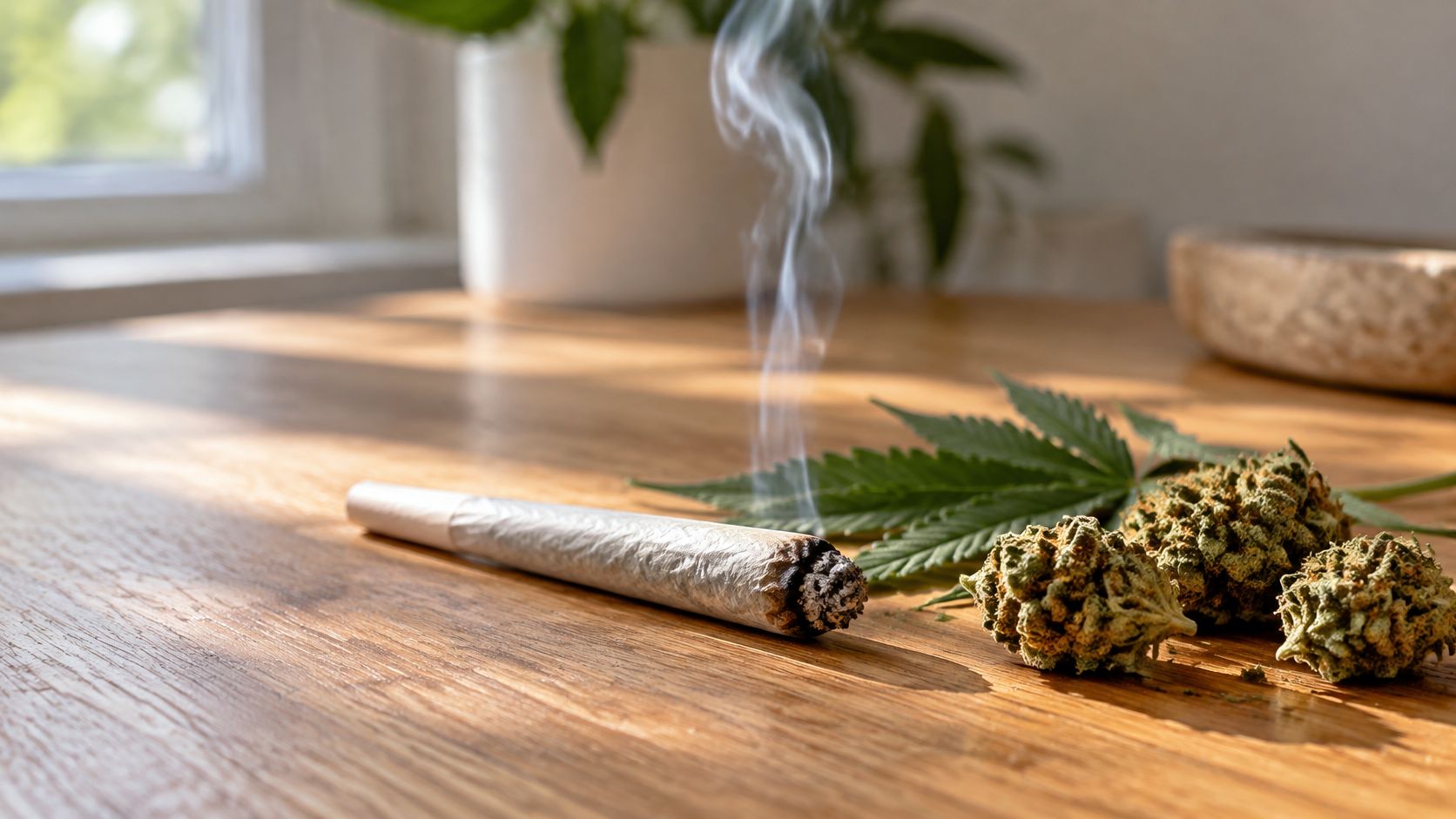
Burning flower is closer to cooking over an open fire than baking in a sealed oven. The heat releases the active compound. The smoke still carries the particles that matter for airways.
A rolled nickname tells you almost nothing about dose, wrap, or tobacco. Those three details change the exposure more than the slang does.
What follows keeps two tracks apart. One is what THC does in blood and brain. The other is what combustion adds on top of the drug.
How Smoking Compares With Other Ways to Use Cannabis
What changes when cannabis is burned, heated without a flame, or swallowed? The method affects whether smoke reaches the lungs, while THC's effects depend on the drug itself. Comparing the two helps clarify which exposures come from combustion and which do not.
Common cannabis consumption methods compared
| Method | How it is used | Burning involved | Typical onset | Main concern |
|---|---|---|---|---|
| Joint | Dried flower rolled in paper | Yes | Seconds to minutes | Inhaled combustion particles and chemicals |
| Blunt | Flower rolled in tobacco leaf | Yes | Seconds to minutes | Added nicotine and tobacco-derived toxins |
| Bong or water pipe | Flower burned in a chamber, smoke cooled through water | Yes | Seconds to minutes | Water does not remove combustion products |
| Vaporizer | Flower or concentrate heated without a flame | No open flame | Seconds to minutes | Less combustion, limited long-term data |
| Edible | Cannabis food or drink swallowed | No | About 30 minutes to 2 hours | Delayed effects make taking more than intended easier |
A joint burns flower in paper. THC enters the body along with particles and chemicals created by combustion. A blunt burns flower wrapped in tobacco leaf, adding nicotine and tobacco-derived toxins to the smoke. Both methods involve burning, though the wrap changes what else is inhaled.
A bong or water pipe cools smoke as it passes through water. Cooling can make smoke feel smoother, but it does not remove combustion products. The sensation of smoothness, therefore, is not a reliable sign that the smoke is free of irritants.
A vaporizer heats flower or concentrate without an open flame, reducing combustion. Long-term data on this trade-off remain limited. An edible avoids inhaling smoke, but its effects are delayed, typically beginning about 30 minutes to 2 hours after use. Taking another serving before the effects begin can lead to consuming more than intended. For readers comparing devices, concentrate smoking tips from Strong Strains discuss a different form of inhaled cannabis; the key distinction here is that heating without a flame reduces combustion, while long-term health data remain limited.
The Centers for Disease Control and Prevention describes cannabis use through joints, blunts, and bongs, and says evidence is insufficient to identify one method as definitively safer. Smoking can expose users and bystanders to harmful chemicals and can affect lung and cardiovascular health. Avoiding a flame changes the smoke exposure, but does not answer every question about THC or heart-related effects.
Decision frame: The wrap, method, dose, potency, and frequency all shape exposure. A product's brand name does not explain those differences.
No method removes every concern. Burning adds smoke-related exposure, while methods without combustion still involve cannabis and its THC. Comparing those separately makes the trade-offs easier to understand.
What Smoking Does to Your Body and Mind
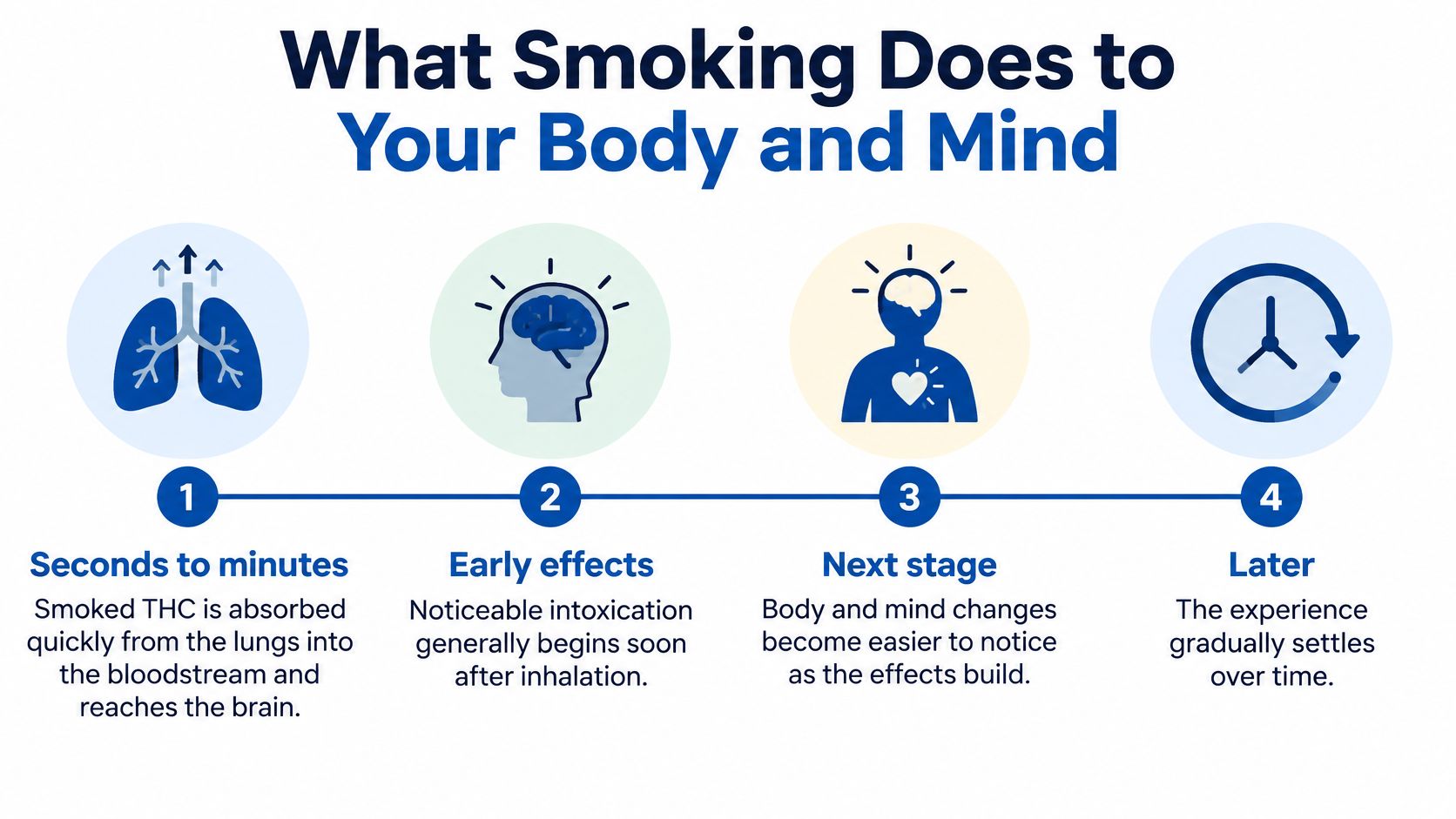
Smoked cannabis sends delta-9-THC through a short path. The compound crosses from the alveoli into the blood and then the brain, which is why the clock starts almost at the first inhale.
The impairment window
The National Academies describe rapid pulmonary absorption. Effects typically begin within seconds to minutes, and noticeable intoxicating effects generally persist for about 1–3 hours. During that window, judgment, reaction time, coordination, and memory can be impaired.
That window is why driving, operating lifts, working at height, or using construction equipment is unsafe while the person is intoxicated. A crew member who feels "mostly fine" twenty minutes after a break is still inside the period when reaction time can lag. Feeling steady isn't the same measurement as a timed brake or a steady hand on a control.
Feeling normal isn't the same as a clear test
THC can remain detectable in the body for days or weeks after the acute effects have ended. A person who no longer feels high can still have measurable cannabinoids. Elapsed time alone doesn't prove sobriety.
Workplaces that treat this seriously prohibit use during work, remove impaired workers from safety-sensitive tasks, and rely on observed fitness-for-duty checks. A clock on the wall isn't a medical clearance.
Practical rule: Leave more than the 1–3 hour window before driving or running machinery, and treat detection as a separate, longer fact.
The drug's timeline is about brain and blood. It doesn't describe what repeated smoke does to airways. That exposure has its own evidence.
Lung and Heart Risks Researchers Are Tracking
What changes when cannabis burns, and what comes from THC itself? Combustion produces smoke containing many of the toxins, irritants, and carcinogens also found in tobacco smoke. The lungs are exposed to that mixture regardless of the THC percentage on the label.
Airway signals in regular users
The National Academies of Sciences, Engineering, and Medicine evidence review links repeated smoking with respiratory irritation and more frequent cough, sputum, wheeze, and chronic-bronchitis episodes. Among regular users in the reviewed studies, approximate odds ratios were 1.7–2.0 for cough, 1.5–1.9 for increased sputum, and 2.0–3.0 for wheeze.
| Signal | What the reviewed studies report |
|---|---|
| Cough | Approximate odds ratio 1.7–2.0 |
| Increased sputum | Approximate odds ratio 1.5–1.9 |
| Wheeze | Approximate odds ratio 2.0–3.0 |
| Chronic-bronchitis episodes | Higher frequency with repeated smoking |
These airway symptoms are plausibly related to particulates and reactive products of combustion, rather than THC alone. Symptoms generally improve after smoking stops. Evidence remains insufficient to establish a clear causal relationship with COPD, asthma, or long-term loss of lung function. A recurring cough is an observed association, not proof of permanent lung damage.
Heart findings that don't line up neatly
Heart and blood-vessel findings are less settled. A small recent study reported lower vascular function among frequent cannabis smokers and edible users than among nonusers. A separate cohort of older veterans with coronary artery disease found no significant link between cannabis smoking and cardiovascular events over follow-up. That analysis did not adequately distinguish joint type, tobacco mixing, potency, or cannabinoid composition.
Lower vascular function among edible users means smoke alone may not explain every cardiovascular finding. At the same time, the veteran cohort involved older adults who already had coronary disease, and its results do not settle the question for other groups. Neither finding is a blanket clearance or a blanket warning. The key distinction is that smoke exposure comes from burning, while THC can have effects apart from inhaling smoke.
Smoke in a closed room
Smoke in an enclosed office, classroom, vehicle, or modular building contaminates indoor air and can expose other people. Prevent indoor combustion to limit that exposure. Ventilation can supplement that step, but a fan only moves smoke; it does not remove the products of burning.
Legal Limits and Where Smoking Creates Problems
Legality is set by country, state or province, and sometimes by city. Rules differ for possession, public use, driving, workplaces, and travel across a border. A product that is lawful to buy can still be unlawful to smoke in a vehicle, a school, or a job site.
In the United States, reported adult use has climbed even while state rules diverge. The National Institute on Drug Abuse Monitoring the Future panel found that 44% of adults aged 19–30 reported past-year marijuana use in 2022, compared with 28% in 2012. Daily use reached 11% in 2022. Among adults aged 35–50, past-year use reached 28% in 2022, compared with 13% in 2012. These figures are self-reported and include vaping and other forms, not smoking alone. They describe behavior, not a legal right to light up anywhere.
Settings where smoking creates problems
- Roads and safety-sensitive jobs: Impairment behind a wheel or on equipment is a separate offense from possession, and local standards differ.
- Lifts, heights, and heavy equipment: A worksite can ban use even where adult possession is legal off the clock.
- Shared indoor space: Offices, classrooms, and modular buildings treat smoke as a contaminant for everyone in the room.
- Public places and transit: Sidewalks, stations, and vehicles often have their own bans, and those bans aren't uniform.
- Crossing a border: Something lawful on one side of a line may be a criminal matter on the other, including under federal rules that don't follow state shops.
Someone facing a possession or use charge needs local counsel, not a general article. A plain-language starting point on defending marijuana charges in Georgia shows how state-specific that advice has to be.
A lawful product doesn't make smoking lawful in every room or every vehicle. Check the rules where the person lives and where the person travels, and match any plan to drive or run equipment to the impairment window rather than to a feeling of being fine.
When Using Cannabis to Self-Treat Needs Attention
When does using cannabis for pain, anxiety, insomnia, or low mood stop feeling casual and start raising concerns? One clue is whether use is becoming more frequent as the symptoms remain unresolved.
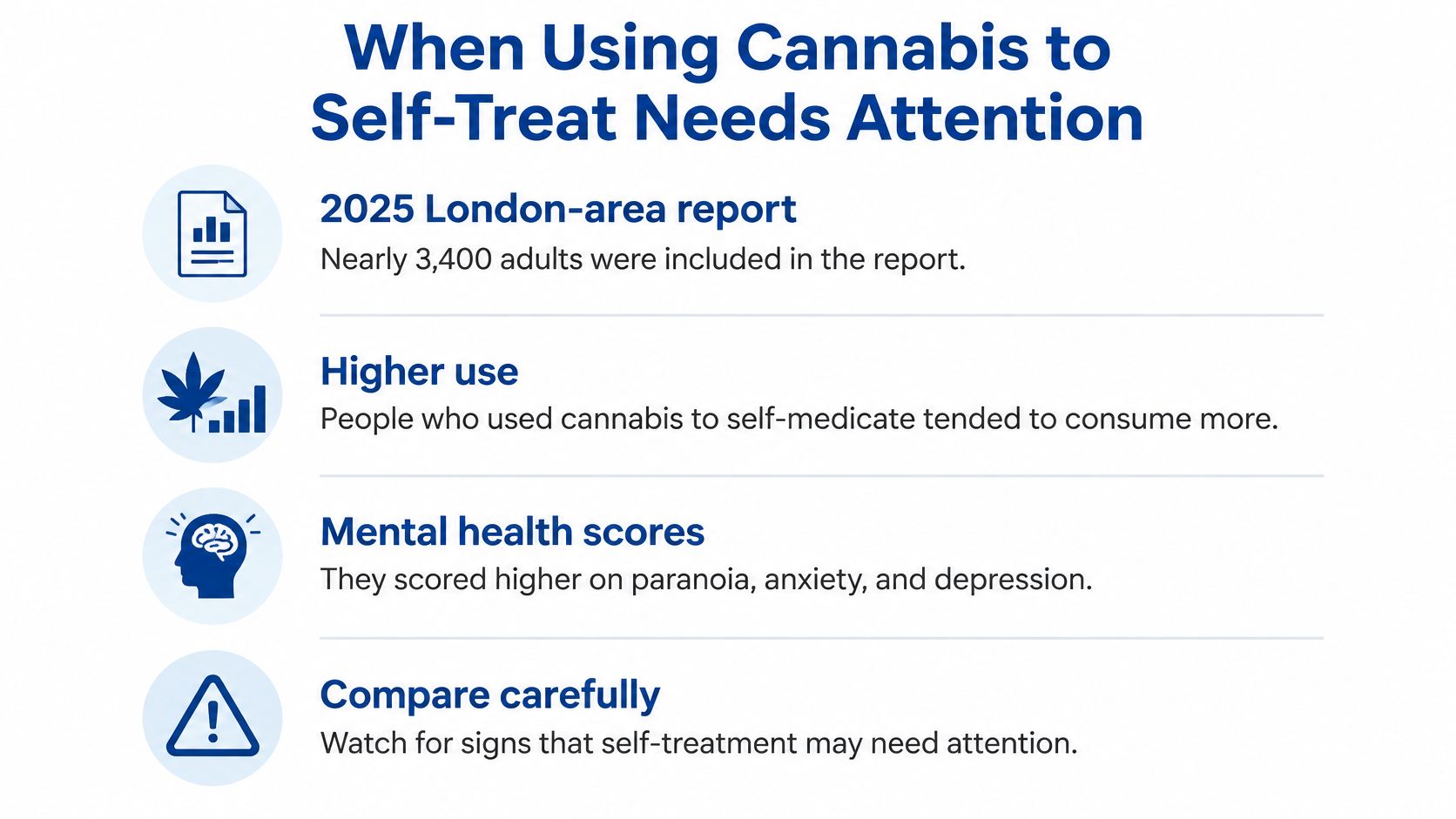
A Fort Bend Herald report on a 2025 study described research involving nearly 3,400 London-area adults. People who used cannabis to self-medicate tended to consume more and report higher paranoia, anxiety, and depression scores than those using it for recreation or curiosity. Their average reported use was about 206 THC units weekly, estimated at roughly 10–17 joints of 20% THC cannabis.
That pattern does not show that cannabis caused those mental-health differences, or that everyone who uses it for relief will have the same experience. It does raise a useful question: is the person using more because symptoms are continuing, or is the pattern of use becoming part of the problem? The amount of THC and frequency of use matter here, while burning cannabis adds smoke exposure that THC itself does not.
Exposure that adds up
Some research associates heavier cumulative cannabis smoking with more respiratory symptoms. The clinical significance of some lung-function differences remains uncertain, so these findings do not establish that smoking causes COPD. Still, repeated smoke exposure is different from a single session: the total exposure builds over time, while THC's effects depend on the drug and the amount used.
Changing from a joint to a vaporizer or edible may change exposure to burning smoke, but it does not address why someone feels they need cannabis every day. The symptom and the pattern of use both deserve attention.
Red flags that call for a clinician
- Daily or near-daily use: Frequent use may be a sign to review whether the approach is helping.
- Rising potency: Seeking a stronger product to get the same relief.
- Needing it to function: Work, sleep, or mood feels impossible without cannabis.
- Mixing with tobacco or alcohol: These add other exposures or effects to the session.
- Driving while impaired: Impairment creates a safety concern, not just a private habit.
- Panic or paranoia: A change in mental health that deserves assessment.
Readers can explore evidence on cannabis use and bring questions about their symptoms, amount, and frequency to a clinician. A different way of taking cannabis changes how it is used, but it does not replace an assessment of why relief feels necessary.
Safer Alternatives and Harm Reduction
The lowest-risk option is not using cannabis. People who want relief from pain, anxiety, insomnia, or low mood can look at clinically tested care before they look at a new way to inhale.
- Treat the symptom with a clinician. Physical therapy or a prescribed medicine for pain has a known dose and a known follow-up. Cannabis doesn't replace that workup.
- Use cognitive behavioural therapy for anxiety and insomnia. That approach has a strong evidence base and no combustion exposure. It asks for practice, not a product.
- Change the day around sleep and mood. A steady sleep time, daytime activity, and a simple stress-reduction practice won't match a drug's speed. They also don't add airway irritants.
- If cannabis stays in the picture, cut burning, dose, and frequency. A vaporizer reduces open flame, and long-term data are still limited. An edible avoids the lungs and acts slowly, so the first amount should stay low.
- Skip tobacco and alcohol in the same session. A tobacco wrap adds nicotine and tobacco toxins. Alcohol stacks impairment on top of THC.
Legal shelves don't equal a safe dose. A clinician can line up the symptom, the health history, and the options without treating every method as equal.
Deciding What to Do Next About Smoking
A clear sequence beats a vague plan to "be careful." Each step answers a different risk: the law, other people's air, the drug's clock, the reason for use, and the size of the exposure.
- Confirm the rules where the person lives and where travel goes, including vehicles and job sites. A shop receipt isn't a permit for every room.
- Keep combustion out of shared indoor space. Offices, classrooms, clinics, and modular buildings hold smoke for everyone nearby. Ventilation doesn't replace keeping the source outside.
- Plan tasks around the noticeable-effects window before driving, running a lift, or using equipment. Remember that THC can stay detectable for days or weeks after the feeling fades, so a clear head isn't a negative test.
- Track frequency, potency, and the reason. If use is daily, potency keeps climbing, or cannabis is carrying pain, anxiety, sleep, or mood, book a clinician. The red-flag list above is the checklist for that call.
- If smoking continues, lower frequency and dose, and don't mix tobacco. No method has been shown to be definitively safer, so fewer and smaller sessions are the lever with the clearest logic.
- Ask for a structured plan if the goal is to stop or to change the pattern. A health professional can match that plan to the symptom instead of swapping one product for another.
Less exposure reduces risk more reliably than a different device. The sound decision uses health history, local law, and a clinician's advice together, not a slogan about natural products or a scare about every puff.
Pacific Mobile Structures, Inc. leases and builds mobile offices, storage containers, and modular classrooms and clinics where crews, students, and patients share enclosed air. Smoking a reefer in those spaces puts combustion byproducts into the same rooms people use for work, class, and care. Visit Pacific Mobile Structures, Inc. to plan smoke-free modular space with the ventilation, layout, and site setup a project needs.