A listing can look perfect until the delivery crew arrives and the site has no compatible power connection, or the unit cools its empty interior but can't keep a loaded pallet at the required temperature. Buyers comparing refrigerator containers for sale need to look past the advertised setpoint and purchase price. The stronger decision comes from documented temperature performance, site fit, serviceability, and the full cost of keeping the unit running.
For a school, clinic, food business, or contractor, a reefer may become essential storage rather than a shipping asset. Before signing, the buyer should be able to verify what the unit can hold, how it will be powered, and what records support its condition.
Table of Contents
- What a Reefer Container Is and Why Buyers Care
- Matching Temperature Range to Your Use Case
- Specs That Decide Whether a Unit Fits Your Site
- Leasing Versus Buying Based on Cost and Control
- Buying Through Cooperative Purchasing Contracts
- Compliance, Power Hookup and Site Setup
- Inspecting a Used Reefer and Signing With Confidence
What a Reefer Container Is and Why Buyers Care
A reefer is a walk-in cooler built inside a steel shipping box. It can travel by ship, truck, or rail while maintaining a controlled temperature, or sit on a prepared site as stationary cold storage. The buyer is paying for three connected parts: the insulated container body, the integrated refrigeration unit, and the power supply that runs it.
That combination distinguishes a reefer from a dry storage container. A dry box protects goods from weather and unauthorized access, but it doesn't actively cool them or maintain a target temperature. A reefer uses refrigeration controls and sensors to manage the interior conditions. If a listing describes insulation but doesn't identify a refrigeration unit, it may not be suitable for cold storage.
Reefers matter to food supply chains, not only frozen cargo. In 2021, global reefer trade reached approximately 290 million tonnes, and fresh products accounted for 49% of refrigerated shipments, according to FreshPlaza's report on reefer container trade. Schools, clinics, contractors, and food businesses can also use these standardized units for stationary storage, provided the equipment suits the contents and the site.
Listing test: A genuine reefer listing should name the refrigeration unit, its temperature setpoint range, and its power requirement. If those details are missing, the listing may describe a dry box rather than a working refrigerated container.
Matching Temperature Range to Your Use Case
The right unit is the one that holds the product's required temperature in real operating conditions. A broad advertised range isn't a substitute for checking the product label, the way goods will be loaded, and the monitoring records the buyer needs to retain.
| Use case | Typical temperature target | Requirement to check | Note |
|---|---|---|---|
| Fresh food storage | At or below 4.4°C (40°F) | Continuous temperature record | FDA control point commonly used for refrigerated food |
| Frozen food storage | -18°C (0°F) or colder | Fast pull-down and uniform airflow | Verify under a loaded test, not an empty one |
| Vaccines and biologics | Often 2–8°C; some require frozen storage | Calibrated monitoring and alarm limits | Follow the product label |
| General pharmaceuticals | Set by the product label | Calibrated sensors, data retention, and corrective-action records | Follow WHO-style monitoring guidance |
| Humidity-sensitive produce | Relative humidity about 60% to 95% | Humidity control in the unit's specification | Confirm the unit can hold both temperature and humidity |
| Backup cold storage for schools or clinics | Set by the contents | Holdover time during outages and generator connection | Ask for documented off-power performance |
For fresh food, 40°F (4.4°C) or below is an FDA control point commonly used for transit and receiving, with continuous recording recommended for verification. That threshold is not a universal setting for every product. Frozen foods, vaccines, and specialty pharmaceuticals need targets tied to their own handling requirements.
Humidity can matter as much as temperature for produce and other sensitive goods. Commercial reefers may offer humidity control across a range of about 60% to 95%, but buyers should confirm that the specific unit has the feature and can maintain the needed conditions. A listing that advertises temperature control alone doesn't establish humidity performance.
For backup storage, the important question isn't whether the container runs on a generator. The buyer needs to know how long contents remain within the required range when power fails and how quickly the unit recovers after restart. A climate-controlled storage container may be a useful comparison when evaluating storage options, but cold-chain requirements still call for verified reefer performance.
Temperature loggers should measure the product environment, not just the cold air leaving the evaporator. The product's core temperature affects shelf life, so representative loggers belong inside the center of boxes or pallets as well as at expected warm and cold points. Before requesting quotes, list each product, its label temperature, allowable time without power, and monitoring obligation, then match those requirements to a unit.
Specs That Decide Whether a Unit Fits Your Site
Start with physical fit and power compatibility, then check whether the system can hold the required conditions under load. The Maersk refrigerated cargo overview describes reefers as powered cold-chain systems whose airflow and operating specifications affect performance.
| Specification | Typical value | What to check |
|---|---|---|
| Container length | 20-foot and 40-foot intermodal formats | Site footprint, door clearance, and delivery route |
| Setpoint temperature | About -60°C to +30°C on many intermodal units | Actual range for the product, confirmed under load rather than by the maximum |
| Relative humidity control | About 60% to 95% | Whether humidity control is needed for produce or sensitive goods |
| Shore power | 360–480 V at 50–60 Hz | Site voltage, plug type, and phase match |
| Road operation | Diesel generator | Needed only if the unit will move; stationary units run on shore power |
| Insulation and seals | Insulated steel body with door gaskets | Gaps, damaged panels, moisture, and gasket wear |
| Airflow design | T-bar floor and high-capacity fans | Clear floor channels, evaporator clearance, and pallet spacing |
Measure the whole delivery path. A container that fits its final pad may still be impossible to place if the access road, gate, overhead clearance, or turning area is too restrictive. Confirm the footprint, the door swing, working clearance around the refrigeration end, and the equipment needed to unload and position the unit.
Treat the setpoint range as a capability claim, not a performance guarantee. A unit may list a very low minimum temperature yet struggle to maintain a uniform -18°C with a full load in warm conditions. Ask for a pull-down test that reflects the intended cargo and ambient conditions. Check the controller, temperature sensors, evaporator, and door seals as part of that test.
Match electrical details before committing. The listing should identify voltage, frequency, plug configuration, and phase, and the site should be checked against those requirements by a qualified electrician. A stationary container generally runs from shore power; a diesel generator is relevant when the unit must operate during transport or at a location without a suitable electrical connection.
Airflow is another common source of avoidable trouble. T-bar floors and high-capacity fans move air beneath and around cargo, but tightly packed pallets, blocked floor channels, or insufficient space near the evaporator can create uneven temperatures. Confirm that the loading plan leaves those air paths open.
Write down the product, required temperature and humidity, available site voltage, and delivery constraints before comparing listings. That simple specification sheet helps prevent both overbuying specialized equipment and choosing a unit that can't handle the actual load.
Leasing Versus Buying Based on Cost and Control
The worldwide reefer fleet is above 1.8 million physical containers, with shipping lines controlling about half and leasing companies providing roughly the other half, according to the Container Owners Association's guidance on reefer containers. Both buying and leasing are established acquisition routes.
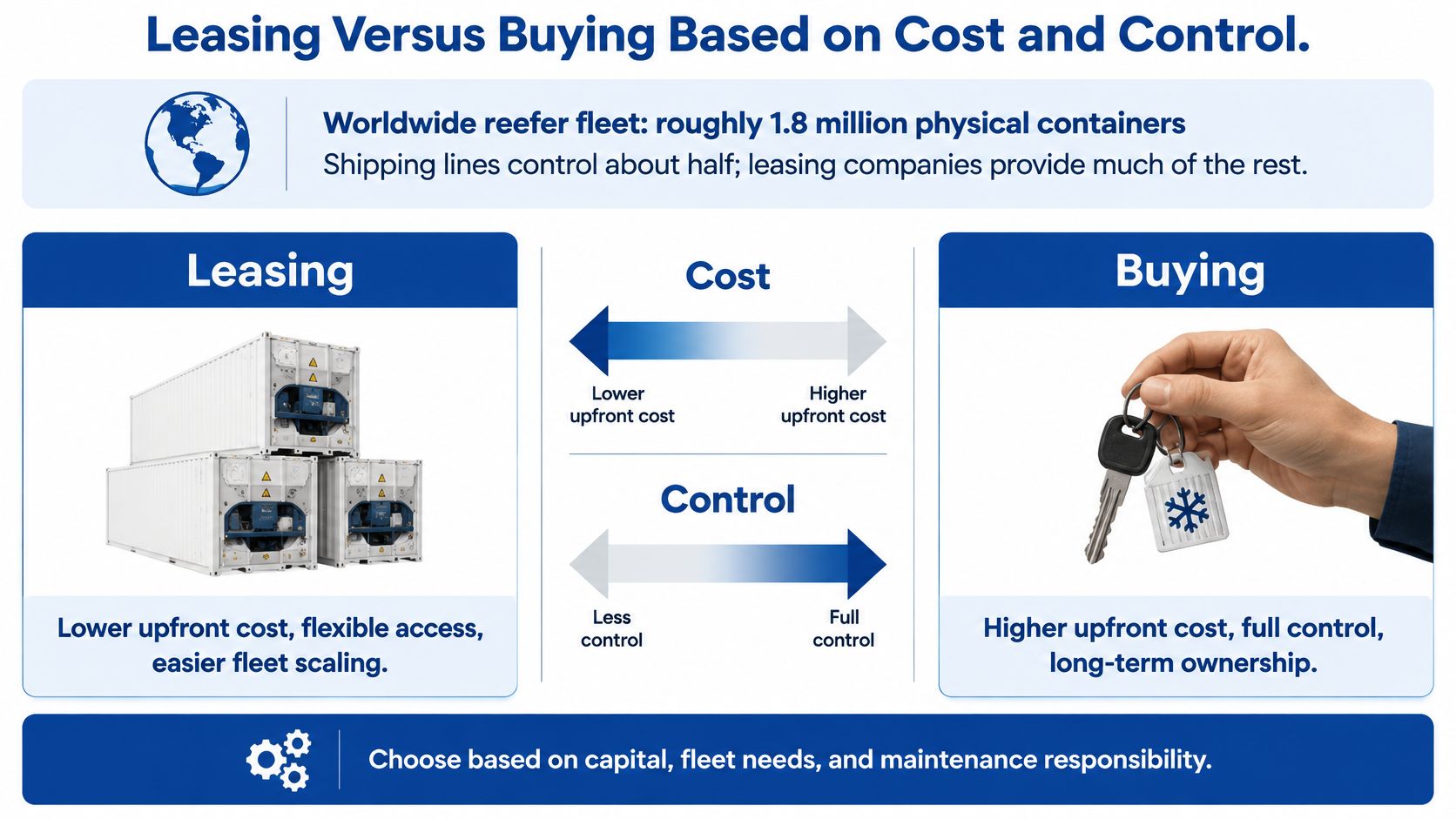
For a school using a reefer during a renovation, leasing can be practical when the need has a defined end date. It generally requires less capital up front and gives the organization a way to return the unit when the project ends. The trade-off is less control over the equipment and lease terms that may assign refrigeration repairs or return-condition costs to the renter.
A buyer takes on more responsibility, but ownership can make sense for a fixed, long-term need. A used unit usually has the lowest upfront cost, but repair risk shifts to the buyer. The actual purchase cost includes the inspection, service needed before operation, and any repairs the unit requires. A new unit costs more, but may include warranty protection and newer refrigerant or controls.
| Factor | Buy used | Buy new | Lease |
|---|---|---|---|
| Upfront cost | Lowest | Highest | Low, spread over the term |
| Equipment age and remaining life | Depends on service records | Newest, with warranty | Set by the lessor's fleet and contract |
| Maintenance responsibility | Buyer | Buyer, with warranty coverage first | Set by the lease's repair clauses |
| Resale or return value | Depends on condition at resale | Declines with age | None; the unit is returned |
| Best fit | Long-term on-site storage with an inspection budget | Long-term use where compliance certainty matters | Short-term or uncertain needs |
Compare total cost over the same period. Estimate the months the unit will be used, add likely service and repair costs, then compare that total with lease payments and any fees over the same term. For a temporary project, leasing may win even if its total payments look high. For continuing use at one site, ownership may become more economical, especially when the buyer can maintain the unit and has a resale plan.
Before signing a lease, review who pays for refrigeration repairs, what counts as acceptable operating condition, and what the return inspection covers. Those clauses can matter as much as the monthly payment.
A short video can help buyers visualize the leasing-versus-buying trade-off:
Buying Through Cooperative Purchasing Contracts
A cooperative purchasing contract lets an eligible organization buy through an agreement that a purchasing consortium or government body has already competitively bid. It can simplify procurement for school districts, hospitals, municipal agencies, and nonprofits that need to document how a purchase was competitively sourced. The contract can reduce administrative work, but it doesn't confirm that a particular reefer is suitable.
A buyer should take these steps before placing an order:
- Confirm the contract covers reefers. Some agreements cover dry storage containers but not refrigerated units or refrigeration service.
- Check delivery and service terms. Confirm that delivery, power hookup, warranty coverage, and repair responsibilities are written into the contract.
- Request the equipment records. Ask for calibration certificates, refrigeration service history, refrigerant type, and a loaded pull-down test.
- Verify eligibility and order conditions. Check whether the organization can use the contract and whether an order minimum applies.
- Compare total cost. Set the contract price beside two independent quotes, including delivery, hookup, inspection, expected service, and repairs.
A guide to cooperative purchasing contracts can help procurement teams understand how this route works and what information to confirm. A contract can speed up paperwork, but it doesn't replace a physical inspection. A competitively procured unit can still carry hidden repair costs if its condition and records haven't been checked.
Compliance, Power Hookup and Site Setup
A reefer that runs today can still carry higher operating costs or service problems over its ownership life. In the United States, a federal commercial-refrigeration rule took effect March 24, 2025, according to the Federal Register's commercial refrigeration standards rule. The rule sets later compliance dates for new and amended standards, so confirm the applicable date in the notice before treating an older unit as a low-cost choice. Put the listing's documented temperature performance and expected service cost beside the purchase price. A cheap unit with a weak compressor or obsolete controls rarely remains the lower-cost choice over its service life.
Refrigerant choice also affects serviceability. Federal global-warming-potential limits now shape which refrigerants can be used in new equipment. The seller should identify the refrigerant and charge, and the buyer should confirm that local technicians can service the system and source parts. Ask about energy use, leak-repair obligations, controller features, and expected duty cycle as well as the purchase price.
Food storage at a school, restaurant, or clinic may also be subject to local health department requirements. Before installation, the operator should confirm expectations for temperature logging, inspections, records, and corrective actions.
Prepare the site before delivery
A reefer needs a firm, level pad and enough clearance for airflow and maintenance. A licensed electrician should design the electrical connection to match the unit's requirements, using the specification confirmed during selection. Match the electrical service to the nameplate and the duty cycle you expect, not to the smallest circuit that will start the unit. The delivery plan should identify the route, unloading equipment, and exact position on the site. For practical installation planning, Simply Hospitality's refrigeration installation guide covers preparing for commercial refrigeration equipment.
Schedule refrigeration service at the manufacturer's intervals, retain service and temperature records, and replace failed gaskets or sensors promptly. Remote monitoring can alert staff to temperature changes, but it does not replace a documented response plan.
Before delivery day, confirm permits, health department expectations, utility capacity, electrician availability, access for the delivery vehicle, and the surface where the unit will sit. Document the setpoint, alarm limits, and who responds when an alarm fires. Resolving those items in advance is cheaper than discovering that the container is ready to run but the site is not.
Inspecting a Used Reefer and Signing With Confidence
The cheapest unit can become the most expensive if its records are missing. A seller's advertised temperature range doesn't prove that a used reefer has stable performance, sound sensors, or a history of reliable service. The buyer should require documentation and a test that reflects how the unit will be used.
The World Health Organization's guidance on temperature monitoring and reefer qualification emphasizes monitoring that demonstrates products weren't exposed to adverse temperatures. Reusable monitoring devices should generally be calibrated against a certified, traceable reference standard at least annually unless another interval is justified.
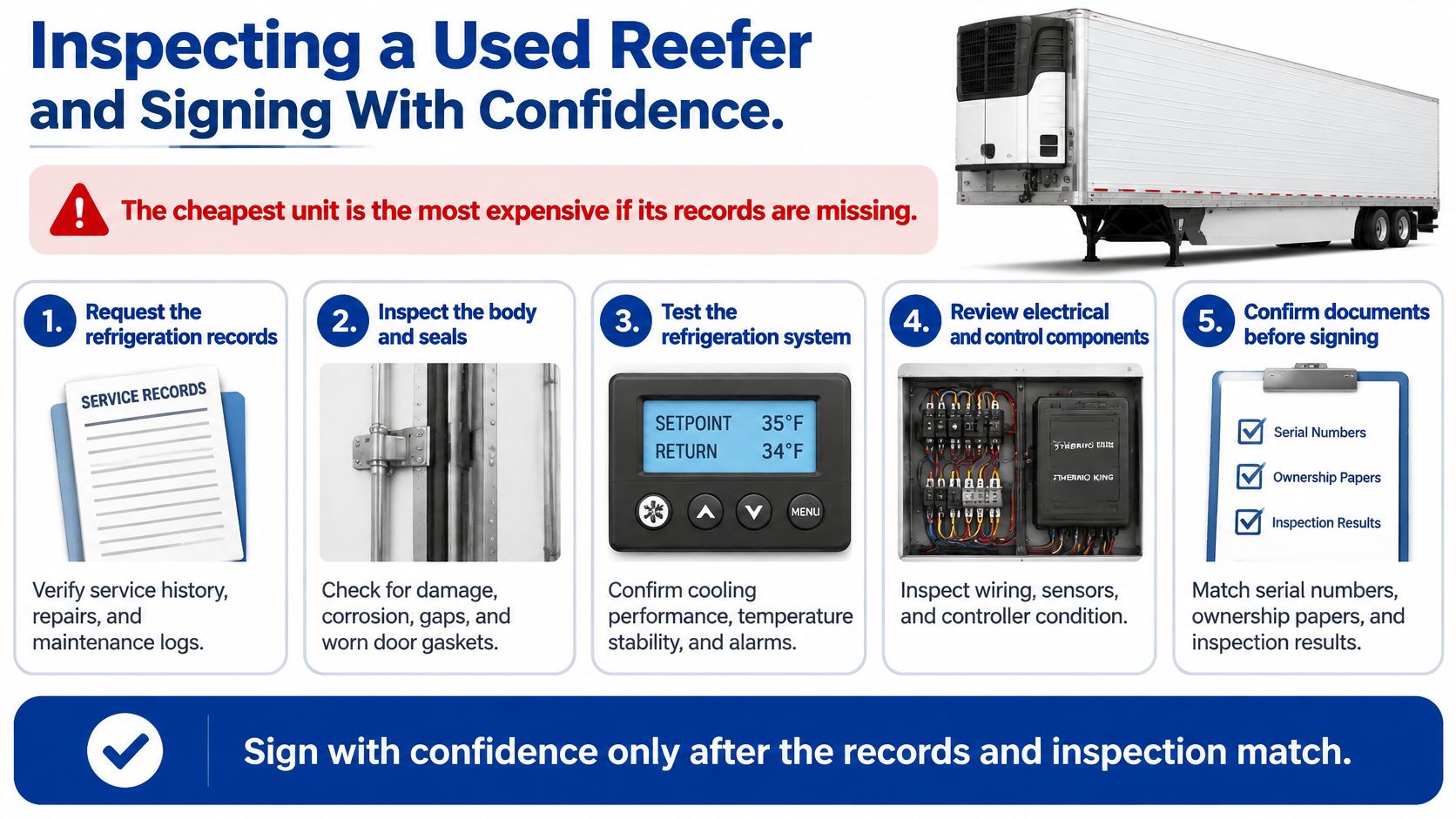
Use this inspection routine before paying:
- Request the refrigeration service history and maintenance log. Missing records can conceal recurring faults or deferred repairs. Ask for itemized work orders on refurbished units, including details of replaced gaskets and refrigeration components.
- Review alarms and stored temperature records. Look for unexplained alarms, repeated excursions, or gaps in monitoring. The seller should explain each recorded fault and show how it was resolved.
- Inspect the door seals and gaskets. Check for cracks, gaps, compression damage, and light visible through a closed door. Worn seals allow warm air and moisture to enter.
- Examine the insulation and body. Look for damaged panels, moisture, corrosion, and patched areas. A cosmetic repair may hide a problem that affects insulation or creates a path for water.
- Run cooling and defrost cycles. Test the unit empty, then observe whether it reaches its target and whether unusual noise, alarms, or interruptions occur. A quick empty cooldown alone doesn't prove that the system can maintain uniform conditions with cargo inside.
- Check sensor calibration documents. Confirm that certificates identify the sensor and traceable reference standard, and that calibration is current for the intended use.
- Perform loaded temperature mapping. Place independent data loggers at expected warm and cold locations and within representative product or packaging positions. A loaded test can reveal poor airflow or temperature differences that an empty test misses.
- Confirm the pre-trip inspection and site compatibility. Match the container's serial number and electrical details to the seller's paperwork and the buyer's site requirements.
Shortlist by evidence, not by listing order. Record the product, target temperature, acceptable time without power, monitoring requirements, site voltage, and preferred container length. Filter listings against those needs, then request the same maintenance records, calibration documents, and recent loaded test results from each seller. Compare two or three quotes on purchase, delivery, inspection, service, and likely repairs.
Pacific Mobile Structures sells and rents storage containers and delivers and sets them on-site to customer specifications. Those offerings don't establish that a particular listing is a refrigerated reefer, so buyers should verify the equipment type rather than assume a storage-container listing meets cold-chain needs. The container grades guide can also help buyers understand why condition and documentation matter when evaluating container equipment.
Go or no-go: An unexplained temperature excursion or missing calibration record calls for walking away or renegotiating. Signing should wait until the records, certificates, serial numbers, and test results match the unit being purchased.
Organizations comparing refrigerated containers can contact Pacific Mobile Structures, Inc. about storage containers available for purchase or rental, with delivery and on-site setup to customer specifications. Before choosing a unit, buyers should confirm that the specific container is a reefer and independently verify its temperature performance, power compatibility, and service records.