Base rent for mobile office trailers typically runs from $200 to $1,800 per month, while new units commonly cost $18,000 to $85,000 to purchase, before adding roughly $1,500 to $5,000 for delivery and setup. The final cost depends on the size tier, amenities, rental term, transport requirements, utilities, and site conditions.
A facilities director may receive a low monthly quote for a trailer needed during a school renovation, only to discover that the quoted price excludes hauling, leveling, stairs, power connections, ramps, skirting, and removal. A construction manager can face the same problem on a jobsite where access is tight or the placement area needs preparation before the trailer can be used.
The useful question isn't “What does the trailer cost?” It's “What does a delivered, connected, compliant, ready-to-use workspace cost on this site?” That shift makes it easier to compare rental and purchase options, size the unit correctly, and prevent a headline rate from hiding the largest line items.
Understanding the True Cost of Mobile Office Trailers
- What the Cost of Mobile Office Trailers Really Includes
- Should You Lease or Buy Your Mobile Office Trailer
- How Size and Features Drive Monthly Pricing
- How to Estimate Your Total Delivered and Ready to Use Cost
- Hidden Fees and Budget Pitfalls to Avoid
- Getting an Accurate Quote and Planning Your Next Move
What the Cost of Mobile Office Trailers Really Includes
A school renovation can make a trailer's monthly rent look manageable until the delivery route, placement area, entry access, utility connections, and removal plan are priced. The usable project cost starts with the unit, then grows through the work required to put it safely into service. Common single-wide rental pricing is often reported between $200 and $900 per month, while broader guidance places rental rates at approximately $200 to $1,800 per month, based on footprint and configuration (mobile office trailer rental pricing guidance, mobile office cost methodology).
A clinic or public agency may also require accessibility equipment, compliance work, or a more substantial interior arrangement before staff can occupy the space. Those requirements belong in the delivered, ready-to-use budget, not in a later change order.
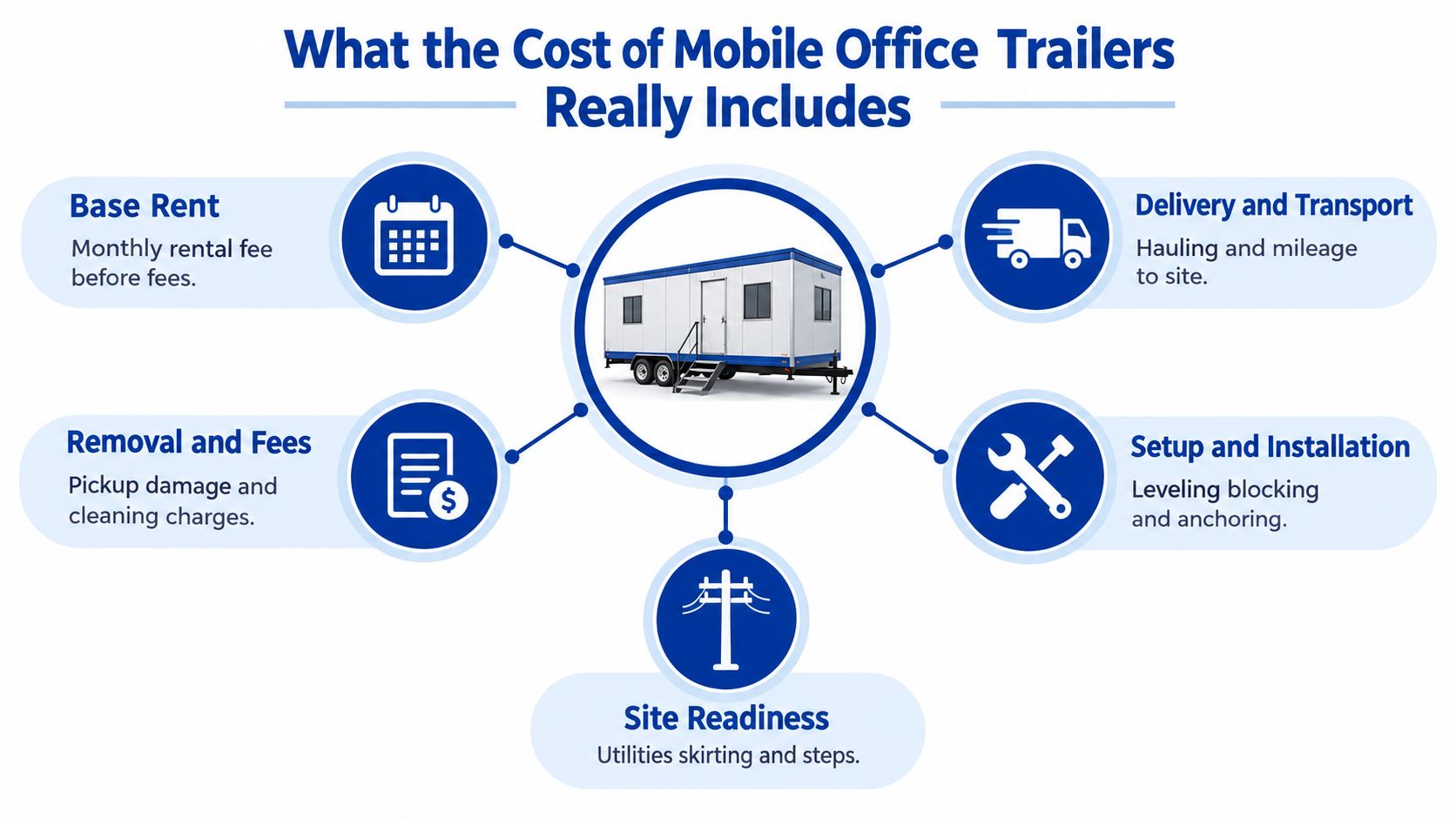
The five cost buckets
A practical estimate separates the project into five categories:
- Base rent or purchase: The trailer charge, shaped by size, configuration, condition, and term.
- Delivery and transport: Hauling, mileage, route restrictions, and special transportation requirements.
- Setup and installation: Blocking, leveling, anchoring, stairs, ramps, and placement work.
- Site readiness: Electrical service, water or sewer access, skirting, grading, permits, and related site work.
- Exit and project fees: Pickup, cleaning, repairs, storage, insurance, and contractual charges.
Delivery and setup alone can run approximately $1,500 to $5,000, according to pricing guidance, and that amount can change the economics of a short deployment (delivered mobile office trailer cost factors). For a brief project, making the unit usable and removing it may cost more than several months of base rent.
Practical rule: Compare the delivered, connected, ready-to-use cost, not only the monthly rate. Distance, access, ramps, hookups, and site preparation can outweigh the headline quote.
Ask every vendor for the same scope. The guide to renting a mobile office trailer helps organize questions about unit selection, rental terms, accessories, and delivery planning. A usable quote identifies included work, exclusions, customer responsibilities, and charges that apply at removal.
Should You Lease or Buy Your Mobile Office Trailer
A school renovation may need swing space for a limited period, while a contractor or public agency may reuse the same unit across several projects. That operating horizon should guide the lease-versus-buy decision before comparing monthly rates or purchase prices.
Leasing generally suits temporary work where quick deployment, flexibility, and service support matter more than ownership. It also limits the work required when the project ends, although the contract may still assign responsibility for damage, cleaning, utility disconnection, or pickup. Buying can fit sustained use when the organization expects to modify the trailer, control its availability, or move it between future sites. A used unit may lower the acquisition cost, but its condition, refurbishment needs, code compliance, transport, and setup require review.
Lease vs Purchase Decision Matrix for Mobile Office Trailers
| Decision Factor | Lease | Purchase |
|---|---|---|
| Upfront cost | Lower initial commitment, though delivery and setup still apply | Higher initial outlay, plus transport, setup, and improvements |
| Monthly cost | Recurring rent, often influenced by term and configuration | No rental payment, but ownership brings maintenance and operating responsibilities |
| Flexibility | Easier to return, replace, or adjust when the project changes | Less flexible if the unit no longer fits the site or operation |
| Maintenance | Often supported through the rental arrangement, subject to contract terms | Owner manages maintenance, repairs, storage, and redeployment |
| Resale | No resale value for the customer | Potential residual value, depending on condition and marketability |
For purchase planning, market guides place new pricing around $18,000 to $24,000 for an 8'×20' unit, $28,000 to $40,000 for a 10'×40' unit, $42,000 to $55,000 for a 12'×60' unit, and $65,000 to $85,000 for a 24'×60' double-wide (mobile office purchase pricing). Those figures cover the unit, not necessarily a trailer delivered, connected, and ready for occupancy.
Rental pricing also varies by size. Smaller 8'×20' trailers commonly fall around $200 to $500 per month, while 24'×60' double-wide units may run around $800 to $1,800 per month. Custom multi-unit complexes can reach approximately $1,500 to $4,000 per month, before project-specific delivery and site charges (mobile office rental tiers).
Match procurement to the operating horizon
A short renovation schedule often favors leasing because acquisition, storage, maintenance, and removal may not justify ownership. A recurring contractor operation, public works program, or multi-phase campus plan may justify buying when the organization can reuse the trailer and manage storage between deployments.
Public-sector buyers should investigate cooperative purchasing and used-unit programs when procurement rules allow them. These options may reduce administrative work, but they do not remove the need to confirm accessibility, utility requirements, delivery conditions, and responsibility for repairs. Review the mobile and modular building rental resource when comparing temporary rental arrangements and ownership alternatives.
The practical test is the delivered, usable cost over the full operating horizon. A low monthly lease can become expensive after site work, connections, and removal. A lower used purchase price can require refurbishment, transport, storage, and site preparation before anyone can work inside.
How Size and Features Drive Monthly Pricing
A trailer that looks inexpensive on a monthly quote can become a poor fit once the team, rooms, utilities, and delivery route are considered. Size affects floor area, transportation, layout, heating and cooling demand, restroom planning, occupancy, and the site work needed before the unit can be used.
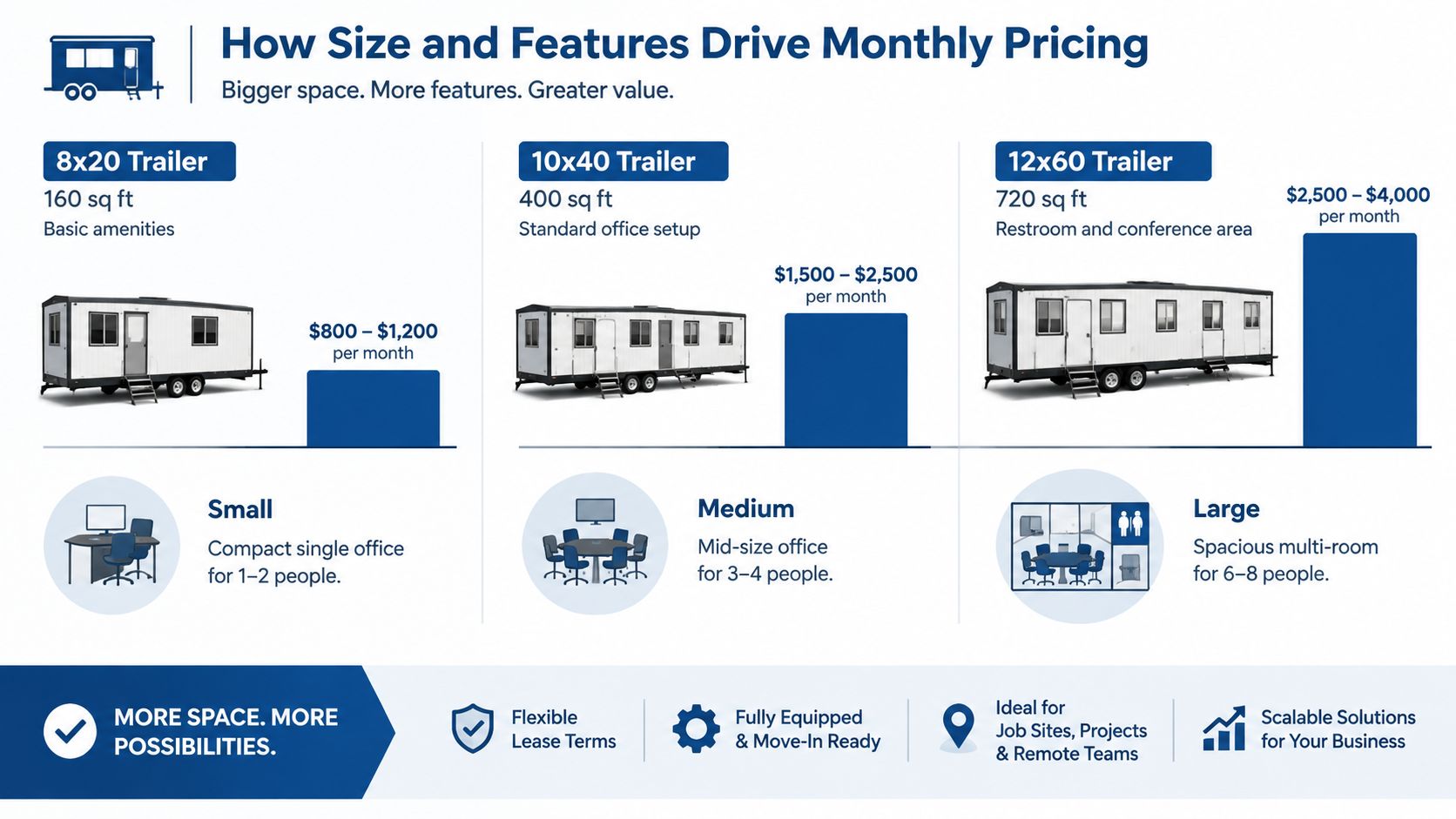
An 8×20 trailer contains about 160 square feet, while a 12×60 unit contains roughly 720 square feet. The larger footprint can support more rooms and amenities, so monthly rent may be approximately 2x to 4x more than the smallest standard trailer, depending on market conditions and configuration. Compare the rental figure with the delivered, usable setup rather than treating rent as the full project cost.
Think in size tiers, not just dimensions
The common tiers support different work patterns:
- 8×20: About 160 square feet, generally suited to a compact office or a small supervisory function. It can keep rent lower when the headcount and workflow are limited.
- 10×40: About 400 square feet, allowing a standard office arrangement, meeting activity, or a small team.
- 12×60: Roughly 720 square feet, supporting a larger office plan, private rooms, a conference area, or additional amenities.
The smallest unit can create extra cost when the plan requires a meeting area, storage, or privacy. A later replacement means another delivery and setup cycle. Oversizing creates the reverse problem, with unused floor area and potentially greater transport requirements.
Amenities create the next price step
A basic office trailer and a unit with a restroom, stronger HVAC provisions, and higher occupancy belong in different pricing categories. Restroom, HVAC, and larger occupancy requirements can move monthly costs into the mid-hundreds or low-thousands (mobile office occupancy and amenity cost drivers).
Double-wide configurations cost more because they provide a larger footprint and involve more complex usable space. Multi-unit complexes add coordination for connected circulation, multiple offices, conference areas, or specialized functions. Those choices also affect delivery access, setup sequencing, utility connections, and the condition required at the receiving site.
Before requesting quotes, record:
- Headcount and work patterns: Identify desk users, private-room needs, meeting activity, and storage.
- Duration: Separate a short-term requirement from a longer commitment.
- Amenities: Confirm restrooms, HVAC capacity, furniture, ramps, security, and connectivity.
- Site limits: Verify that the property can receive and accommodate the selected footprint.
This information gives vendors a defined size and feature package. It also makes competing proposals easier to compare, because each quote addresses the same operating requirements instead of only naming a monthly rental rate.
How to Estimate Your Total Delivered and Ready to Use Cost
A trailer can fit the floor plan and still miss the budget once it reaches the site. Estimate the delivered, connected, occupied, and eventually removed unit, not the headline rent alone.
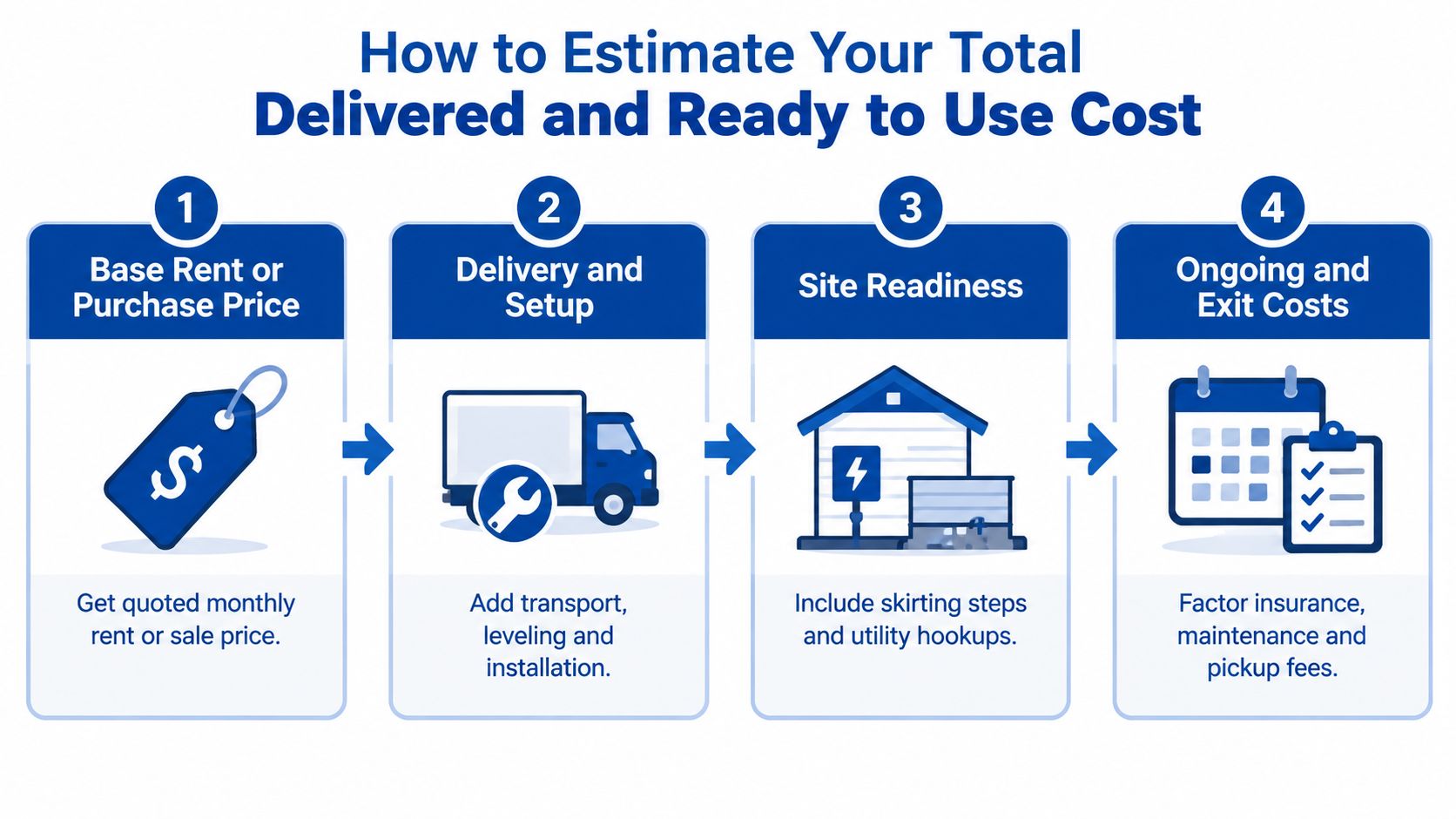
Total delivered and ready-to-use cost = base rent or purchase price + delivery and setup + site readiness and utilities + operating and exit costs.
The formula is straightforward. The work lies in assigning a site-specific allowance to every category and recording what the vendor excludes.
Step 1, establish the base cost
Estimate the required floor area, select a size tier, and decide whether the project calls for a rental or purchase. Broad rental guidance places base rates at approximately $200 to $1,800 per month. New purchase pricing commonly falls between $18,000 and $85,000, depending on size and configuration. These figures are starting points, not delivered project totals.
For a rental, confirm the term, renewal assumptions, included features, and charges for early return or extensions. For a purchase, document the unit's condition, improvements, warranty terms, and ownership responsibilities. A low purchase price can still leave a large site-work allowance.
Step 2, price delivery and setup
Give the vendor the exact address, access route, placement area, and target date. Request separate line items for transport, mileage, route restrictions, blocking, leveling, anchoring, and removal.
A 12×60 trailer illustrates the exposure. It may suit the staffing plan, yet a narrow approach, limited staging area, or uneven placement zone can complicate delivery and positioning. The monthly rate will not show that risk.
Step 3, verify site readiness
Confirm how power will reach the trailer and who arranges licensed connections. Price water, sewer, HVAC work, grading, skirting, stairs, ramps, and permits before issuing the purchase order. A modular construction cost resource can help separate building-related expenses from site and project costs.
Site readiness determines whether the delivered unit can operate. Schools and healthcare projects may require accessibility provisions and controlled utility work. Construction sites may rely on temporary power or face rough ground, changing the setup plan and schedule.
Step 4, add operating and exit costs
Include insurance, maintenance, furniture, security features, cleaning, damage exposure, storage, and pickup. Short deployments need close review because fixed delivery and removal charges can consume a substantial share of the rental budget.
Request an all-in schedule of values rather than a single monthly figure. Every line should show whether it is included, estimated, optional, or assigned to another party. That format exposes the difference between a trailer delivered to the property and one ready for staff to use.
Budget control starts with exclusions. Every item marked “by others” needs an owner, a cost allowance, and a deadline.
Hidden Fees and Budget Pitfalls to Avoid
A low monthly rent can still produce a high project invoice. Delivery, placement, connections, access equipment, operating requirements, and removal may sit outside the advertised rate, often across separate vendors and contract notes. Budget control starts by pricing the trailer as delivered and usable on the actual site.
A quote that omits delivery and setup deserves immediate review. Those charges can include transport, blocking, leveling, anchoring, and pickup. Short deployments face greater exposure because fixed logistics costs take up more of the rental budget (mobile office delivered-cost guidance).
Quote review checklist
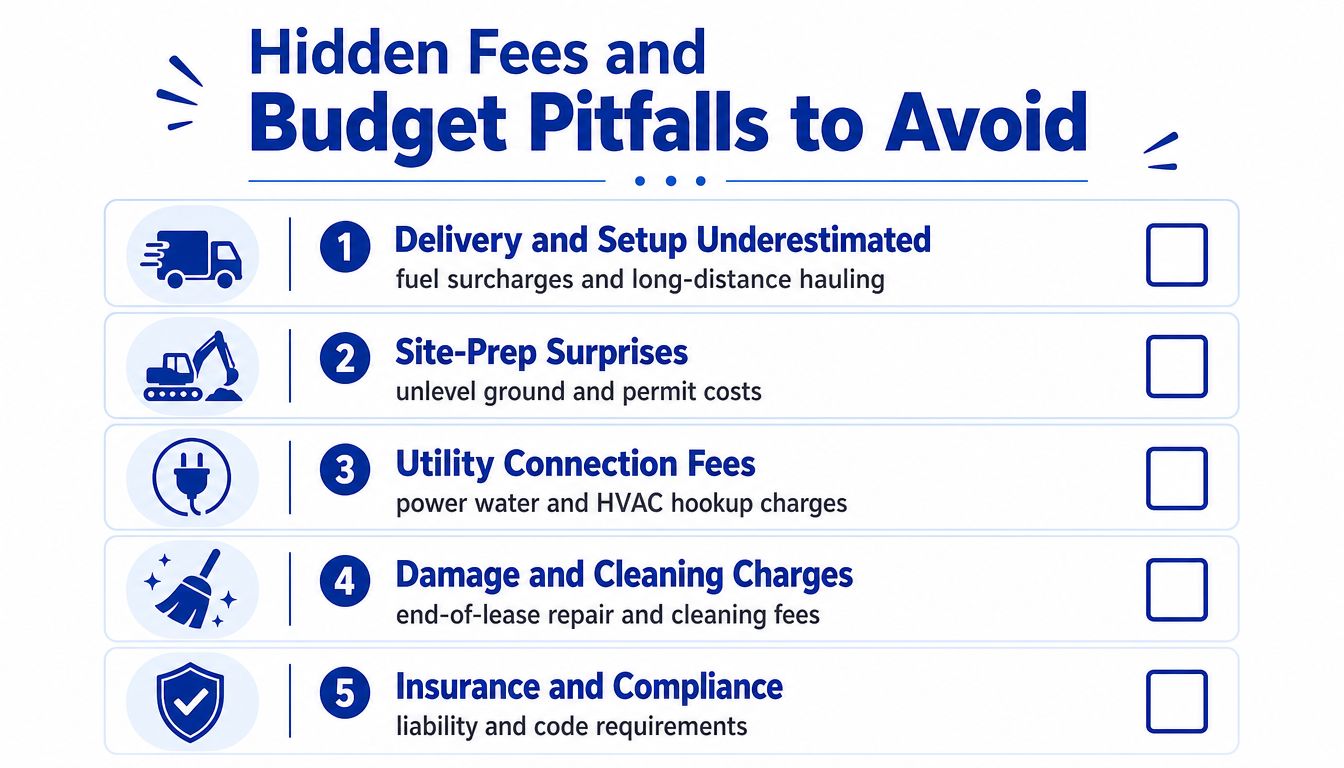
- Delivery and setup: Confirm mileage, fuel or distance adjustments, blocking, leveling, anchoring, and pickup. Ask whether a narrow entrance, restricted route, or difficult placement area changes the transport plan.
- Site preparation: Verify grading, permits, ground conditions, staging, and access to the placement area. An open-looking site may still require work before installation.
- Utility connections: Identify who supplies electrical service, water, sewer, HVAC connections, and licensed trade work. Internal trailer systems do not automatically include connections to site services.
- Access equipment: Price stairs, handrails, canopies, ADA ramps, skirting, and other entry components before approval. These items determine whether staff can enter and use the unit safely.
- Damage and cleaning: Review end-of-lease cleaning standards, repair responsibility, inspection procedures, and pickup conditions.
- Insurance and compliance: Confirm liability coverage, local code requirements, permits, accessibility obligations, and occupancy documentation.
What tends not to work
Comparing one vendor's monthly rent with another vendor's delivered total creates a false bargain. Selecting a unit before confirming headcount can lead to unnecessary space, while choosing the smallest option without mapping workflow may force a replacement.
Compressed schedules increase the cost of omissions. If utility access, ramps, or placement conditions remain unresolved until delivery week, correcting them can delay occupancy and add emergency work.
Ask one question in every procurement meeting: “What does a delivered, usable trailer actually cost on this site?”
Require the answer in a written proposal with assumptions attached. Site photos, utility information, delivery access details, and the intended placement area help vendors identify cost volatility before the contract is finalized. Review each line marked “by others” and assign an owner, allowance, and deadline before issuing approval.
Getting an Accurate Quote and Planning Your Next Move
Accurate budgeting begins before a vendor receives a request for pricing. The project owner should define the operational need, select a realistic size tier, and provide enough site information for the vendor to price the work rather than guess at it.
A complete request for quotation should include:
- Project location: Provide the address, delivery entrance, access restrictions, and placement area.
- Space requirement: State headcount, private-office needs, conference functions, storage, and expected workflow.
- Schedule: Include the desired delivery date, expected duration, possible extension, and removal target.
- Site information: Attach photos, ground-condition details, utility locations, and information about power, water, or sewer access.
- Required accessories: List stairs, ramps, skirting, furniture, security features, connectivity, restrooms, and other essential additions.
- Commercial format: Request separate pricing for rent or purchase, delivery, setup, site work, utilities, ongoing charges, and removal.
This format makes proposals comparable. It also shows where a vendor needs a site visit or additional engineering review before committing to a final number.
Turnkey support can reduce the coordination burden when a project involves multiple trades, public procurement requirements, or a compressed occupancy schedule. Pacific Mobile Structures, Inc. provides mobile office trailers for lease and sale, along with modular construction services, accessories, site components, and delivery and setup support for temporary and permanent space needs. Organizations should still request a site-specific scope and verify every inclusion before approval.
The strongest procurement decision isn't the one with the lowest advertised rent. It's the one that aligns the trailer footprint, amenities, term, delivery plan, utility scope, and exit obligations with the actual site. That approach gives school districts, healthcare operators, public agencies, and contractors a defensible budget and fewer operational surprises.
For a site-specific estimate, gather the delivery address, intended placement area, headcount, schedule, utility details, and required access or furnishing packages. Then visit Pacific Mobile Structures, Inc. to request pricing for a mobile office trailer or modular solution that reflects the delivered, ready-to-use cost rather than the headline rental rate.