
The trailer is already on the yard, the stairs are still on the truck, and the crew is looking for somewhere to sit. That is how construction site trailer rentals go wrong more often than the monthly rate suggests. The unit shows up late, the pad is soft, the only door faces a crane swing, and the office sits empty while the job keeps moving.
A field office that gets used every day is a site-integration job, not a delivery. Size follows who sits down in it each day. Cost follows permits, utilities, and every month the schedule slips. Placement follows truck access, drainage, and a punch list that still holds after the first rain.
Table of Contents
- Size the Trailer to Your Crew and Floorplan
- Comparing Total Cost by Project Length
- Confirm the Order Before You Sign With a Leasing Partner
- What to Inspect on a Rental Trailer Before You Accept It
- How to Prepare the Site and Utilities Step by Step
- Delivery and Installation Timeline From Order to Occupancy
- Safety Handover and Accessibility Checks Before Occupancy
Size the Trailer to Your Crew and Floorplan
A superintendent orders a 40-foot office for six people, then finds the crane swing blocks the only door. The drawing was fine. The yard was not. Size the unit from who sits down daily, not from total headcount. Add a meeting table only if owners or inspectors show up every week.
| Use case | Typical occupants | Layout notes |
|---|---|---|
| Field superintendent or inspector | 1-2 | Desk, plan storage and phone space |
| Site office with meeting space | 3-6 | Desk area plus a small conference table |
| Owner or design team office | 6-10 | Private office and separate meeting room |
| Crew break and restroom facility | 15-25 | Set restroom count with the authority having jurisdiction |
| Secure materials storage | Not occupied | Ground-level, lockable, placed near the work area |
Read the row for daily use, then price what the layout adds. One long unit means one delivery and one set of steps. Two linked units add a second set, a weather joint, and often a second permit look. A restroom in the trailer pulls water and sewer onto the critical path. A restroom in a nearby building drops that work if the walk stays short. Desk and conference packages cost less than a week of borrowed furniture. A lockable storage room keeps drawings off the open yard. Compare those choices against published mobile office trailer floor plans before you lock a length.
Who the exemption actually covers
The U.S. Access Board generally exempts structures tied to the actual construction process, including construction trailers, from many ADA scoping requirements. That exemption does not settle a school swing classroom, a clinic, a public counter, or other use outside active construction. Temporary facilities can still fall under the ADA, and an accessible route may be required from the arrival point to a covered entrance. An occupancy permit or local inspection does not by itself establish ADA compliance.
Write this down: a one-page use classification listing who enters, what happens inside, and which local rules apply.
Confirm three numbers before any quote goes out: daily occupants, weekly visitors, and the date the trailer must be usable.
Comparing Total Cost by Project Length
A low monthly rate can still produce a costly setup. Total occupancy cost includes rent plus delivery and pickup, blocking and leveling, stairs or ramps, utility connections, permits, grading, security, furniture, repairs, any move to a new pad, and rent during schedule extensions. Price the trailer as a site-integration project, not just a rental. Short emergency deployments often favor renting; longer renovations, phased campuses, or repeat use may make a purchase or relocatable modular building worth comparing.
| Project length | Lean toward | Why | Watch for |
|---|---|---|---|
| Under 3 months | Rent | Mobilization and pickup are spread over a short period | Delivery and setup fees can exceed the rent |
| 3 to 12 months | Rent, unless the unit will be reused | Rent often wins when no reuse is planned | Extensions and site-prep costs |
| 12 to 24 months | Compare both options | Break-even depends on purchase price, resale, and maintenance | Resale value moves with the unit's condition |
| 24+ months or repeat use | Purchase or relocatable modular | Ownership cost spreads across several projects | Storage between jobs and refurbishment |
| Phased or uncertain scope | Rent with extension pricing | Delays extend rent without new mobilization | Fixed monthly rate versus an escalation clause |
Model three schedules: planned completion, a moderate delay, and a major delay. Keep recurring rent separate from one-time mobilization and demobilization, and include pad work, permits, and utility costs in the same comparison. Those costs can change which option is cheaper, especially when the site or schedule shifts.
For example, at $1,200 a month, with $2,500 for delivery and setup and $1,800 for pickup, ten months of rent totals $12,000. Add $4,300 in one-time charges and occupancy costs $16,300. A three-month delay adds $3,600 in rent without another mobilization, bringing the thirteen-month total to $19,900. Compare that figure with the purchase price minus a realistic resale value. If the same unit will move to another site, ownership may avoid paying for another full mobilization. For a multi-year program, compare a basic office trailer with a ground-level office or relocatable modular building on the same worksheet. The differences between modular and portable buildings help frame differences in foundation, transport, and resale.
Public buyers may need the full lifecycle comparison to support procurement, rather than relying on the rent line alone. Rental rates can rise during a long rental, so put a fixed extension rate or capped escalation in the quote. That term matters when delays add months of occupancy without another mobilization.
Confirm the Order Before You Sign With a Leasing Partner
Settle one question before price: who carries site work, permits, utility tie-ins, and restoration. Build a shortlist and ask every provider the same things. Pacific Mobile Structures, Inc. belongs on that list alongside other regional lessors, not as a default.
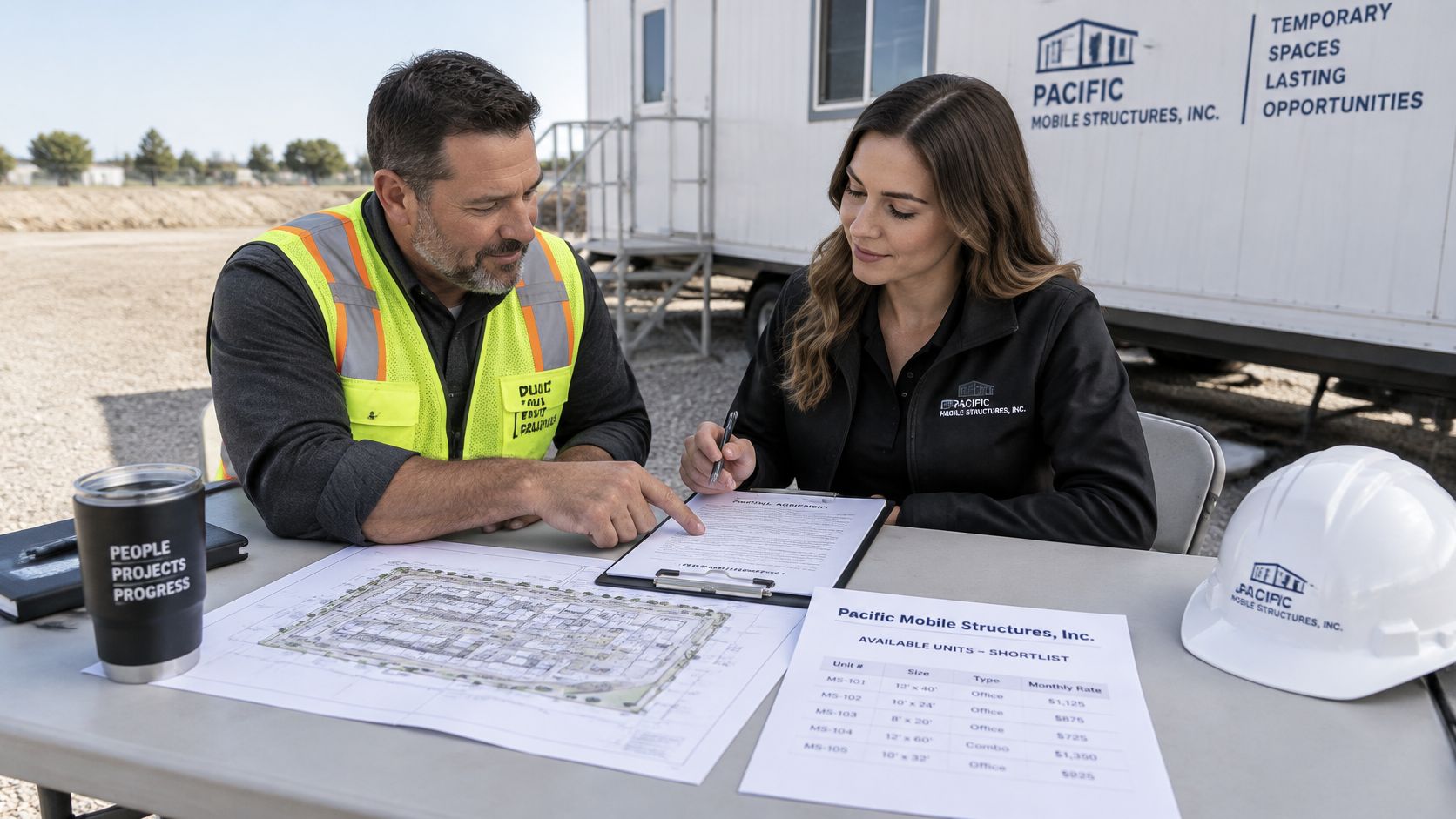
Ask how each unit was inspected and reconditioned, and whether the record and recent photos can be shared. Ask whether the quote includes delivery, blocking, leveling, and utility connections, who pulls permits, how fast a failed component is replaced, and what restoration is due at pickup. Public buyers should also ask whether the provider holds a cooperative contract such as TIPS or KCDA, which can shorten procurement.
Match the contract to this list before anyone signs:
- Rent schedule with extension pricing and any escalation cap.
- Itemized mobilization and demobilization fees.
- Insurance and liability limits.
- Delivery window, and who clears truck access.
- Service response time for a failed component.
- A signed punch list tied to the pre-delivery inspection.
Request one quote covering three durations and the full site-prep scope. Sign only after punch-list ownership and permit ownership are in writing.
What to Inspect on a Rental Trailer Before You Accept It
A rental can look clean in photos and still hide a soft floor or a bad circuit. Fresh paint covers stains. It doesn't fix them. Ask for the inspection record and recent photos, then walk the unit in daylight with the provider's representative and the site lead.
- Floor: press near the entry and under the desk line. A spongy spot means water got into the deck.
- Ceiling and walls: brown stains, sagging tiles, loose panels, and missing skirting are stop signs.
- Doors and windows: latches must catch, and seals should be intact. A door that won't latch is a security and weather problem.
- Power: test every outlet and light. Warm outlets, or a breaker that trips on a lamp and a heater, mean the unit goes back.
- HVAC: run a full heating cycle and a full cooling cycle, not a ten-second fan check.
- Plumbing: run sinks and flush toilets. Look under every trap for a drip.
Ask what was repainted, re-floored, or replaced, and when. "Reconditioned" is a claim until the parts list is dated. Agree a written punch list, a fix deadline, and who pays, and get it signed before the unit is placed. A passed pre-delivery inspection doesn't finish the job. The same walk repeats after set, because grading, mud, and temporary power create new faults.
Treat that punch list like any other asset on the job. A Value Tools Co maintenance scheduling guide is a useful model for dating each check and naming who closes it, so a warm outlet doesn't become "someone was going to look at that."
How to Prepare the Site and Utilities Step by Step
A trailer can arrive on schedule and still sit unused if the pad, access route, permits, or utility tie-ins are not ready. Treat site preparation as part of the rental cost: assign responsibility for permits, civil work, connections, temporary accessibility, fire protection, and restoration before signing. Include the time and cost of that work when comparing the rental term, since delays can lead to extensions while the unit remains unoccupied.
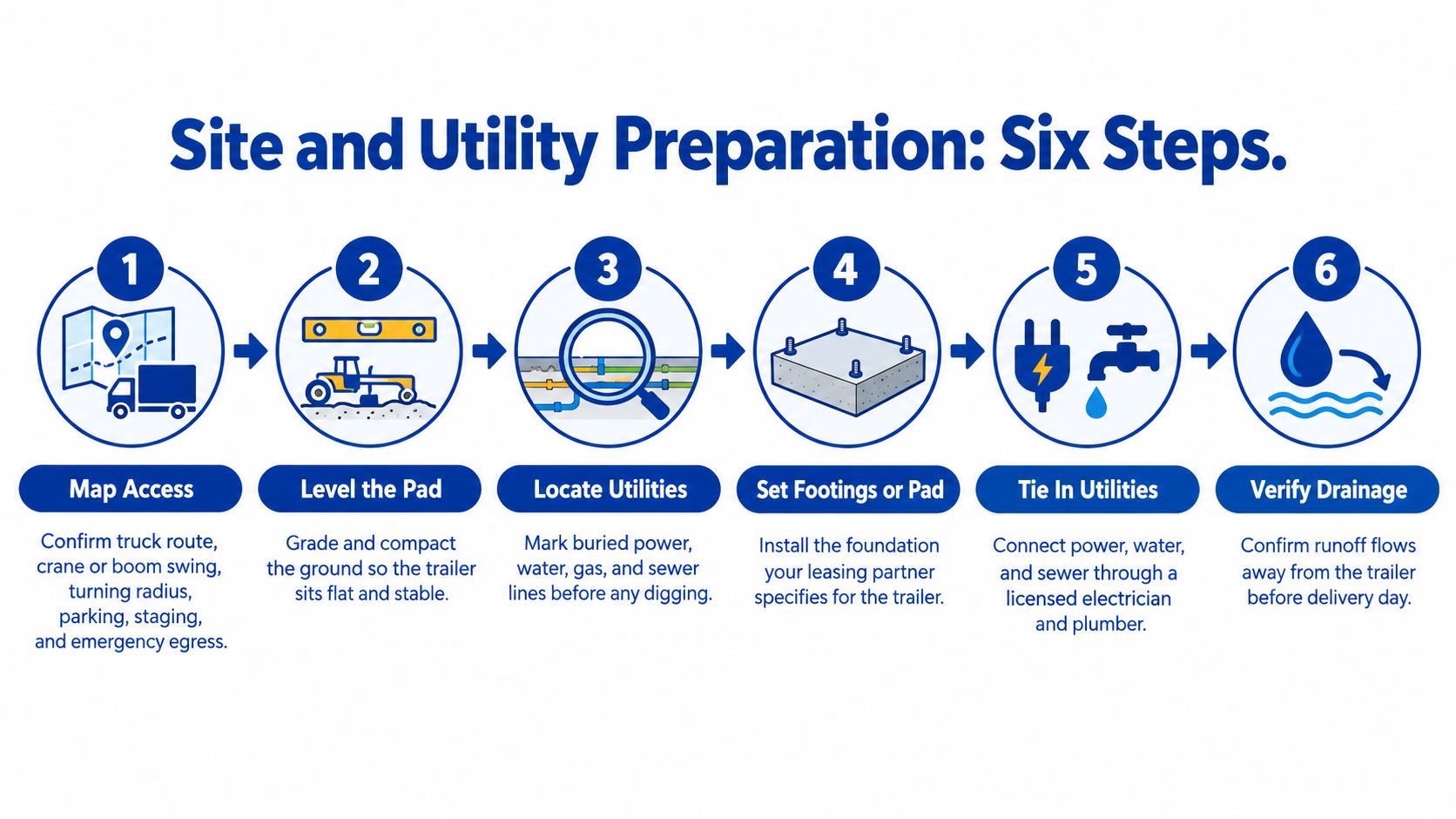
Map access. Confirm the truck route, crane or boom swing, turning radius, parking, staging area, and emergency egress. Check the route before booking delivery. A tight gate or blocked turning area can delay placement and add site-work costs.
Verify connection points. Mark water, sewer, electrical service, communications, and fire-service access on the site plan before trenching. Do not assume the nearest pole or pipe can serve the trailer; confirm connection locations and capacity with the relevant utility providers.
Screen the ground. Check for wetlands, culturally sensitive areas, and floodplain exposure before excavation. Starting ground work before these constraints are understood can halt the set and leave the rental waiting.
Secure approvals. Confirm building, zoning, accessibility, and utility permit requirements with the local jurisdiction. Include tie-downs and wind bracing where local rules require them, and assign someone to track approvals before scheduling site work.
Prepare the pad. Level and compact the base, grade drainage away from the unit, set anchorage, and trench to the marked connection points. Add the steps, ramps, and skirting required by the floorplan. An uneven pad can bind doors, while drainage toward the skirt can expose the floor to water damage. For temporary power, follow the electrical standards for a mobile office trailer and have a licensed electrician make the tie-in.
Inspect the installed unit. Before occupancy, check that the trailer is level, doors swing freely, utility connections are complete, and fire protection is in place. Resolve problems before the crew begins using the space.
Coordinate perimeter controls with the site work, including preventing breaches along site boundaries. A trailer placed outside the controlled gate can become a weak point, particularly while crews and equipment are moving through the work area.
Delivery and Installation Timeline From Order to Occupancy
Delivery day is rarely the critical path. Permits and utilities usually are. The ranges below are typical, and they move with the jurisdiction, the season, and crew availability.
| Phase | Typical duration | Usual owner | What can slip it |
|---|---|---|---|
| Scope and floorplan sign-off | 2 to 5 days | Project manager | Late headcount or use changes |
| Site survey and access check | 1 to 3 days | Site superintendent | Tight turns and low overhead lines |
| Permits and utility approvals | 2 to 8 weeks | Contractor and jurisdiction | Plan review queues |
| Pad, drainage and trenching | 3 to 10 days | Site contractor | Rain and unlocated buried lines |
| Delivery and set in place | 1 day | Rental provider | Crane or truck access and delivery window |
| Utility tie-in and inspection | 1 to 5 days | Licensed trades and inspector | Inspector scheduling |
| Occupancy handover | 1 to 2 days | General contractor and safety lead | Open punch-list items |
Pad work can run while permits are in review only where the jurisdiction allows early site work. Utility tie-ins wait on the inspector, not on the truck. A school district that needs swing classrooms by August should start permitting in February, because a plan-review queue alone can run six weeks.
Sign the scope first, confirm access and utilities second, then book delivery. Pickup needs the same truck path as delivery, so write the removal route and the restoration obligation into the order, not into the last week. Add two weeks to any date the owner needs, and put a delay clause in the rental so an extension doesn't reprice the whole deal.
Safety Handover and Accessibility Checks Before Occupancy
The trailer can pass its factory inspection and still be unsafe to occupy. Grading, weather, mud, temporary power, changing traffic, and debris alter conditions after the unit is set. Treat handover as a site check, not a paperwork step.
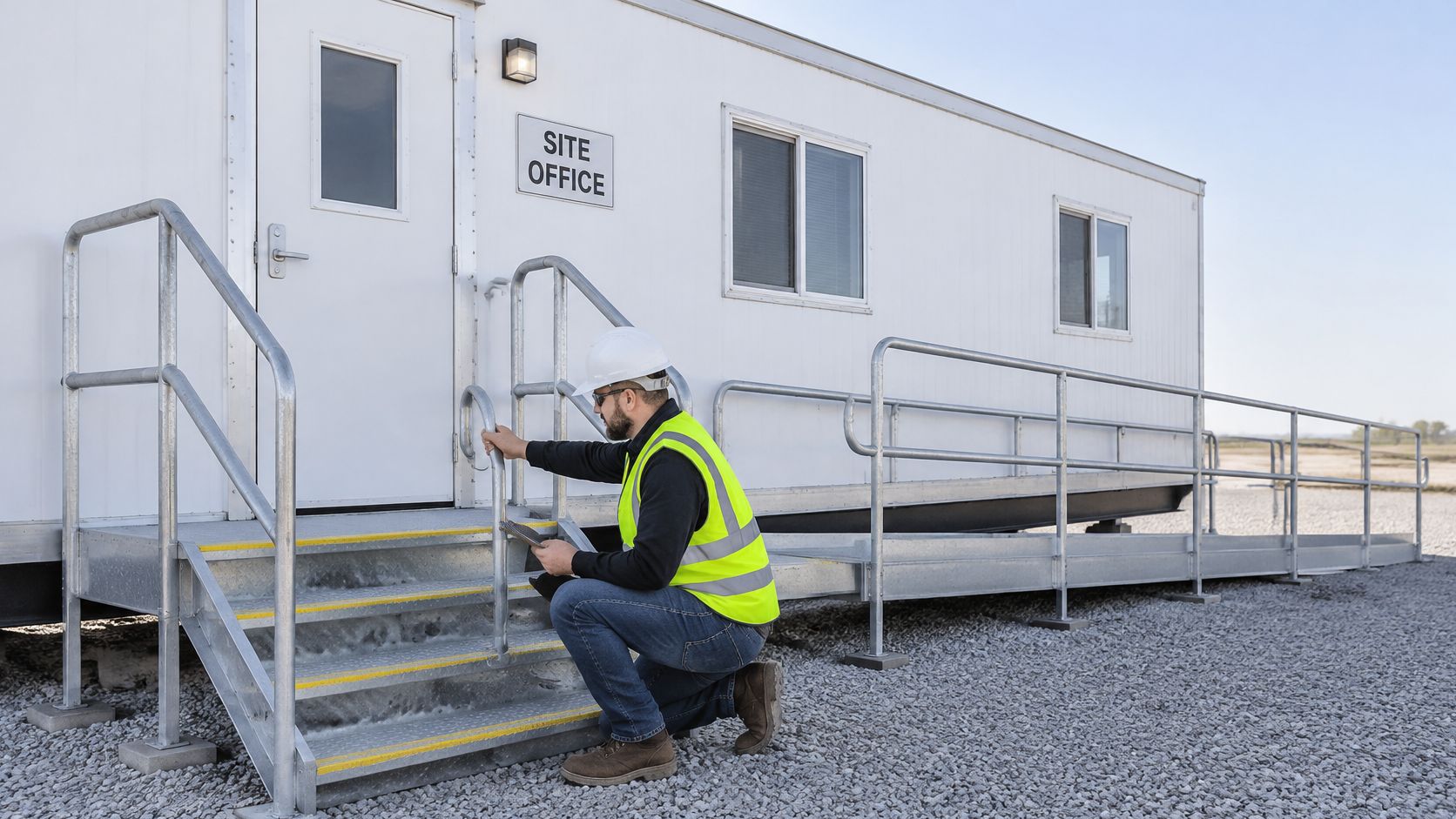
Before keys go out, walk the placed unit with the safety lead. Check stairs, ramps, guardrails, walking surfaces, lighting, electrical distribution, fire extinguishers, HVAC, doors, and emergency exits. Falls are a leading cause of construction fatalities, as summarized in the OSHA construction falls summary. OSHA generally requires fall protection at six feet or more above a lower level, using guardrails, safety nets, or personal fall-arrest systems. For a raised entry, document the protection plan and confirm that the steps are secure. Where staff or the public need a code stair, specify ADA-compliant stairs during handover, and check ramp slope and handrails against the standard that applies to the use.
Separate people from equipment. Route pedestrians away from truck and forklift paths, and keep the loading zone clear of the trailer door. Mark overhead and underground hazards, post the site emergency plan, and brief occupants on evacuation routes and restricted areas.
If the public will enter, check the accessible route from the arrival point to the door. The ADA generally limits ramp running slope to 1:12 and calls for handrails when the rise exceeds six inches. Measure the slope with a level rather than estimating by eye.
Brief the crew on routes before occupancy. Record the briefing, then walk the routes together so people can identify exits and restricted areas in place.
Reinspect after severe weather, relocation, utility changes, or a major layout change, and retain the records through demobilization. Check stairs again after wet weather; a pre-delivery photo cannot show whether a step has loosened in mud.
Pacific Mobile Structures, Inc. leases and sells mobile office trailers, storage containers, and modular buildings, and provides delivery, setup, and furnishings for construction offices and swing space. Ask for a quote that prices the unit, site work, and any rental extension together.