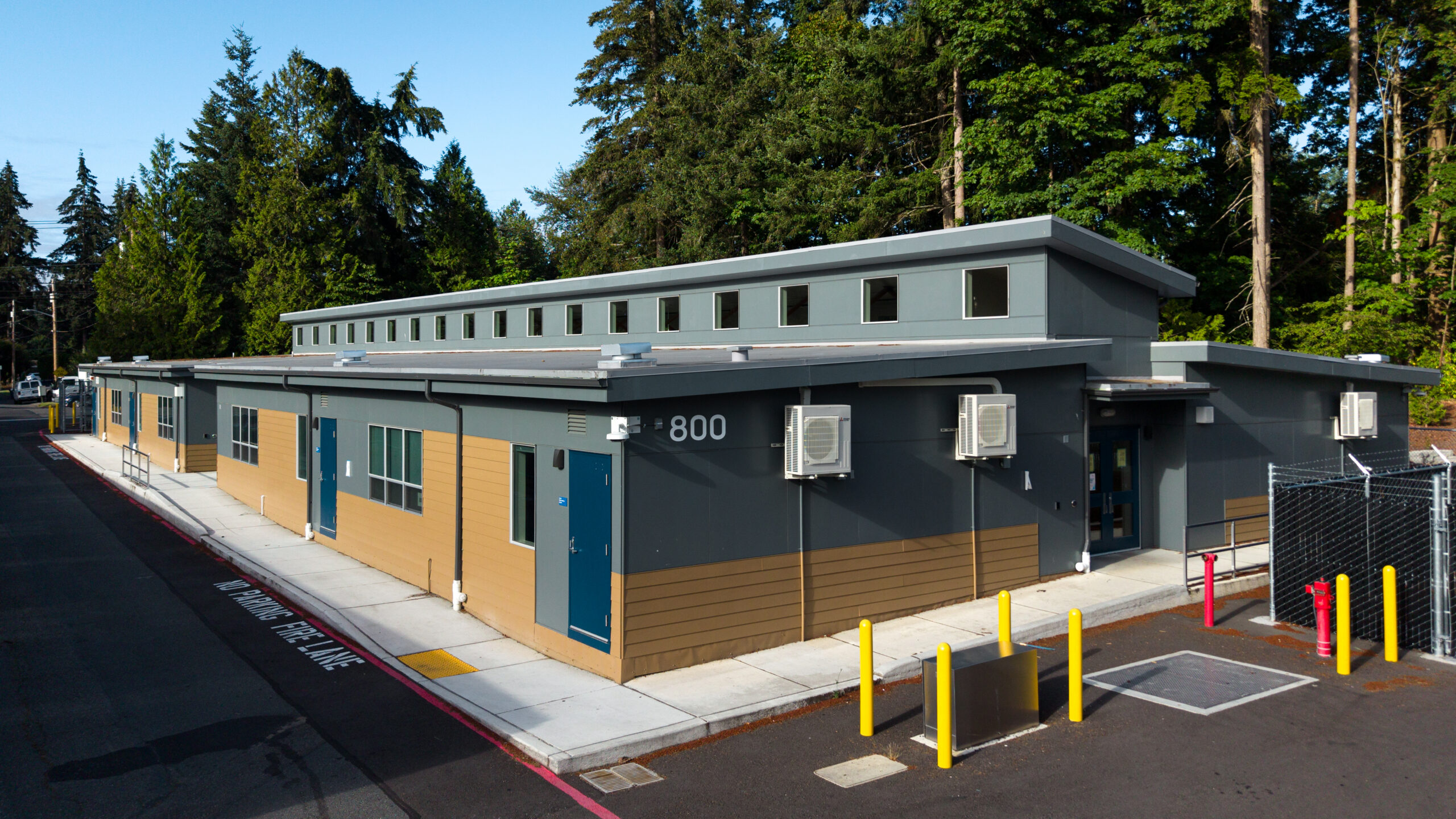
A basic used 40-foot container can cost roughly $1,500, while a fully configured, modified, and delivered unit at a remote site can exceed $15,000. There is no single cost of a 40 ft container because the final amount depends on condition, route, delivery, placement, permits, and the work needed to make the unit usable.
A facilities manager may start with a supplier quote that appears comfortably within budget. Then the project adds inland transport, unloading, ground preparation, access work, inspections, electrical connections, and modifications. The container itself remains the same, but the delivered and operational cost changes sharply.
That distinction matters for schools, contractors, healthcare providers, public agencies, and commercial operators. The right question isn't just, “What does the steel box cost?” It's “What will it cost to have a functional container in the required place, ready for its intended use?”
Table of Contents
- The Hidden Costs Behind a 40 Ft Container Price
- Understanding What Drives Container Pricing
- Purchase Versus Rental Evaluating Your Options
- Building a Realistic All-In Project Budget
- The Strategic Value of Modular Space Solutions
- Common Misconceptions About Container Costs
- Final Thoughts on Budgeting for Your Project
The Hidden Costs Behind a 40 Ft Container Price
A project manager approves a low container quote for temporary storage. The supplier price looks manageable, but the final invoice includes delivery from a distant depot, difficult site access, a crane, ground leveling, and changes required for the intended use. The original quote wasn't necessarily wrong. It was incomplete.
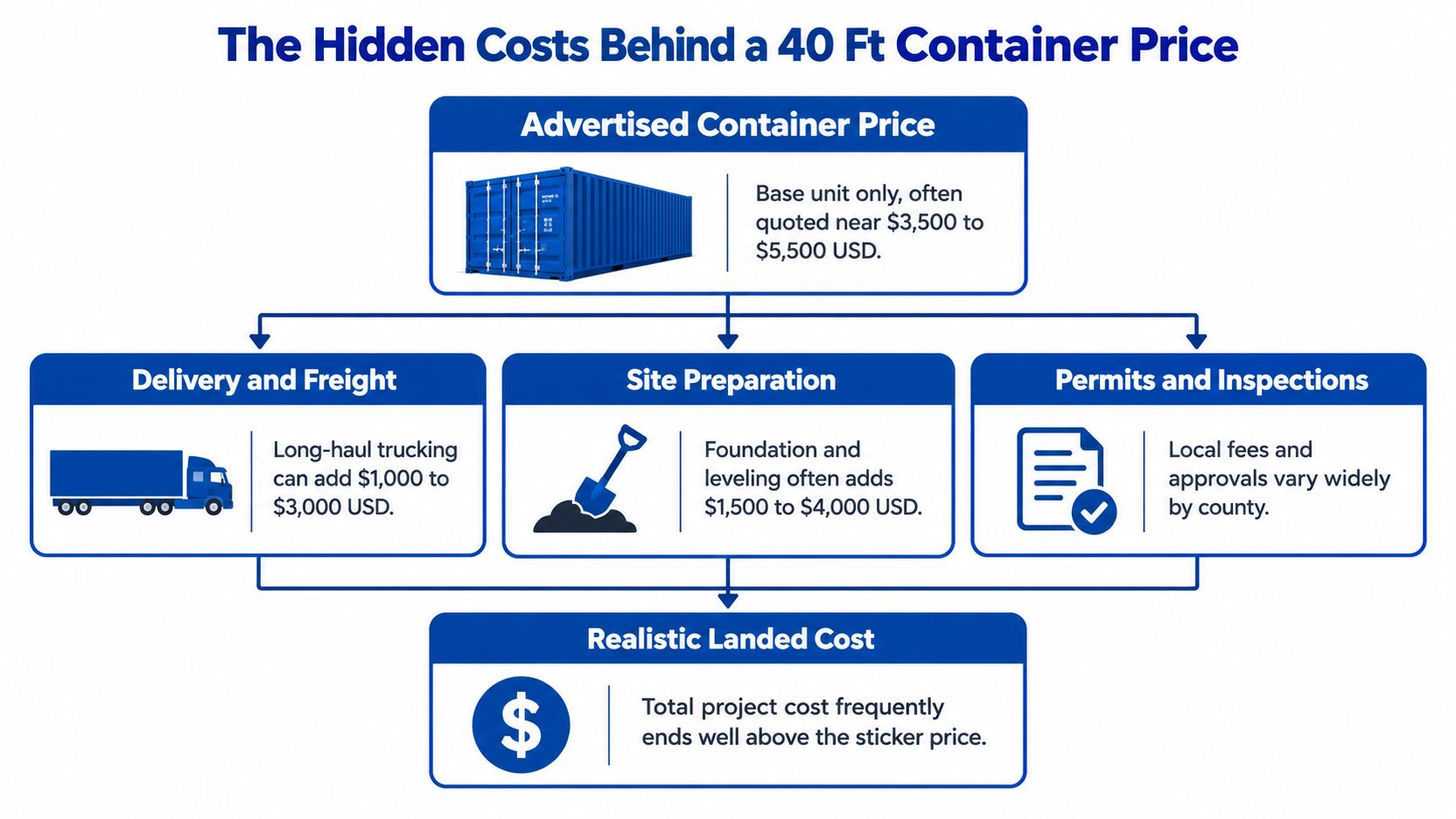
The cost of a 40 ft container is a package of expenses, not a universal retail price. A used wind-and-watertight unit may be suitable for basic storage, while a cargo-worthy unit or office configuration carries different acquisition, certification, and preparation requirements. Recent market estimates place used wind-and-watertight units around $1,500 to $2,100, while a new 40-foot high-cube unit may fall around $4,000 to $7,000, before project-specific deployment costs (container pricing guidance).
Why the delivered figure changes
The final budget usually contains several separate cost centers:
- Equipment: Purchase or lease price, condition grade, height, flooring, doors, and certification.
- Transport: Origin handling, freight, destination charges, drayage, and final-mile trucking.
- Placement: Driver time, tilt-bed delivery, crane service, access planning, and positioning.
- Site work: Leveling, gravel, concrete supports, drainage, utility connections, and restoration.
- Approvals and changes: Permits, inspections, insulation, electrical work, doors, windows, ventilation, or interior finishes.
A useful import-cost framework should separate the product price from customs, transport, handling, and other landed expenses. DreamBid's guide to import expenses provides useful context for that broader landed-cost approach.
The same discipline applies to domestic procurement. A supplier quote should identify whether freight, unloading, placement, and site conditions are included. A quote that says “delivered” may still exclude a crane, permits, foundations, or utility work.
Practical rule: Treat the advertised price as the first line of the budget, not the budget itself.
Before requesting bids, the buyer should record the destination address, access conditions, intended use, required condition, placement surface, and project duration. A 40-foot container rental price guide can also help establish whether temporary use should be evaluated against ownership.
Understanding What Drives Container Pricing
Container pricing behaves more like a route-dependent logistics cost than a fixed equipment price. Two visually similar units can have very different delivered costs because one is near a depot and the other requires long-haul transport, special placement, or international freight.
Condition is the first major variable. A basic used storage unit may show dents, surface rust, faded paint, or flooring wear. A cargo-worthy unit must satisfy more demanding transport requirements, and a new or one-trip unit may be preferable where appearance, clean surfaces, and modification potential matter. The buyer shouldn't pay for a higher grade unless the application benefits from it.
Freight can overwhelm the equipment comparison
Ocean rates have shown extreme volatility. On the Shanghai to New York route, UNCTAD reports an approximate rate of $2,325 per FEU in September 2019, rising to $3,979 in December 2020 and $11,778 in September 2021. Those negotiated gate-in/gate-out figures included terminal-handling and ocean-transport charges, making them broader than a bare ocean-line base rate (UNCTAD Review of Maritime Transport).
The Drewry World Container Index provides another useful benchmark. Its average was approximately $1,420 per 40-foot container in 2019, reached $10,377 in September 2021, and stood at $5,901 in July 2024. Reported late-June route figures included approximately $7,322 from Shanghai to Rotterdam, $6,673 from Shanghai to Los Angeles, and $7,827 from Shanghai to New York, demonstrating why route and timing matter (Drewry World Container Index coverage).
Domestic buyers may not pay those exact ocean rates, but the principle remains important. Fuel, congestion, equipment imbalance, diversions, port capacity, and distance from inventory can alter the delivered figure. Practical storage advice, such as MG Self Storage's discussion of storage containers, is useful for understanding the difference between a container as a storage asset and a container moving through a freight network.
A 40-foot high-cube dry container provides approximately 76.4 cubic metres, or 2,697 cubic feet, of internal volume, with a tare weight of about 3,940 kilograms and a nominal payload near 28,560 kilograms, subject to transport and cargo-distribution limits (40-foot high-cube technical specification). Buyers should compare condition, usable volume, payload, certification, and deployment cost together. A guide to container grades helps prevent a low sticker price from hiding unsuitable condition.
Purchase Versus Rental Evaluating Your Options
Buying creates an asset and requires more capital at the start. Renting reduces the initial commitment and can make sense when the project duration, site, or future need is uncertain. The correct choice depends on total time on site, relocation plans, condition requirements, and who pays for delivery, maintenance, damage, and removal.
Public estimates place 40-foot rental pricing around $100 to $350 per month, with longer leases commonly around $100 to $185 per month. Purchase prices may range from roughly $1,300 to $7,000, depending on condition and specification (rental cost guidance).
At $150 per month, 24 months of rent equals $3,600 before delivery, pickup, damage, and site charges. At $250 per month, the same period equals $6,000. Those calculations don't automatically make ownership cheaper, because buying also involves delivery, placement, capital, maintenance, and eventual transport. They do show why short-term and long-term decisions should be separated.
| Option | Upfront Cost | Monthly Cost | Best For |
|---|---|---|---|
| Purchase | Higher equipment payment plus delivery and placement | Usually no rental payment after purchase | Reusable assets, long-term storage, stable sites |
| Rental | Usually lower initial commitment, with delivery and site charges possible | Approximately $100 to $350, depending on agreement and market | Short, uncertain, or mobile projects |
| Lease with defined term | Contract-dependent initial charges | Agreed recurring payment | Projects needing predictable budgeting and service terms |
Match the contract to the project
Rental tends to work when a construction site may close, a facility renovation has an uncertain schedule, or the container will move between locations. It also transfers some ownership responsibilities, although the agreement must be checked for damage, access, pickup, and return conditions.
Purchase becomes more compelling when the organization can reuse the unit, preserve its condition, and keep transport costs controlled. A buyer should calculate total cost at 6, 12, 24, and 36 months, using the same delivery, placement, removal, and maintenance assumptions for both choices. That calculation is more reliable than comparing a monthly rental figure with a purchase price alone.
The number of units matters too. One 40-foot unit provides substantial volume, but two smaller units may improve separation, access, and redeployment. A larger box isn't automatically the lowest-cost capacity choice if the site layout or operating process makes it difficult to use.
For buyers evaluating ownership, 40-foot storage containers for sale provide a useful reference point for comparing available specifications and purchase pathways.
Building a Realistic All-In Project Budget
A defensible estimate starts with a written scope, not a supplier catalog. The buyer should describe what the container must do, where it will sit, how it will arrive, and whether it must remain transportable. That information prevents an inexpensive storage unit from being compared with a modified office or a certified freight container as if they were identical products.
Build the estimate in separate lines
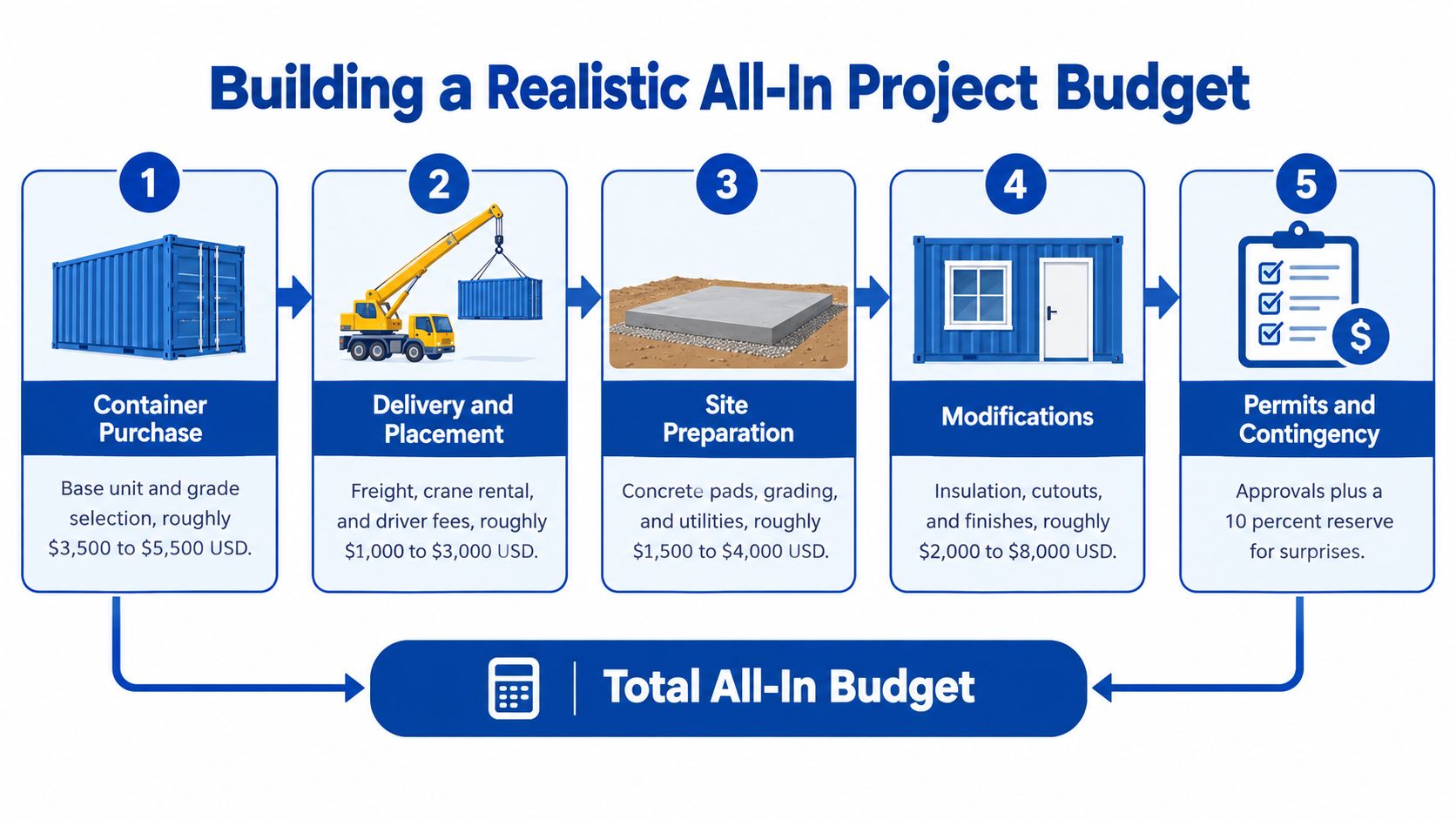
Define the container. Record standard or high-cube format, condition, doors, floor condition, ventilation, certification, and intended use. A high-cube unit offers more vertical space, but its additional height and tare weight can affect handling and legal payload.
Price transport and placement. Request separate figures for origin handling, ocean freight if relevant, destination terminal charges, customs, drayage, final-mile trucking, crane service, and placement. A 2026 market example cited Shanghai to Rotterdam freight near $2,308 and Shanghai to New York near $3,671, with bunker-related surcharges potentially adding 10% to 20%. Broader estimates placed additional terminal handling, documentation, customs, government fees, and drayage around $800 to $2,500 beyond base ocean freight (2026 freight cost guidance).
Inspect the site before ordering. Check road width, turning space, overhead clearance, ground bearing, slope, drainage, and the route from truck to final position. A container may arrive on schedule but still require a crane or additional site work if the truck can't safely reach the intended location.
Separate site work from modifications. List foundations, grading, gravel, concrete supports, leveling, utility trenches, electrical service, insulation, doors, windows, HVAC, security, and interior finishes. Don't bury these in a vague “setup” allowance.
Add approvals and risk controls. Confirm zoning, building, fire, electrical, accessibility, and transport requirements with the relevant authority. Keep contingency as a clearly identified reserve rather than hiding it inside the container price.
The final spreadsheet should show equipment, transport, handling, insurance, permits, site preparation, modifications, placement, commissioning, removal, and future relocation as separate lines. That format reveals which assumptions drive the result and makes supplier quotes comparable.
A facilities team should request one quote for a basic storage deployment and another for the fully configured requirement. Comparing those two scopes shows whether the organization needs a container, a ground-level office, or a broader modular solution.
The Strategic Value of Modular Space Solutions
A container can solve more than a storage shortage. Properly selected and budgeted, it can provide secure space near a work area, support continuity during renovation, or create a temporary operating point without committing immediately to permanent construction.
The value comes from speed, reuse, and controlled scope, but those benefits disappear when the organization ignores access, utilities, compliance, or future movement. A low-cost unit placed on an unsuitable surface can create door, drainage, security, or maintenance problems. A modified unit can become difficult to transport if changes affect certification or structural performance.
Budgeting supports operational flexibility
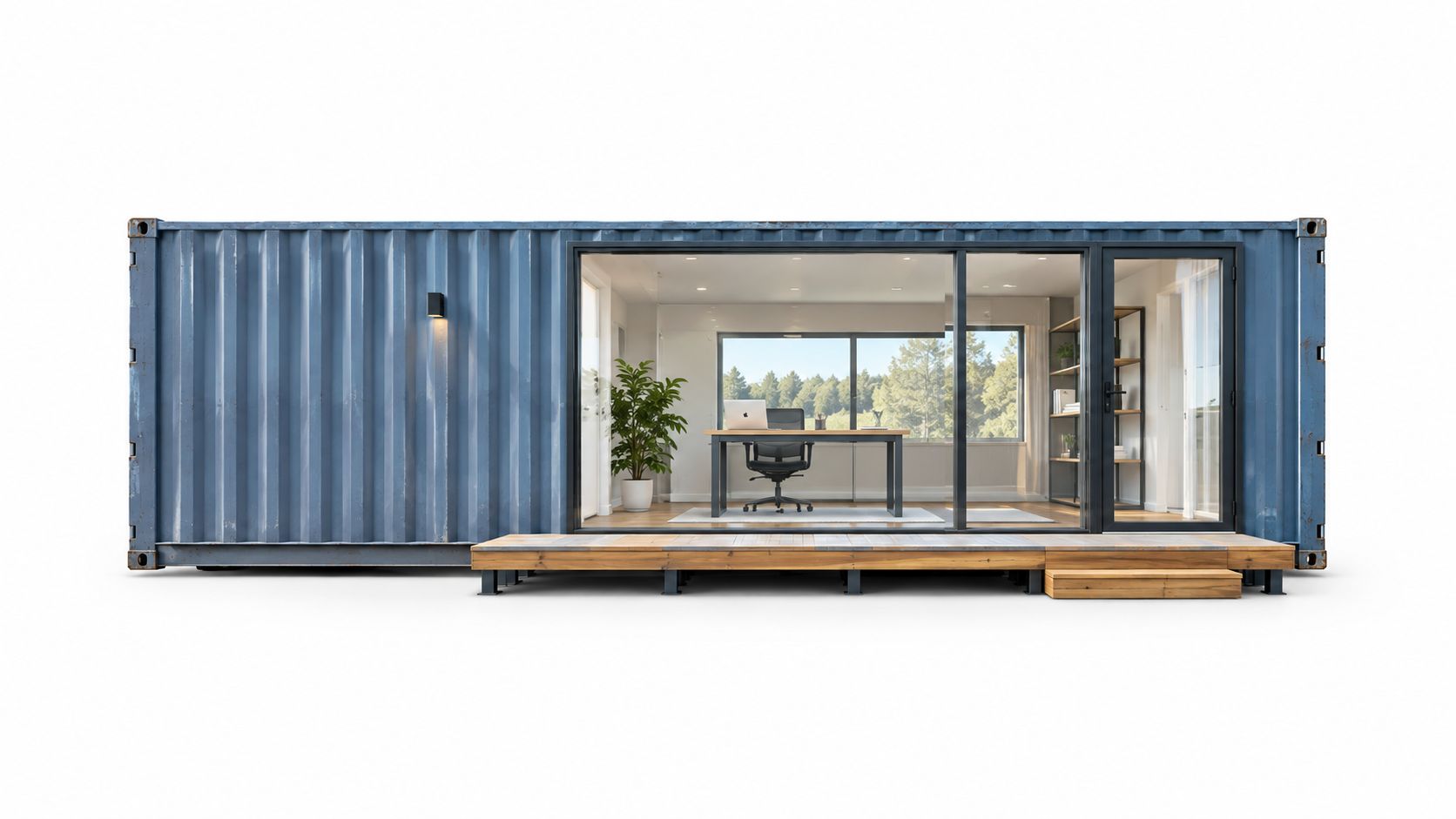
A strong procurement decision considers the next use, not only the current deployment. A storage unit may later move to another project. An office container may need steps, ramps, furniture, power, climate control, and accessibility features. A school, clinic, agency, or contractor should decide whether the asset is temporary, relocatable, or likely to remain in place.
For more complex requirements, a modular lab construction planning tool can help teams think through configuration before committing to site work and fabrication. The same principle applies to container procurement: define the operating function before selecting the cheapest available shell.
Pacific Mobile Structures, Inc. provides storage containers and mobile office solutions for rent and purchase, alongside modular construction services that can include delivery, setup, site components, furnishings, and utility coordination. That type of integrated scope can be useful when the project requires more than an empty container, although buyers should still compare line items and service responsibilities.
The practical test is simple. If the container reduces downtime, protects equipment, supports staff, or preserves operations during a facility change, its value extends beyond the steel. If the project requires extensive modifications, permanent utilities, or regulatory review, a purpose-built modular structure may produce a clearer cost and performance outcome.
Common Misconceptions About Container Costs
The most persistent mistake is treating the advertised unit price as the project price. A supplier may quote the container accurately while excluding transport, unloading, site preparation, permits, or modifications. Those exclusions become budget problems only after the purchase decision has been made.
A cheap unit isn't always economical
A basic used container may be perfectly suitable for weather-protected storage. It may be a poor starting point for an office, clinic, classroom, or customer-facing installation where rust, floor condition, insulation, interior finish, and door operation affect the work.
The reverse mistake happens too. Buyers sometimes specify a near-new unit for a use that only requires dry storage. Paying for appearance or condition that won't improve the operation ties up funds without creating equivalent value.
The correct grade is the one that satisfies the use case, transport requirement, and expected service life. It isn't automatically the newest or cheapest grade.
Another misconception is that “delivered” always means “placed.” Delivery may mean the truck reaches the site, while final placement requires a tilt-bed maneuver, clear access, leveling, or a crane. The quote should state whether delivery includes unloading, positioning, blocking, leveling, and removal of transport equipment.
DIY work can create false savings
Owner-performed site preparation may reduce labor cost where the ground is already suitable and the work is simple. It becomes risky when grading, drainage, lifting, electrical work, structural cutouts, or permits are involved. A small mistake can cause door alignment problems, water intrusion, unsafe lifting, or rework after the container arrives.
Modification is another area where low bids can mislead. Cutting openings into a steel shell, adding doors, installing insulation, routing electrical systems, and preserving structural performance require coordinated trades. The right comparison isn't DIY versus contractor price in isolation. It is the total cost of materials, equipment, time, inspection, correction, and liability.
Finally, a 40-foot unit isn't always the most efficient format. Two smaller units may improve access and staging, even if the combined transport cost is higher. The best decision reflects the operating layout, not only the volume calculation.
Final Thoughts on Budgeting for Your Project
The cost of 40 ft container procurement should be presented as a landed project figure. Equipment price is only one line. Transport, handling, placement, ground conditions, approvals, modifications, utilities, and future removal can determine whether the project stays within budget.
A reliable estimate identifies the intended use, selects the appropriate condition, confirms the route, inspects the site, and compares purchase with rental over the expected time on site. It also tests uncertain schedules instead of assuming the project will end on the original date.
The strongest procurement teams ask suppliers for transparent, itemized proposals. They compare like with like, preserve flexibility where it has operational value, and avoid paying for specifications that the project doesn't need.
Pacific Mobile Structures, Inc. offers storage containers and mobile office solutions for rent and purchase, with modular construction, delivery, setup, and related site services for organizations that need usable space rather than an empty box. Visit Pacific Mobile Structures, Inc. to discuss the container specification, landed-cost assumptions, and deployment requirements for the project.