A project manager has found a clean-looking mobile office trailer used by another contractor, and the seller's price appears to solve the space problem immediately. The trailer has offices, HVAC, and a restroom. The site needs workspace next month. The temptation is to compare the asking price with a new unit and sign.
That comparison is too narrow. The question is whether ownership will cost less than rental after inspection, reconditioning, transport, site preparation, utilities, permits, and eventual resale. A used trailer can be an excellent asset, but a cheap unit with a damaged subfloor, incomplete title, or unsuitable site approval can become an expensive project before anyone moves in.
Table of Contents
- Should You Buy a Used Mobile Office Trailer
- Pricing Benchmarks for Used Mobile Office Trailers
- How to Inspect a Used Mobile Office Trailer
- What Reconditioning Should Cover Before Delivery
- Delivery, Site Prep, and Utility Hookups
- Permits, Codes, and Hidden Costs Buyers Overlook
- Your Decision Framework for Buying Used
Should You Buy a Used Mobile Office Trailer
Start with the break-even question before inspecting a listing. A used unit can cost 40% to 60% less than a new trailer, according to this used mobile office trailer pricing guide. That discount helps only when the trailer stays useful long enough to recover purchase, delivery, setup, repair, and later relocation costs.
For one project, buying deserves serious consideration when the need lasts years instead of months. A predictable, multi-phase construction site, a recurring seasonal operation, or work scheduled beyond the early rental period gives ownership time to absorb those costs. Short assignments, uncertain schedules, and operations that must expand or contract quickly usually favor rental.
Use this comparison to frame the first spreadsheet. It is a planning model, not a quoted market schedule. Local rental rates, financing terms, transport charges, site work, and trailer condition will change the result.
| Project Duration | Buy, Monthly Cost | Rent, Monthly Cost | Recommendation |
|---|---|---|---|
| Short assignment | Purchase, delivery, and setup concentrate ownership costs at the start | Rental preserves flexibility and limits residual risk | Rent unless the trailer already has a confirmed second use |
| Extended project | Continued occupancy spreads purchase costs, while repairs and resale remain the buyer's responsibility | Rental is simpler but continues adding monthly charges | Compare both offers using all-in costs |
| Long-duration or recurring use | Ownership may become more economical after transport and setup costs are spread across deployments | Repeated rental may cost more over time | Buy when condition and local resale demand are strong |
A useful planning window for many single-unit decisions is about 18 to 36 months. Treat it as a trigger for analysis, not a promise. Financing, condition, project duration, and residual value can move the break-even point substantially. Build the spreadsheet before issuing a purchase order.
Operational fit belongs in that same calculation. Reliable internet, secure rooms, adequate lighting, and usable workstations determine whether the trailer functions as a project office rather than a weatherproof shell. Use this guide to a productive mobile office to review connectivity and workspace requirements before delivery. If the required capacity exceeds a trailer's practical layout, compare used modular buildings for sale instead of forcing an undersized unit to serve the site.
Practical rule: Purchase price is only the first ownership line. Put every repair, permit, move, hookup, and future use into the same decision.
Track these categories from the first quote:
- Acquisition: purchase price, taxes, title work, and financing.
- Condition: inspection findings, required repairs, and contingency.
- Logistics: freight, applicable escorts, crane or placement equipment, and relocation.
- Site: pad, blocking, anchoring, ramps, steps, and drainage.
- Utilities: electrical, water, sewer, holding tanks, communications, and inspections.
- Exit: storage, resale, next deployment, or disposal.
A short project can favor rental even when the used trailer's asking price looks attractive. Buying becomes stronger when the unit will serve several projects and the buyer can control its condition, site requirements, and next deployment.
Pricing Benchmarks for Used Mobile Office Trailers
A low asking price can mislead a project manager. Compare each unit by size, age, prior use, configuration, title status, restroom condition, HVAC history, transport distance, and local inventory. Those factors determine whether the trailer supports the project or becomes a repair and logistics problem.
The pricing benchmarks cited in the previous section place common used units in these ranges:
| Size Class | Typical Age Range | Asking Price Range | Common Features |
|---|---|---|---|
| 8×20 | Typically 8 to 15 years old | $3,500 to $9,000 | Compact office, basic HVAC, doors, windows |
| 10×40 | Typically 7 to 14 years old | $10,000 to $25,000 | Larger office layout, more work area, possible restroom |
| 12×60 | Typically 6 to 14 years old | $12,000 to $30,000 | Multiple offices, larger circulation area, possible restroom |
| 24×44 double-wide | Typically 5 to 12 years old | $19,000 to $45,000 | Broader floor plan, multiple rooms, institutional or project use |
Treat these figures as planning ranges, not promises that a specific trailer will sell within them. A unit at the low end may need substantial work, while a higher-priced trailer may include documented repairs and a clearer delivery scope.
The useful comparison is asking price versus delivered, occupiable cost. A $10,000 trailer is not a $10,000 project if the buyer must correct the roof, replace flooring, arrange a long-distance move, install a ramp, and complete utility work. A higher asking price can make sense when the seller provides reconditioning records, service documentation, a clear title, and realistic transport terms.
Depreciation creates buying opportunities, but it also demands a close inspection. The cited guide indicates that purchasing often makes financial sense after about three years of continuous use, because depreciation is steep early in the asset's life. It also estimates that standard wood-framed trailers may retain only 20% to 30% of their purchase price after five years. That creates regular trade-in and resale inventory. Take advantage of the depreciation only when the lower value reflects normal age, not structural failure.
Location can change the decision quickly. A trailer near the intended site may cost less overall than a cheaper unit farther away once freight, permits, and placement are included. Request a delivered quote before comparing listings. Require it to identify the trailer, transport scope, site assumptions, utility exclusions, and any reconditioning allowance.
For larger requirements, mobile office trailer cost guidance helps frame the difference between a standard single-wide, a larger unit, and a connected modular arrangement. Set the budget around the amount required to make the space legal, functional, and movable, not the lowest number in an online listing.
How to Inspect a Used Mobile Office Trailer
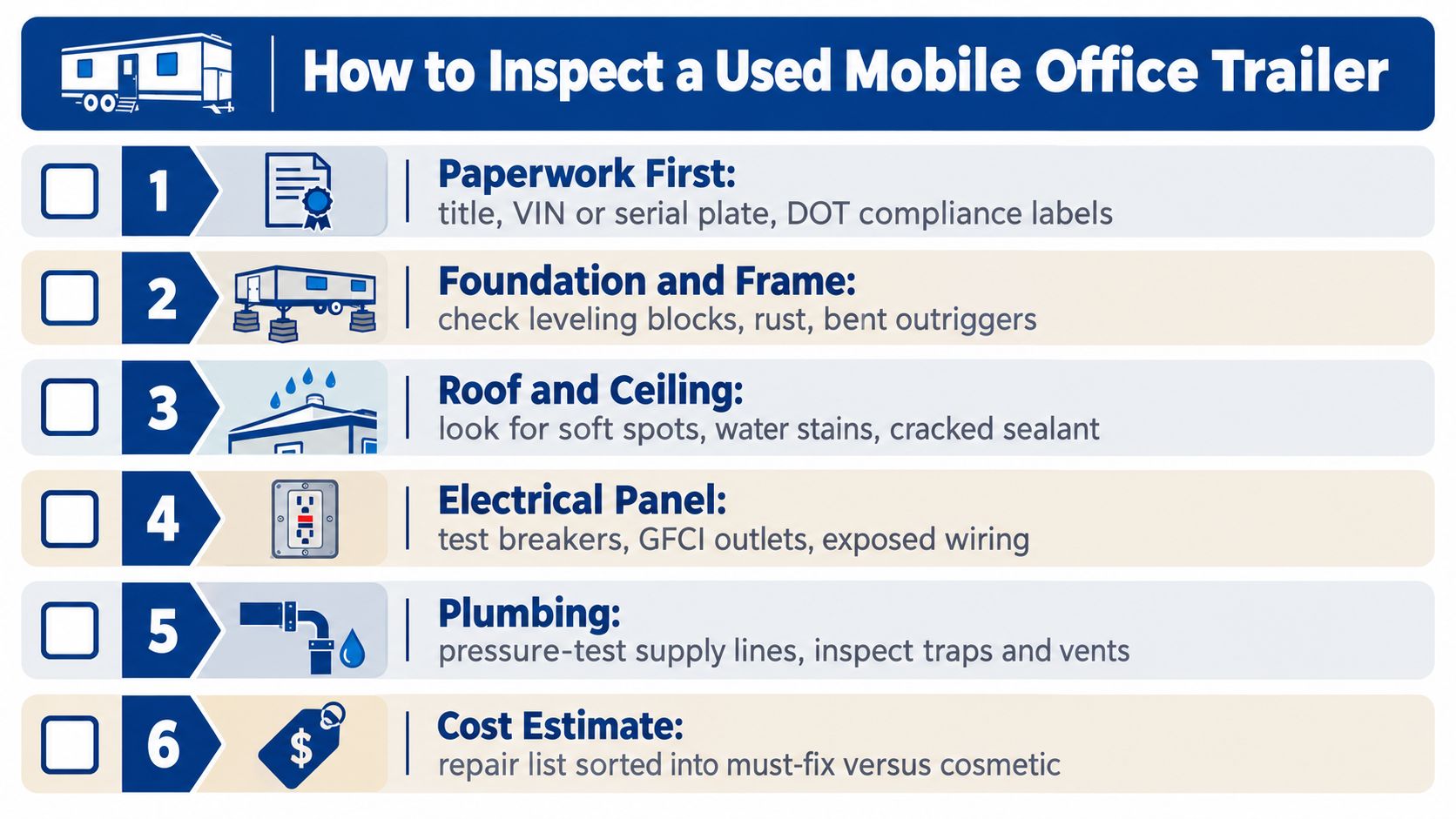
A used trailer should be inspected in a fixed sequence. Buyers who start with paint color and cabinet condition often miss the expensive evidence underneath. The inspection should begin with identity and ownership, move to the structure and envelope, then finish with mechanical and life-safety systems.
Start with documents and identity
Request the clear title, the VIN or serial plate, prior-use records, compliance labels, and service documentation before committing money. The VIN-stamped plate should match the seller's paperwork. A mismatch isn't an administrative nuisance. It can delay titling, transport, insurance, and resale.
The buyer should request underside, roof, electrical-panel, HVAC-nameplate, and floor photographs before traveling to the lot. Those images won't replace an inspection, but they can eliminate obviously unsuitable units and expose areas the listing photographs avoided.
Inspect the frame before the finishes
Walk the perimeter with a flashlight. Examine cross-members, axle mounts, outriggers, the tongue, hitch, tires, lights, and visible welds. Cosmetic surface rust is common on older equipment. Structural rust at cross-members, axle mounts, or the hitch is a reject condition, not a cosmetic repair item, as outlined in this used office trailer inspection guidance.
Bring a moisture meter, outlet tester, flashlight, and level. Check whether doors close squarely and whether the floor feels consistent as the inspector walks from the entry toward the HVAC pad and restroom. Soft spots near doors, restrooms, or exterior walls often point to water intrusion below the visible finish.
Test the envelope and systems
Inspect roof seams, penetrations, flashing, ceiling stains, wall-panel joints, window seals, and weatherstripping. Diagonal movement or cracking around openings deserves careful documentation, and this resource on diagonal crack warning signs provides useful context for separating surface movement from a more serious concern.
At the electrical panel, photograph the labeling, test representative outlets and GFCI protection, and look for exposed wiring or heat damage. Record the HVAC make, model, age, service history, and operating condition. Under sinks and restroom fixtures, check supply lines, traps, drains, and signs of previous leaks.
The deal should stop when the seller can't establish ownership, the identification plate doesn't match, structural rust is present, the floor has widespread softness, or water damage remains active and unexplained. Cosmetic work can be priced. Unresolved structure and moisture can consume the entire purchase advantage.
What Reconditioning Should Cover Before Delivery
Reconditioning is the buyer's strongest negotiating tool because it converts vague promises into a defined scope. The seller should state what will be repaired, who will perform the work, how completion will be verified, and what warranty applies.
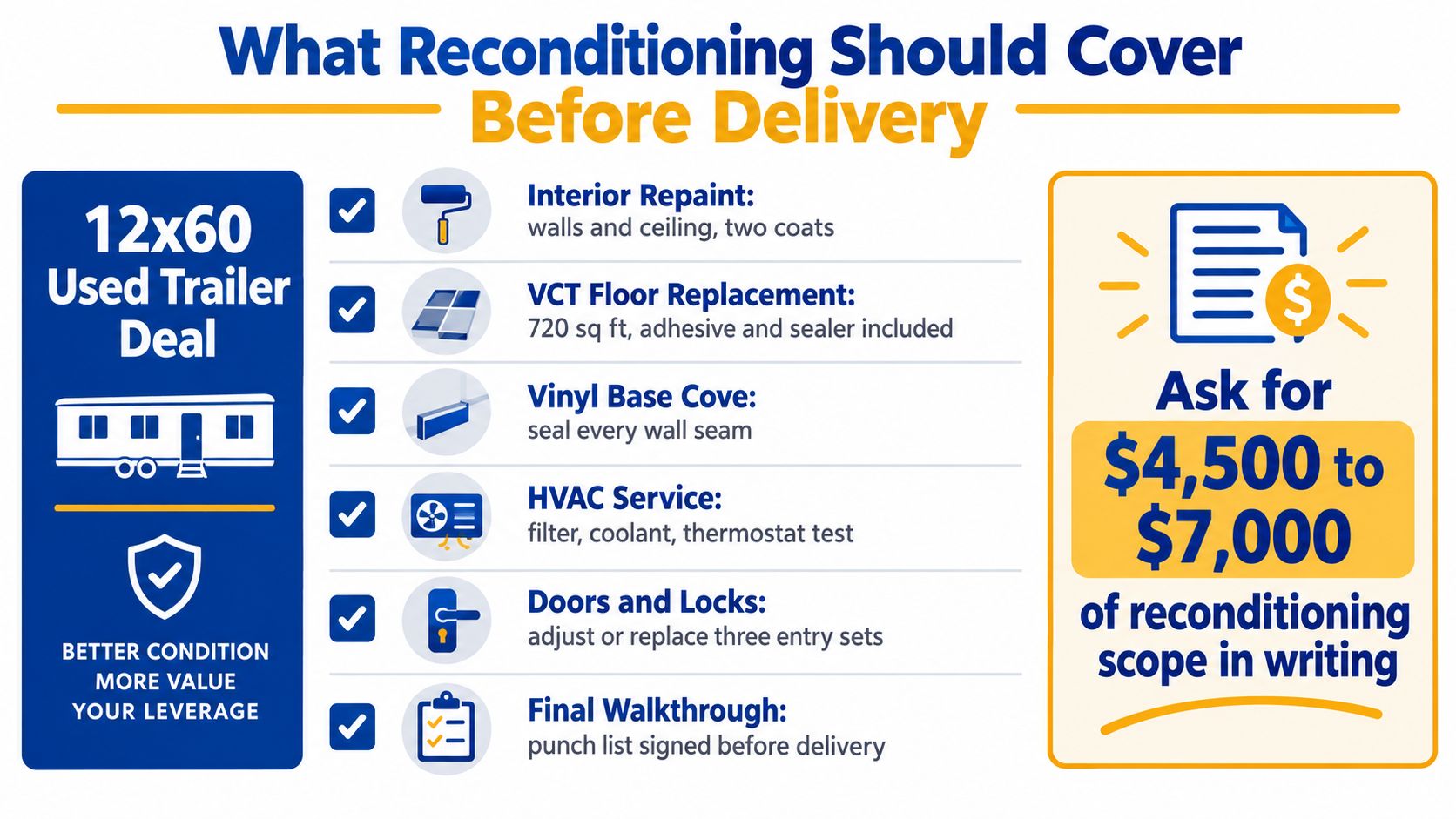
Consider a representative 12×60 negotiation. Cosmetic work might include interior repainting, VCT flooring, vinyl wall-panel patching, and an HVAC filter change. The supplied scenario places that scope at $4,500, reducing a $14,000 asking price to an $8,500 sale when the buyer negotiates the work into the deal. Those figures are a negotiation example, not a universal estimate.
Separate cosmetic work from risk control
Paint and flooring improve presentation, but they don't correct a leaking roof or a wet subfloor. A sound cosmetic package can make sense when the frame, roof assembly, and utilities are documented as serviceable.
A structural scope is different. Subfloor replacement, roof-seam resealing, axle and tire work, electrical-panel review, and an accessibility retrofit can push the repair budget beyond $12,000 in the provided scenario. That level of exposure should trigger a hard question about whether the seller is offering a used trailer or transferring an unfinished rehabilitation project.
The written scope should cover:
- HVAC: service, filter replacement, refrigerant check, thermostat test, and operating-temperature verification.
- Electrical: panel inspection, breaker labeling, outlet testing, GFCI verification, and correction of exposed wiring.
- Plumbing: pressure test, fixture operation, drain inspection, and leak repair.
- Envelope: roof seams, exterior joints, window seals, door weatherstripping, and water-entry points.
- Floor system: moisture mapping, soft-spot repair, subfloor review, and finish installation.
- Access: steps, ramps, handrails, and accessibility features required for the intended use.
The seller should provide a scope-of-reconditioning letter, itemized invoices, before-and-after photographs, and at least a 90-day warranty on completed work. The buyer should also reserve the right to inspect the finished unit before dispatch.
Negotiating position: A buyer shouldn't pay retail for repairs that remain undocumented. Either the seller completes the work and proves it, or the purchase price must reflect the unresolved exposure.
Delivery, Site Prep, and Utility Hookups
A trailer isn't ready for occupancy when it leaves the seller's yard. Delivery becomes a chain of dependencies, and one missed dependency can cause storage charges, a failed set, or a second mobilization.
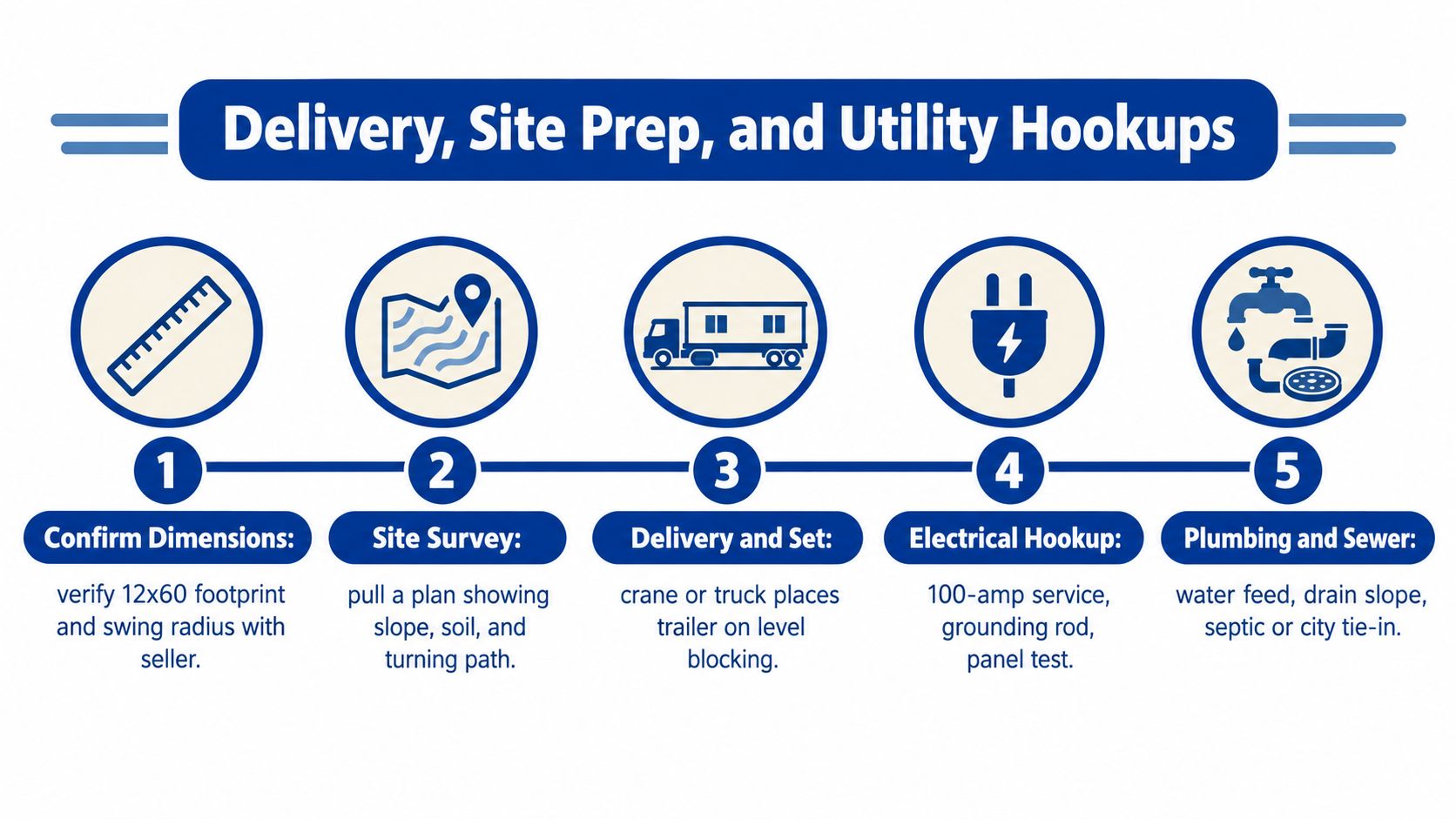
First, confirm the actual dimensions, weight information, hitch arrangement, clearance requirements, and placement points with the seller. A site survey should show the travel path, turning radius, overhead obstructions, power-line clearance, slope, soil condition, and available bearing area. The site must accommodate both the trailer and the equipment required to place it.
Prepare the site before the truck arrives
The foundation approach depends on local conditions and the planned duration. Options can include concrete supports, a prepared gravel area with blocking, or ground anchors. Frost depth, drainage, wind exposure, soil bearing, and local code determine whether a simple setup is acceptable.
The transport company should be selected for the trailer's size and weight, with a hauler that carries the appropriate authority and insurance. Oversize requirements may apply to wider units, and the buyer should confirm permits, route restrictions, escort needs, and utility-line clearance before scheduling.
Placement equipment must arrive in the same delivery window. If a crane, tilt-bed, or specialized set crew is required, a missed appointment can create handling and storage charges. The installation scope should identify who supplies blocking, leveling, tie-downs, steps, ramps, skirting, and final adjustments.
A practical pre-delivery sequence looks like this:
- Two weeks before delivery: confirm dimensions, site drawings, permits, route, and utility responsibility.
- Before transport: complete grading, pad or support work, access clearance, and utility trenching.
- Delivery day: set the trailer, level it, install supports, and verify doors and windows operate.
- After setting: connect electrical, water, sewer, communications, and required safety equipment.
- Before occupancy: test systems, document deficiencies, and schedule inspections.
The modular building installation process is a useful reference when the project includes more than a simple trailer placement.
A short visual overview can also help the field team understand the order of work:
Permits, Codes, and Hidden Costs Buyers Overlook
A used trailer isn't automatically cheaper. The seller's quote often excludes the exact work that determines whether the unit can legally operate at the intended site.
Permit requirements vary by jurisdiction and occupancy. A temporary trailer on an active construction site may receive different treatment from a unit used for a public-facing sales office, classroom, clinic, or long-duration administrative operation. Local guidance also indicates that a permit is often unnecessary for some temporary construction-site placements with an active building permit, while longer-term, public-facing, or residential-neighborhood placements are more likely to require approval. The local building department should be contacted before the purchase becomes irreversible.
Identify the code triggers early
Temporary public or institutional use can require documentation for structural strength, fire safety, exits, accessibility, lighting, ventilation, sanitation, and utility connections. A unit can look clean and still fail occupancy because the electrical hookup, water connection, sewer arrangement, ramp, or life-safety documentation is incomplete. The temporary-structure permit checklist illustrates the type of final inspection coordination that may be required.
The buyer should ask whether the intended use triggers a building permit, electrical permit, plumbing approval, right-of-way approval, anchoring review, or accessibility work. A generator or temporary power source can introduce another approval path, so project teams should review applicable generator permit codes and rules rather than assuming the equipment is exempt.
| Cost Category | Typical Range, USD | Who It Depends On |
|---|---|---|
| Permits and inspections | Varies by jurisdiction | Building, electrical, plumbing, and fire authorities |
| Transport and placement | Varies by route and unit | Trailer dimensions, distance, hauler, crane access |
| Foundation and anchoring | Varies by site | Soil, wind exposure, frost conditions, local requirements |
| Utility connections | Varies by scope | Electrical service, water, sewer, septic, communications |
| Accessibility and life safety | Varies by occupancy | Public access, employee use, exits, ramps, alarms |
| Taxes, title, and registration | Varies by destination | State and local rules |
The most dangerous hidden cost is not a single fee. It is discovering after delivery that the unit needs a different ramp, anchoring method, electrical service, or restroom arrangement than the project budget assumed. The purchase decision should use an all-in estimate that includes acquisition, correction, transport, site work, utilities, approval, and contingency.
For public agencies and institutional buyers, procurement rules add another layer. Documentation, inspection records, title, accessibility evidence, and a clearly defined installation scope can matter as much as the physical trailer. A used unit only creates savings when the project team can put it into lawful service without reopening the budget.
Your Decision Framework for Buying Used
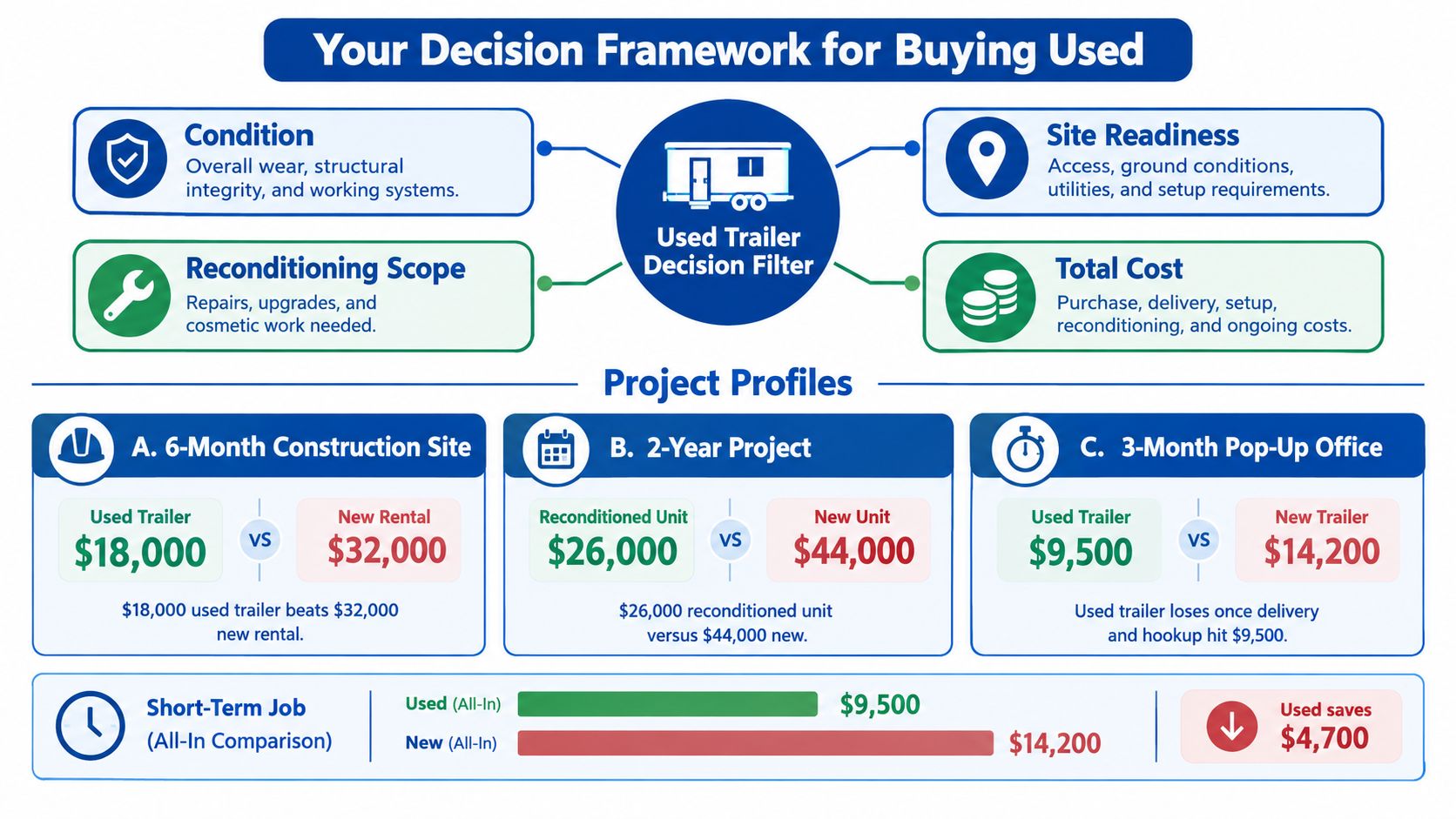
The used purchase decision becomes clear when the project manager stops asking whether the trailer is cheap and starts asking whether the project can absorb ownership risk.
A six-month construction site usually leans toward rental. Delivery and setup costs arrive at the beginning, while the buyer may have little time to recover them before demobilization. Buying can still work if the same unit has a confirmed second deployment, but a single short assignment rarely justifies deep reconditioning or uncertain resale.
A two-year project deserves a full comparison. The longer occupation gives the buyer time to spread fixed costs, use the asset, and plan a later sale or relocation. The purchase only works if inspection results are strong, the site approval is straightforward, and the repair scope is controlled.
A long-term yard office or recurring seasonal operation is the strongest ownership profile. Transport and setup costs can be amortized across continued use, while the organization retains control over layout, maintenance timing, and future deployment. The buyer still needs a realistic exit plan because condition and local demand determine resale value.
Run the five-minute ownership filter
Answer these questions without relying on the seller's optimism:
- How long will the unit stay on site? Include the likely schedule, not only the current contract date.
- Can the project fund transport and site work? A low trailer price doesn't help if delivery, placement, and utilities remain unfunded.
- Will the local jurisdiction approve the intended occupancy? Public-facing, institutional, and extended uses require more diligence.
- Does the region support resale or relocation? A useful exit market protects the buyer's residual value.
- Can the organization manage repairs? Ownership requires a plan for HVAC, plumbing, electrical issues, roof maintenance, and future moves.
Buying used is defensible when at least three of the four core ownership factors, duration, transport budget, permitting tolerance, and regional resale demand, point toward ownership. If condition is weak, the repair estimate is open-ended, or the project timeline is uncertain, rental is usually the more disciplined choice.
Pacific Mobile Structures, Inc. offers used mobile office trailers and other relocatable modular buildings for sale or lease, with services that can include delivery, setup, site work, utilities, and accessories. Project managers comparing a mobile office trailer used for a jobsite or institutional deployment can review Pacific Mobile Structures, Inc. and request a project-specific assessment covering unit condition, reconditioning, installation, and total deployment cost.