Most buyers start with the lock. That's the wrong starting point.
A heavier padlock can help, but it doesn't control who receives the key, whether the container sits in a hidden corner, whether a departing subcontractor still knows the access code, or whether anyone notices the door opening at night. Secure storage containers work best as part of a layered system, combining a resistant enclosure, protected locking hardware, detection, site design, inventory discipline, and accountable people.
That matters most at schools, clinics, public facilities, and job sites where several employees, vendors, and rotating crews need access. The strongest container door can still fail when the wrong person has the key. The practical buyer's question isn't “Which lock is biggest?” It's “Which control is most likely to fail, and what prevents that failure?”
Table of Contents
- Why a Better Lock Won't Actually Make Your Container Safer
- How Standard Container Sizes Shape Your Choices
- The Layered Security Model That Actually Works
- Locks, Reinforcements, and Smart Monitoring Compared
- Lease vs Purchase and How to Decide
- Sizing, Configuration, and Real-World Use Cases
- Maintenance and Inspection Routines That Hold Up
- Putting It All Together and Choosing Your Next Step
Why a Better Lock Won't Actually Make Your Container Safer
The popular advice is simple: buy a bigger padlock and security problem solved. That advice confuses resistance with control.
A thief who finds an open door doesn't need cutting equipment. A person with an old key doesn't care how thick the hasp is. A poorly positioned container can give an intruder privacy, while an unrecorded duplicate key can defeat every mechanical upgrade on the door. A lock is useful only when the surrounding process makes it difficult to obtain, misuse, or ignore.
Tools can attack exposed shackles, hasps, hinges, and door gaps. Protected lockboxes and anti-pry hardware make that work harder, but they don't eliminate the risk. The more common operational failure is simpler: a worker leaves the door unsecured, a code remains active after a crew changes, or nobody checks the inventory after an access event.
Practical rule: Treat the lock as one control in a chain, not as the chain itself.
A sound specification covers five layers:
- Container: A rigid shell, protected hinges, sound door seals, and resistant door hardware.
- Access: Controlled keys, codes, badges, or locks that can be changed when personnel change.
- Detection: Door contacts, motion sensors, cameras, or an alarm path that reaches a responsible person.
- Site: Lighting, visibility, vehicle positioning, anchoring, and restricted approach routes.
- People: Sign-out procedures, delivery verification, inventory checks, and clear responsibility.
The security and container add-ons guide can help buyers identify accessory categories, but the procurement process should begin with the assets and the people who need access. A school storing athletic equipment needs a different control plan from a clinic storing sensitive supplies or a contractor yard holding high-value tools.
The central recommendation is direct: specify the enclosure and lock, then spend equal attention on who can open it, where it sits, how openings are detected, and what happens after a worker leaves.
How Standard Container Sizes Shape Your Choices
Standard dimensions are more than a logistics convenience. They determine which trailers, lifting equipment, stacking systems, doors, shelves, ramps, and resale channels will work with a unit.
The international freight-container system began with standards work by ISO Technical Committee 104 in 1961. ISO 668, the first global standard in this system, was adopted in 1968. Series 1 dimensions established familiar lengths of 10, 20, 30, and 40 feet, with a uniform width and height of 8 feet. Later recommendations standardized corner fittings and identification markings, allowing compatible equipment to lift, move, stack, and inspect containers across markets. These milestones are documented in the history of freight-container standardization.
Standard dimensions and practical implications
| Size | External L x W x H | Internal L x W x H | Usable Volume | Notes |
|---|---|---|---|---|
| 10-foot | 10 ft x 8 ft x 8 ft | Confirm with supplier | Confirm with supplier | Useful where the site has a tight footprint |
| 20-foot | 20 ft x 8 ft x 8 ft | Confirm with supplier | Confirm with supplier | Common balance of capacity and maneuverability |
| 30-foot | 30 ft x 8 ft x 8 ft | Confirm with supplier | Confirm with supplier | Requires more delivery and placement planning |
| 40-foot | 40 ft x 8 ft x 8 ft | Confirm with supplier | Confirm with supplier | Suited to larger inventories and longer material runs |
The table's external dimensions come from the standardized Series 1 dimensions. Internal dimensions vary by construction, door arrangement, lining, insulation, and equipment, so a buyer should request a manufacturer's usable-dimension drawing instead of estimating storage capacity from the outside footprint.
A standard unit also supports accessories from multiple suppliers. Shelving, fork pockets, ramps, lockboxes, corner hardware, and lifting equipment can be specified against a known format. Non-standard units may solve an unusual site problem, but they can narrow accessory compatibility and make later relocation or resale more difficult.
The storage container unit guide is useful for comparing standard configurations. Before ordering, the site manager should confirm delivery clearance, door swing, ground bearing, turning space, overhead obstructions, drainage, and the final position of cameras and lights. A container that cannot be placed where staff can see it is a security compromise before the first key is issued.
The Layered Security Model That Actually Works
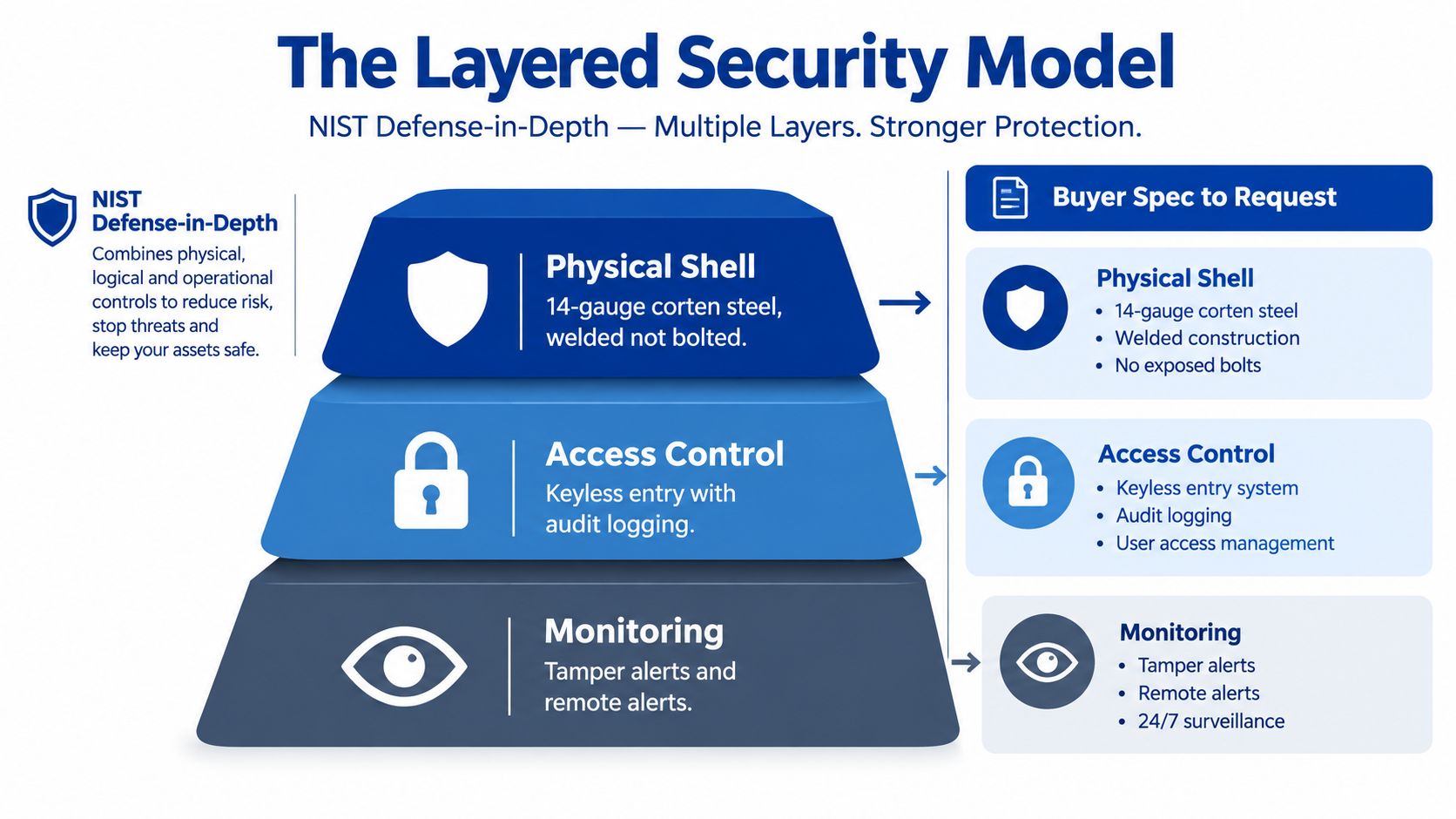
NIST treats storage security as a set of interdependent controls rather than a single device. Its guidance connects physical security with authentication, authorization, configuration control, incident response, recovery, data protection, isolation, restoration assurance, and encryption. The NIST storage infrastructure security guidance also supports environmental controls for recorded media, including protection from heat, moisture, humidity, and electromagnetic fields.
For a ground-level container, that translates into a specification with several separate layers.
Start with the shell and door
The enclosure should resist casual entry and slow down forced entry. Buyers should ask for a rigid steel shell, protected or concealed hinges, anti-pry door treatment, sound seals, and door hardware that cannot be reached easily from outside. A lockbox that shields the shackle is usually more useful than a decorative heavy-duty padlock left fully exposed.
Buyer specification: State the required shell construction, hinge protection, door reinforcement, lockbox design, weather sealing, and anchoring method. If the contents include backup media or sensitive records, add raised storage, environmental monitoring, and a recovery plan.
Control access instead of distributing keys
A container becomes difficult to govern when every supervisor has a copy of the same key. Use a restricted key system, a managed electronic lock, or a sign-out process that records who opened the unit and why. Codes should be revoked promptly when an employee, vendor, or subcontractor no longer needs access.
Buyer specification: Define authorized roles, approval authority, key or code issuance, revocation timing, emergency access, and the location of access records.
Detect openings and unusual activity
A contact sensor can report a door opening. Motion detection can identify movement inside after hours. A cellular alarm path can send alerts when local staff aren't present, while cameras provide context for an investigation. These controls are valuable only when an assigned person receives alerts and knows what action to take.
Buyer specification: Request sensor type, communications path, battery or backup power, alert recipients, alarm response procedure, and data retention.
Design the site to discourage approach
Place the unit where occupied buildings, security staff, or routine vehicle traffic provide natural observation. Add suitable lighting, camera coverage, clear sightlines, and barriers that prevent an intruder from positioning a vehicle or tool beside the door without being noticed.
Buyer specification: Include the container's orientation, lighting, camera field of view, vehicle restrictions, perimeter treatment, and emergency access route.
Make the process auditable
The final layer is procedural. Staff should record access, reconcile high-value inventory, authenticate deliveries, and report forced-entry signs or missing items immediately. For sensitive backup media, physical separation from the primary facility reduces the chance that one fire, flood, or intrusion event destroys both copies.
Buyer specification: Attach an access register, inventory schedule, incident procedure, personnel briefing, and recovery responsibility to the purchase order.
Locks, Reinforcements, and Smart Monitoring Compared
Locks, reinforcement, alarms, and connected monitoring solve different problems. Procurement teams should not rank them as substitutes.
A paddle-style hasp can work for basic controlled storage when its body and fasteners are protected. A disc-detainer padlock or a lock with a shrouded shackle can reduce exposure to cutting tools. The brand matters less than the lock body, shackle protection, key control, and whether the hasp can be pried away from the door.
Door reinforcement often delivers more practical value than moving from one premium lock to another. Anti-pry guards protect the gap between the doors. Internal deadbolts remove some hardware from the attacker's reach. Welded hinge protection reduces access to the hinge side. On double doors, a steel crossbar can prevent one door from flexing independently of the other.
Passive motion detection is appropriate when staff can respond to an alarm locally. An actively monitored cellular system makes more sense for an isolated site, valuable contents, or a location that remains unattended for long periods. The alarm must be tested, powered, and assigned to someone who will act on it.
Smart monitoring deserves a narrower promise. GPS trackers, door-open sensors, and connected access systems improve visibility, but they don't physically stop a pry bar or prevent an authorized person from removing inventory. A connected device also depends on cellular coverage, battery condition, alert configuration, data ownership, cybersecurity, and a response plan when connectivity fails.
One 2025 market analysis estimated the smart-locking-systems market at $3.2 billion and projected $6.8 billion by 2034, with electronic locks representing 38.5% of the market. Those figures come from the smart locking systems market analysis, whose return-on-investment example assumes a large operator managing 50,000 containers. That assumption doesn't transfer neatly to a school district, clinic, municipality, or single job site.
| Feature | Typical Cost | Deterrence Level | Best Use Case |
|---|---|---|---|
| Protected mechanical lockbox | Varies by specification | Strong against casual access and exposed hardware attacks | General equipment and materials storage |
| Anti-pry guards and hinge protection | Varies by door design | Stronger door resistance | Sites holding tools, electronics, or supplies |
| Internal deadbolt or crossbar | Varies by configuration | Strong door retention | Double-door units and high-use containers |
| Local motion or door alarm | Varies by sensor package | Useful for after-hours detection | Staffed sites with a clear response owner |
| Cellular monitored alarm | Varies by service and coverage | Better off-site awareness | Isolated or unattended sites |
| GPS and connected door sensors | Varies by device and service | Visibility rather than physical prevention | Mobile units, repeated relocation, and audit needs |
Access systems also need to fit the wider property. A practical access control gate guide can help facilities teams coordinate gate permissions, vehicle entry, and container access instead of treating the storage unit as a separate island.
The RFQ should request the exact lock type, door reinforcement, alarm path, power backup, communications coverage, access-log format, alert response, and installation responsibility.
Lease vs Purchase and How to Decide
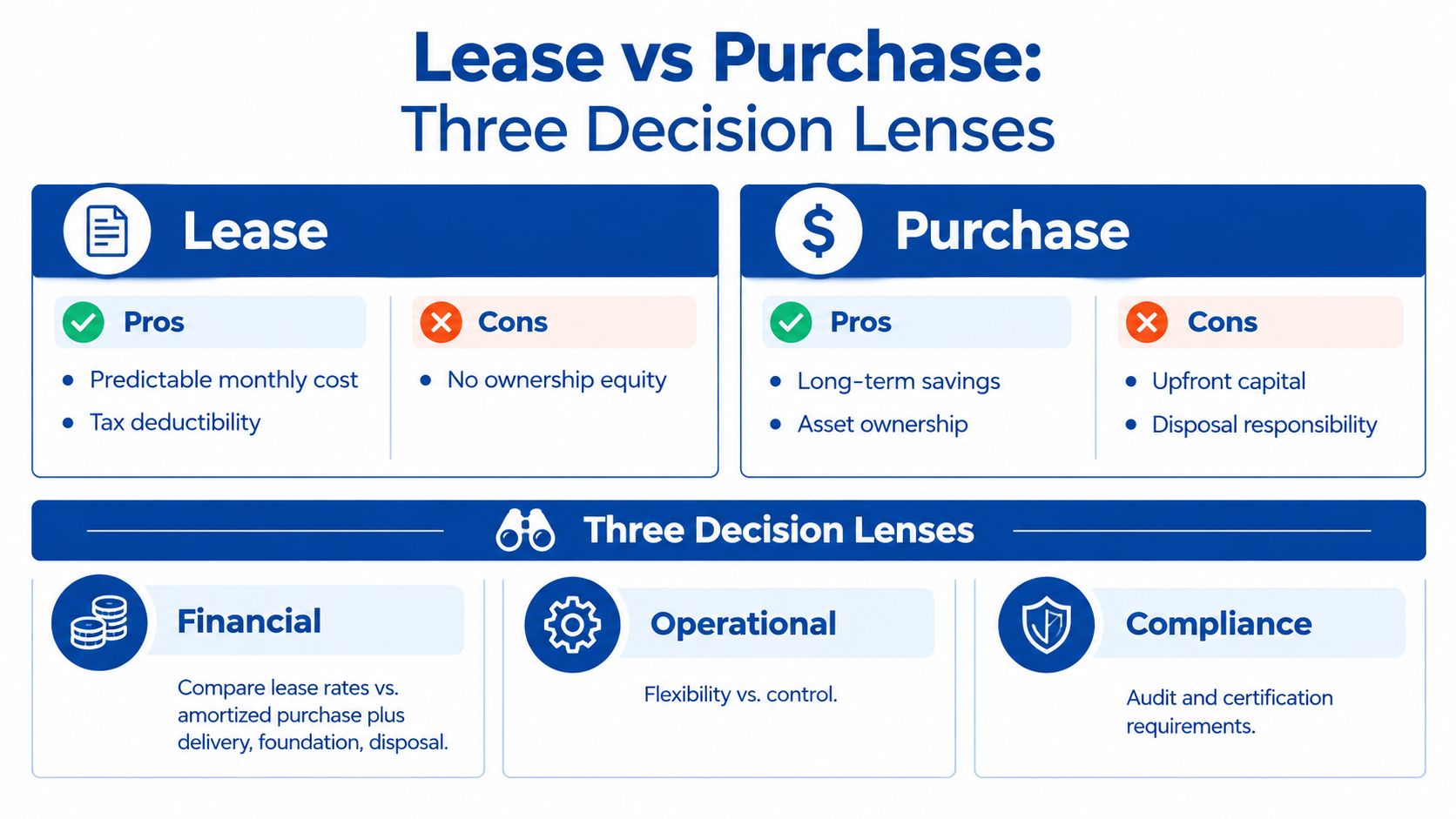
Lease and purchase decisions should be made through financial, operational, and compliance lenses. A low monthly payment can be misleading if delivery, repositioning, foundation preparation, security upgrades, insurance treatment, and removal costs are excluded. A purchase can create a useful asset, but ownership also leaves the customer responsible for maintenance, resale, relocation, and disposal.
Financial considerations
Leasing preserves capital and can make a temporary project easier to budget. It may also include service support, replacement options, or a known return process. Purchasing can make sense when the unit will serve a stable program, can be depreciated under the organization's accounting rules, or needs custom shelving, cabling, partitions, or climate equipment that would be difficult to recover from a short-term rental.
A buyer should compare the full delivered lease cost with the purchase price plus delivery, site preparation, security modifications, maintenance, relocation, and end-of-life handling. The storage-container rental questions guide helps procurement teams identify charges and responsibilities before signing.
Operational considerations
Lease when the site, program, or project duration is uncertain. It preserves flexibility if a construction schedule changes or a school needs temporary storage during a renovation. Purchase when the unit will remain in a known location, the organization expects repeated use, or the required configuration justifies a permanent investment.
A leased unit also needs an access reset. The customer should replace or rekey locks where permitted, confirm who has received keys, inspect the door and lockbox at delivery, and document condition before the unit enters service.
Compliance considerations
Schools and clinics should confirm fire-code clearances, emergency access, accessibility around ramps and doors, electrical requirements, and local treatment of temporary structures. Public agencies should also check procurement rules, insurance requirements, anchoring documentation, and any permit conditions tied to the site.
The decision rule is straightforward: lease for flexibility when the site or need is temporary, and purchase when the location, use, and configuration are stable enough to justify ownership.
Sizing, Configuration, and Real-World Use Cases
A container should be sized around movement, access, and separation, not just the total amount of material. Dense storage that blocks the door or forces staff to unload half the unit before reaching a box creates operational risk and encourages shortcuts.
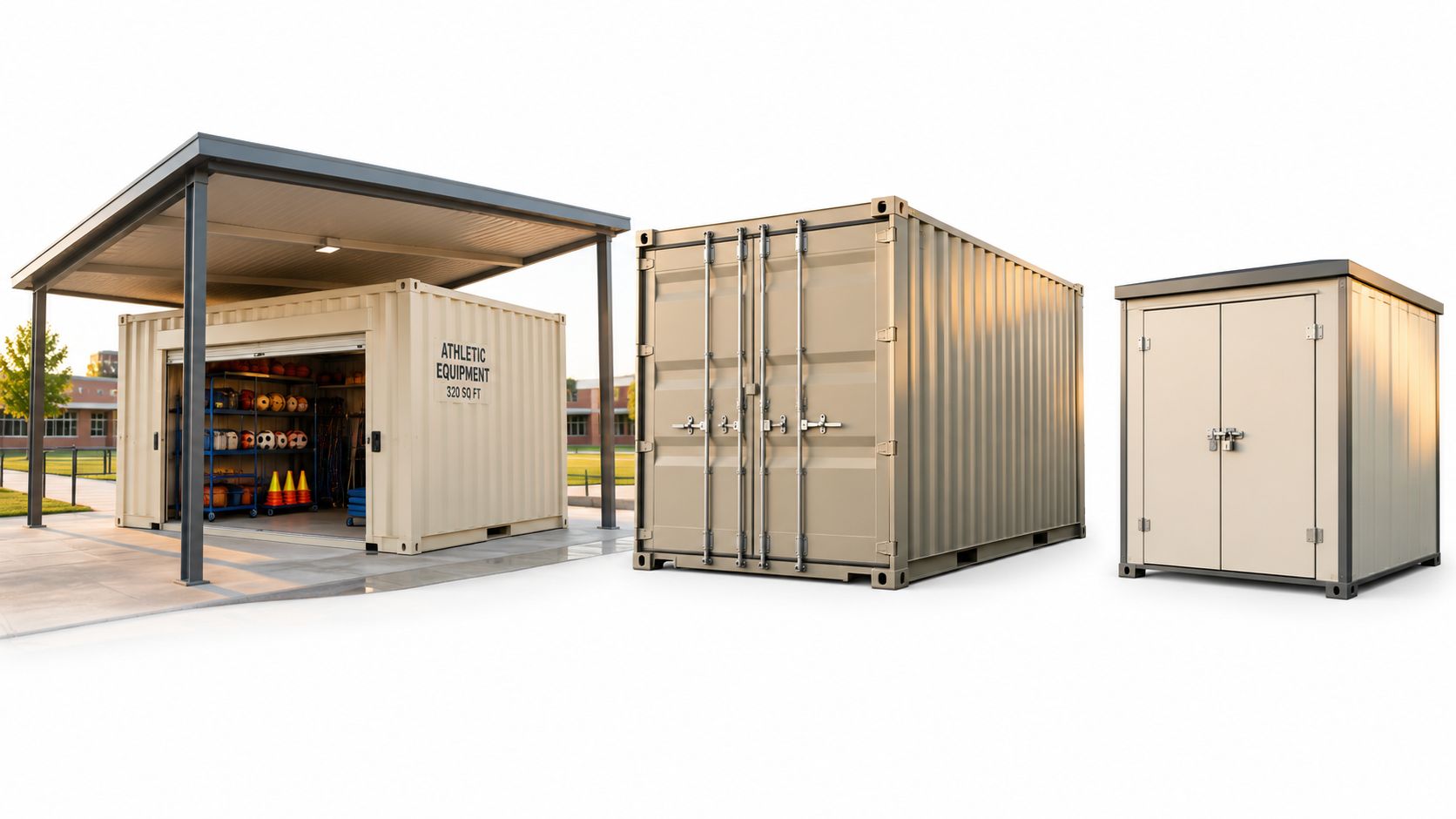
A school equipment unit
A K-8 school storing athletic equipment should prioritize broad access and fast retrieval. A standard unit with double-door access, heavy-duty shelving, labeled bins, wall-mounted racks, durable LED lighting, and a covered awning can keep carts and wet equipment moving without blocking the primary aisle.
Ramps matter when staff roll ball carts, goals, or grounds equipment into the unit. Gutters and site drainage protect the approach, while a durable exterior finish reduces the maintenance burden. The security package should include a protected lockbox, staff access rules, and an inventory map posted inside the door.
A clinic annex
A community clinic using a 20-foot unit has a familiar standard footprint, but the interior should be configured around cold-chain and clinical workflow rather than general storage. Climate control, temperature logging, insulated surfaces, a personnel door, washable finishes, and separate storage for sharps or incompatible materials should be evaluated by the facility and compliance teams.
A clinic should also define who can access medication or temperature-sensitive supplies. A door sensor, access log, backup power plan, and escalation procedure are more important than just adding a larger padlock. The unit should be positioned where staff can observe it and emergency responders can reach it.
A contractor yard
A contractor yard may need longer units, partitioned bays, shelving for hand tools, vertical racks for conduit, and separate lockable compartments for copper, equipment, and client-supplied materials. A high-volume yard benefits from clear labels, dedicated lighting, durable skids or a prepared base, and access records tied to crew leaders.
Stacking or placing units near one another requires an engineered site plan, compatible lifting points, safe access routes, and confirmation that the ground and anchoring arrangement suit the installation. Security cameras should cover doors and loading areas, not just the perimeter.
The useful sizing question is: How many people need to work inside at the same time, and what must each person reach without moving another person's inventory? The answer should determine aisle width, shelving height, door selection, partitioning, lighting, and the number of access points.
Maintenance and Inspection Routines That Hold Up
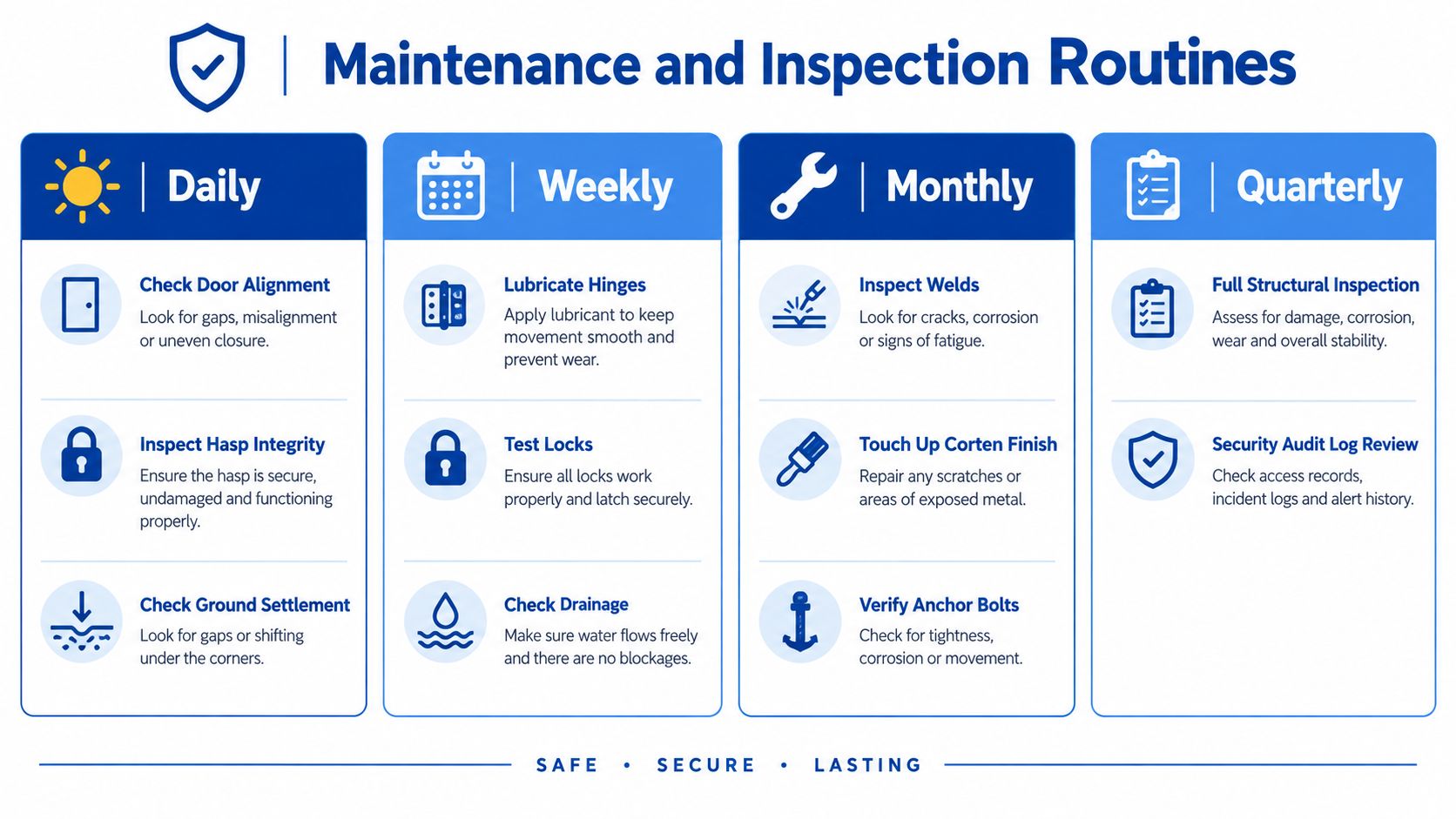
Security hardware loses value when doors sag, seals fail, locks seize, or alarms generate false alerts. A facilities lead should use a repeatable checklist and record corrective work rather than waiting for a forced-entry event.
Daily checks
- Door alignment: Confirm that doors close fully without unusual force.
- Hasp and lockbox: Look for looseness, damage, tampering, or fresh tool marks.
- Corner support: Check for settlement, rocking, or visible changes beneath the container corners.
- Site condition: Remove obstructions that block lighting, cameras, or emergency access.
Weekly checks
- Moving hardware: Lubricate hinges and exposed lock components with a product suitable for the hardware.
- Alarm function: Test door contacts, motion sensors, local annunciators, and alert routing.
- Access records: Compare expected users with recorded openings and investigate unexplained activity.
- Drainage: Clear leaves, standing water, and debris around doors and the base.
Monthly checks
- Welds and finish: Inspect seams, corners, and repaired areas for corrosion or coating damage.
- Door seals: Check compression and replace damaged gaskets before water or dust enters.
- Anchoring: Verify visible anchor hardware and look for movement after severe weather or site work.
- Inventory: Reconcile controlled items against the storage register.
Quarterly and annual reviews
A more complete inspection should assess the shell, doors, hinges, lockbox, anchors, electrical equipment, alarm communications, camera views, and access-control records. Annual planning should determine whether locks need replacement, whether touched-up corrosion has been properly treated, whether monitoring credentials remain current, and whether the site's anchoring and wind documentation still match the installation.
A stiff door is often a sign that the container has shifted or settled, not proof that the hinges need more lubricant. A recurring alarm may point to a failed seal, loose contact, or movement in the door rather than an intruder. Maintenance staff should diagnose the physical cause instead of disabling the alert.
Putting It All Together and Choosing Your Next Step
A heavy lock without controlled access, sensible placement, detection, and disciplined procedures is security theater. The container should slow unauthorized entry, the site should make approach difficult to hide, the monitoring layer should expose unusual activity, and the people responsible should know exactly what to do when something looks wrong.
The most useful procurement document is not a list of impressive hardware. It is a risk-based specification that identifies the contents, assigns an access owner, describes the site, sets environmental requirements, defines alarm response, and states how inventory will be checked.
Procurement test: If a departing worker can keep access, an unverified delivery can enter the yard, or an alarm can trigger without a named responder, the security plan is incomplete.
A practical next step is to review recent losses and near misses by category. Separate open doors, missing keys, unauthorized access, poor visibility, forced-entry damage, inventory errors, and environmental damage. Map each issue to the relevant layer, then place the missing control on a single quote request that includes the container, site work, lock hardware, monitoring, access procedure, and maintenance responsibility.
Lease when flexibility and uncertain site conditions matter more than ownership. Purchase when the location is stable, the configuration will be used repeatedly, and the organization is prepared to maintain and eventually relocate or dispose of the asset. That decision, paired with a layered security specification, gives schools, clinics, agencies, and contractors a defensible path from storage need to controlled deployment.
Pacific Mobile Structures, Inc. provides storage containers for rent or purchase, along with delivery, setup, security options, and storage organization for temporary and permanent applications. Review the available configurations and request a site-specific recommendation from Pacific Mobile Structures, Inc. before issuing the quote.