A crew has cable drums under a tarp, a school has grounds equipment in a corridor, or a clinic needs records out of a hallway. A small conex box looks like a quick answer, and often it is. The mistake is ordering by the name on the listing, then discovering the doors won't clear a pallet, shelving eats the aisle, or an uninsulated steel box drips condensation onto stored paper. Nominal size is only the starting point. Usable interior, floor and lifting limits, climate, and hazard controls decide whether the box works.
Table of Contents
- Small Conex Box Sizes and What the Box Is
- Everyday Uses on Sites, Schools and Businesses
- Doors, Shelving, Ventilation and Security
- Hazardous Materials and When a Plain Box Is Not Enough
- Which Fits Your Project
- Permits and Placement Rules Before You Install
- Inspect, Site and Move a Small Conex Box
Small Conex Box Sizes and What the Box Is
A box labeled “8 ft” tells you its nominal length, not how much room is left for shelves, a pallet, or a person to pass. Use the table to compare reference sizes, then check the actual unit's interior dimensions and limits before choosing.
| Size class | Typical external size (L x W x H) | Minimum internal size | Common use |
|---|---|---|---|
| Historical CONEX I | About 8.5 x 6.25 x 6.5 ft | No standardized minimum; measure the actual unit | Military-era reference only |
| Compact 8 ft box | 8 ft long; width and height vary by unit | Measure the finished interior, including the door opening | Tool crib, single-person job-site storage |
| Mid-size 10 ft box | 10 ft long; width and height vary by unit | Measure the finished interior, including the door opening | Equipment storage, small office conversion |
| 20 ft ISO container | About 20 x 8 x 8.5 ft | 19 ft 3 in x 7 ft 8.5 in x 7 ft 7.7 in | Full-size storage, multi-room office |
How To Read Nominal And Internal Figures
A published reference can help explain the difference between nominal and usable dimensions. The DHL cargo container sizes and types guide gives minimum internal dimensions for a representative 20-foot general-purpose container of approximately 5.867 m long x 2.350 m wide x 2.330 m high (19 ft 3 in x 7 ft 8.5 in x 7 ft 7.7 in). Corrugated walls, floor structure, door frames, and corner posts reduce the interior space. Shelving, pallets, insulation, and partitions reduce it further.
For an 8- or 10-foot box, the table does not substitute for a supplier's drawing or measurements of the specific unit. Ask for finished interior length, width, and height, plus the clear door opening. Also check tare weight, maximum gross mass, floor rating, and the specified lifting method. If the container will travel by sea, confirm its ISO and CSC status and whether its Safety Approval Plate meets the transport requirements.
Width can be easy to overlook because standard containers are generally about 8 feet wide, while lengths vary. A 20-foot container represents one TEU, or twenty-foot equivalent unit. A longer box adds floor area, not width, so check whether the added length provides room for the items and access you need.
Where The Name Came From
The Wikipedia history of the Conex box traces the format to the Army's 1948 “Transporter” container, a corrugated-steel unit rated to carry 9,000 pounds (4,082 kilograms). It evolved into CONEX, short for “Container Express,” in late 1952. One early CONEX I design measured approximately 8.5 feet long, 6.25 feet wide, and 6.5 feet high. The history explains the name, but modern boxes vary, so an old design is not a reliable specification for a unit you are considering.
Two sizing examples show how to apply the table. For a four-person crew storing parts on pallets, a 10-foot box may offer more room for a person to move alongside the load. For a desk and filing cabinet at a gate, an 8-foot box may suit the purpose if the door clears the furniture and the interior leaves space to sit and open drawers. In both cases, confirm the actual measurements before ordering.
Practical rule: Measure the largest item, check the door opening, and allow room for access. Length alone cannot tell you whether the box will work.
Everyday Uses on Sites, Schools and Businesses
A Locked Box Beside The Trench
Say a utility crew opens a trench each morning and closes the site each night. Cable, fittings, hand tools, and test gear can't ride back to the yard daily without losing time, and they can't sit under a tarp without theft and weather risk. The core need is security with quick placement at ground level, close to the work but clear of the excavation and truck path.
The first question is access. Can workers reach the doors safely in mud, load the bulkiest fitting without lifting over a threshold lip, and lock up fast at shift end? The failure to avoid is treating steel walls as security by themselves. A weak hasp, an exposed padlock, or a box parked in a dark corner defeats the point, so lighting, sight lines, and lock hardware belong in the first specification, not as afterthoughts.
A Tool Crib A Facilities Team Can Run
Say a plant facilities team issues drills, meters, and spare motors from a cage that's always overflowing. A small conex box becomes a tool crib with wall-mounted shelving, labeled bins, a lockable personnel door, and a workbench near the entrance. The core need shifts from storage volume to organized access, because the cost isn't the box, it's a technician hunting for a part during a breakdown.
The first question is layout. Which items are picked daily, which are heavy, and which must stay at waist height? Heavy motors belong low and near the door, fast-moving consumables belong along the first wall, and the aisle must stay clear for a cart. The failure to avoid is filling every wall with fixed shelves before testing the workflow. Adjustable shelving costs little flexibility later and prevents a layout that looks tidy on delivery day but blocks the items used most.
A Small Office Or Intake Room
Say a school district needs a check-in room during a remodel, or a clinic needs intake space while a wing is closed. A ground-level box can serve as a small office or intake room, but the core need is now comfort, light, and ventilation for people who stay inside for hours. Storage tolerates heat and dim light. Occupied space doesn't.
The first question is occupancy. How many people, for how long, with what privacy, power, and accessibility needs? The failure to avoid is converting a plain storage box without insulation, proper egress, lighting, and fresh air, then calling complaints about heat a surprise. Pacific Mobile Structures, Inc. offers ground level office containers and office/storage combo units, which illustrates the distinction buyers should draw between a storage shell and a purpose-built occupied unit.
Most projects combine uses over time, so the box should fit the first use well while leaving door, power, and layout options open for the next one.
Doors, Shelving, Ventilation and Security
Every addition consumes interior space, adds cost, or creates maintenance. Specify only what the use needs, then verify the finished dimensions after the work.
| Option | What it involves | Trade-off to check | Best for |
|---|---|---|---|
| Side or end door | Single or double doors sized for equipment access | Door opening reduces wall strength and interior wall space | Equipment storage, forklift or cart access |
| Shelving | Fixed or adjustable racks mounted to walls | Shelves reduce usable width; check load ratings | Tool cribs and parts storage |
| Passive vents | Wall or roof vents for airflow | Vents alone do not control condensation in humid climates | Light storage with low moisture risk |
| Mechanical ventilation | Fan or powered exhaust | Adds power and running cost | Occupied offices and workspaces |
| Insulation | Interior or exterior layer on walls and roof | Consumes interior floor area; affects condensation control | Offices, clinics and climate-sensitive storage |
| Security | Hasps, padlock bars, alarms or cameras | Lock quality matters more than the box steel gauge | Equipment, fuel-adjacent and high-value storage |
Doors And Shelving Decide Daily Use
End doors suit straight-in pallet loading, while a side door suits frequent person entry and keeps the end wall free for shelving. Double doors help with wide equipment but need swing clearance outside and leave less uninterrupted wall inside. Buyers reviewing secure storage container configurations should match the opening to the widest load and the machine that moves it, a hand cart, pallet jack, or forklift.
Shelving needs the same discipline. Fixed racks are sturdy and simple, adjustable racks handle changing bin sizes, and both need a stated load rating per shelf. Leave the floor near the door open for heavy items, and don't let shelf depth narrow the aisle until a person carrying a box has to turn sideways.
Insulation Is The Trade-Off Readers Miss
Steel conducts heat, sheds condensation, and creates thermal bridges at ribs and frames. The Modular Building Institute discussion of repurposed sea-crossing boxes notes container-specific provisions from the International Code Council covering anchors, foundations, structural integrity, welding, penetrations, and bracing, while identifying thermal bridges, air infiltration, solar heat gain, moisture resistance, and vapor permeability as critical design risks, particularly in hot-humid regions. Inadequate envelope design can create condensation, discomfort, corrosion, and higher energy consumption, so the cheapest small box isn't necessarily the lowest-cost usable space.
Interior insulation protects the finish and is easier to install, but framing and lining reduce usable floor area on every insulated wall. Exterior insulation preserves interior room and covers thermal bridges better, but it needs weather protection and changes the outside dimensions. Either way, buyers should order shelving only after measuring the finished interior, and any occupied box specification should address climate zone, humidity, occupancy duration, utility availability, fire separation, local approval, and whether a separate roof is needed to cut solar gain and shed rain.
Security follows the same logic. A lockbox that shields the padlock, a solid padlock bar, and hinges that can't be punched out matter more than extra steel thickness, and buyers comparing hardware can find suitable locks for your container by checking how dead locks resist cutting and prying. Alarms and cameras help only when someone responds, so the response plan belongs in the purchase decision.
Hazardous Materials and When a Plain Box Is Not Enough
Say a crew stores paint thinner and fuel cans in an unvented box beside a warm compressor. The doors seal well, the sun heats the roof, and vapor builds up with nowhere to go. Steel walls don't make that safe. They can make it worse by containing the vapor.
WorkSafeBC warns that unmodified shipping containers can be unventilated and potentially pressurized, and vapors from flammable or explosive materials may accumulate and ignite if the container is exposed to a heat source. The OSHA flammable liquids storage rule at 1926.152 provides a useful engineering benchmark, mechanical or gravity exhaust providing at least six complete air changes per hour, with exhaust intake located no more than 12 inches above the floor because many vapors are heavier than air. OSHA also requires approved containers, prohibits storage in exits or normal passageways, and requires a clear aisle at least 3 feet wide in an inside storage room.
Those figures are reference points, not a do-it-yourself design. Ordinary wall vents alone should not be assumed to achieve the required air-exchange rate. A compliant setup may need low-level intake and high-level exhaust, ignition-source control, compatible spill containment, fire protection, access clearance, bonding where required, and documented inspection.
Before any hazardous use, three steps come first.
- Read the safety data sheet: Confirm flash point, vapor behavior, incompatible materials, and container requirements for each product.
- Get authority review: Have the authority having jurisdiction assess the box, location, quantities, and separation distances before delivery.
- Document the controls: Record ventilation, spill containment, fire protection, inspection intervals, and signage, including sourcing durable laser-engraved safety signs that stay legible outdoors for hazard and no-ignition warnings.
A plain conex box is an enclosure, not a hazardous-materials safety system. The system has to be designed, approved, and inspected.
Which Fits Your Project
Project length drives most rent-versus-buy decisions. A short job, a seasonal peak, or a trial location usually favors renting, while permanent or long-term storage usually favors buying. The table shows where each option wins.
| Factor | Rent | Buy |
|---|---|---|
| Upfront cost | Lower; recurring payments | Higher one-time purchase |
| Best project length | Short to medium terms, trial sites | Long-term or permanent use |
| Ownership and resale | Returned or swapped at term end | Owned; resale value depends on condition |
| Customization | Usually limited to what the supplier allows | Full control, subject to code and approvals |
| Maintenance responsibility | Check the lease; often shared or supplier-led | Owner responsibility throughout |
| Relocation | Simpler to move or exchange | Owner pays to move and re-site it |
Compare The Whole Term, Not The Monthly Rate
The honest comparison adds total rental payments over the expected term and sets that figure against the purchase price plus modifications and transport, then subtracts resale value that can realistically be recovered. Delivery, pickup, site preparation, anchoring, permits, insurance, and repairs belong on both sides where they apply. A low monthly rate can lose over a long term, and a low purchase price can lose once a roof repair, door rebuild, and two moves are added.
Say a road project needs secure storage for a single construction season. Renting usually wins because the supplier handles pickup and the box doesn't become a yard asset nobody wants. Say a maintenance yard needs the same box for years of daily use. Buying usually wins because shelving, power, and paint can be customized once and the cost spreads across the full service life. Buyers still framing the decision can work through questions to answer before renting a storage container before requesting quotes.
Three questions expose weak offers quickly. Can the box be customized and who approves penetrations or shelving anchors? Who handles maintenance, door adjustment, leaks, and lock failure during the term? What happens at lease end, including pickup condition, cleaning, damage standards, and notice periods? Clear answers in writing protect both sides.
Permits and Placement Rules Before You Install
Permits aren't paperwork after delivery. They're placement decisions that can force a box to move. Clear each check in order, before booking the truck.
- Ask about a building or siting permit: The local authority confirms whether a placed container needs approval, and zoning rules may govern setbacks, height, screening, and use.
- Confirm authority review: Occupied space and hazardous storage especially need review by the authority having jurisdiction.
- Check fire separation and access: Measure distance from buildings and property lines, and confirm emergency vehicles can still reach the site.
- Plan utility routes first: Power, lighting, data, and ventilation fans may need trenching or overhead routing that's far easier before the box is set.
- Verify occupancy rules: A converted office or intake room must meet local ventilation, insulation, egress, lighting, and accessibility requirements before anyone uses it.
- File the complete record: Keep approvals with delivery paperwork, including the CSC plate details and tare weight, so handover documentation is complete.
Why Order Matters
Each step protects the next one. A permit answer can change the pad location, which changes utility trenching, which changes where the delivery truck can stand. Fire separation can also rule out the most convenient corner, and an easement can rule out a strip that looks empty on a site sketch. Buyers should mark property lines, easements, underground services, overhead lines, and the delivery path on one drawing, then walk it with the supplier.
The common slip is placing a unit on the assumption that no permit applies, then learning a property line or easement requires moving it at the owner's cost.
Temporary doesn't always mean exempt. Duration, occupancy, size, anchoring, and utility connections can each trigger review, and rules change by jurisdiction. A short call early is cheaper than a crane revisit later.
Inspect, Site and Move a Small Conex Box
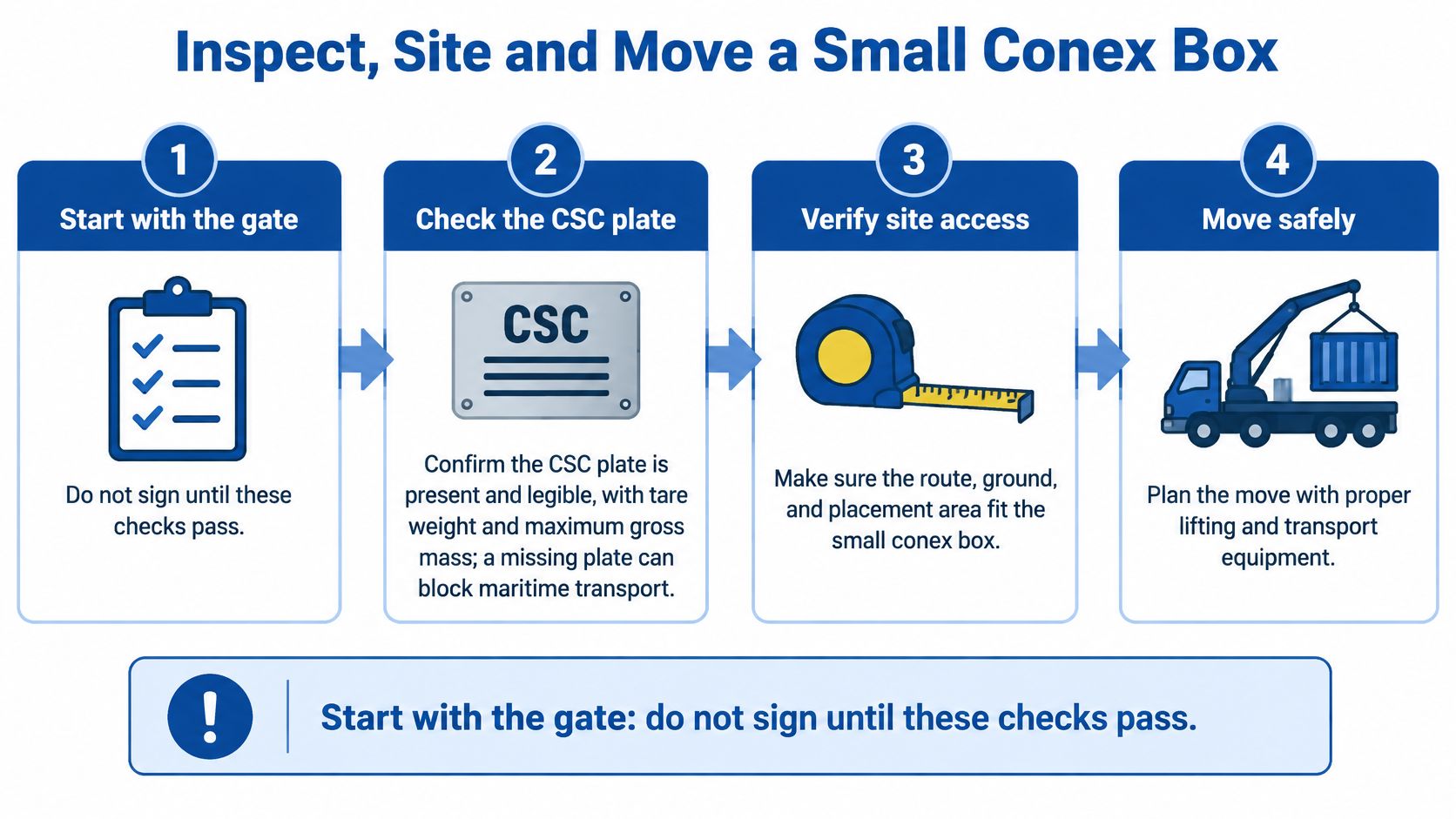
Start with the gate. The process summary below shows the sequence from pre-signing checks to safe movement.
The Five Checks Before Signing
- Confirm the CSC plate: The plate should be present and legible, with tare weight and maximum gross mass readable for transport planning. A missing or invalid plate can block maritime transport and signals weak records. Photograph it and match the numbers to the quote.
- Measure after modifications: Tape the internal length, width, height, and door opening after planned shelving, lining, and insulation are accounted for. The usual slip is ordering racks from nominal size, then watching the aisle disappear.
- Check the floor against loaded weight: Compare the floor rating with the heaviest loaded condition, not the empty box. Walk every bay and press for soft spots, delamination, oil damage, and patched sections, because concentrated loads on pallet feet or machine skids punish weak floors first.
- Inspect steel, seals, and moving parts: Look for rust at roof seams, bottom rails, corners, and door frames, then open and close every door. Seals should compress evenly, hinges should move without binding, locking rods should engage fully, and welds around repairs should be sound rather than cracked or heavily ground.
- Request the inspection record: A reconditioned unit should come with a multi-point inspection record that a buyer can read, not a verbal assurance. Ask what was checked, what was repaired, what was repainted, and what remains as cosmetic wear.
Site The Box So Doors Stay True
- Survey the base and access: Choose level, firm, well-drained ground with clearance for the delivery truck, lifting equipment, door swing, and safe walking access. Standing water under a box accelerates corrosion and turns loading into a slip hazard.
- Choose the lifting method: Crane, forklift, and truck-mounted equipment each need confirmed lifting points, capacity at the working radius, and ground that can carry the machine. The supplier should confirm whether the box moves empty or loaded and which points are approved.
- Support all corners: Set the box on a concrete pad, piers, or compacted gravel with all corners supported so the frame doesn't rack. A twisted frame shows up immediately as doors that scrape, seals that gap, and locking rods that need force.
- Anchor against wind: Use anchors suited to the ground and local exposure, especially for empty boxes and tall or stacked arrangements. Anchoring also keeps a lightly loaded unit from creeping on frost or softened ground.
- Recheck after set-down: Cycle the doors, inspect seals, confirm floor condition, check level, and verify clearances before the delivery crew leaves. Small adjustments take minutes with equipment on site and days without it.
The short video below is useful for buyers who want to see the handling sequence before coordinating a delivery window.
Provider Records Worth Asking For
Pacific Mobile Structures, Inc. sells and rents storage containers, delivers and sets storage containers to the customer's specifications for on-site storage, and freshly reconditions offices and other temporary-use modular buildings through a multi-point inspection process before delivery. Buyers comparing portable storage container options should ask each provider for the same evidence, inspection record, delivery method, site requirements, and service responsibilities. Comparable records make quotes comparable, while vague promises hide the costs that appear after set-down.
Don't sign until the plate, finished interior, floor, doors, and inspection record all pass. Those five items predict most ownership problems.
Buyers who've measured the load, checked climate and hazard limits, and confirmed site access can turn that specification into the right storage container, ground-level office, or combination unit delivered and set to their requirements. Visit Pacific Mobile Structures, Inc. to discuss a small conex box for a school, job site, clinic, agency, or business location and request the inspection and delivery details before scheduling placement.