The pasture trough is running low, the refill truck is tied up, and a tank that looked large enough yesterday suddenly doesn't look like much storage. A construction superintendent can face the same problem when temporary facilities open before permanent utilities are ready. In either setting, a mobile watering tank needs more than enough nominal gallons.
The first distinction is potable versus nonpotable service. A vessel suitable for livestock or dust control isn't automatically suitable for drinking water, regardless of how clear its contents look. The practical choice starts with service history, peak demand, and a refill route that can keep the operation supplied.
Table of Contents
- Mobile Watering Tank Sizes and Types Compared
- How Much Water Your Herd or Crew Needs
- Potable or Nonpotable Rules That Apply
- How to Install and Mount the Tank Safely
- How to Disinfect a Tank Before Potable Use
- Maintenance Schedule, Residuals and Records
- Confirm Your Size and Service Before You Buy or Rent
Mobile Watering Tank Sizes and Types Compared
Portable tank sizes cover different deployment patterns. The linked USDA Natural Resources Conservation Service guide for Missouri describes units from 55 to 1,000 gallons.
| Tank size (gallons) | Typical format | Typical use | Animals served |
|---|---|---|---|
| 55 | Small portable field unit | Quick moves between paddocks | Set by peak demand and refill rate |
| 1,000 | Large seasonal reservoir on trailer or skid | Drought and seasonal supply | Set by peak demand and refill rate |
The same guide gives a continuous-flow benchmark of 1 gallon per minute producing 1,440 gallons daily, enough under its assumptions for approximately 50 cow-calf pairs. That is a flow-rate example, not a universal stocking rating. A small drinking tub supplied continuously through a float valve serves a different purpose from a haul tank that receives no replenishment until the next delivery.
Storage and drinking access are different jobs
A trailer-mounted reservoir stores and transports water. A paddock tub gives animals access to it. Combining both functions can simplify equipment, while separating them lets the trailer stay on firm ground and supply a drinking point by hose.
Smaller units suit frequent moves. Larger reservoirs suit longer deployments, provided the mounting arrangement, access route, and unloading method fit the site. A float valve maintains water level only if the supply line can deliver water as animals drink. Check replenishment under draw, not just whether the valve opens.
Practical rule: Choose a tank size the refill route can keep supplied without interrupting service.
Match the format to the route
Wheel-mounted equipment suits routes with maintained access and regular moves. Skids suit units that will stay in position and can be handled with appropriately rated machinery. Use supported tank bases and designated lifting points.
Agricultural deployments also need a clean place for fittings, spare valves, and dedicated hoses. Planning those items alongside agricultural storage arrangements helps keep clean equipment separate from fuel containers and loose chemicals. The right format is the one the site can move, refill, and service reliably.
How Much Water Your Herd or Crew Needs
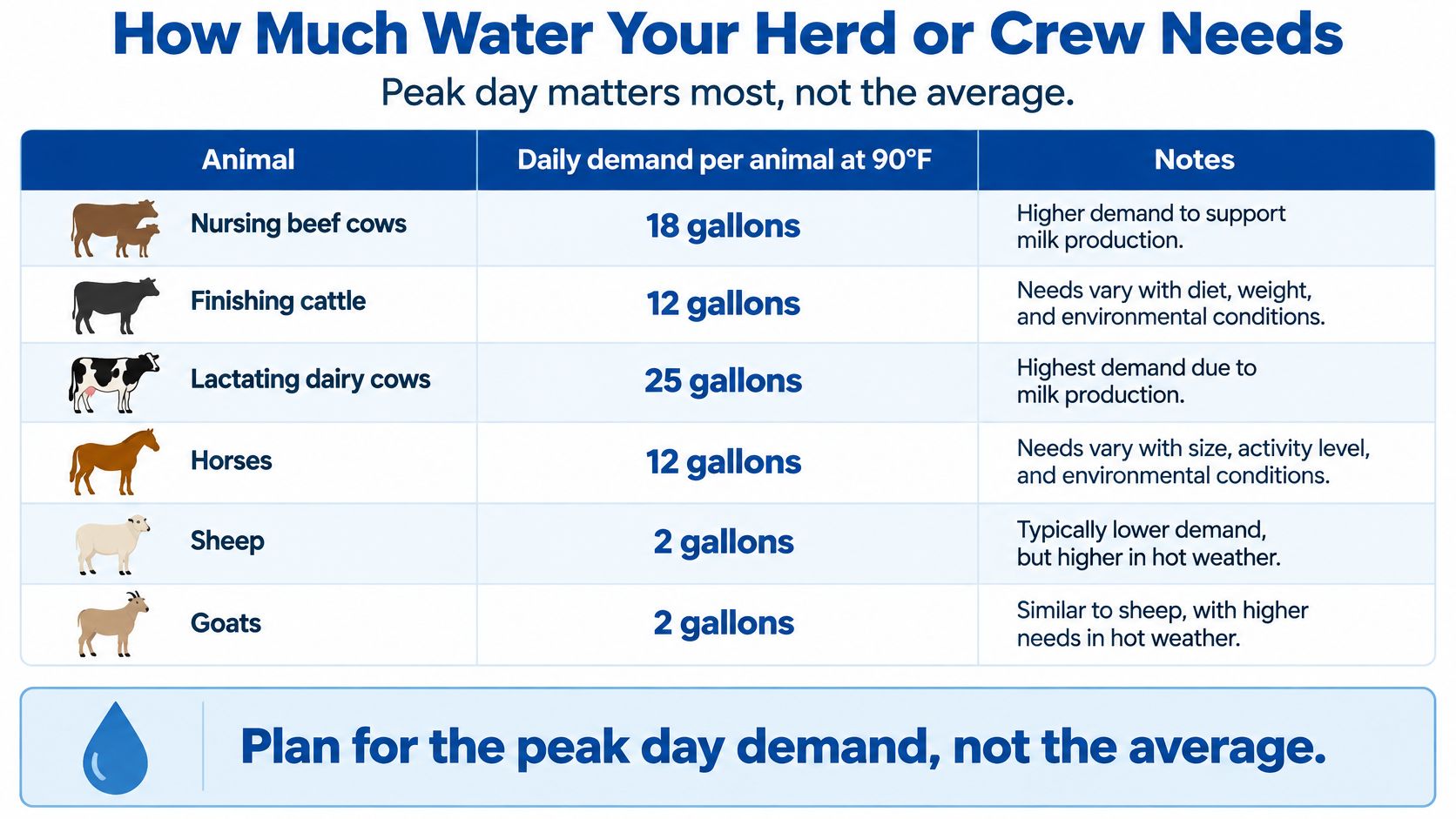
Peak-day demand sets the working requirement. An average-day estimate leaves too little room when hot weather coincides with a delayed delivery.
At 90°F, the North Dakota State University Extension drought-planning guidance gives the daily cattle requirements below and illustrates why 50 nursing cows can require about 900 gallons daily, before spillage, reserve, or additional animals.
Daily water demand per animal at 90°F
| Animal | Weight or stage | Gallons per day at 90°F |
|---|---|---|
| Nursing beef cow | Mature | About 18 |
| Bull | Mature | About 20 |
| Growing cattle | 400 lb | About 9.5 |
| Growing cattle | 600 lb | About 12.7 |
| Growing cattle | 800 lb | About 15 |
| Finishing cattle | 600 lb | About 14.3 |
| Finishing cattle | 1,200 lb | About 24 |
Body weight and production stage matter. Applying a single allowance across a mixed herd can understate demand, particularly when heavier finishing animals share the supply.
The illustration emphasizes peak-day planning. For cattle calculations, the weight- and stage-specific table above should govern rather than the illustration's generalized animal allowances.
Turn animal demand into a delivery requirement
The nursing-cow example uses straightforward arithmetic: herd count multiplied by the hot-weather allowance. That result represents consumption, not a complete tank specification.
A practical sizing sequence adds the operating conditions:
- Total the groups separately. Use the appropriate weight and production stage rather than averaging the herd.
- Allow for losses and disruption. Include trough overflow, handling losses, and a delivery delay that the operation can realistically encounter.
- Set the refill interval. Storage must cover consumption until the next dependable delivery, not the next hoped-for delivery.
- Verify recovery capacity. The source, pump, and transport vehicle must replace withdrawn water while demand continues.
A reservoir only slightly larger than a peak day's consumption offers little breathing room. During drought hauling, loading queues, road conditions, and source availability can matter more than another increment of tank volume.
Heat waves deserve a fresh calculation. Weaning and pasture moves also deserve closer observation because animal grouping, access, and drinking patterns change, even when an operator hasn't changed the nominal herd count.
Use measured flow for buildings and crews
Cattle allowances don't belong in a construction-site calculation. Fixture supply, washdown, and dust suppression should be calculated from measured flow multiplied by operating time, with overlapping activities added together.
A site using a mobile toilet unit also needs confirmation of its actual supply arrangement. Drinking water, flushing water, and wastewater storage are separate planning tasks.
Pump output should be measured through the intended hose at the actual lift. A pump's unrestricted outlet performance doesn't describe delivery through a long hose uphill. If the available water will run out before the refill system can recover, the arrangement needs more dependable supply, more storage, or less simultaneous demand.
Potable or Nonpotable Rules That Apply
A tank that watered cattle last season can look clean and still fail a drinking-water review. Source, prior contents, hoses, pump, and seals decide suitability, and a rinse does not reset the tank's service history. Capacity is rarely the risk. A smaller tank with a known potable history can be easier to approve than a larger one with an unknown past.
Massachusetts emergency bulk-water hauling procedures set chlorine residuals of at least 1 ppm at the start and 0.2 ppm at the end of a haul, with approved sources, inspection, equipment disinfection, and coliform testing. Those numbers describe hauling under that procedure, not a universal target for every tank.
Tank requirements by service type
| Service | Prior use of the tank | Disinfection and testing | Water source |
|---|---|---|---|
| Potable drinking water | Dedicated potable history; conversion from unknown service requires approval | Sanitation procedure and release testing under the applicable drinking-water rules | Approved source only |
| Emergency hauling for drinking water | Inspect before filling and verify acceptable service history | Disinfect tank, hoses, and pumps; coliform testing and residual checks under the hauling procedure | Approved source only |
| Livestock watering | Verify previous contents and clean before reuse | Routine cleaning; additional testing as directed by agricultural or veterinary authorities | Supply suitable for the species and local conditions |
| Dust control or irrigation | Keep dedicated to nonpotable service | Cleaning and clear labeling under local requirements | Source authorized for the intended application |
The potable row is not permission to convert an unknown used tank. Establish prior contents before price or availability decides the purchase. A tank with unknown history is a procurement reject, not a dosing problem.
Keep the service boundary physical
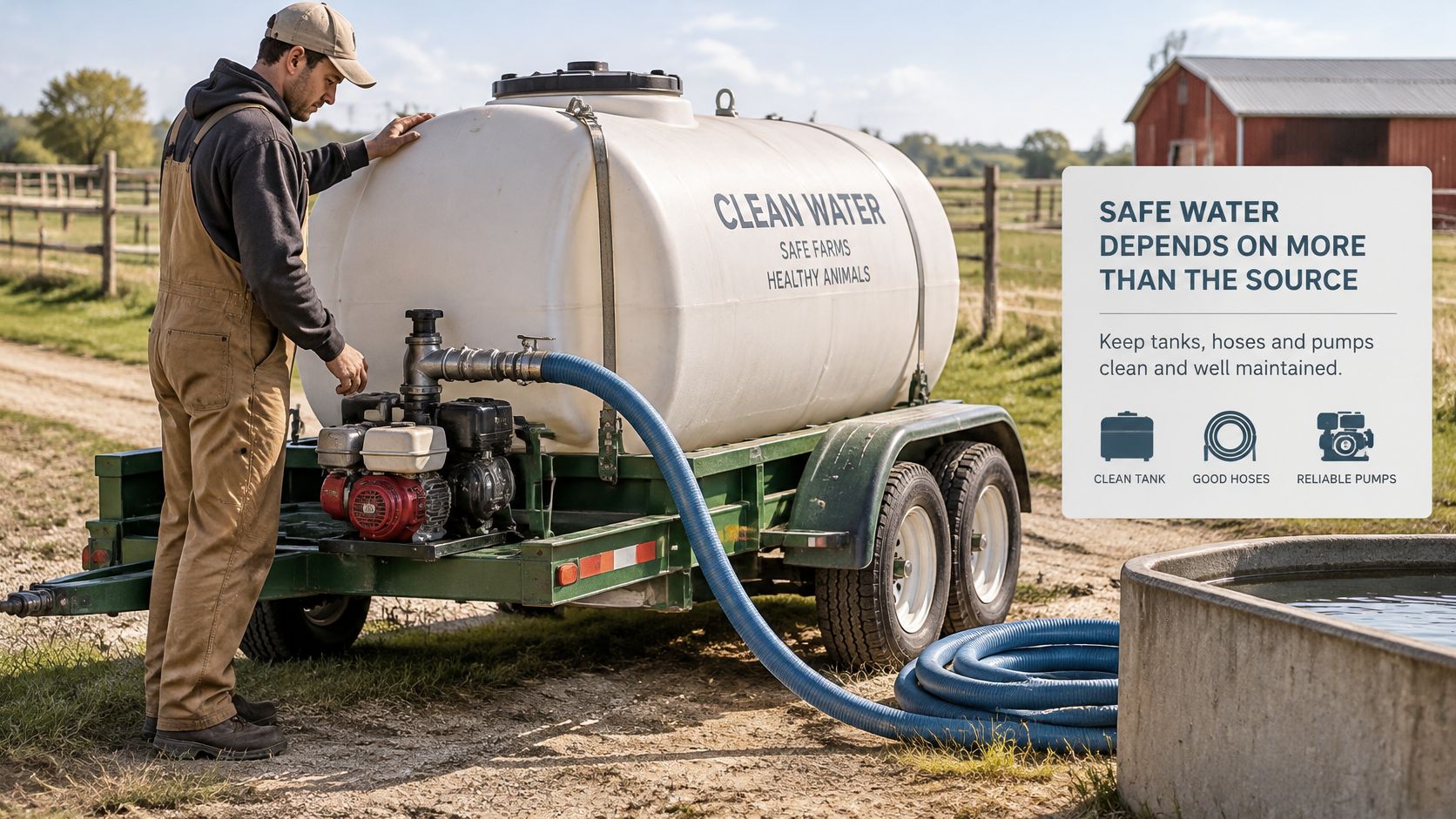
A label helps. Dedicated equipment is stronger. Potable hoses should have capped ends and separate storage, so an operator never has to guess which hose handled irrigation water. Color coding plus locked storage is cheap compared with a failed sample.
Livestock service is not a disposal route for questionable water. Salt content, contaminants, and previous chemical contents can still make a supply unsuitable for animals. Dust-control water needs an authorized source, because nonpotable does not mean unrestricted.
Municipal facilities require coordination between building access and utility operations. A project such as the West Boise Water Facility provides relevant facility context, but building selection doesn't establish a mobile tank's drinking-water approval. The approval belongs to the tank, the source, and the handling chain.
Confirm the local approval package
Before deployment, the responsible operator should document:
- Permitted use. Drinking, livestock, irrigation, or dust suppression.
- Approved source. Including any required hauling authorization.
- Contact materials. Tank lining, hoses, seals, and pump components.
- Service history. Previous contents and dedicated-use restrictions.
- Release requirements. Sampling, residual limits, labeling, and records.
An unknown service history is a procurement problem, not something a stronger chlorine dose automatically solves.
How to Install and Mount the Tank Safely
A tank suited to livestock or jobsite use may not be suitable for drinking water. Set up the tank for its intended service, then confirm that the filled unit will remain stable and accessible for inspection and maintenance.
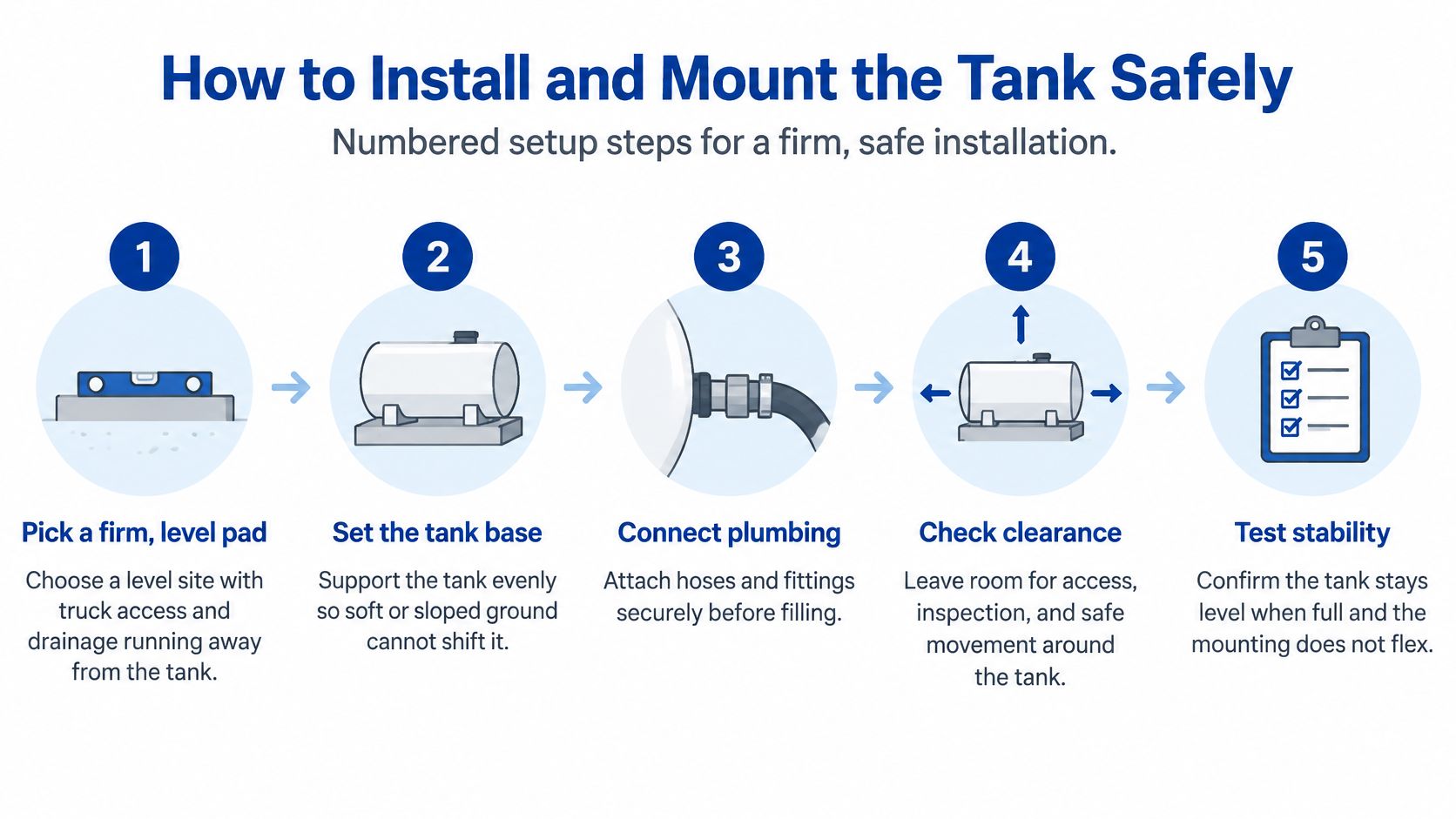
Choose a firm, level operating location. Keep truck access usable after rain, and direct surface drainage away from the installation. Leave room to handle hoses, inspect connections, and turn vehicles without driving over supply lines.
Check the loaded rating before filling. The chassis, skid, supports, restraints, tires, and tow vehicle must accommodate the tank in its filled configuration, including attached equipment. An empty tank's weight does not show whether the setup can safely carry a full load.
Support the tank as its design requires. Position the tank so water can drain toward its outlet without compromising stability. Avoid improvised tilting; follow the tank's installation requirements and ensure the outlet and drain remain accessible.
Protect the fill point and vent. Use a secure cover and a screened vent suitable for the service, with both left accessible for inspection. A blocked vent can interfere with filling or withdrawal; an exposed opening can admit debris.
Protect connected drinking-water plumbing from backflow. Have the connection assessed for the required air gap or approved backflow assembly. A generic check valve may not provide adequate protection for every connection or hazard.
Plan for freezing conditions around all exposed components. Insulation, suitable heat tracing, accessible drains, and protected pump housings need to work as a system. Provide a way to drain trapped sections of hose and valve bodies.
Test the installation under intended operating conditions. Fill the tank in a controlled way and check for movement, leaks, venting problems, and poor discharge. Stop and correct any instability or leakage before putting the setup into service.
Measure usable supply rather than nameplate capacity
Water left below the outlet, inaccessible residual water, and required freeboard reduce the amount available for delivery. A drawdown test shows how much water can be withdrawn and whether the tank can drain for cleaning.
Match the pump to the destination. If the setup includes a separate well pressure tank, DIY well pressure tank sizing tips can help with that component. Pressure-tank sizing does not determine bulk-storage capacity.
The installation is ready when supports remain stable, joints stay dry, the vent is clear, and the tank drains as designed.
How to Disinfect a Tank Before Potable Use
A tank intended for livestock or other nonpotable service may be unsuitable for drinking water. Before potable use, clean and disinfect the entire wetted system, then hold it out of service until the required test results are acceptable.
The Washington State tank-disinfection guidance describes treatment with approximately 50 ppm chlorine, using approximately 0.75 gallon of unscented 8.25% hypochlorite per 1,000 gallons, and at least 4 hours of contact. The applicable authority may require a longer approved treatment.
Commission the complete wetted system
Rinse and flush before disinfecting. Remove sediment, rust, and loose debris from the tank, hoses, pump, and fittings. Scrub deposits that remain attached; circulating disinfectant over them may not clean the surfaces underneath.
Fill the complete water-contact system to the approved chlorine concentration. Open and operate the relevant lines so the treatment reaches components beyond the tank shell. Use bleach whose strength matches the dosing calculation, without fragrance or unsuitable additives.
Maintain the approved contact period. Record when the required concentration reaches the system and prevent water from being used during treatment. Follow the local authority's accepted procedure rather than shortening the hold time.
Drain the treatment solution, refill with potable water, and obtain the required coliform result before release. Follow laboratory instructions for sample bottles and handling. Clear water and a chlorine smell do not establish that the tank has passed the release test.
Handle and dispose of the shock-disinfection solution as the approved procedure directs, protecting drains, vegetation, and surface waters.
Eliminate the usual failure points
A failed result requires corrective action and repeat treatment. If contamination persists after retreatment, keep the unit out of potable service while investigating inaccessible deposits, damaged components, or unsuitable equipment.
- Missed components. A clean tank can be recontaminated by a dirty delivery hose or pump.
- Wrong product. Fragrance and other additives make household-product substitution unsuitable.
- Interrupted treatment. Early draining or incomplete filling can leave wetted surfaces untreated.
- Shared service equipment. Using the same hoses for potable and nonpotable work undermines separation between the two services.
Filtration and disinfection address different problems. Information on water filtration upgrades for Atlanta homes concerns building-side treatment; a downstream filter does not show that a hauling tank has passed commissioning.
Record the tank identification, source water, product strength, dose, measured concentration, contact period, operator, and test results. Release the tank only when the required results support potable use.
Maintenance Schedule, Residuals and Records
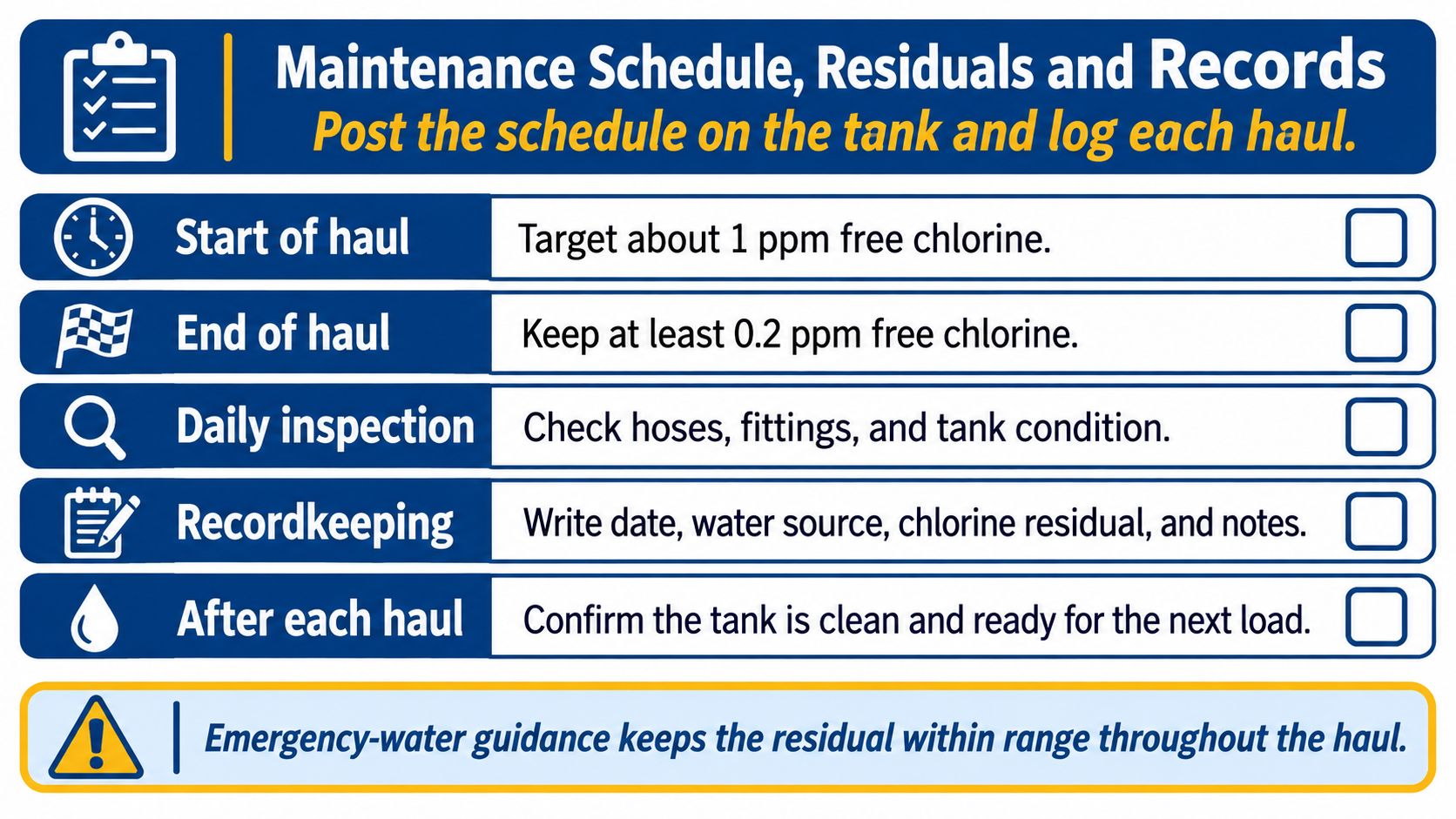
A delivery can leave the loading point within limits and arrive with too little disinfectant remaining. Set the operating schedule around the approved local requirements, and record actual results at loading and delivery.
The USDA watering-facility operating reference gives about 1 ppm free chlorine at loading, at least 0.2 ppm at delivery, and about 20 minutes of contact before use. These figures are guidance; the limits approved for the specific service and jurisdiction govern.
Maintenance and testing schedule
| Task | Interval | Target or record |
|---|---|---|
| Chlorine residual at loading | Every delivery cycle | Measure and record the approved starting residual |
| Chlorine residual at delivery | Every delivery cycle | Verify the approved receiving residual before release |
| Contact time before use | Each fill | Record filling and earliest permitted use times |
| Residual measurement | Loading and delivery | Measure actual free chlorine rather than relying on calculated dose |
| Tank and opening check | Every delivery cycle | Confirm suitable contact materials, watertight condition, lockable cover, and screened vent |
| Recommissioning after repair or failed test | After a contamination-related failure or water-contact repair | Repeat the approved process and obtain acceptable release testing |
Post the schedule where operators fill or inspect the tank. A reminder supports the operating procedure; it does not replace the jurisdiction's accepted requirements.
Measure what arrives
Sediment, biofilm, temperature, and water chemistry can reduce disinfectant during transport. A calculated dose alone cannot confirm that the required residual remains at the destination.
Use a suitable free-chlorine test kit with maintained reagents and consistent sampling points. Record the measured result, not the planned target. Excess dosing can cause taste complaints or exceed the applicable limit without resolving the underlying contamination.
Keep a usable chain of custody
Each delivery record should connect the approved source to the destination. Identify the tank, delivered volume, loading and receiving results, and any corrective action. The receiving operator needs enough information to accept or reject the load without reconstructing its history.
Release control: An out-of-limit result should stop delivery for use until the responsible operator completes the approved corrective action.
After unloading, cap hose ends and protect equipment from dirt. Before the next cycle, check for a damaged seal, an open hatch, or debris. A previously acceptable inspection does not clear new damage or contamination.
Confirm Your Size and Service Before You Buy or Rent
A purchase or rental decision should begin with an operating sheet, not a gallon rating. The sheet needs enough detail for the tank supplier, hauler, site manager, and approving authority to evaluate the same arrangement.
For rotational grazing, frequent movement may justify a compact system with dependable replenishment. For a remote construction operation, transport interruptions may justify more stored water, provided the site can support and service the larger unit. Neither choice is automatically better outside its operating conditions.
Put the commitment in writing
The operating sheet should capture:
- Peak demand. Expected consumption and simultaneous activities, with an explicit allowance for interruption.
- Service category. Potable, livestock, irrigation, or dust control, with no ambiguous shared-use description.
- Refill route. Approved source, loading access, travel restrictions, and backup arrangements.
- Site readiness. Truck clearance, support conditions, power availability, and freeze exposure.
- Acceptance documents. Material suitability, prior contents, sanitation records, and required release testing.
For a school, clinic, or municipal deployment, the drinking-water approval should be resolved before the tank arrives. Occupied buildings create a deadline, but that deadline doesn't make undocumented equipment acceptable.
Compare availability rather than sticker price alone
A rental comparison should establish who cleans the unit, who supplies dedicated hoses, who performs sampling, and what happens if the equipment fails. A purchase comparison should include storage between deployments, maintenance access, and responsibility for keeping records current.
Larger tanks take more effort to reposition and can leave more water standing when demand falls. Smaller tanks require tighter refill coordination. The useful comparison is the cost and reliability of maintaining supply, including cleaning downtime and backup delivery, rather than the price per nominal gallon.
The best specification describes how the operation will stay supplied when the normal plan slips.
Before an order is placed, the responsible manager should reconcile the demand calculation, service category, transport arrangement, and local approval requirements. Any unresolved question about prior contents or permitted drinking-water use belongs on the rejection list, not the delivery-day punch list.
Pacific Mobile Structures, Inc. offers mobile offices, storage containers, and modular buildings for temporary and permanent facilities. For projects that also need mobile water service, those spaces should be coordinated with tank access, utility routes, and operating clearances. Project teams can visit Pacific Mobile Structures, Inc. to discuss building and storage requirements alongside their site-utility plan.