A modular school is on a tight schedule, the HVAC units are staged, and the crane is already booked on another corner of the site. The courtyard's too cramped for a big pick, the scaffold estimate came up short, and the foreman points to a straight boom lift as the fastest way to keep the install moving without tearing up finished work or blocking the only access lane.
That's the moment most project coordinators run into the same question. Not “How high can it go?” but which telescopic boom lift fits the job, the ground, and the logistics. On modular and construction sites, the right answer usually sits in the space between height, outreach, and capacity, with site conditions deciding whether the machine is a clean solution or a costly mistake.
Table of Contents
- A Day on Site When the Boom Goes Up
- What a Telescopic Boom Lift Is
- The Three Specs That Drive Every Decision
- Common Uses on Modular and Construction Sites
- Why Bigger Machines Demand Better Site Planning
- The Safety Question Most Buyers Ask Too Late
- Training Standards and Daily Inspection Basics
- Choosing the Right Lift for Your Project
A Day on Site When the Boom Goes Up
The first thing that changes on a modular job is the map. A classroom module lands, the roof unit still needs setting, and the trailer queue is already backing into the delivery lane. Two installers are waiting for access, the slab edge is close, and the only open setup spot is a narrow strip of compacted ground beside stacked materials.
That's where a telescopic boom lift earns its keep. The boom reaches out in a straight line, so crews can work over a parapet, past a module edge, or across a small gap without having to snake around an obstruction. In a tight school or office retrofit, that often matters more than raw height.
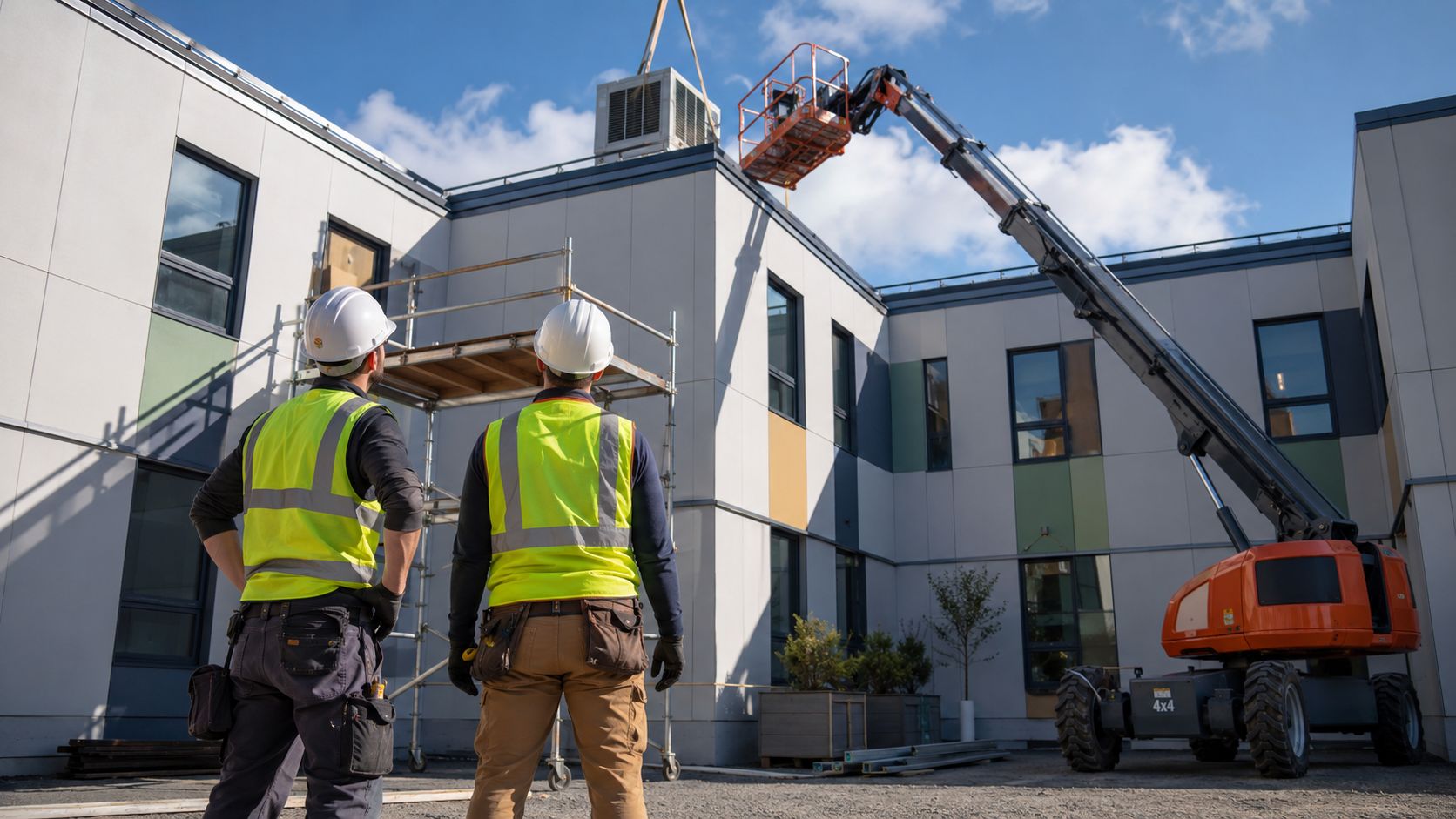
What the coordinator is really deciding
A good rental call isn't about picking the tallest machine on the lot. It's about whether the lift can reach the work, carry the crew and tools, and still fit the site without creating a traffic jam.
Practical rule: if the machine can't get to the setup point cleanly, the extra reach doesn't help much.
That's why modular projects are such a useful test case. Finished floor heights, temporary fencing, narrow access roads, and weather windows all shape the decision. A lift that looks perfect on paper can become the wrong choice if it can't cross the slab, clear the edge, or park where the work happens.
The rest of the decision comes down to spec-sheet details that translate directly into field performance. Once those are clear, the rental choice gets much easier.
What a Telescopic Boom Lift Is
A telescopic boom lift is a mobile elevating work platform, or MEWP, with a straight boom that extends section by section. On site, it behaves like a telescoping fishing rod mounted on a machine. Each nested section slides out to carry the platform farther from the base.
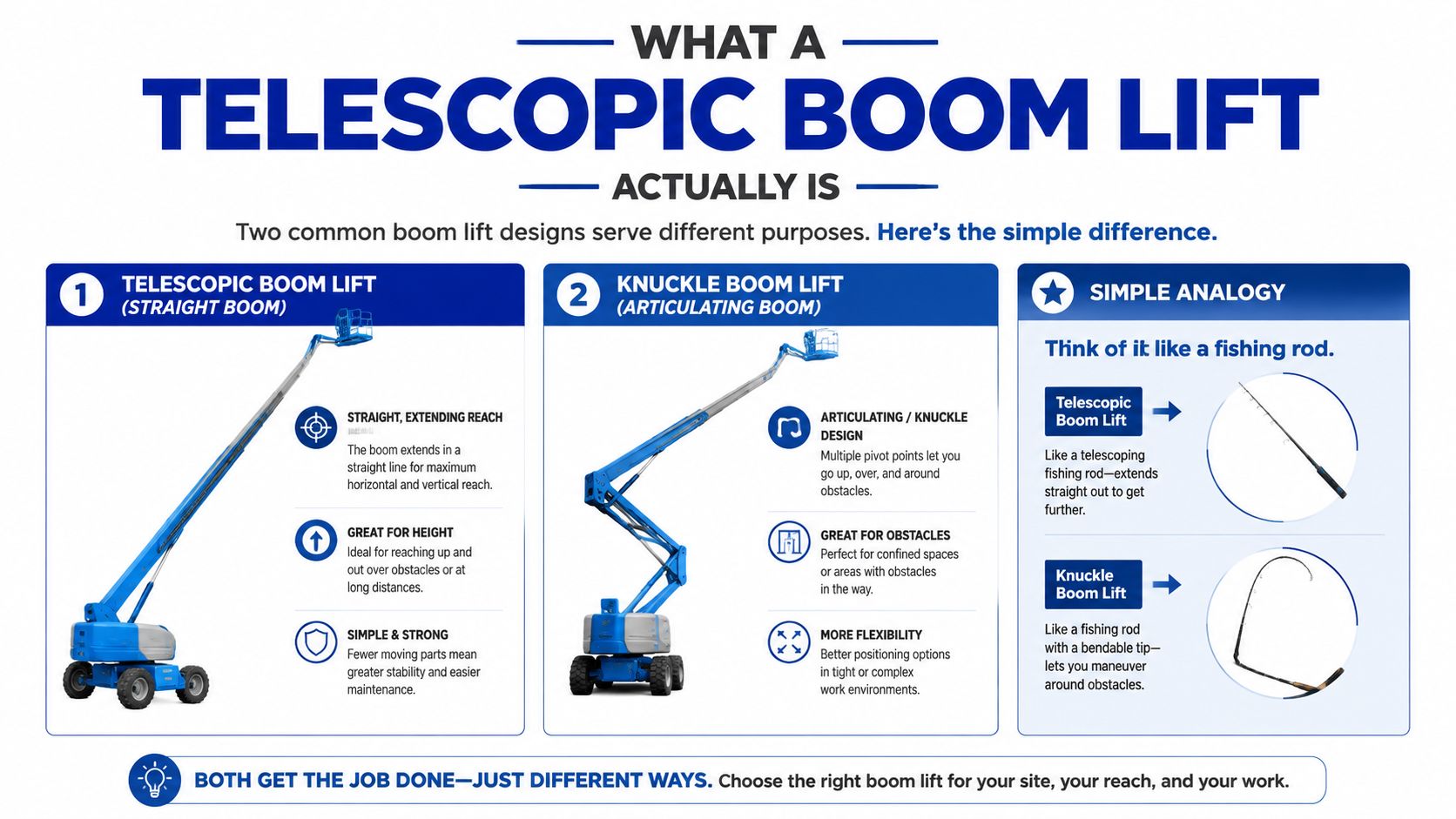
Straight reach versus bend-around access
A scissor lift goes straight up. It works well on flat slabs, but it does not solve an over-and-around problem very well. An articulating boom lift bends at joints, so it can snake around obstacles, yet that flexibility usually gives up some direct outreach and often some platform usefulness.
A telescopic boom lift takes the other route. It works best when the crew needs to work outboard of the machine, not just above it. That matters around parapets, excavations, module edges, and utility corridors where the base has to stay on solid ground and the platform has to land well past the obstacle.
Start with the height the crew must touch
The boom does not just “go up.” Operators usually control drive, boom extension, boom elevation, swing, and platform positioning from the basket, with ground controls for emergency lowering. Some machines also use leveling systems, and many include platform rotation so workers can line up on a façade or roof edge without moving the base.
That geometry changes the job. The farther the platform extends, the more the coordinator has to think about the whole envelope around the machine, not only the point above it. New coordinators often miss that part because the lift's footprint on the ground is only half the picture.
The Three Specs That Drive Every Decision
The easiest way to sort telescopic boom lift options is the working envelope triangle, which is really just three numbers that have to agree with the job. Those numbers are working height, horizontal outreach, and platform capacity.
| Working Envelope Comparison: Three Telescopic Boom Lift Models | Working Height | Horizontal Outreach | Platform Capacity |
|---|---|---|---|
| Compact class | Lower-rise work on one level | Short outreach for nearby access | Lower crew-and-tool loads |
| Mid-range class | Moderate vertical access | Better outreach for façade and roof-edge work | Capacity suited to mixed tools and materials |
| Large class | High-reach installs and maintenance | Long outreach over obstacles | Capacity often changes with reach position |
Start with the height the crew must actually touch
Working height is the point that has to clear the task, not just the roofline. If a team is fastening conduit, hanging trim, or landing an HVAC unit, the platform has to get the worker's hands above the highest touch point with enough room to work comfortably.
That's why a lower machine can still be the right one if the job is compact and the approach is clean. Height alone doesn't guarantee usefulness, especially on modular projects where the critical work is often on the edge of a unit, not at the highest roof point.
Outreach usually decides the rental faster than height
Horizontal outreach is where a lot of job plans get made or broken. On a modular install, the lift might need to reach over a finished façade, a safety fence, or a planted courtyard to land at the actual work zone.
Capacity is the third leg of the triangle, and it's the one people underestimate. A platform that carries a crew easily at one position may need a reduced load envelope once the boom is extended farther. That's why a machine with less height can still be the smarter choice if it carries more usable load where the work really sits.
A lift with the wrong envelope doesn't just slow the job down. It can force extra moves, extra setup, and extra risk.
Common Uses on Modular and Construction Sites
On a modular school or office job, a telescopic boom lift often shows up for the work that sits just beyond normal reach. Crews use it to set roof equipment, finish exterior trim, route conduit, and land materials while the next module is being placed. The straight boom is especially useful when the install point sits directly outboard of the building edge.
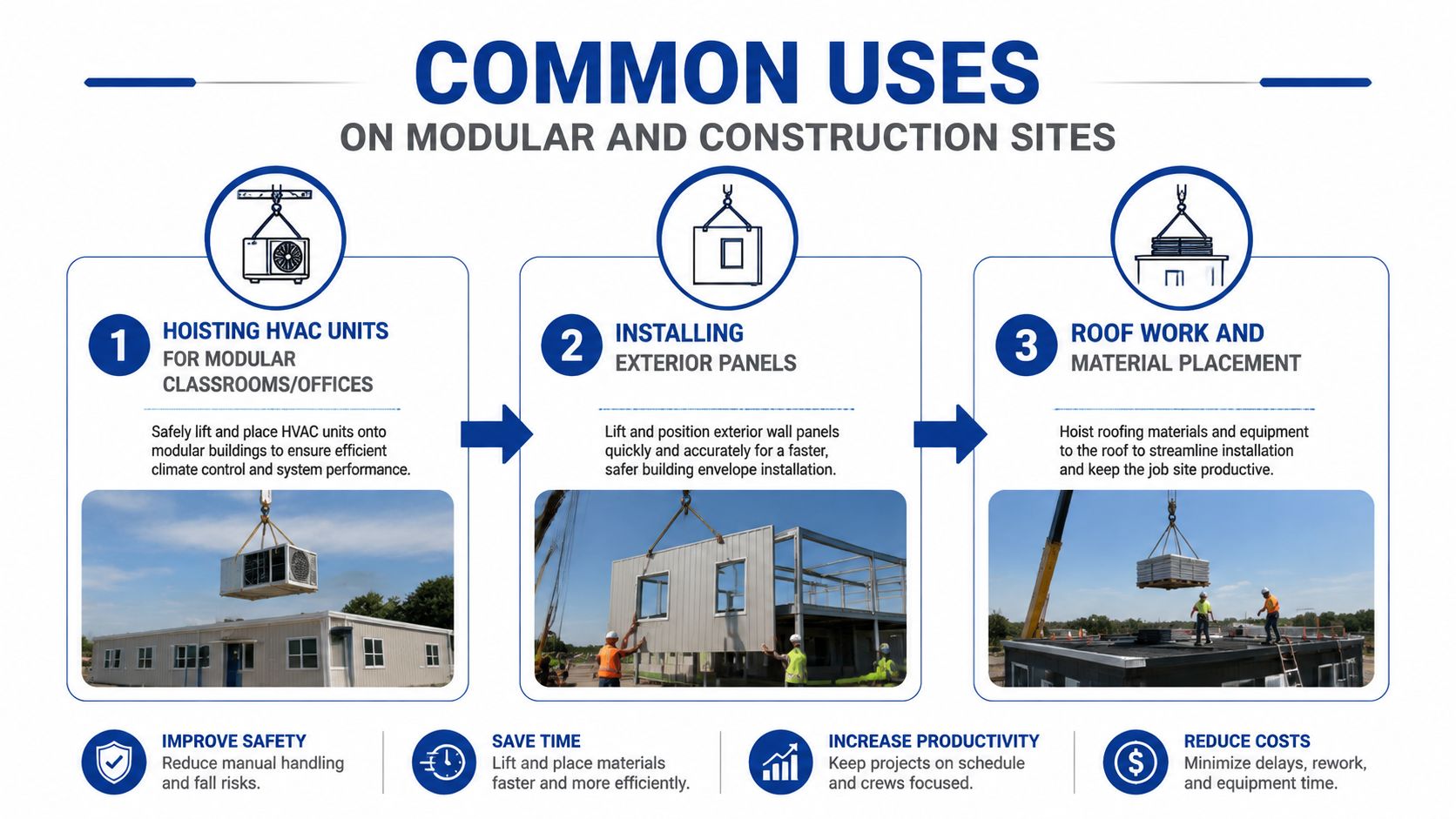
Where the straight boom fits best
Steel erection is another natural fit. A crew can reach past deck edges to bolt connections or handle material without having to work around a bent boom path. Bridge and utility work also benefit from the same direct line, especially when the task is high, exposed, and not hidden behind obstacles.
Signage, lighting, and façade work are common too, because the machine can park on a clear base and reach straight to the face of the structure. Tree trimming near a new build is another practical use, particularly when the crew needs outreach more than maneuvering around branches.
Where another lift can still be smarter
An articulating boom lift still makes sense when the crew has to bend over a roofline or weave around a fixed obstacle. The telescopic machine is better when the target is out and up, not around and back. That boundary is easy to see once the work zone is drawn on the plan.
For scope planning, a good estimating workflow helps. Teams that are mapping roof equipment, wall penetrations, or panel installs often pair field measurements with a tool like Exayard roofing estimating software so the access plan matches the actual takeoff. For broader modular site context, the logistics around temporary facilities also matter, including the planning considerations covered in this data center mobile office overview.
A short site note can save a lot of repositioning later. The lift should serve the task, not force the task to adapt to the machine.
Why Bigger Machines Demand Better Site Planning
A larger telescopic boom lift can solve a reach problem, but it also brings a heavier planning burden. More mass means more concern about slab strength, asphalt condition, turning space, and the path from delivery to setup. On modular sites, those issues stack up fast because deliveries, stacked containers, and access lanes already compete for the same square footage.
Ground bearing matters more than gross weight
The machine's total weight is only part of the story. What reaches the ground through tires or outriggers is what matters when the subgrade is soft or the surface is newly finished. A setup that looks stable on paper can still fail if the pad location settles, tilts, or crushes the surface below it.
That's why mats, plates, or a different setup point are often the right answer. A coordinated move across a yard can save far more time than forcing a large machine to work from a compromised spot.
| Telescopic Boom Lift Size vs. Site Impact | Typical Working Height | Approx. Machine Weight | Outrigger Load per Pad | Site Planning Implication |
|---|---|---|---|---|
| Smaller class | Lower to mid-rise access | Lower transport burden | Lower localized demand | Fits tighter gates and lighter prep |
| Mid-size class | Common modular and façade work | Moderate weight | More surface planning needed | Often needs matting or firmer access lanes |
| Large class | High-reach exterior work | Heavy transport and setup needs | Higher surface stress at setup points | Requires stronger slabs, more clear space, and closer review |
Tight modular yards reward the smaller fit
A smaller machine often wins because it can get through standard gates, turn inside narrow lanes, and set up without reshaping the whole site. That can be the difference between a same-day install and a delayed one.
For transport planning, oversized moves introduce another layer of coordination. Teams that need a broader reference point for route and load planning can also look at the UK out of gauge haulage guide, especially when machine size starts to affect delivery timing and access windows.
The practical lesson is simple. Bigger reach is useful only if the site can support the machine's footprint, its setup pattern, and the working space around it.
The Safety Question Most Buyers Ask Too Late
People often start with fall protection, but the more serious risk usually starts on the ground. Telescopic boom lifts are vulnerable when the setup area is uneven, soft, or crowded, and the biggest problems come from overturn, entrapment, and overhead contact rather than a simple fall from the basket. Industry safety coverage has repeatedly pointed to overturns as a major MEWP hazard, and the concern gets worse when the machine is pushed onto uncertain ground.
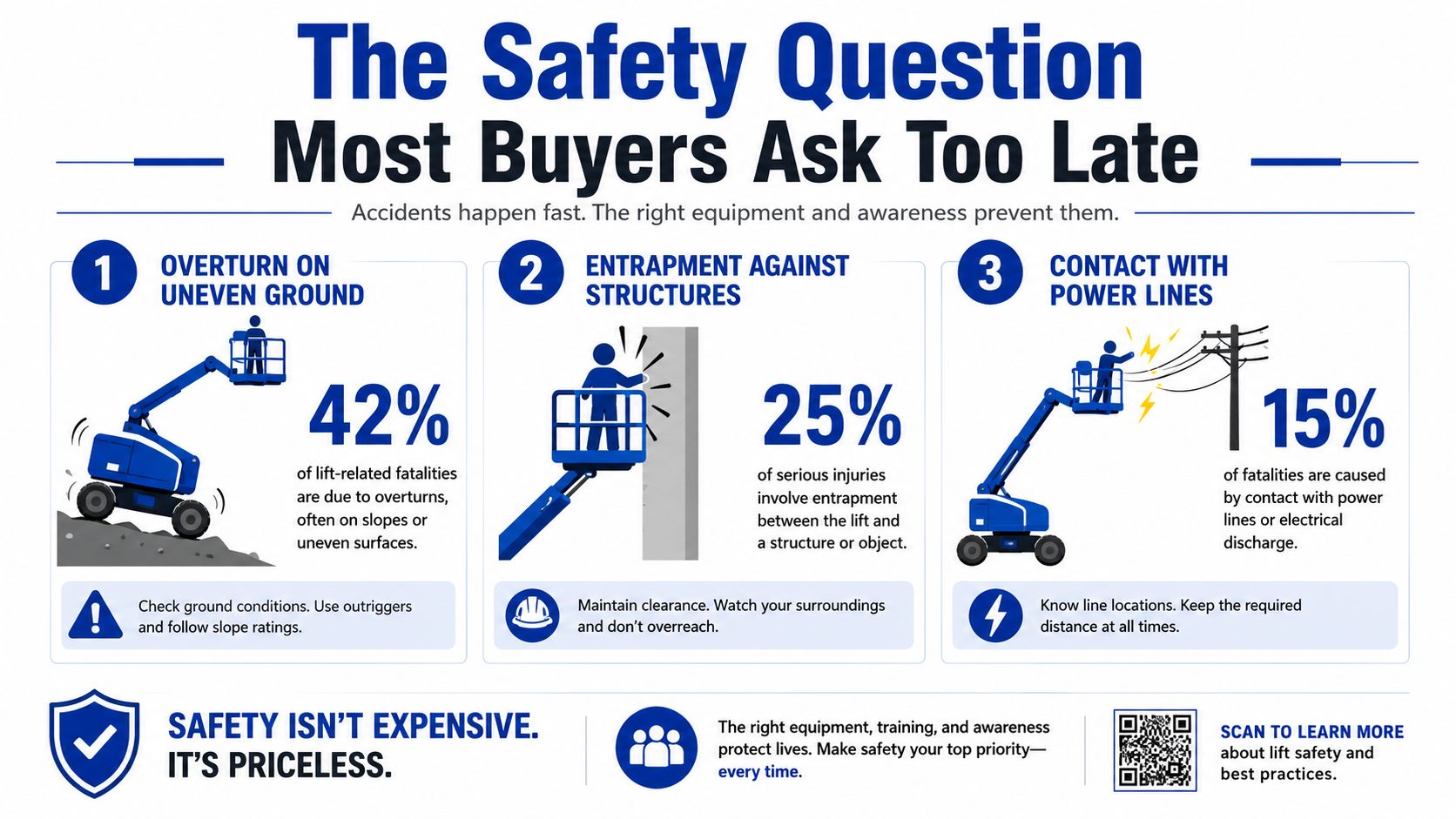
The setup zone is the real safety zone
If the ground is wrong, the rest of the plan starts to wobble. Slope, surface compaction, and clearance to walls or utilities all shape whether the lift can work safely. The machine may still fit physically, but that doesn't mean it should be used there.
Crews that spend all their energy on harness clips and ignore the pad location are solving the wrong problem.
That is especially true on retrofit work, school campuses, healthcare sites, and data centers, where the route from staging to the workface often passes through narrow corridors or active operations. The lift must be able to travel, set, and lower without pinching a worker against the structure or crossing into an unsafe overhead zone.
Hazard planning beats last-minute improvisation
Wind limits, slope limits, and approach distances change with the machine and the task. The operator and supervisor need a clear egress path, a clean rescue plan, and a setup zone that has already been checked before the boom comes off the transport position.
For site teams that also manage temporary facilities, the planning mindset is similar to the one described in mobile office building safety features, where access, stability, and daily use all depend on the conditions around the unit, not just the unit itself. The same idea applies to boom work.
The safest rental is the one that fits the ground, the edge conditions, and the rescue plan before the first worker leaves the platform.
Training Standards and Daily Inspection Basics
A telescopic boom lift is only as safe as the person operating it and the inspection behind it. Training should match the actual machine, the worksite, and the people involved. Modern MEWP practice in the U.S. is tied to ANSI/SAIA A92.20, A92.22, and A92.24, while the standards framework in Australia and New Zealand uses AS/NZS 1418.10:2011 for MEWPs. Those standards matter because they separate a casual lift rental from a controlled access plan.
Training has to match the person and the site
Operators need familiarization with the exact unit, platform-level operating skill, and review by a supervisor or competent person before they are trusted on a live project. On modular jobs, that matters because a crew may move from one campus to another and bring the wrong habits with them. The lift that worked yesterday may face different ground, a tighter route, or a new overhead hazard today.
Daily inspection should start before the machine leaves staging. Check tire condition, outrigger pads or level indicators if equipped, hydraulic leaks, control response from both ground and platform stations, and whether the load chart is legible and matches the exact unit on site. The machine should also be clean enough that leaks, cracks, or loose fittings are easy to spot.
- Tires and running gear: Look for damage, wear, and pressure issues before the machine leaves the staging area.
- Boom sections and hydraulics: Walk the boom line for visible leaks or anything that suggests uneven movement.
- Controls and alarms: Test functions from ground and platform so surprises do not show up mid-task.
- Paperwork and sign-off: Keep inspection logs in the site trailer, with a clear signature trail so rental records do not go missing.
Modern MEWP practice is guided by sources like the safety resources available at Pacific Mobile Structures, and that same mindset applies here. For maintenance-minded crews, hydraulic oil tank maintenance tips can also reinforce the value of clean fluids and routine checks, which support the inspection discipline the lift depends on.
The last check happens every time the machine moves. Ground conditions change hour by hour on modular sites, so even experienced operators need to rewalk the setup area before they reposition.
Choosing the Right Lift for Your Project
The cleanest way to choose a telescopic boom lift is to start with the work, not the machine. First, mark the highest working point, the furthest outreach needed at that height, and the weight of the crew plus tools. Then check ground bearing, access width, overhead hazards, and how close the machine must work to modular units already in place.
A simple field decision sequence
A 45-foot unit often makes sense for HVAC service on a single-story modular office when the approach is open and the load is light. A 60-foot unit with roughly 30 feet of outreach fits better when the crew has to reach past the edge for second-floor cladding or similar façade work. An 80-foot-plus class machine is usually reserved for taller modular building erection or other jobs where vertical reach and outreach both matter.
If two lifts both meet the technical spec, the smaller one that fits the site usually wins.
That rule works because a machine that can't get to the pad on day one costs more than a few extra feet of reach on day two. The best choice is the one that moves cleanly through the gate, sets up on sound ground, and lets the crew work without extra repositioning.
Pacific Mobile Structures, Inc. supports modular projects with mobile offices, storage containers, and modular buildings that need the same kind of access planning covered here. If the next project calls for temporary space, storage, or a turnkey modular solution, visit Pacific Mobile Structures, Inc. to see how the right building and the right site plan can keep the job moving.