Used Conex containers typically cost $1,075 to $2,175 in the U.S. before delivery, while new one-trip units typically cost $1,825 to $3,225, with 20-foot units at the lower end and 40-foot units at the higher end. That split answers how much are Conex containers at sticker price, but it doesn't answer what a buyer pays to get a usable box on site.
The gap matters because containers trade in a huge global system. UN Trade and Development reported that global container ports handled 920 million TEUs in 2024, a 6.9% year-over-year increase and 37% above 2014 levels, according to a UN Trade and Development container fleet document. Local sticker prices therefore move with port inventory, repositioning costs, and trucking distance, not just with steel.
A procurement decision should start with the bare-unit range, then add delivery, placement, permits, and any finishing work. A cheap used box can lose its advantage quickly if it needs floor repairs, door work, a crane set, or a long inland haul.
Table of Contents
- Typical Prices for New and Used Conex Containers
- What Moves a Container's Price Up or Down
- Delivery, Permits and Site Costs That Raise the Total
- Choosing Based on Duration and Use
- Sample Budgets for Common Container Projects
- Ways to Lower Your Container Costs Safely
- Confirm Your All-In Cost Before You Order
Typical Prices for New and Used Conex Containers
A practical U.S. budget starts at approximately $1,075 to $2,175 for a used unit and $1,825 to $3,225 for a new one-trip unit, with length, condition, location, and delivery distance driving the final quote, according to a Container Management price guide. Those figures cover the bare container only. Delivery, placement, locks, ramps, ground work, and modifications sit outside the range.
The advertised box price is the starting line, not the cost answer. A usable container budget is the delivered, set, permitted, ready-to-use total, and that total can reorder the choices: a low used price may stop looking low once floor repairs, door work, a crane set, or a long inland haul are added.
Buyers should pick the row closest to the intended use before comparing sellers. A storage buyer who only needs weather protection shouldn't pay for transport certification. A buyer planning to move loaded cargo, stack units, or keep a box for many years has the opposite priority.
Why the 20-Foot Unit Is the Baseline
The industry measures capacity in TEUs, or twenty-foot equivalent units. A 20-foot container equals 1 TEU and a 40-foot container equals 2 TEUs, so suppliers and freight operators use the 20-foot box as the standard comparison point. The 40-foot unit carries roughly twice the usable length, but it also needs more transport and handling capacity, which is why its price doesn't double in every market.
Typical US purchase prices for standard conex containers
| Unit type | Condition | Typical US price range | Best fit |
|---|---|---|---|
| 20-ft standard dry | Used, wind-and-watertight | $1,075–$1,600 | Basic storage |
| 20-ft standard dry | Used, cargo-worthy | $1,300–$1,700 | Transport and heavier storage |
| 20-ft standard dry | New, one-trip | $1,825–$2,475 | Clean finish, long-term use |
| 40-ft standard dry | Used, standard | $1,350–$2,000 | Large storage footprint |
| 40-ft high-cube | Used, cargo-worthy | $1,675–$2,175 | Taller storage or workspace |
| 40-ft high-cube | New | $2,825–$3,225 | Premium new unit before delivery |
Reading the Table Without Overbuying
Wind-and-watertight means the box keeps weather out well enough for storage, but it isn't certified for loaded transport. Cargo-worthy means the structure meets requirements for transport use, so it commands a premium. One-trip units have made a single loaded journey from the factory region, so steel, flooring, doors, seals, and paint are usually in far better shape than fleet-retired units.
Published ranges can disagree because they often describe different condition grades, depot locations, and delivery assumptions. A local delivered quote, tied to a named depot, condition grade, and delivery address, settles which range applies.
Estimating accuracy improves when the container line sits inside a full project estimate rather than alone. The same itemization discipline used for remote estimating talent from HireArchitects applies here: list the box, haul, set, permits, site prep, and finishing before choosing a seller. The container itself is rarely the hardest number to pin down. The site work around it is.
Budget rule: Quote the box, the haul, and the set as three separate lines. A supplier who won't split them can't be compared fairly.
What Moves a Container's Price Up or Down
A 2026 market monitor reports average used prices of approximately $1,786 for a 20-foot container, $2,187 for a 40-foot standard container, and $2,288 for a 40-foot high-cube unit, with reported retail ranges of roughly $999 to $4,900 for 20-foot units and $1,349 to $4,900 for 40-foot units, according to an Eveon Containers market monitor. The spread is the point: two boxes with the same nominal size can land at very different totals because one is nearer a depot, cleaner at the doors and floor, and cheaper to place.
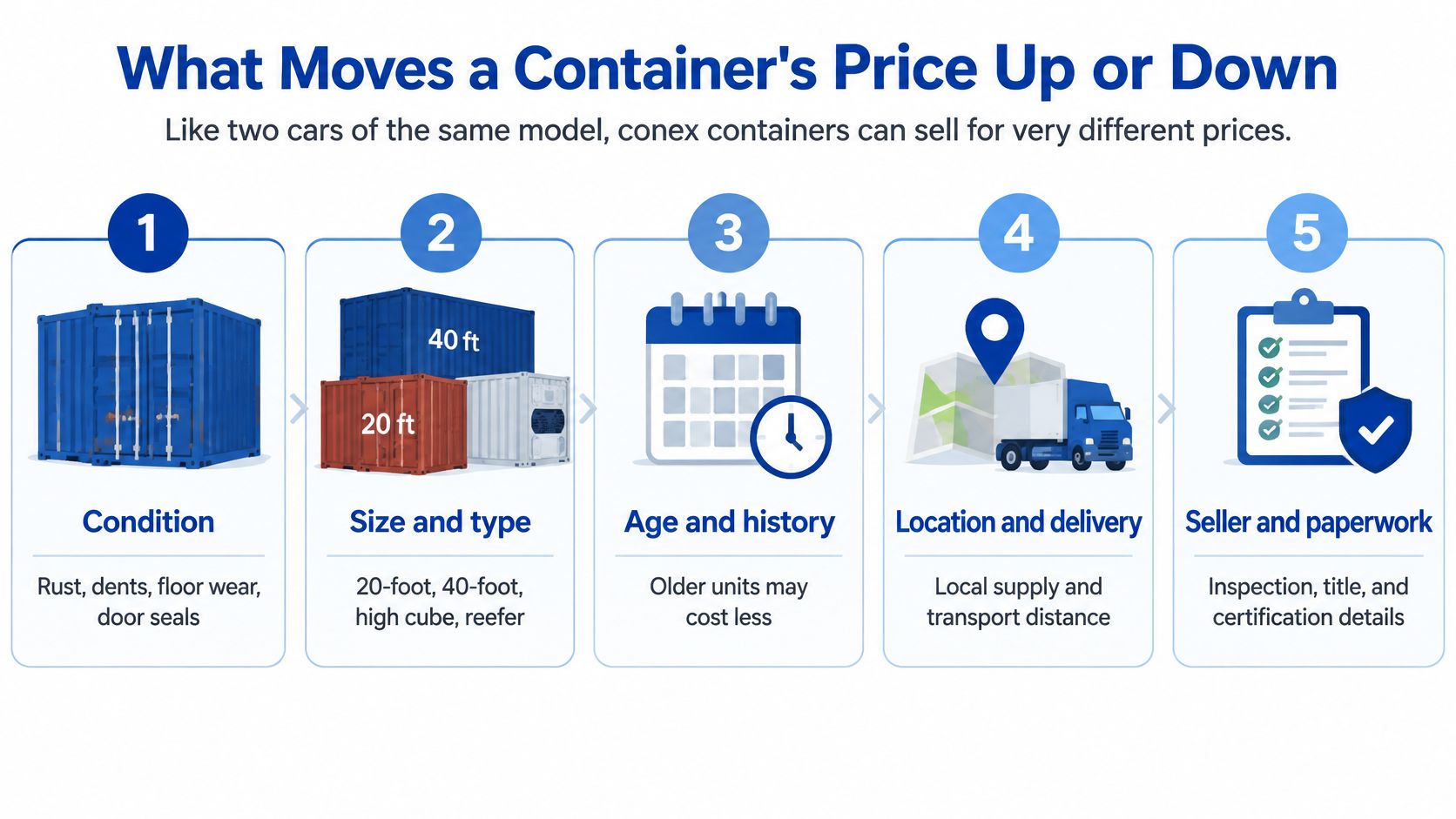
Five drivers explain most of that gap, ordered by how often they change a delivered quote.
Condition and Certification Come First
Condition is the largest driver. Rust at the corner posts and door frames, floor delamination, bent door hardware, perished seals, and patch repairs all cut both price and usable life. A box with sound flooring and doors that swing and seal properly is worth more because the next owner is buying storage capacity, not a repair list. A cheaper unit can lose that advantage once floor work, seal replacement, leveling, and placement labor enter the budget.
Certification sits close behind. Wind-and-watertight units are cheaper because they are sold for static storage. Cargo-worthy units cost more because they must satisfy structural and transport-related requirements. Buyers who need help separating grades before requesting quotes can use a guide to container grades and what separates them to match the grade to the job.
- Rust and dents: Surface rust is cosmetic, but rust-through at corners and crossmembers is structural.
- Flooring: Soft spots, oil saturation, and delamination raise repair cost and limit loads.
- Doors and seals: Misaligned doors often signal racking, and torn seals let water in.
Age, Location, and Modifications
New versus used is the third driver. One-trip units cost more because the buyer gets newer steel, intact flooring, working seals, and clean paint. That premium makes sense for visible sites, food-related storage, or conversions. It makes less sense for a fenced equipment yard where appearance carries little value.
Location is fourth, and it is mechanical. Coastal port markets such as Los Angeles, Houston, Newark, and Savannah generally price below inland markets because repositioning and depot inventory costs are lower. Inland delivery usually adds cost because containers are heavy, low-value-per-mile assets and every extra trucking mile shows up in the delivered total.
Modifications and type round out the list. High-cube units add interior height for a modest premium over standard boxes. Refrigerated, insulated, office-equipped, and otherwise modified units cost considerably more than standard dry boxes because the buyer is paying for equipment and labor, not just steel.
The practical step is specific. A quote request should name the size, certification, acceptable condition grade, delivery address, and any modification required. Without those five items, two quotes that look comparable often price different boxes and different amounts of site risk.
Delivery, Permits and Site Costs That Raise the Total
The advertised price is rarely what the buyer pays. Current market estimates put delivery at roughly $150 to $2,500 or more, and delivery may represent 20 to 50% of the container's base price, especially for inland or difficult-access sites, according to an HZ Containers price analysis. On a low-priced used box, the haul can cost nearly as much as the steel.
That single fact changes how quotes should be judged. A distant seller with a low sticker price can lose to a nearer seller with a higher one. Distance from the depot, road access, and the equipment needed to set the box decide the outcome.
Storage-Only Placement Costs
A storage-only set is the cheapest scenario, but it still carries a list beyond the box. Most of the money goes to getting the container onto level, stable ground and keeping the doors working.
- Trucking: Tilt-bed delivery where there's room to slide the box off, or crane placement where there isn't.
- Ground preparation: Gravel pad, concrete footings, railroad ties, or blocking to keep the floor frame level.
- Leveling: An out-of-level box racks the frame, and the doors stop closing properly.
- Access: Tight gates, soft ground, overhead lines, and slopes can force smaller equipment or extra labor.
Occupied Use Costs More Than the Box
Occupied use changes the budget category entirely. An office, classroom, or clinic needs insulation, electrical work, lighting, ventilation or HVAC, interior finish, and safe entry. Steps, ramps, and accessible routes add cost that a storage set never carries. Buyers comparing that path against a ready unit can review what a rental office container includes as delivered space before pricing a conversion piece by piece.
Permits and inspections sit on top of the physical work. Schools, healthcare providers, municipalities, and construction firms often face code compliance, utility connections, accessibility, fire safety, and procurement rules that can outweigh the steel-box purchase price. Taxes and site access charges may also be billed separately from the container.
The cheapest used container is not automatically the cheapest project. Repairs, extra preparation, and expensive transportation can erase the saving before the box is usable.
The comparison that matters is the delivered, permitted, usable total at the exact site. Suppliers should be asked for that number, itemized, rather than a bare-unit price with delivery quoted later.
Choosing Based on Duration and Use
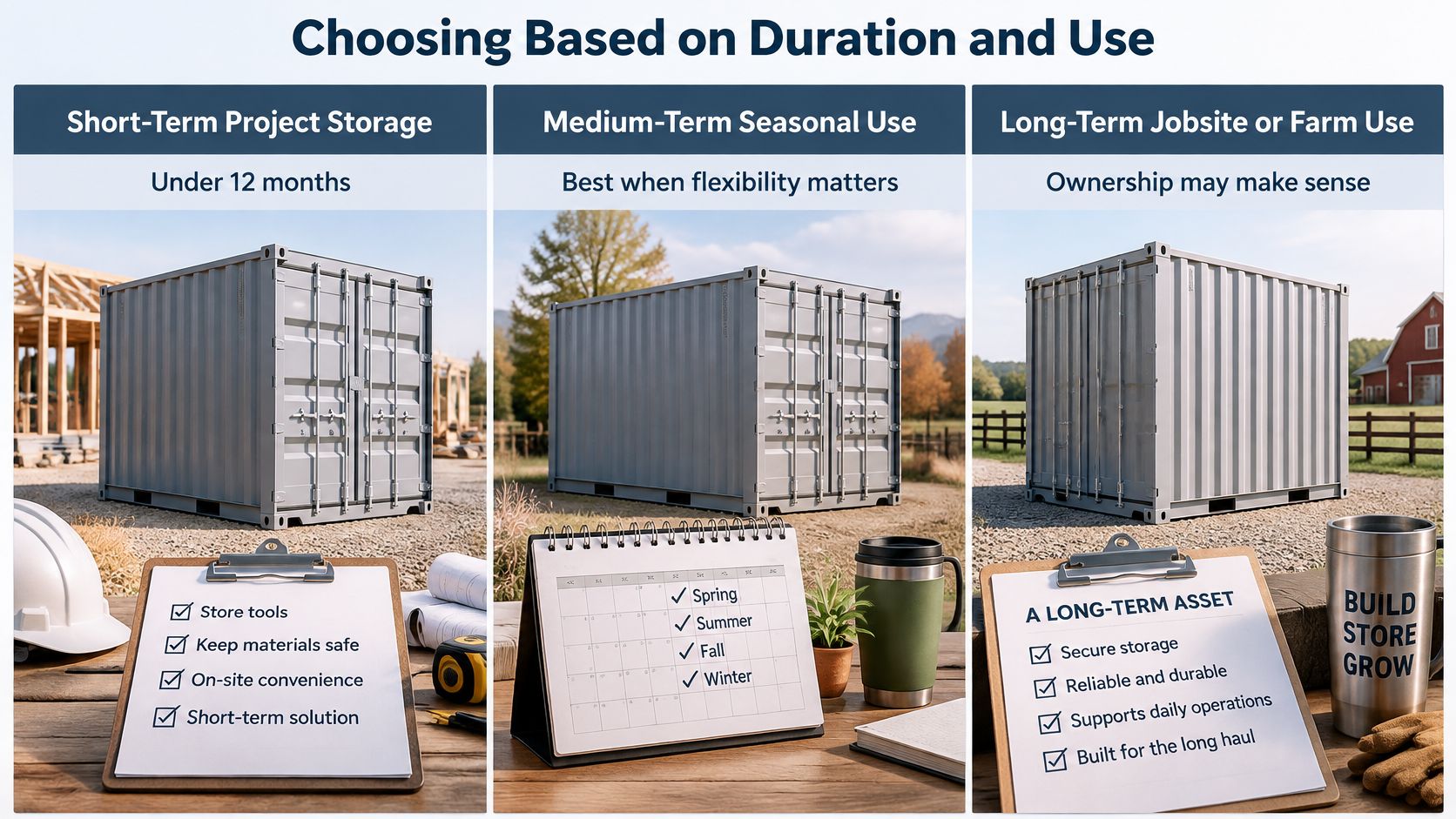
Duration decides the buy-versus-lease answer more reliably than the monthly figure does. Four scenarios cover most institutional and commercial demand: project storage under 12 months, storage or office use for three or more years, temporary classroom or clinic space during renovation, and storage needing custom modifications. Each one points to a different default.
The chart below frames the choice by time horizon before any quote is requested.
Buy or lease by scenario
| Scenario | Usually better | Deciding test |
|---|---|---|
| Project storage under 12 months | Lease | Rental fees stay below purchase plus delivery |
| Storage or office for 3+ years | Buy | Break-even passes before the unit is resold |
| Temporary classroom or clinic during renovation | Lease turnkey | Cost of delayed occupancy exceeds the purchase saving |
| Storage needing custom modifications | Buy, then modify | Modification cost stays within the expected useful life |
Running the Break-Even Test
The test compares two totals over the same period. On the purchase side: box price, delivery, placement, repairs, and modifications, minus expected resale value. On the lease side: monthly rent multiplied by expected months, plus delivery and pickup charges. The month where the lease total passes the net purchase total is the break-even point.
Rental benchmarks make the math concrete. A shipping container rent price guide puts typical rental at $75 to $200 per month for a 20-foot unit and $100 to $350 per month for a 40-foot unit, depending on condition, region, and lease length. At $200 per month, a 20-foot rental reaches $2,400 in 12 months before delivery and pickup. A buyer expecting three years of use at that rate faces $7,200 in rent, which usually clears the net cost of buying a sound used unit. A buyer expecting five months faces $1,000, which usually doesn't.
Market timing rarely overturns that math. Global container fleet capacity was reported as 6.3% higher year over year in the first quarter of 2026, while average spot freight rates were 14% below the same quarter of 2025, according to a Maersk investor report. Rising fleet supply can moderate some container-related costs, but local delivery and schedule constraints still decide an individual project. Waiting for a softer box price while a renovation sits idle usually costs more than it saves.
The video below walks through how container space gets matched to project timelines in practice.
For classrooms and clinical space, readiness carries its own value. A reconditioned, turnkey lease that arrives inspected and ready can beat a cheaper purchase that still needs transport, setup, and approvals. The cost of delayed occupancy often outweighs a small difference in purchase price.
Sample Budgets for Common Container Projects
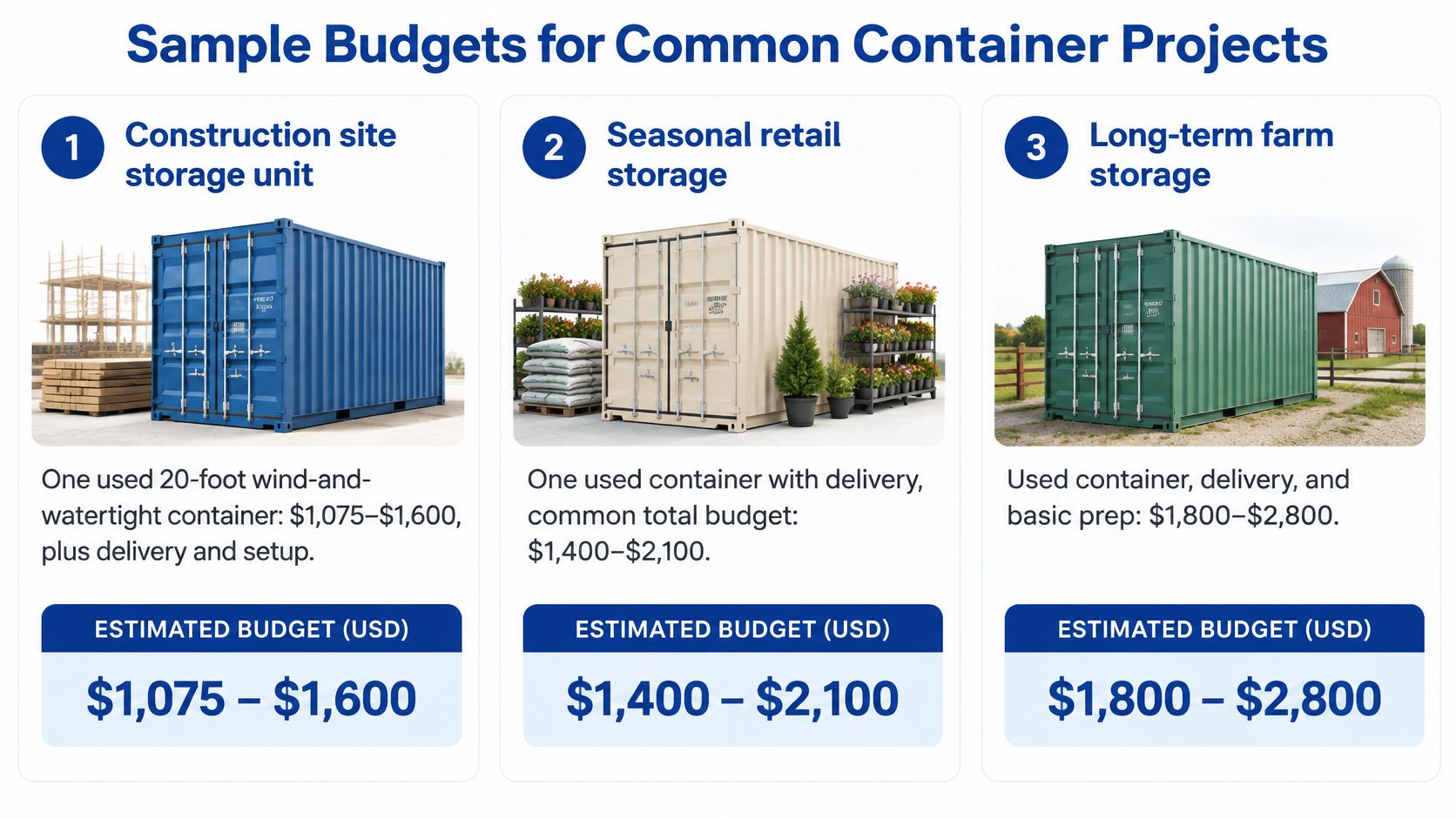
Worked examples reveal where the money goes. Each scenario below starts with a sourced purchase range, adds the delivery band, and names the finishing items that need a local quote. The pattern is consistent: the box is the most predictable line, and the site is the least.
Three Scenarios, Three Different Cost Structures
Construction site storage is the simplest case. A contractor needs dry, lockable space for tools and materials near the work. A used wind-and-watertight 20-foot unit does the job, ground work stays basic, and no interior finish is required. The budget risk is mostly haul distance and site access for the delivery truck.
School or office classroom space carries the heaviest finishing load. A used 40-foot cargo-worthy unit provides the shell, but insulation, electrical service, lighting, accessible entry, and permits turn a steel box into occupied space. Those finishing items are the largest and least predictable part of the budget, and they're set by local code and trades pricing rather than by any national container range.
Clinic or secure storage sits between the two. A new one-trip 20-foot unit gives clean interior surfaces and sound seals from day one. A lockbox, access work, permits, and any accessibility requirements complete the installation.
Sample cost breakdowns for three common uses
| Project | Container purchase | Delivery and placement | Finishing and permits |
|---|---|---|---|
| Construction site storage | Used 20-ft wind-and-watertight, $1,075–$1,600 | $150–$2,500 or more, plus ground leveling | None required for storage use |
| School or office classroom | Used 40-ft cargo-worthy, $1,675–$2,175 | $150–$2,500 or more, plus crane placement | Insulation, electrical, ramp, permits, priced by local trades and permit quotes |
| Clinic or secure storage | New 20-ft one-trip, $1,825–$2,475 | $150–$2,500 or more, plus access work | Lockbox, accessibility, permits, priced by local security and permit quotes |
Turning an Example Into a Site Budget
A reader can convert any row into a working budget in one pass. Keep the purchase range as the starting line, replace the delivery band with a quote for the exact address, and price each finishing item with a local trades or permit quote. Where a finishing cell has no published range, that absence is itself the signal: the number must come from the jurisdiction and contractors involved, not from a national table.
Analyst note: When two of the three columns are site-specific, negotiating hard on the first column alone produces a precise answer to the wrong question.
Ways to Lower Your Container Costs Safely
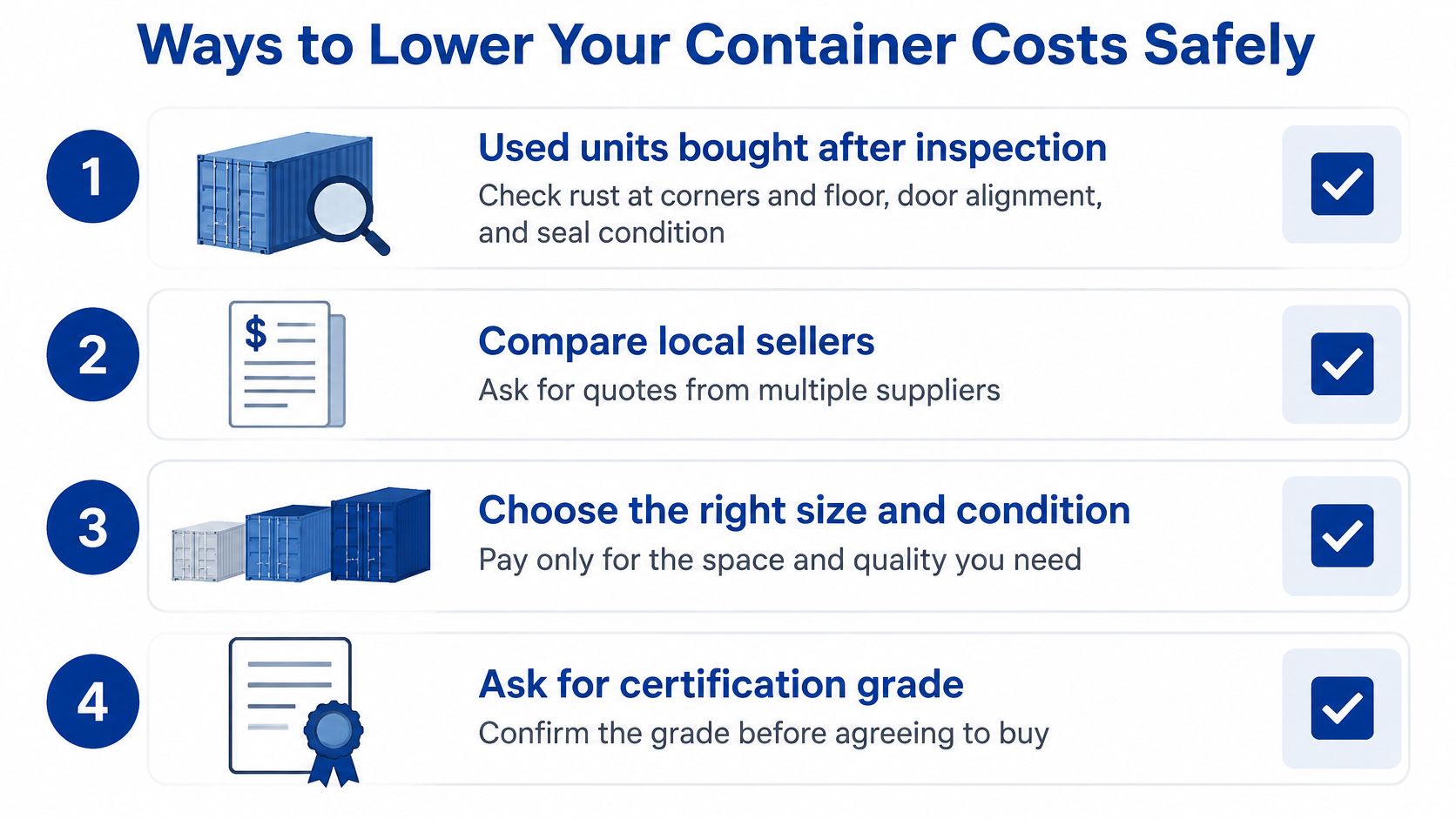
The most reliable saving is a used unit bought after inspection. The discount on used equipment is real, but it only survives if the box doesn't need structural work. Inspection is what separates a saving from a deferred expense.
Inspect Before Agreeing on Price
A buyer or inspector should check four things on any used unit. First, rust at the corner posts, door frames, and crossmembers, where structural strength lives. Second, the floor, walking it for soft spots and checking for delamination or contamination. Third, door alignment and seal condition, opening and closing both doors to confirm they swing freely and compress the seals. Fourth, the certification grade, confirmed in writing before price is agreed.
Photos help, but they hide floor condition and door operation. Where an in-person visit isn't practical, a video walkthrough that includes door operation and floor close-ups is the minimum substitute.
Use Purchasing Structure and Timing
Cooperative purchasing cuts a different kind of cost. Programs such as TIPS and KCDA let eligible public entities and qualifying organizations buy from pre-competed contracts. That structure reduces bidding time and administrative cost, which matters when a school district or municipality needs space on a fixed calendar.
Reconditioned rental units suit temporary needs. Pacific Mobile Structures, Inc. inspects and reconditions rental units before delivery, which gives a temporary project a checked, ready unit without a purchase commitment. For a short project, that route can cost less than buying new and reselling later.
Timing and quantity are the final levers. Requesting a delivered-and-set quote for several units at once gives a supplier one mobilization instead of several, and fleet supply conditions that are easing can soften box prices for non-urgent purchases. Neither lever helps a project with a fixed start date, so schedule should be priced before patience is assumed.
The warning that closes every option is the same. The cheapest used unit on a listing page is not always the cheapest option once repairs, placement, and permits are added.
Confirm Your All-In Cost Before You Order
A one-page worksheet, completed before any order is signed, prevents most budget surprises. Each step produces a number or a named quote, and the steps build the delivered total in order.
- Decide the use. Storage only, or occupied classroom, office, or clinic. This single choice sets the permit and finishing burden.
- Choose size and certification. Pick the 20-foot or 40-foot row, then wind-and-watertight, cargo-worthy, or one-trip.
- Record bare-unit prices. Get at least two quotes naming the same size, grade, and depot.
- Add delivery for the exact address. Distance from the nearest port or depot and the delivery method, tilt-bed or crane, belong on this line.
- Add placement and ground work. Blocking, leveling, pad preparation, and any access work the site requires.
- List permits and finishing. Inspections, insulation, electrical work, ramps, steps, and accessibility items, each with its own quote.
- Run the lease alternative. Monthly rent over the expected duration, plus delivery and pickup, tested against the purchase total.
- Request a delivered-and-set quote. A supplier such as Pacific Mobile Structures can quote the container with code, utility, and site coordination included for education, healthcare, government, and commercial projects.
Totals, not sticker prices, should decide the signature. Two quotes with identical box prices can differ by thousands once steps four through six are filled in. A buyer who completes the worksheet first finds that out on paper instead of on delivery day.
Pacific Mobile Structures, Inc. sells and leases storage containers, ground-level offices, and modular buildings for education, healthcare, government, and commercial projects, with delivery, setup, and site coordination handled as part of the project. Buyers who want a single delivered-and-set figure instead of separate box, haul, and placement quotes can request pricing from Pacific Mobile Structures, Inc. and compare it line by line against the worksheet total.