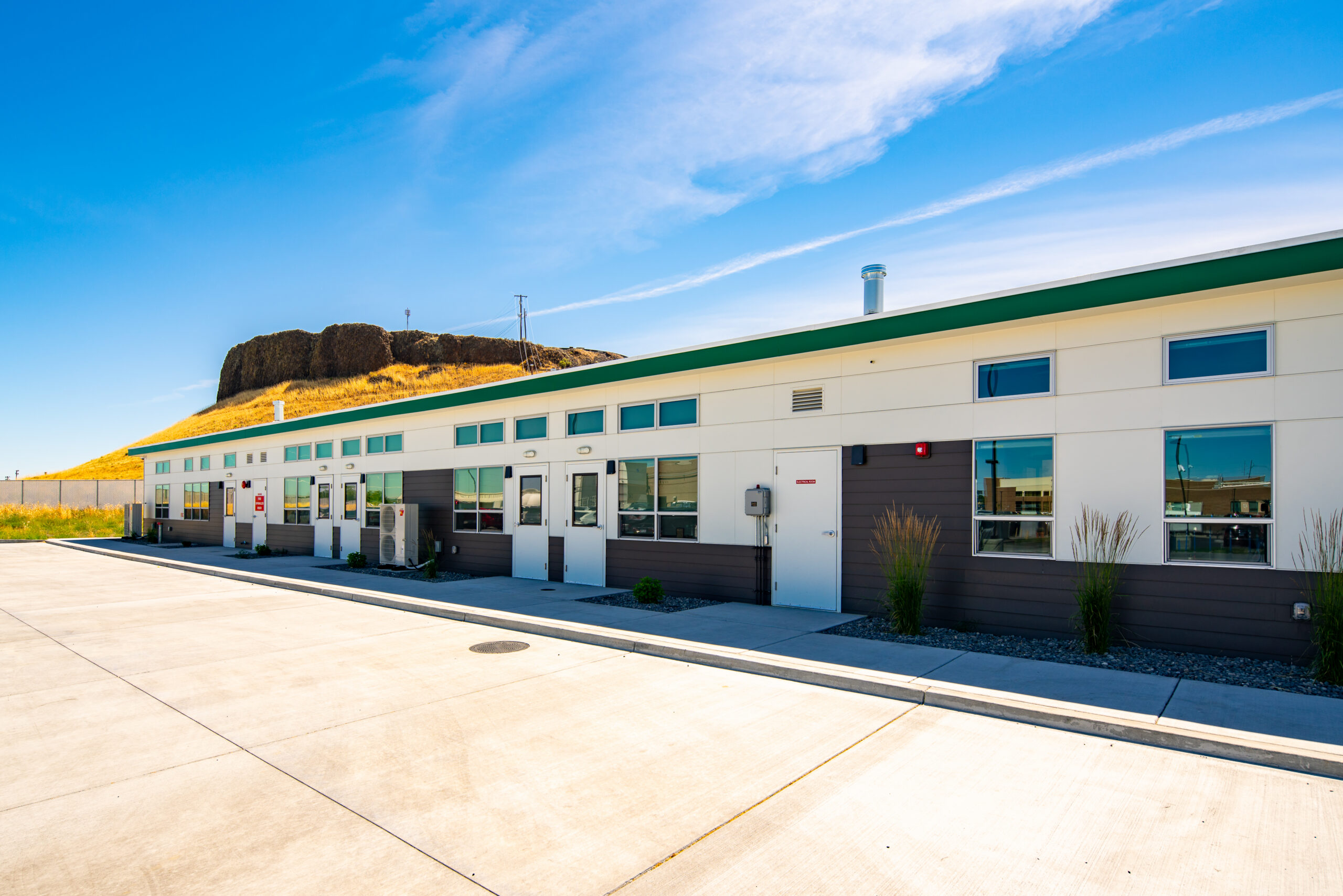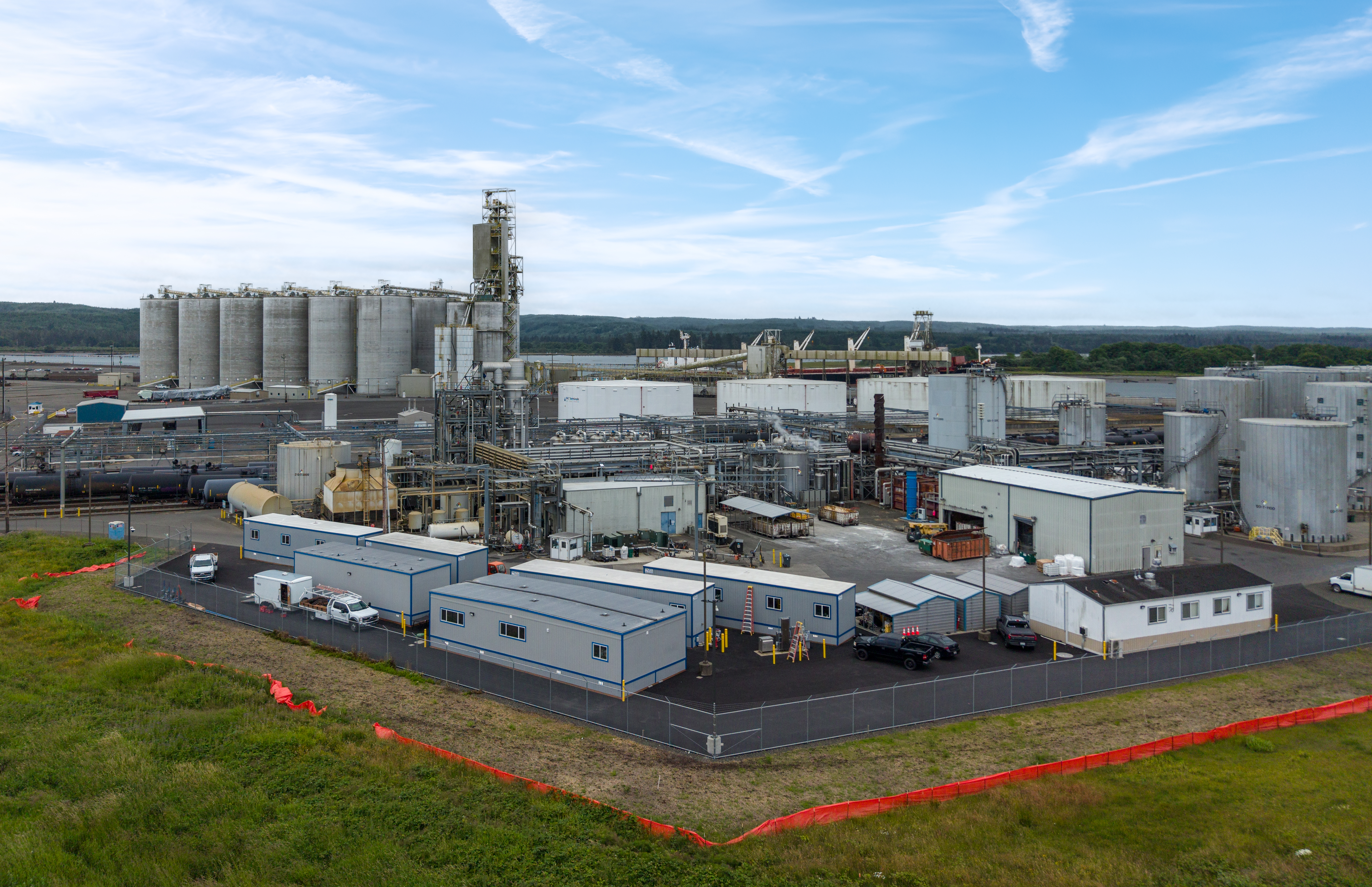
Factory fabrication is often presented as the answer to rapid data center deployment. It isn't. A modular unit can leave a plant quickly and still sit idle while the project waits for energized capacity, utility approval, civil works, cooling infrastructure, or fire-code sign-off. The practical value of modular data center solutions comes from controlling the parts that can be standardized, then managing the site constraints that cannot.
That distinction matters for procurement teams. A sound project compares module lead time with time to usable IT capacity, measures efficiency using consistent whole-facility boundaries, and treats cooling as an energy and water decision rather than a simple equipment selection. Done properly, modular construction supports phased growth, repeatable quality, and faster capacity expansion without pretending that local infrastructure moves at factory speed.
Table of Contents
- The Reality of Rapid Data Center Deployment
- Comparing Containerized and Prefabricated Architectures
- Decoding Energy Efficiency and PUE Boundaries
- Navigating the Power and Site Readiness Bottleneck
- The Hidden Trade-offs of Waterless Cooling Designs
- Evaluating Embodied Carbon and Lifecycle Sustainability
- Executing a Turnkey Modular Procurement Strategy
The Reality of Rapid Data Center Deployment
“Operational in weeks” only holds when the site, utility connections, and permits are ready. Conventional data centers commonly require approximately 18–36 months for construction and commissioning, while standardized modular architectures can become operational in roughly 8–16 weeks under those conditions, according to market data on modular data center deployment. That shorter period covers fabrication, integration, and deployment. It does not cover every activity needed to make the facility legally approved, electrically energized, and ready for IT equipment.
Procurement teams should run two schedules from the start. The factory schedule covers design release, component purchasing, assembly, testing, transport, and delivery. The site schedule covers land preparation, foundations, access, grounding, utility interconnection, telecommunications, water or cooling-loop readiness, inspections, and commissioning. Usable IT capacity arrives only when both schedules converge.
Practical rule: Treat “module ready” and “IT load ready” as separate milestones in every bid and project dashboard.
Where modular construction creates advantage
Modular data center solutions allow power distribution, cooling, racks, monitoring, and security equipment to be integrated into repeatable factory-built assemblies. Factory work can run while site crews complete foundations and utility pathways. This reduces complex installation in an exposed, variable jobsite environment, but it does not remove the need to complete those site activities.
The model also supports phased capacity additions. An operator can install an initial module, validate operations, and add further modules as demand and budgets increase. That approach can be more defensible than building an oversized conventional facility before the workload is certain. It ties infrastructure spending more closely to actual growth and lets the team test operating assumptions before committing to the next stage.
The market's scale shows that modular facilities extend beyond temporary buildings. Estimates place the global modular data center sector at approximately USD 29.04 billion in 2024, with a projection of USD 75.77 billion by 2030 and a projected 17.4% compound annual growth rate from 2025 through 2030, as reported in the modular data center market estimate. These figures describe market expectations, not a guarantee for an individual project.
The site still controls the critical path
Permitting authorities, utilities, civil contractors, and network providers can set the actual delivery date. A remote parcel may look inexpensive, but weak grid access, transformer availability, difficult transport, or delayed approvals can erase the benefit of rapid fabrication. Teams assessing why modular construction is transforming modern data center development should identify which activities can run in parallel and which depend on local approvals.
Utility readiness also affects the facility's operating case. Procurement teams should define the PUE boundary across the whole facility, then examine how cooling energy, water availability, backup generation, and electrical losses are counted. A design marketed as waterless may shift resource demand into electricity consumption, so the trade-off belongs in the site and operating model, not only in the cooling specification.
For teams unfamiliar with infrastructure delivered as a service, a clear explanation of what is utility computing can connect capacity planning with the cost and availability of the physical platform. Modular construction accelerates repeatable building work. Site utilities and approvals still determine when the facility can operate.
Comparing Containerized and Prefabricated Architectures
Not every modular data center solution is a shipping container. The structural format affects transport, physical security, service access, expansion, thermal design, and the amount of equipment that can be integrated before delivery.
Containerized modules
A containerized system uses a ruggedized steel enclosure, often based on a standardized transport footprint. This format suits edge computing, temporary capacity, disaster recovery, remote communications, and small deployments where the facility must arrive as a compact, weather-resistant package.
Its main advantage is logistical simplicity. A container can be transported, placed, secured, and connected with less site assembly than a larger building. The enclosure can also support a self-contained arrangement of racks, cooling, power conditioning, monitoring, and access controls.
The limitations are equally important:
- Restricted internal volume: Equipment layout, maintenance clearances, cable pathways, and airflow separation must fit within a fixed shell.
- Transport constraints: Route surveys, crane access, bridge limits, and local delivery permits can shape the design before fabrication begins.
- Expansion by addition: Growth usually means adding another enclosure, which requires coordinated power, cooling, networking, fire protection, and physical security.
- Serviceability: Technicians need safe access to components without blocking adjacent racks or exposing live equipment to unnecessary disruption.
Containerization works when the workload is compact, the site is constrained, and repeatable deployment matters more than architectural flexibility.
Prefabricated modular buildings
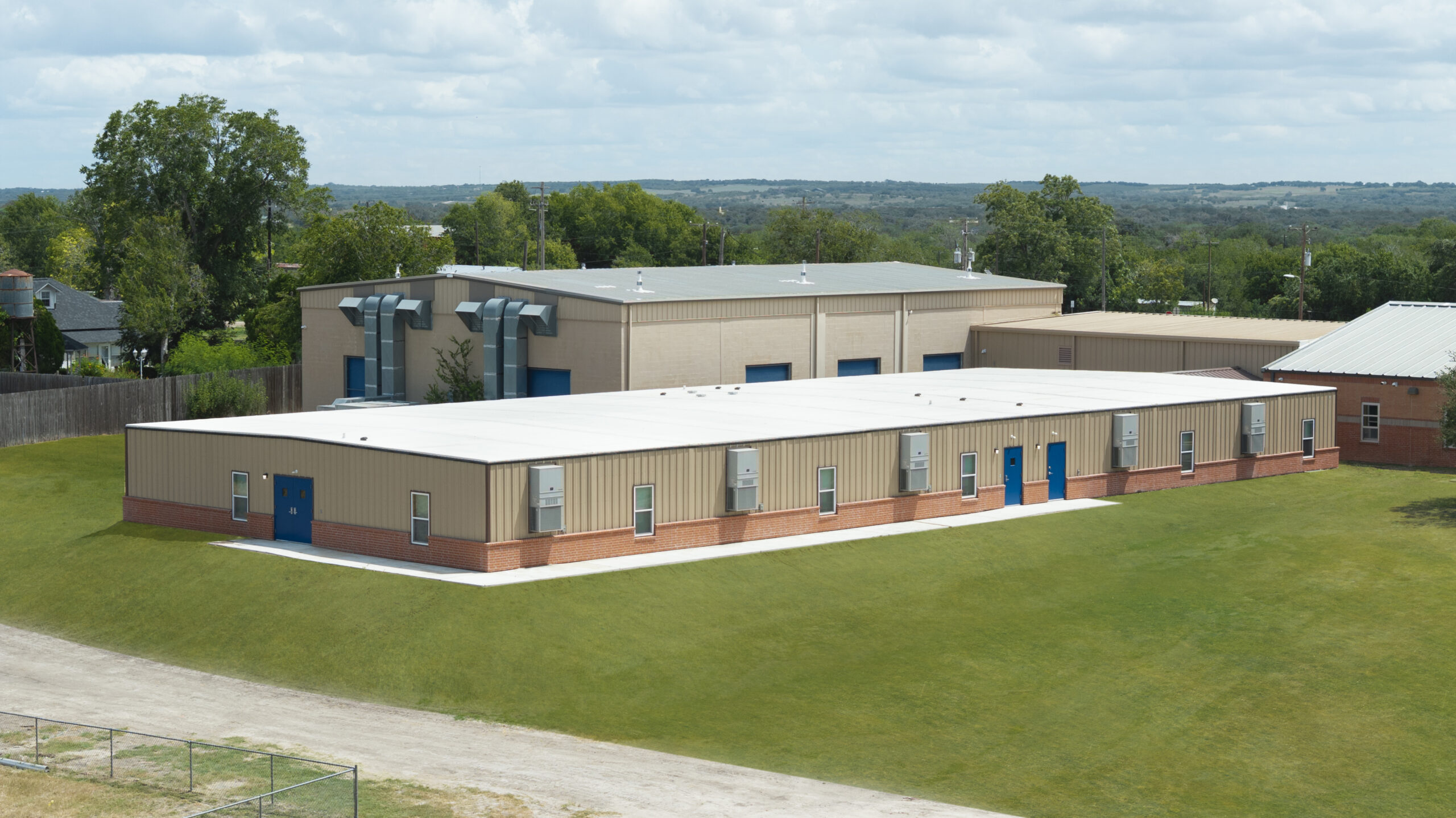
A prefabricated modular building uses factory-built panels, structural assemblies, and integrated systems to create a larger enclosure. It can resemble a conventional data hall while retaining the advantages of controlled manufacturing and repeatable installation.
This format gives designers more room for separate electrical and mechanical spaces, wider service corridors, higher equipment quantities, and future subdivision. It may also support a more deliberate security plan, including controlled personnel flow, equipment staging, and maintenance areas. For facilities expected to grow through multiple capacity phases, a building-scale module can provide a more coherent expansion strategy than a series of isolated containers.
The trade-off is greater site and logistics complexity. Foundations, transport planning, crane operations, tie-ins, and local inspections still require careful coordination. A larger module may also be harder to relocate, so the initial decision should account for expected service life and future site use.
Choosing by workload and operating model
The best architecture isn't determined by the word “modular.” Procurement teams should define rack count, density, cooling medium, redundancy, security classification, maintenance access, expansion sequence, and relocation requirements before comparing shells.
A compact edge node may favor a containerized enclosure. A campus expansion with separate utility and cooling zones may favor prefabricated building modules. Guidance on the future of cloud and edge computing with modular data centers is useful for framing that choice, but the final specification should remain site-specific. Structural format is an operational decision, not merely a shipping decision.
Decoding Energy Efficiency and PUE Boundaries
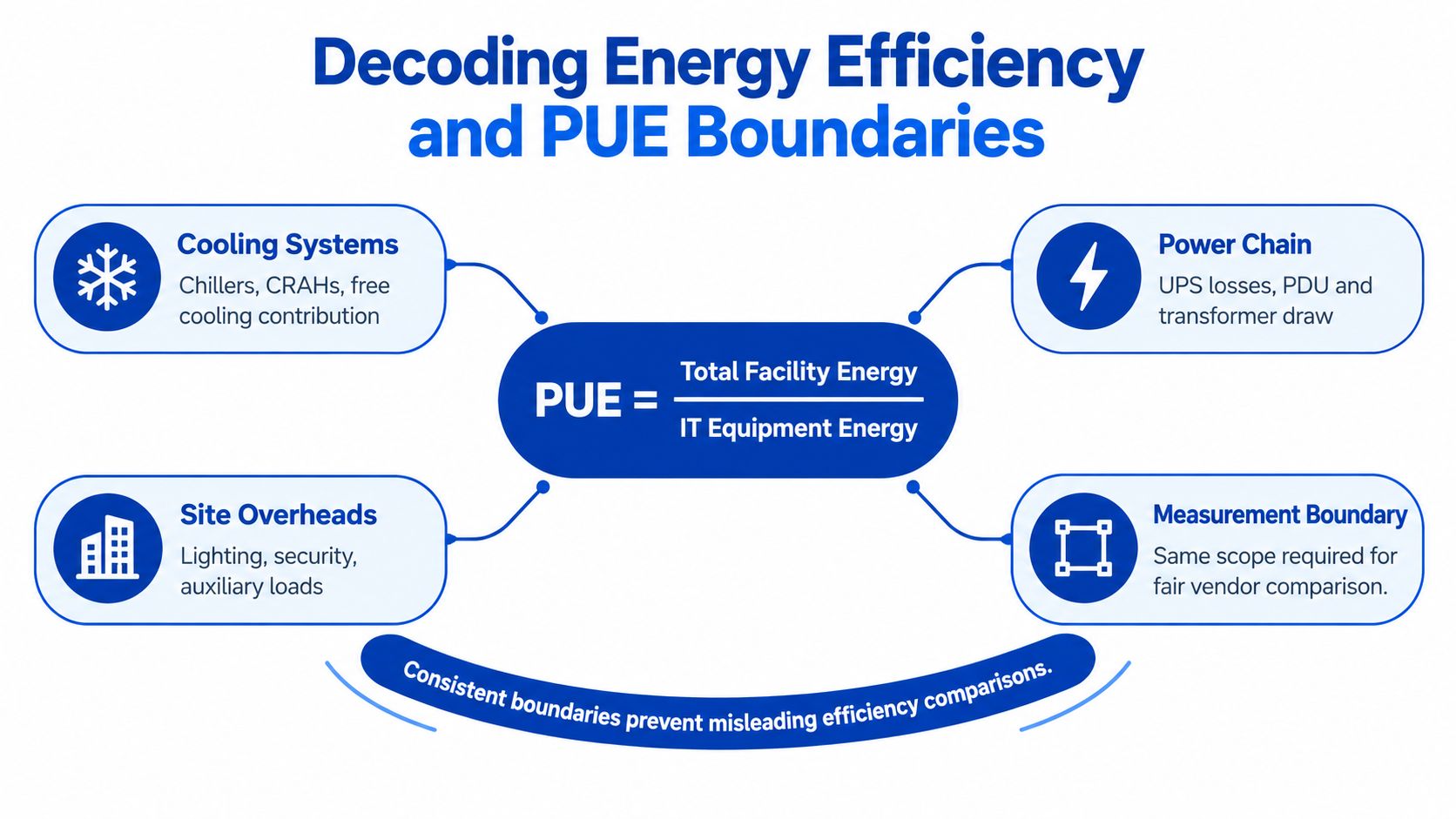
Energy comparisons become unreliable when suppliers report different measurement scopes. Power usage effectiveness, or PUE, is calculated as total facility energy divided by energy consumed by information-technology equipment. A lower result indicates that less energy supports cooling, power conversion, lighting, security, and other facility overhead.
Market research reports modular facilities achieving approximately 1.1–1.3 PUE, compared with about 1.58 for legacy facilities, as described in the modular data center efficiency assessment. The comparison is useful only when the facilities operate under comparable workloads, climates, utilization levels, redundancy arrangements, and measurement boundaries.
At a PUE of 1.2, every 1.0 unit of IT electricity requires approximately 0.2 additional units for facility overhead. At a PUE of 1.58, the overhead is approximately 0.58 additional units. Under those assumptions, a facility operating at 1.2 would use roughly 24% less total electricity than one operating at 1.58 for the same IT workload. Actual results vary with climate, utilization, equipment density, and cooling design. Reported operating-cost reductions of approximately 20%–35% per unit of IT workload are market-research estimates, not universal guarantees.
Why PUE can look better than the facility performs
The Lawrence Berkeley National Laboratory and U.S. General Services Administration procurement guide uses PUE* for modular systems. The metric is defined as module power plus externally produced chilled-fluid power, divided by IT power. In the guide's sample, chilled-water-dependent units averaged a PUE* of 1.16, while second-generation units reached values as low as 1.02, according to the Modular Data Center Procurement Guide.
Those figures aren't directly interchangeable with a whole-facility PUE. A module reporting 1.02 may exclude lighting, UPS losses, external transformers, and backup generation. A buyer comparing that figure with a vendor's all-inclusive facility result could select an apparently superior system that has merely used a narrower boundary.
Writing a defensible efficiency specification
Every request for proposal should define the calculation boundary before vendors submit values. The specification should require:
- IT-load assumptions: State the expected load, utilization profile, and rack-density basis.
- Thermal conditions: Identify entering-water temperatures, ambient design conditions, and operating modes.
- Cooling scope: Clarify whether chilled-water production, pumps, heat rejection, and auxiliary cooling equipment are included.
- Electrical scope: Include UPS systems, transformers, switchgear, distribution losses, and backup generation where applicable.
- Redundancy basis: Compare systems using the same availability and reserve assumptions.
- Verification method: Require factory data, commissioning results, and an operating measurement plan.
Chiller selection deserves the same discipline. Technical background on Forge Reliability chiller solutions can help facilities teams evaluate cooling equipment within the broader thermal plant rather than treating the module as an isolated box. A credible bid makes every exclusion visible.
Navigating the Power and Site Readiness Bottleneck
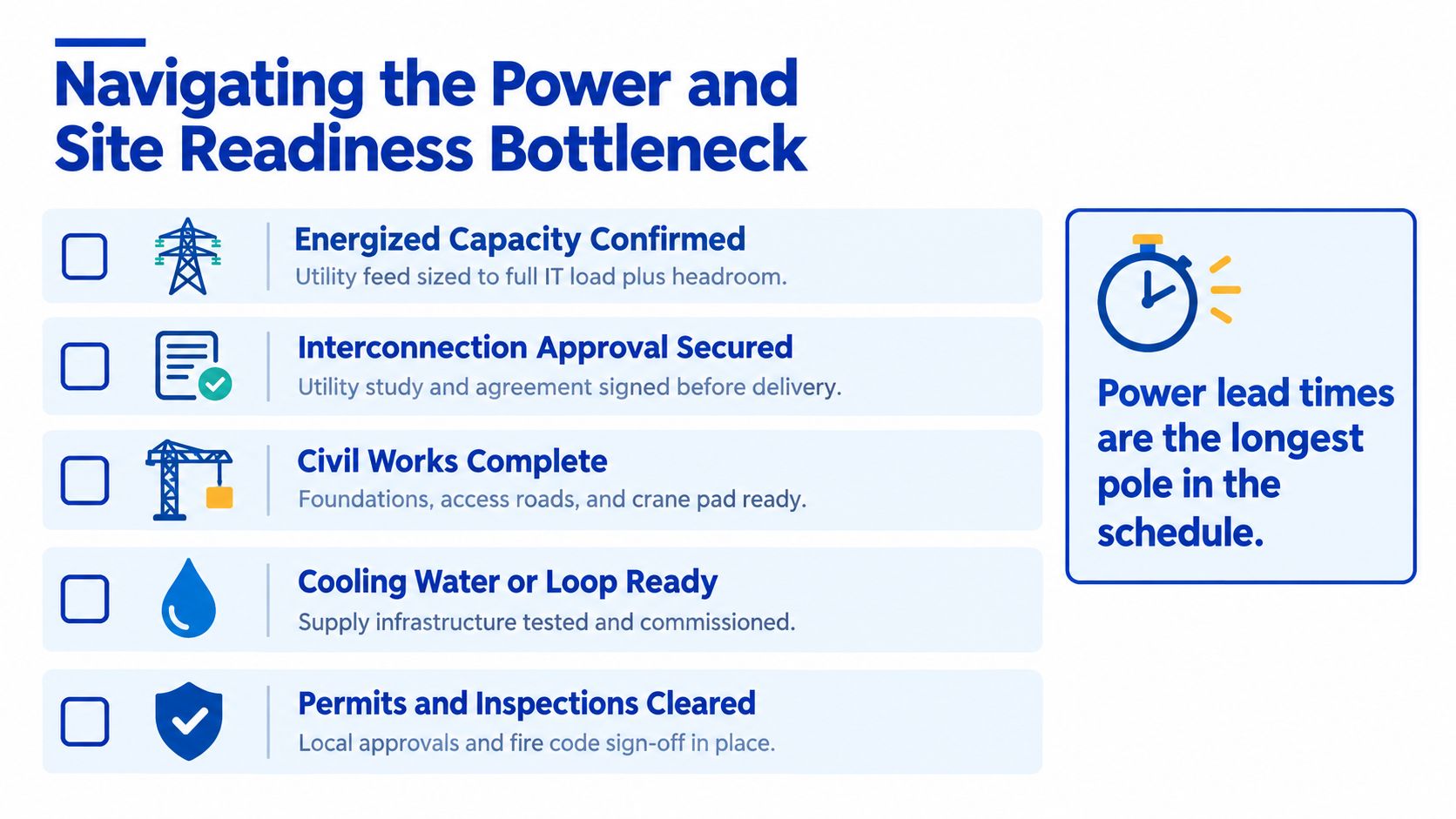
A completed module cannot process a byte of data without energized capacity. The most important project question is not “When can the factory ship?” but “When can the site safely accept and operate the intended IT load?”
Utility access is a major constraint as data center demand competes for power, water, equipment, and compressed construction schedules. One industry risk analysis reports that U.S. data center power demand increased about 22% in one year and could approach 134 GW by 2030, nearly triple current demand, as described in the data center infrastructure risk analysis. The projection underscores why a site with available land isn't necessarily a site with usable capacity.
Module lead time versus usable capacity
The distinction should appear in the procurement schedule and the contract. Module lead time covers manufacturing and delivery. Usable capacity requires a completed chain of dependencies:
- Utility confirmation: Obtain a written indication of available service capacity and the conditions attached to connection.
- Interconnection approval: Confirm that utility studies, agreements, protection requirements, and energization conditions are complete before delivery.
- Civil readiness: Complete foundations, drainage, grounding, access roads, crane pads, equipment clearances, and underground pathways.
- Electrical coordination: Review available fault current, protection settings, transformer requirements, grounding, and selective coordination.
- Cooling readiness: Commission the water supply, closed loop, heat-rejection equipment, or dry-cooling arrangement required by the design.
- Compliance clearance: Secure building, electrical, fire, environmental, generator, battery, water, and wastewater approvals relevant to the site.
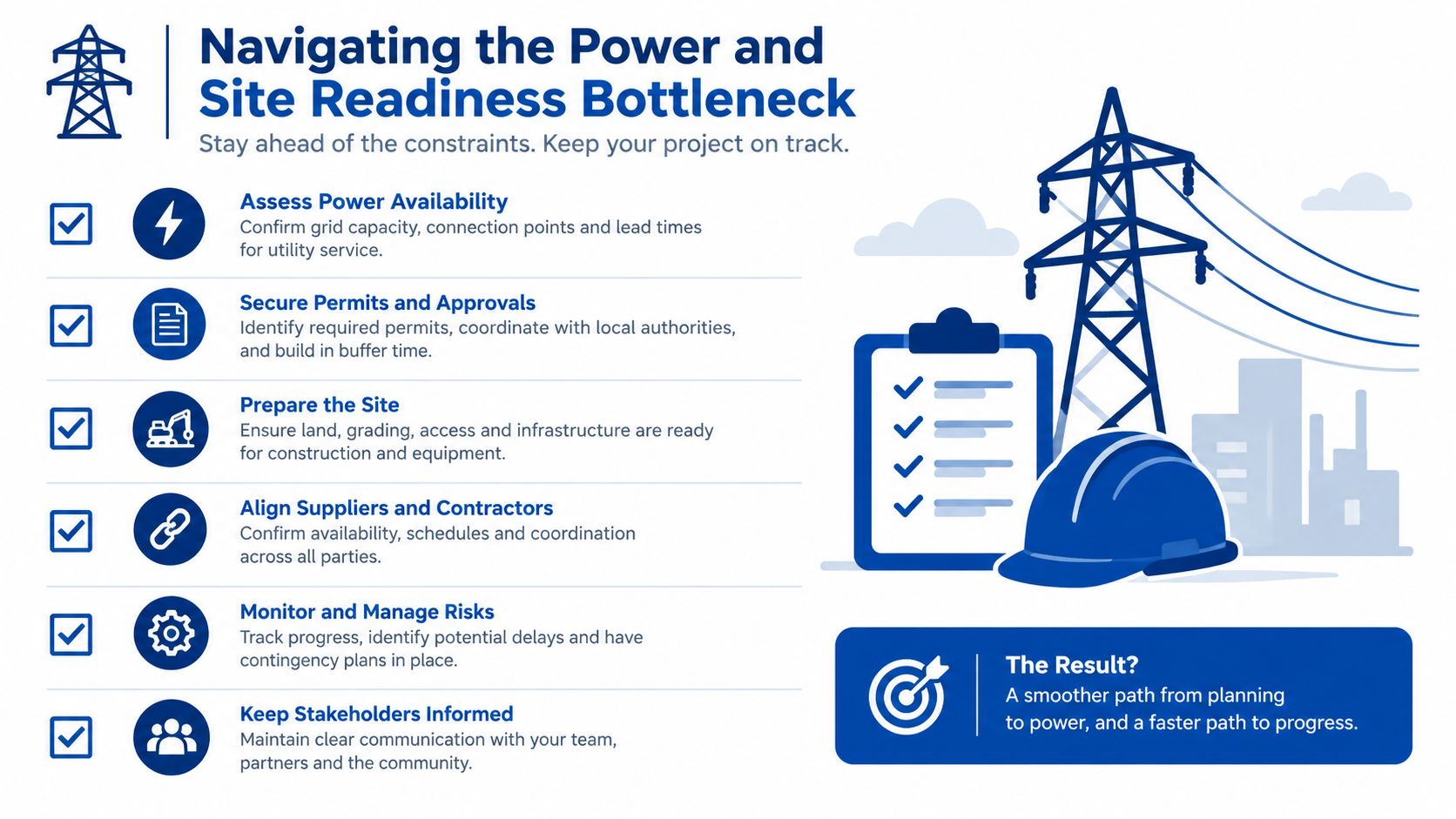
The sequence doesn't always run linearly. Factory fabrication and site development can proceed in parallel, but a missing utility agreement can still prevent final energization.
Evaluating remote and behind-the-meter sites
Remote land can introduce hidden costs. A site may need transmission upgrades, a new transformer, longer fiber routes, additional fuel logistics, or a microgrid that brings emissions, noise, maintenance, and permitting obligations. Behind-the-meter generation can support resilience, but it doesn't make interconnection, environmental review, or operational risk disappear.
The site-screening team should ask for the utility's written assumptions, not just a verbal capacity estimate. The review should include future expansion headroom, outage response, generator and battery locations, flood and fire exposure, crane access, and the authority responsible for each permit.
The rise of hyperscale data centers and modular construction illustrates why scalable deployment must be connected to infrastructure planning. A module placed before its power path is secured is stored capital, not operating capacity.
The Hidden Trade-offs of Waterless Cooling Designs
“Waterless” sounds like a sustainability conclusion, but it describes only one resource outcome. Dry or air-based cooling reduces direct water consumption while often increasing electricity demand, especially during hot periods when the grid is already under pressure.
Independent analysis indicates that U.S. data centers could require 697–1,451 million gallons per day of additional water capacity by 2030 if current water-use intensity persists, roughly comparable to New York City's average daily supply, as reported in the analysis of data center water demand. That projection makes peak-water availability a serious siting question, but it doesn't make dry cooling automatically preferable.
The site-level energy and water choice
Air-based cooling generally uses less water and more electricity. Evaporative systems can be more energy-efficient but consume more water. Closed-loop liquid cooling can reduce the air-side burden for dense computing, yet it still requires heat rejection, pumps, controls, maintenance access, and a suitable facility design.
Procurement teams should compare architectures against local constraints rather than selecting a label:
- Dry cooling: Useful where water supply or discharge is restricted, but the electrical and summer-peak consequences require modeling.
- Evaporative cooling: Potentially efficient in suitable climates, but dependent on water availability, treatment, blowdown, and permitting.
- Closed-loop liquid cooling: Appropriate for high-density loads when the facility can support heat exchangers, pumps, leak detection, and service procedures.
- Hybrid cooling: Allows operating-mode changes as ambient conditions, water availability, and workload requirements change.
- Reclaimed water: May reduce demand on potable supplies, but requires reliable quality, treatment arrangements, discharge planning, and utility approval.
Ask for peak demand, not annual averages
Annual water consumption can hide the condition that threatens operations. The site review should identify peak water demand, drought restrictions, discharge requirements, backup power, and the authority responsible for water and wastewater permits.
Procurement warning: A waterless module may transfer environmental and operating costs to the electrical system rather than eliminate them.
For schools, healthcare providers, municipalities, and commercial operators, the practical answer may be a smaller edge facility with a cooling design matched to constrained utilities. The right choice depends on the workload, local climate, water rules, electricity price, grid reliability, and expansion plan. Sustainability claims should be tested against those conditions, not accepted from the equipment name alone.
Evaluating Embodied Carbon and Lifecycle Sustainability
Operational electricity receives most data center sustainability attention, but the shell and construction method also establish a permanent part of the facility's environmental footprint. A technical assessment comparing a prefabricated steel shell with an onsite-built concrete shell reported approximately 57% lower greenhouse-gas emissions for the steel prefabricated model and about 3.5 times lower embodied carbon per megawatt, as documented in the Vertiv carbon footprint comparison.
The result needs a careful boundary. The assessment excluded operational energy, so it doesn't establish that every modular facility has lower lifetime emissions. Cooling, UPS losses, power distribution, IT efficiency, transport, and utilization can dominate the long-term outcome.
Require comparable carbon boundaries
A bid evaluation should separate construction materials from operations and require each vendor to state what the submitted figure includes. The following categories create a workable comparison:
- Shell and structure: Steel, concrete, insulation, roof systems, finishes, and foundation assumptions.
- Mechanical and electrical plant: Cooling, UPS, switchgear, transformers, generators, batteries, and distribution equipment.
- Transport and installation: Factory location, route assumptions, shipment requirements, cranes, and site assembly.
- Use phase: Expected service life, operating PUE, maintenance, replacement cycles, and utilization.
- End of life: Disassembly, relocation, reuse, recycling, demolition, disposal, and residual value.
Prefabrication can reduce site waste, repetitive material use, weather exposure, and construction labor. Factory acceptance testing can also identify integration issues before delivery, reducing rework at the site.
Test the assumptions that can reverse the result
Oversized modules may carry unnecessary material for the actual load. Long-distance transport can erode the shell's embodied-carbon advantage, while low utilization can make the carbon intensity of each active rack less favorable. Buyers should therefore require transport assumptions, module utilization, repairability, expected service life, and expansion provisions.
The evaluation should sit beside the energy model, not replace it. A lower-carbon shell paired with inefficient cooling may perform poorly over its operating life. A defensible procurement decision compares carbon, schedule, reliability, maintainability, and total lifecycle cost using the same functional capacity and boundary.
The following video can provide additional context for teams reviewing construction-stage sustainability decisions:
Executing a Turnkey Modular Procurement Strategy
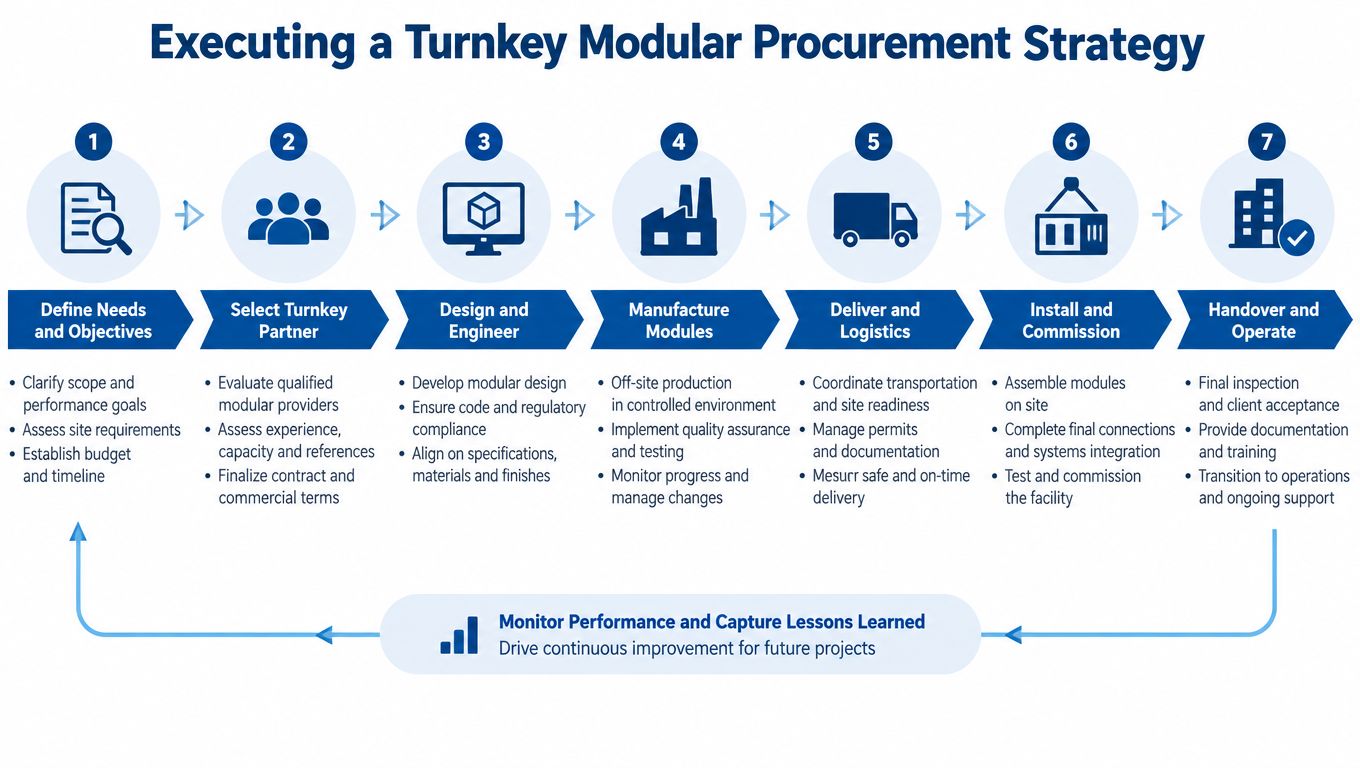
Turnkey procurement works when one coordinated plan connects the factory, the site, the utility, and the IT commissioning team. It doesn't mean the vendor can control every external approval. It means responsibilities, interfaces, documentation, and acceptance criteria are defined before fabrication begins.
The process should start with a site and workload definition. The owner identifies the IT load, rack density, redundancy, cooling medium, security requirements, expansion sequence, transport envelope, and operating environment. Engineers then establish the electrical and mechanical topology, confirm utility assumptions, and identify which work belongs in the factory and which must remain site-specific.
A controlled delivery sequence
- Feasibility and site validation: Confirm land, access, utilities, permitting authorities, civil requirements, water or cooling-loop options, and network connectivity.
- Reference design: Freeze the module arrangement, equipment ratings, redundancy paths, service clearances, protection philosophy, and expansion interfaces.
- Procurement and fabrication: Release long-lead equipment and assemble power, cooling, racks, controls, monitoring, and security systems in the factory.
- Factory acceptance testing: Test wiring, alarms, controls, interlocks, protection settings, sequences, and documentation before shipment.
- Site preparation: Complete foundations, grounding, pathways, utility connections, drainage, crane access, and required inspections.
- Placement and tie-ins: Set the module, connect electrical and mechanical services, terminate communications, and verify physical security.
- Integrated commissioning: Test normal and failure modes, validate telemetry, confirm cooling behavior, energize the facility, and hand over operating documents.
Make acceptance measurable
Factory acceptance testing should use a written procedure tied to the final operating sequence. The owner should receive test records, equipment schedules, control narratives, as-built drawings, protection settings, maintenance requirements, warranties, spare-parts recommendations, and training materials.
Site acceptance shouldn't just confirm that the module has power. It should verify the complete chain from utility service through distribution, cooling, monitoring, alarms, security, and IT load. The contract should define who owns failed tests, corrective work, retesting, transport damage, and schedule impacts caused by incomplete site readiness.
For public agencies, cooperative purchasing contracts can reduce administrative effort when the scope and compliance requirements fit the project. Pacific Mobile Structures, Inc. provides modular buildings and turnkey delivery and setup, with capabilities that include code coordination, utility connections, site development, and modular solutions for data center applications. That type of integrated responsibility can reduce interface gaps, but buyers should still require project-specific performance criteria and independent verification where appropriate.
A modular data center succeeds when factory speed is matched by site discipline. Procurement teams that verify utilities early, define PUE boundaries, model energy-water trade-offs, and test the complete system before handover can capture the benefits of modular delivery without confusing a shipped enclosure with operational capacity.
Pacific Mobile Structures, Inc. offers modular construction, turnkey delivery and setup, and site coordination for facilities that need temporary or permanent capacity, including data center applications. Visit Pacific Mobile Structures, Inc. to discuss a project that connects the modular building, utility readiness, code requirements, and installation plan.