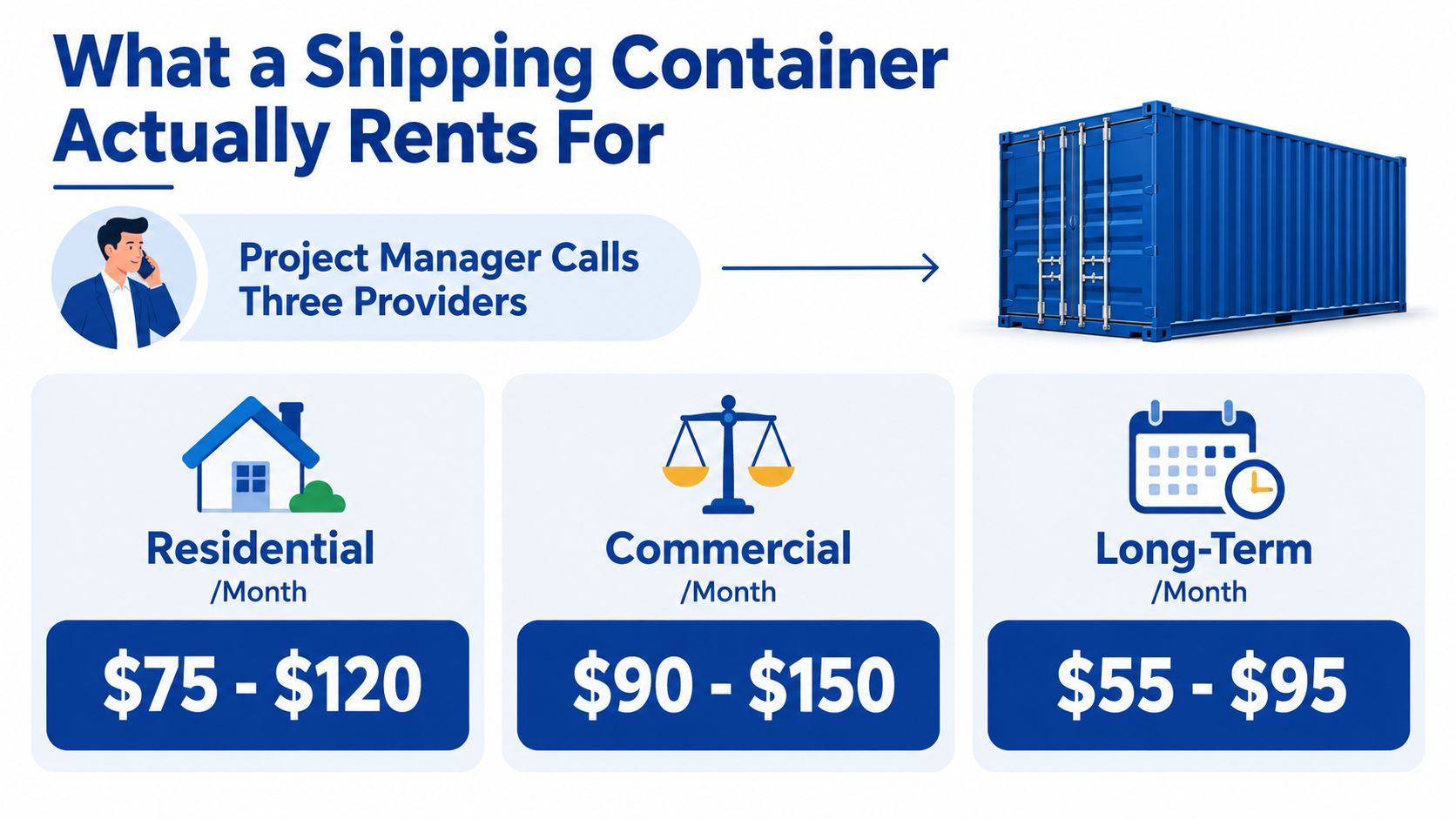
Standard dry containers usually rent for about $75 to $175 per month for residential storage and $130 to $280 per month for commercial use. For 20-foot units, month-to-month deals often land around $75 to $120, while 12-month terms can drop to $55 to $95.
That's the answer many want, but the quote on the screen rarely matches the final bill. A project manager can call three providers for the same box and still get three very different numbers once delivery, term length, and unit type are factored in.
Table of Contents
- What a Shipping Container Actually Rents For
- Why Container Rent Prices Vary So Much
- Rental Terms and the Real Landed Cost
- How Market Cycles Shift Container Pricing
- Questions to Ask Before You Sign a Container Rental
- Deciding Between Renting and Buying a Container
What a Shipping Container Actually Rents For
A shipping container quote usually looks simple until the first call gets real. One provider quotes a 20-foot dry unit at a tempting monthly rate, another adds delivery separately, and a third folds more of the transport cost into the headline price. That's why the shipping container rent price only becomes useful when the size, term, and market are all clear.
For standard dry containers in the U.S., the common range is about $75 to $175 per month for residential storage and about $130 to $280 per month for commercial applications. The same pricing data shows that small units up to 10 feet tend to run $75 to $130, medium 12- to 16-foot units land around $120 to $200, and large 20-foot-and-up commercial-grade dry containers often sit at $175 to $350 per month. Premium coastal markets can push 30% to 40% above national averages in places like New York City and San Francisco, so a quote that looks high in an inland market may be normal in a dense metro. Pacific Mobile's storage container rental pricing page is a useful comparison point when a buyer wants to sanity-check a local quote.
What to expect from a quote
A clean quote should answer three questions immediately. What size is it, what term is it based on, and whether the number includes delivery or not.
Practical rule: If a provider won't say whether the rate is month-to-month or locked to a longer term, the quote isn't finished yet.
That basic check catches most surprises before they show up on an invoice. If the unit is for a jobsite, commercial storage, or a public-sector yard, the quote should also make clear whether the box is dry, modified, or specialized. That distinction matters because specialized units don't price like a standard storage box.
Why Container Rent Prices Vary So Much
Four variables drive almost every rental quote, and they're easy to miss when someone only asks for a monthly number. The first is size, then condition, then market density, and finally specialization. A logistics manager looking at a storage yard, for example, should compare the container request the same way an operator would in Doczen logistics solutions, by matching the unit to the job instead of chasing the lowest sticker price.
Size sets the floor
Small containers are cheaper because they're easier to place, move, and supply. Medium units cost more, and 20-foot-and-up commercial-grade dry containers move into a higher bracket because they're the most useful size for many jobsite and storage applications. A quote without the size tier attached is basically meaningless.
| Typical Monthly Rent by Container Size and Type | Typical Monthly Rent |
|---|---|
| Small dry container, up to 10 feet | $75 to $130 |
| Medium dry container, 12 to 16 feet | $120 to $200 |
| Large commercial-grade dry container, 20 feet and up | $175 to $350 |
| Refrigerated unit | $450 to $950 |
Condition and specialization change the equation
Standard dry containers are one thing, refrigerated units are another. Reefer rentals sit far above dry-container pricing at roughly $450 to $950 per month because they bring energy and maintenance requirements that a plain storage box doesn't. That's also why a dry container and a reefer can't be compared as if they're the same product with different paint.
Condition matters too, even when a quote doesn't spell it out. A clean, reconditioned unit isn't the same as a rough used box, and site users should always ask what grade they're being quoted. This guide to container grades is the right reference when the listing says “used” but nothing else.
A cheap rate on the wrong unit usually costs more than a fair rate on the right one.
The practical takeaway is simple. When a provider says “container rental price,” that number only matters after the size, condition, and location are nailed down.
Rental Terms and the Real Landed Cost
The monthly rate is only part of the cost. A 20-foot container often shows up at $75 to $120 month-to-month, but the same unit can fall to $55 to $95 on a 12-month term. Delivery can add about $100 to $400 or more depending on distance, and that's before any extra handling, site constraints, or accessories are counted. These five questions to answer before renting help buyers spot the charges that stay hidden until the invoice arrives.
A simple landed-cost check
If a customer needs a box for three months, the month-to-month route can be the safer fit because there's no long commitment. But the short-term rate is usually higher, so the buyer pays more per month for flexibility. The 12-month rate lowers the monthly figure, but only makes sense when the container will stay put long enough to use that discount.
A rough example shows why. A month-to-month 20-foot unit at $75 to $120 for three months comes out to $225 to $360, before delivery. A 12-month term at $55 to $95 would lower the monthly rent, but the customer is still committing to a full year, so the lower rate only helps if the container stays in place long enough to absorb the contract. Add delivery on top, and the true landed cost can be higher than the headline monthly price suggests.
What usually gets missed
The monthly number is never the whole story. Storage rental, transport, reconditioning, and accessories can outweigh the base rent, especially when the site is awkward or the delivery window is tight. That's why a quote that looks cheap on paper can turn into the most expensive option once the box is on the ground.
Bottom line: compare the total contract cost, not the monthly rate alone.
For teams that move fast, the right question isn't “what's the cheapest container?” It's “what will this cost delivered, placed, and kept for the actual term?”
How Market Cycles Shift Container Pricing
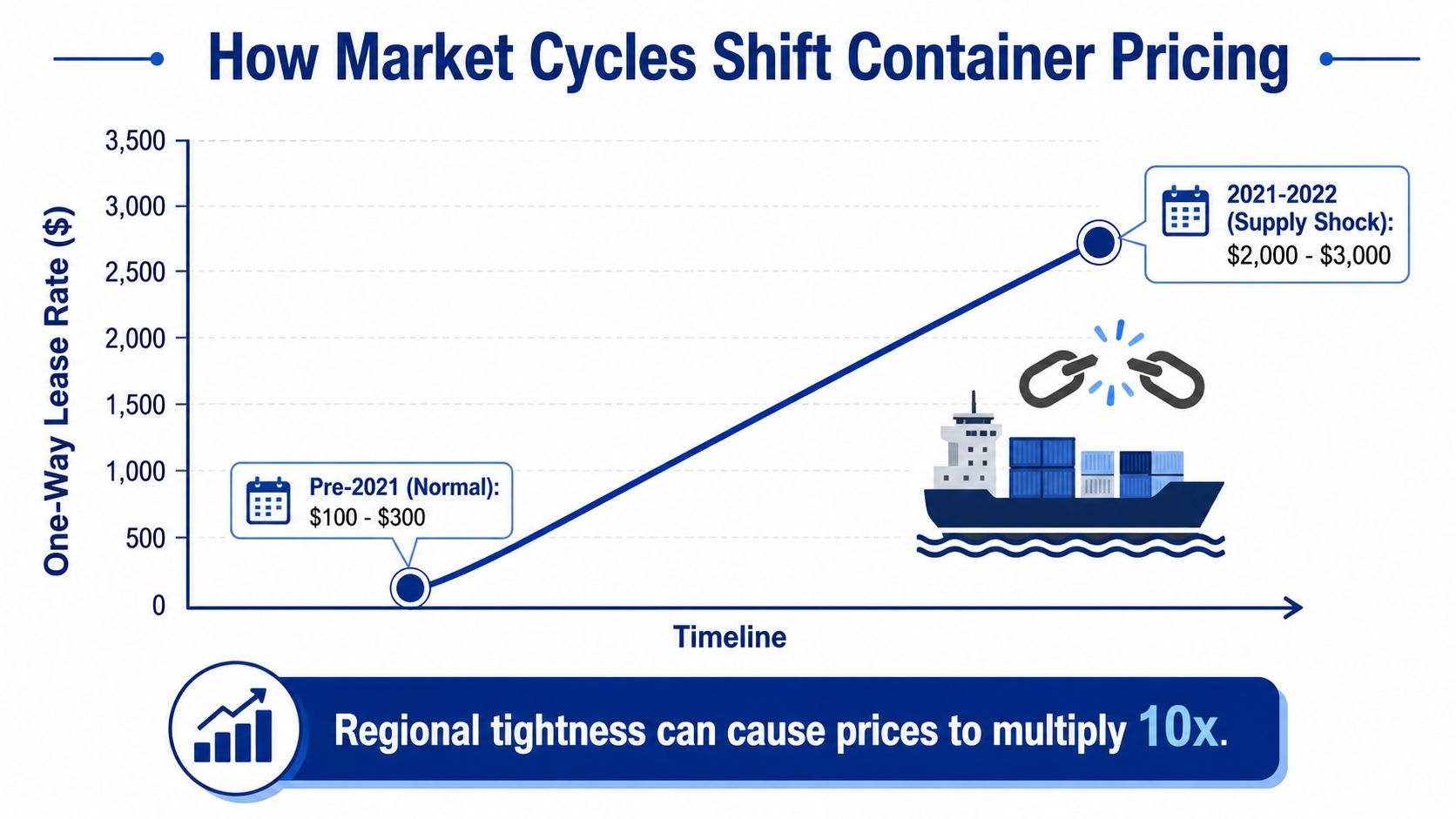
Container leasing is cyclical, and the 2021 shock proved how violent those swings can be. Standard one-way leasing rates sat around $100 to $300 before June 2021, surged to $1,470 in July 2021, peaked at $2,792 by September 2021, and were still $1,277 in May 2022. The same market later showed normalized 20-foot dry-container lease rates around $0.38 to $0.52 per TEU per day in early 2025, with dry-container lease rates in general at roughly $0.35 to $0.65 per TEU per day. Arete Global Shipping Services blog is a useful place to compare how operators talk about that volatility in practice.
Why timing matters
Scarcity doesn't raise prices a little, it can multiply them fast. When inventories tighten, providers with available units can charge more, and buyers in dense markets feel it first. Regional availability matters just as much as the national average because a unit sitting near the right depot is cheaper to move than a unit pulled from a strained market.
That's the practical lesson for renters. If the project date is known, lock the terms early. If the date is flexible, keep checking nearby availability before accepting the first offer.
Regional tightness can turn a normal quote into a painful one within weeks.
The old assumption that container rental is a flat market doesn't hold up. Procurement teams that plan around availability, not just rate sheets, usually get the cleaner deal.
Questions to Ask Before You Sign a Container Rental
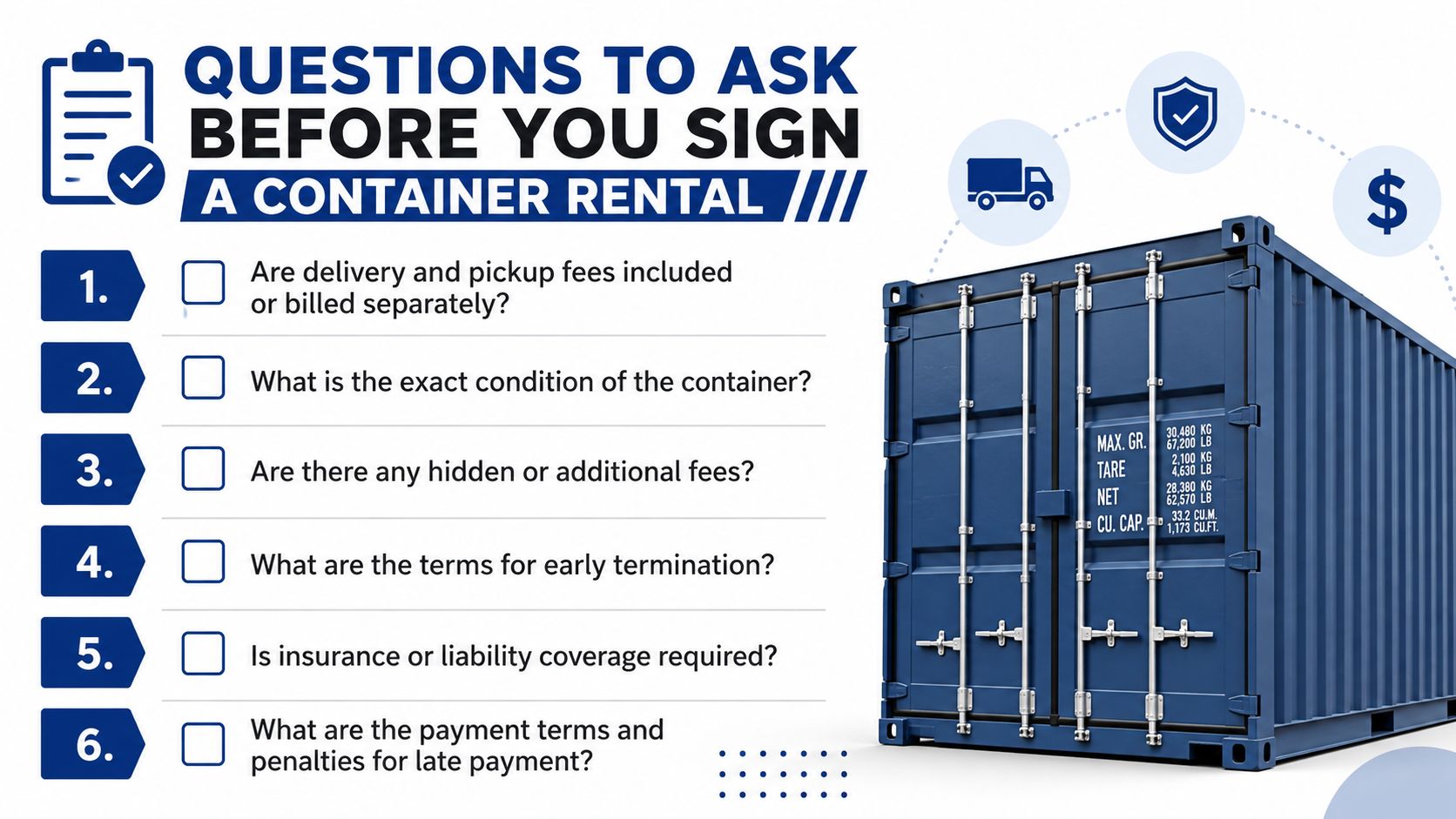
A quote that looks low on paper can still turn into a costly job once delivery, term changes, and accessories show up. Ask the questions that expose the full landed cost before anyone books a truck.
The quote checklist that catches hidden costs
- Are delivery and pickup included? Some companies quote the box and add transport later, which can make a fair-looking rate expensive.
- What condition is the unit in? Ask whether the container is inspected, cleaned, and reconditioned before it arrives.
- What happens if the term changes? Early returns, extensions, and overages can all change the final cost.
- Which accessories cost extra? Ramps, locks, shelving, and security options often sit outside the base rate.
- What are the payment terms? Late fees, invoice timing, and deposit rules all affect cash flow.
- Is insurance or liability coverage required? That answer can matter as much as the rental price itself.
What the right answers sound like
A strong provider separates the rental, the delivery, and the extras in plain language. If the quote leaves pickup fees or contract changes unclear, the customer carries the risk. The landed cost hides in those gaps, not in the monthly rent line.
Ask for the total cost in writing before the unit is dispatched.
Some providers supply only the unit, while others handle setup, reconditioning, and add-ons as part of the service. Pacific Mobile Structures, Inc. fits into the full-service category, supplying storage containers for rent and purchase along with related accessories and delivery support.
Any provider should put delivery, terms, and extras in writing before dispatch, because surprising invoices are avoidable with the right questions upfront.
Deciding Between Renting and Buying a Container
Renting makes sense when the end date is uncertain, the project is short, or the site needs flexibility. Buying starts to win when the container stays in place for a long stretch, especially if the box will be used repeatedly or moved between sites. For specialized needs, the decision shifts again, because refrigerated or access-modified units can change the economics fast.
A clean decision frame helps more than a low quote. If the job is temporary, rent. If the need is long and stable, compare purchase or a longer commitment against the landed rental total. If the site requires ramps, security features, or special access, put those costs in the comparison before anyone signs.
For tight budgets, the next step is to gather two or three quotes using the question list above and compare them on the same basis. That means delivery, term, condition, and accessories all on one page. Buyers who do that usually spot the winner quickly, even when the headline monthly numbers look close.
Pacific Mobile Structures, Inc. provides storage containers for rent and purchase, along with delivery support, related accessories, and other modular space solutions. For a quote that reflects the actual landed cost, not just the monthly headline, visit Pacific Mobile Structures, Inc. and compare options against your project timeline, site needs, and delivery location.