For a standard 20-foot dry container, expect roughly $75-$175 per month for residential use and $130-$280 per month for commercial use in the U.S. market, while 40-foot dry units commonly run higher. The biggest cost driver most buyers miss is delivery and site access, not the monthly rent.
You can get burned fast if you only compare the sticker rate. A quote that looks cheap on paper can turn expensive the minute the truck can't reach the drop spot, the ground isn't ready, or the rental term is shorter than expected.
Table of Contents
- What Storage Container Rental Price Actually Covers
- The Main Factors That Move the Number
- Typical Monthly Price Ranges by Size and Type
- How to Read a Quote and Spot Hidden Fees
- Choosing the Right Container for Your Project
- Budgeting for the Full Rental Period
What Storage Container Rental Price Actually Covers
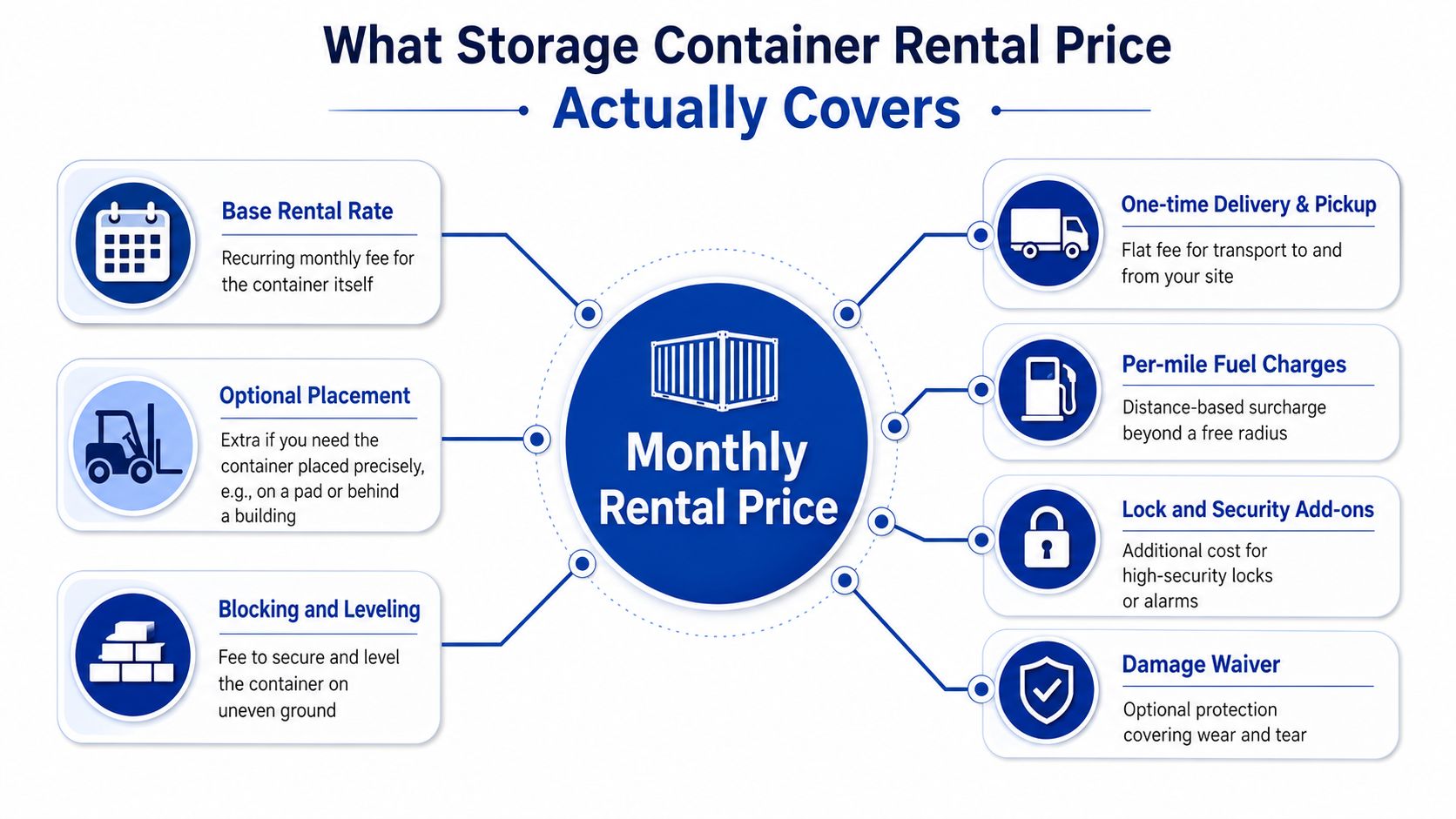
Stop treating the monthly figure as the whole bill. Storage container rental price usually covers the container itself, but the quote often hides the total spend in transport, placement, and add-ons.
A clean quote normally has a base rental rate, then a separate line for delivery and pickup. After that, some vendors add blocking and leveling, locks, shelving, alarms, or a damage waiver. The monthly rent may look manageable, but the first invoice can jump once the unit is mobilized.
That's why a quote with a $120 monthly rate can still land far above that in the first month. If the vendor charges for transport and site setup, the first bill can feel closer to a setup fee plus rent than a simple subscription. Buyers who compare only monthly rent miss the part that wrecks the budget.
A good outside reference point is the difference between sticker pricing and true landed cost. If a project team is comparing container rentals with other storage options, the cheap self storage rates guide from Get n Go Removals Melbourne is useful because it shows how advertised pricing and real total cost can diverge.
Practical rule: treat the monthly rate as one line item, not the quote total.
For buyers looking at product pages, the rental catalog at Pacific Mobile container rentals is the kind of place where the base unit selection starts, but the final number still depends on site and term details.
The mental model is simple. Rent is recurring, but delivery, access, and placement are usually the swing factors that change whether the quote is reasonable or inflated. If the vendor can't clearly separate those items, the quote isn't ready for approval.
The Main Factors That Move the Number
The price moves in four directions, and the same container can sit in a very different range depending on how those factors stack up. Size, term length, geography, and features act like multipliers, not minor tweaks.
Size sets the floor
A 20-foot unit is the practical middle ground for most projects, and a 40-foot unit usually costs more because it takes more steel, more transport capacity, and more yard space. Smaller units are easier to place and move, which is why they usually sit lower on the pricing ladder.
Term length cuts the monthly rate
Longer commitments usually lower the effective monthly cost. Short rentals carry a premium because the vendor still has to recover mobilization and handling costs over fewer billing cycles. Month-to-month looks flexible, but flexibility costs money.
Geography changes both demand and delivery
Urban and coastal markets tend to be tighter, and trucking distance matters just as much as the posted rent. Premium metros can push pricing above national averages, while remote or hard-to-access sites add transport friction that shows up on the invoice.
Features add fixed uplift
Refrigeration, double doors, high-cube height, shelving, and custom paint all move the number upward. These are not cosmetic extras. They change equipment needs, labor, and maintenance.
| Cost Driver | Effect on Monthly Rate | Example Adjustment | Why It Moves |
|---|---|---|---|
| Size | Higher as container volume rises | A 40-foot unit usually costs more than a 20-foot unit | More material, more transport burden, more yard space |
| Term length | Lower on longer commitments | Month-to-month costs more than a longer agreement | The vendor spreads mobilization over more months |
| Geography | Higher in dense or distant markets | Urban sites often price above broad market averages | Transport, demand, and site logistics get harder |
| Features | Higher for specialty equipment | Refrigerated units cost far more than dry units | Power, maintenance, and specialized hardware add cost |
A straight answer helps here. If the site is easy, the container is standard, and the term is long enough, the monthly rate should stay disciplined. If two of those variables get ugly, the quote will climb fast.
Typical Monthly Price Ranges by Size and Type
A storage quote looks simple until you match it to the job. A small unit, a standard job-site box, and a refrigerated container belong in different budgets, and the monthly rate should reflect that.
For U.S. market guidance, standard dry rentals are commonly framed around $75-$175 per month for residential use and $130-$280 per month for commercial use in one 2026 market summary, while refrigerated units land around $450-$950 per month because they bring power and maintenance into the equation. Another 2026 guide gives broader monthly bands of $125 average overall, with $75-$200 typical monthly ranges, plus 10-foot units at $50-$125 and 40-foot units at $150-$250. A separate pricing guide places 20-foot units at roughly $90-$200 per month and 40-foot units at about $120-$300, which is a useful reminder that the 40-foot premium is often real but not always dramatic. Source comparisons: 2026 market summary on container rental rates, 2026 rental and buying cost guide, and 2026 storage container rental cost guide.
The most common budgeting error is approving the monthly rate before reviewing the full invoice. That mistake gets expensive fast.
The monthly rent is the easiest number to quote and the least useful number to budget from.
Pick the container by use case first, then check whether the site can support it. A project with a tight footprint should not get pushed into a larger unit just because the rate sheet is easier to read. Size affects transport, placement, and access, and those are the costs that sneak up on a project manager.
If you need a practical size reference, the 8 x 20 containers page gives a clean benchmark for what a compact unit usually covers.
| Container Type | Typical Monthly Range | Best Fit Use Case | Notes |
|---|---|---|---|
| 10-foot dry | $50-$125 | Tight sites, small renovations, seasonal overflow | Lowest footprint, easiest to place |
| 20-foot dry | $90-$200 | Standard construction, retail overflow, general storage | Most common planning baseline |
| 40-foot dry | $120-$300 | Larger projects, bulk inventory, phased work | More capacity, more delivery sensitivity |
| Refrigerated | $450-$950 | Temperature-sensitive goods | Power and maintenance drive the premium |
For local context, the Home Removals Sydney storage cost guide shows the same pattern in another market, even with different currency and local conditions. Standard dry units are the economical choice. Specialty units are priced like specialty equipment.
How to Read a Quote and Spot Hidden Fees
Most first-time renters make the same mistake. They approve the monthly number, then get surprised when the first invoice includes transport, handling, and setup charges.
The monthly rent is the easiest number to quote and the least useful number to budget from.
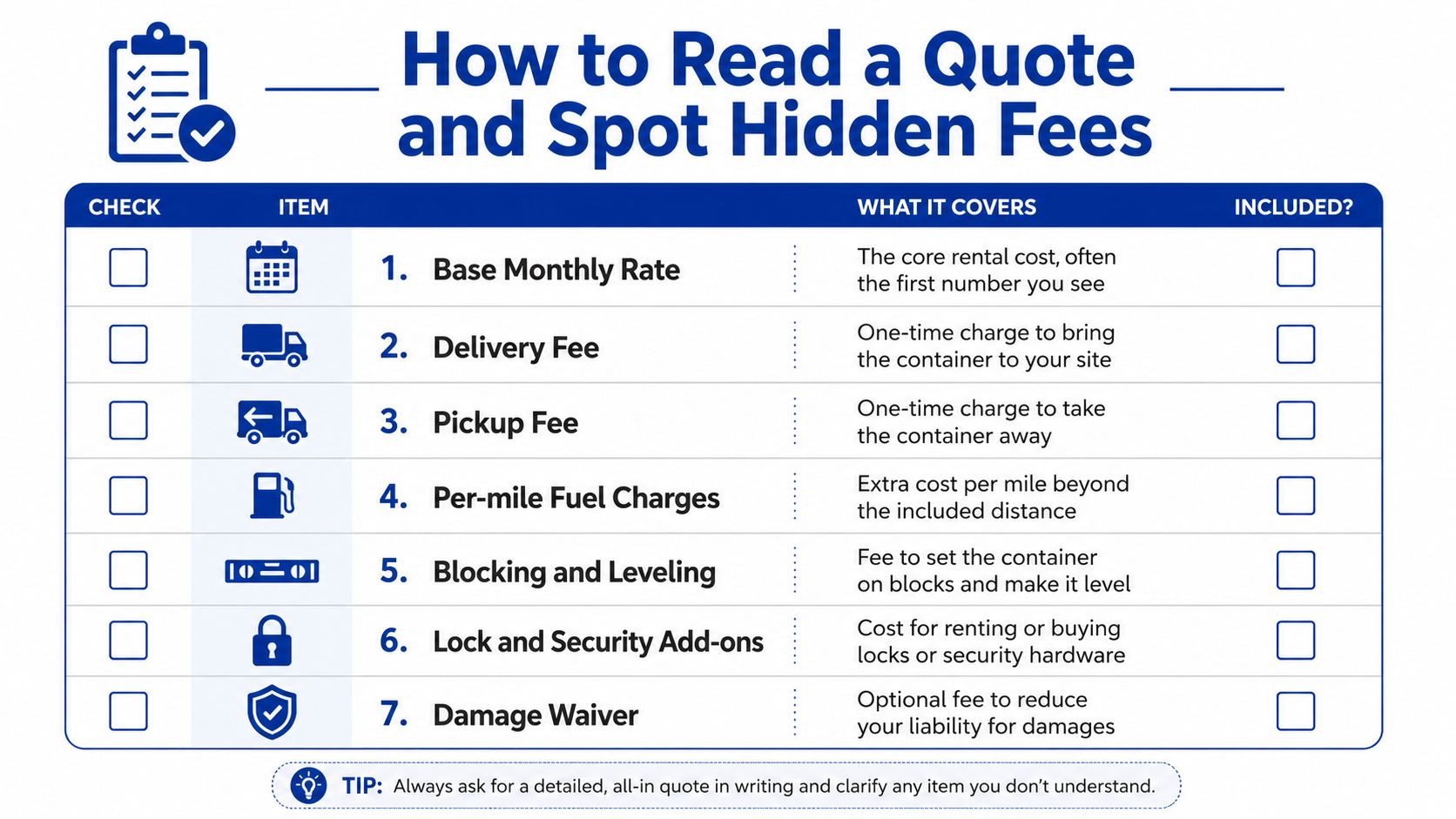
Read every line in order. First comes the base monthly rate, then delivery, then pickup. After that, look for per-mile fuel charges, blocking and leveling, lock and security add-ons, and any damage waiver or damage deposit choice.
The fees that usually surprise people are easy to spot once they know where to look. Delivery minimums can be based on a radius that doesn't match the actual route. Blocked-access surcharges show up when a crane truck can't reach the drop spot. Admin or environmental fees can be buried in the first invoice. Early termination clauses can also sting, because some vendors bill the remaining months at a reduced rate.
Here's the practical math. A $150 monthly rent on a 20-foot container can turn into a $400 to $500 first-month bill once delivery, blocking, lock, and the first month are combined. If pickup goes smoothly at the end, the final month can fall to $0 to $50, because the rent may already be paid and only release or handling remains. That gap is why the monthly headline number alone is useless.
The best way to protect the budget is to push the vendor on five points before signing:
- Ask for the off-rent process in writing.
- Confirm who pays for permits.
- Ask whether taxes are included.
- Verify whether delivery and pickup are flat fees or distance-based.
- Confirm what happens if the container can't be placed at the first drop point.
A more detailed prep list sits in 5 questions you need to answer before renting a storage container. That kind of checklist is what keeps a quote from turning into a change order.
Choosing the Right Container for Your Project
The right container is the one that fits the site, the schedule, and the load pattern without creating extra charges later.
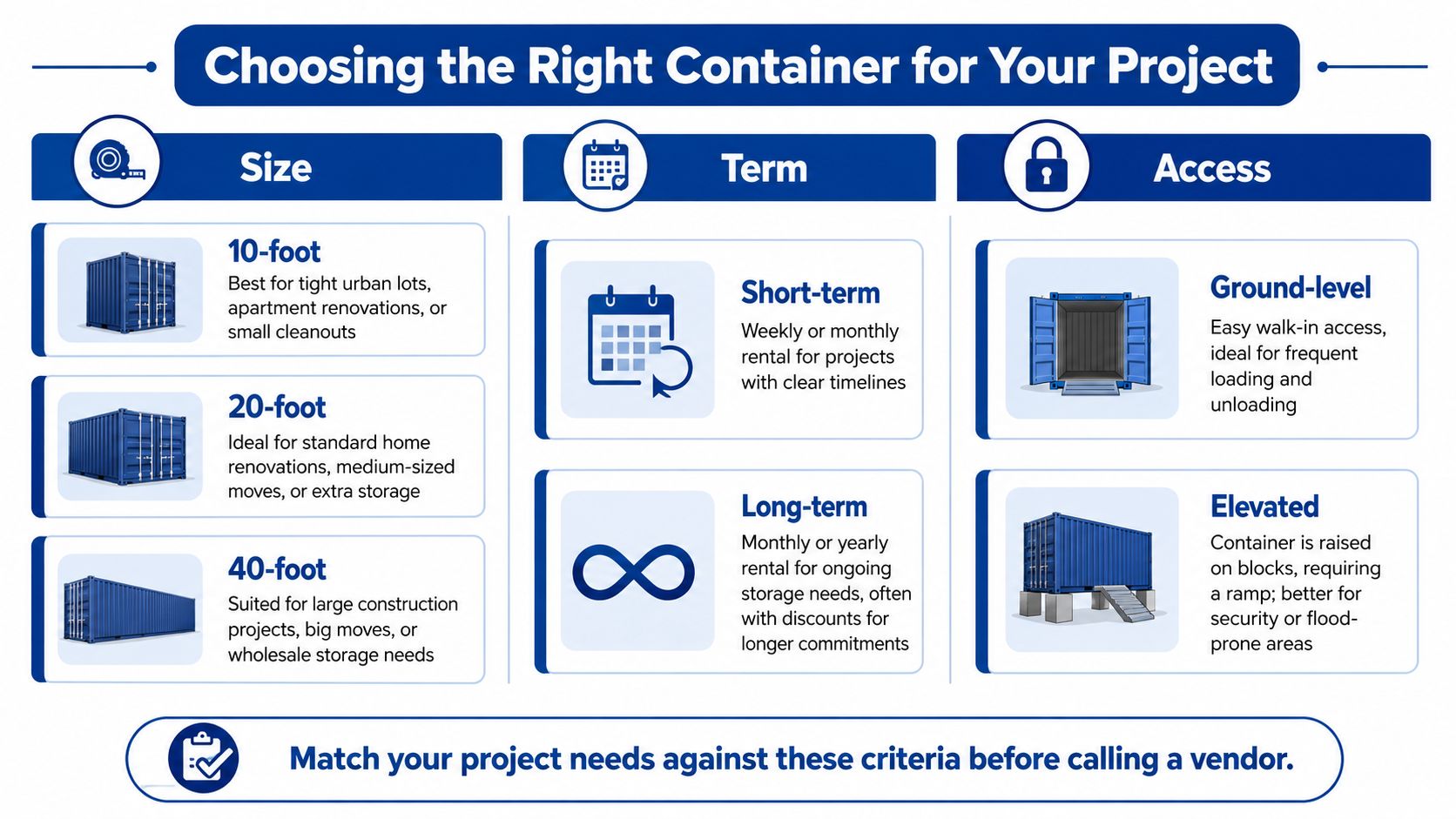
Match size to the job
A 10-foot unit works for tight urban lots, apartment renovations, and seasonal inventory. A 20-foot unit fits standard home renovations, medium moves, and most job-site storage. A 40-foot unit makes sense for larger construction projects, bulk stock, and phased work.
Match term to the project clock
Short projects need a short-term rate or a refurbished unit. Mid-length work usually fits standard stock. Long commitments deserve a rental-versus-purchase comparison, because the economics can shift once the container stays parked for a long stretch.
Match access to the delivery truck
If the site can accept a tilt-bed truck and has enough straight-line clearance, standard delivery is usually workable. If it cannot, shrink the unit or plan for a surcharge tied to tougher placement. That single call can matter more than the monthly rent.
Decision rule: pick the smallest unit that protects the load, the shortest term that fits the schedule, and the easiest site that still meets the project need.
One practical exception matters. Refrigerated containers should only be used when the cargo needs temperature control. Otherwise, the premium burns budget.
Pacific Mobile Structures, Inc. supplies storage containers for rent alongside other modular and site-space options, so it fits the same planning conversation when a project manager is comparing temporary storage choices.
A simple summary works best. Size first, term second, access third. If any one of those three is off, the final storage container rental price will move more than the vendor's quote sheet suggests.
Budgeting for the Full Rental Period
Start with landed cost, not the monthly sticker. A quote for a 20-foot container at $175 per month looks tidy until delivery, pickup, blocking pads, and a damage waiver or refundable deposit hit the budget. Based on current market guidance, those extras can add another $340 to $850 up front. If the site is awkward or the pickup window is tight, the actual spend climbs faster than the rent line suggests.
| Cost Line | Minimum (5 mo) | Expected (6 mo) | Worst Case (9 mo) |
|---|---|---|---|
| Monthly rent | 5 months of rent | 6 months of rent | 9 months of rent |
| Delivery | Up-front fee | Up-front fee | Up-front fee |
| Pickup | End-of-rental fee | End-of-rental fee | End-of-rental fee |
| Blocking pads | Site prep line | Site prep line | Site prep line |
| Damage waiver or deposit | Protection or deposit line | Protection or deposit line | Protection or deposit line |
Build every budget around three cases. The minimum term sets the floor. The expected term is the working plan. The worst-case extension is what protects you when the job slips and the container stays parked longer than planned.
That cushion should sit above the quoted monthly rent. Access problems, lock changes, and pickup delays are the usual reasons the final invoice grows.
A project manager should ask for the full contract value under the likely timeline, then ask what changes if the site pushes pickup by a month. That question forces the vendor to show the actual number, including the parts that tend to hide outside the rent line.
Pacific Mobile Structures, Inc. provides storage containers for rent, along with modular buildings and temporary site space for projects that need controlled setup and delivery coordination. For budgeting, use that kind of quote as a check against the actual site conditions, then compare the landed cost before you sign.