
The cheapest quote looks fine on paper until the truck shows up and the gate is too tight, the ground is soft, or the overhead line makes the driver stop cold. By the time the site crew starts clearing space, the delivery has already been postponed, and the “low-cost” container rental is now costing time, labor, and patience.
That's the lesson with storage containers for rent. The monthly rate matters, but the deployed cost is what hits the schedule. If the unit can't get to the pad, can't be set safely, or can't support the way the site works, the bargain turns into a problem fast.
Table of Contents
- Why Storage Container Rentals Demand a Smarter Approach
- The Growing Role of Rental Containers in Modern Operations
- Choosing the Right Container Size and Configuration
- Site Readiness and Delivery Access Requirements
- When a Standard Storage Container Is the Wrong Choice
- Verifying Container Safety and Compliance Standards
- Your Storage Container Rental Decision Checklist
Why Storage Container Rentals Demand a Smarter Approach
A project manager can sign off on the lowest quote and still lose the week. The driver arrives, walks the access route, and finds a narrow approach, a muddy turnaround, and a fence line that leaves no room for placement. The container goes back on the truck, the crew waits, and the renter pays for a second attempt that should have been avoided on day one.
That mistake happens because many teams price the container as if it were the only variable. In the field, it is one part of a larger delivery event, which includes access, placement, compliance, and the work needed to make the site ready.
Practical rule: the quote that looks cheapest on the invoice is not always the cheapest to deploy.
Storage containers for rent have also matured into a serious temporary infrastructure category. The broader portable storage containers market was valued at USD 4.8 billion in 2024 and was projected to reach USD 7.9 billion by 2034 at a 5.6% CAGR (Intel Market Research). Rental demand is no longer a side channel. It now reflects longer deployments, tighter planning, and more scrutiny around where a unit can land.
The better decision model is simple. Start with the unit, then price the delivery path, the setup conditions, and the time the container will be useful on site. A site manager who runs that check early avoids the expensive surprise that comes from treating a steel box like a drop-off package instead of a piece of working infrastructure.
The Growing Role of Rental Containers in Modern Operations
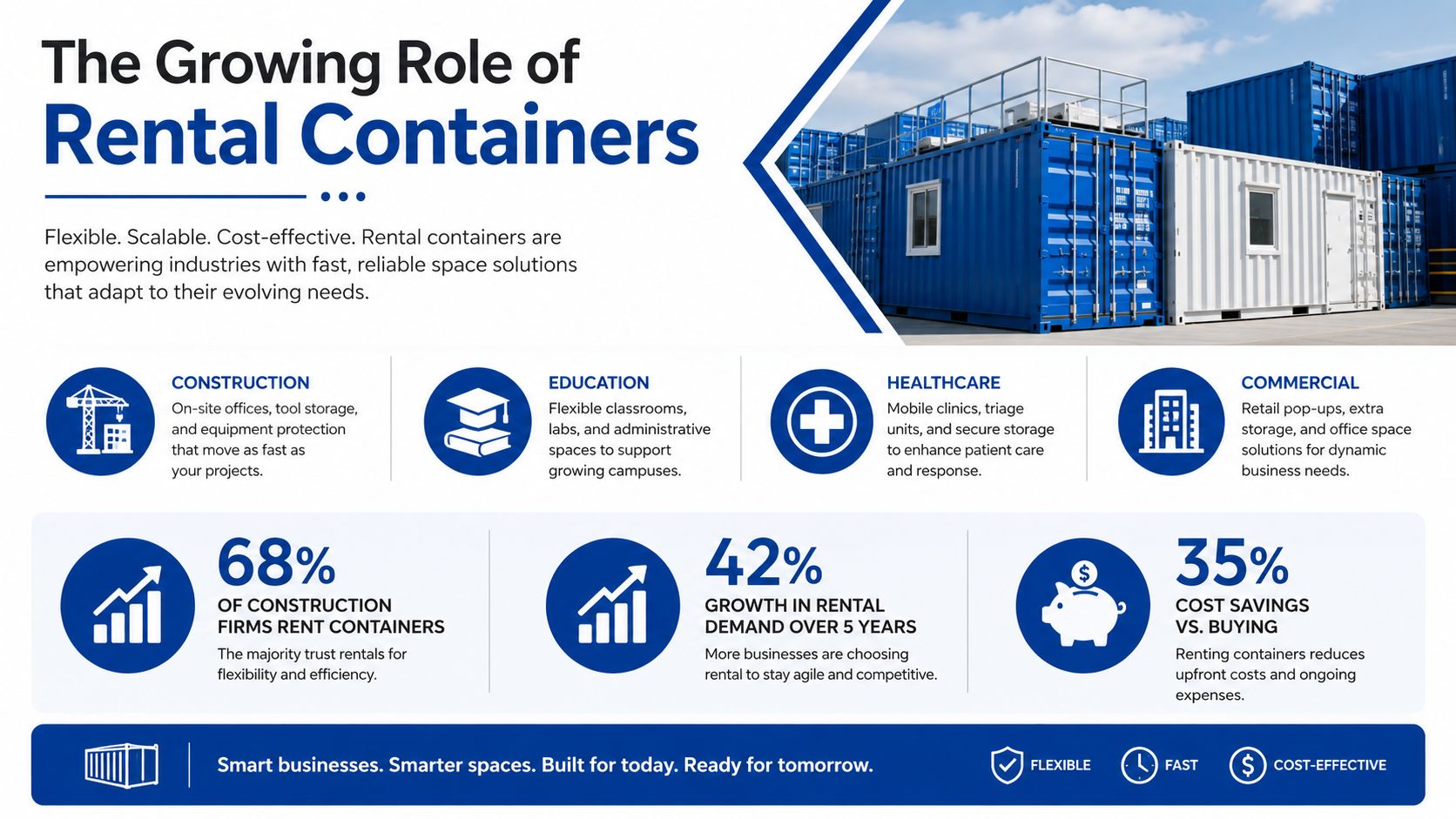
A cheap rental quote can turn expensive fast when the delivery truck cannot reach the drop point, the yard has no turning room, or the ground will not take the weight. Rental containers now sit in the middle of that kind of decision making. They are used for jobsite storage, campus support space, retail overflow, and temporary buffer capacity where timing and access matter more than ownership.
One industry estimate says there were more than 82 million containers in circulation worldwide in 2023, with over 19 million units actively involved in short- and long-term rentals (Market Growth Reports). The same source reported rentals represented 23% of total container usage in 2023, up from 17% in 2020, and that average on-site rental duration rose from 3.4 months in 2021 to 5.1 months in 2023. That points to longer deployments, which makes site fit, delivery access, and placement planning harder to ignore.
What the market shift means on the ground
Longer rental periods change the job. A unit that barely fits a short-term task can become a daily obstruction if it sits in the wrong place for months. Schools, clinics, and commercial sites run into the same problem, because once the container is on site, it becomes part of the workflow.
Rental growth also signals a more mature supply chain. Buyers are not dealing with a one-off arrangement as often as they used to, and that usually means better access to the right configuration, scheduling, and support. The primary difference is practical. Teams get fewer surprises when they treat the container as deployed infrastructure rather than a simple drop-off item.
For moves that depend on coordinated transport, specialist port haulage services can matter as much as the unit itself. If access is tight, the haulage plan is part of the rental decision, not an afterthought.
The right way to evaluate rental containers is by total deployed cost. That includes the unit, the delivery path, the setup conditions, and the time the container will be useful. Site managers who check those points early avoid the mistake of buying the lowest monthly rate and paying for it in failed drops, delays, and extra handling.
Choosing the Right Container Size and Configuration
Sizing decisions get easier when they're tied to load pattern instead of instinct. A team that stacks boxes vertically has different needs from a crew that moves pallets in and out with a forklift. A campus storage yard has different constraints from a retail back lot, even if both want the same nominal footprint.
Standard and high-cube units solve different problems
Standard 20-foot and 40-foot ISO containers share a fixed external footprint under ISO standards, with widths of 2.438 m and heights of 2.591 m. High-cube versions keep the same footprint but rise to 2.896 m, which changes usable cubic capacity without changing transport compatibility (CSC Plate reference). A 40-foot standard container provides about 67.7 m³ of internal volume, while the high-cube version gives extra overhead space where vertical density is the constraint (CSC Plate reference).
That's why the extra height isn't automatically the better deal. If the stored goods are low-profile, the extra lease cost may buy unused air. If the site stores tall shelving, awkward cartons, or stacked materials, the extra height can be the difference between organized access and wasted floor space.
A useful comparison is below.
| Container Type | External Height | Internal Volume | Best Use Case |
|---|---|---|---|
| Standard 20-foot | 2.591 m | Not specified in the verified data | Smaller storage loads, tighter sites |
| High-cube 20-foot | 2.896 m | Not specified in the verified data | Taller items, vertical stacking needs |
| Standard 40-foot | 2.591 m | About 67.7 m³ | Larger general-purpose storage |
| High-cube 40-foot | 2.896 m | Greater overhead space than standard | Tall inventory, stacked materials |
For a quick look at one common size format, the internal layout on this 8 x 20 container reference shows why smaller footprints stay popular on constrained sites.
A shopper comparing options in dense urban use cases can also benefit from practical rental examples like portable storage containers for Boston moves, since city placement often favors compact, easier-to-place units over bigger boxes.
Match the container to the actual loading pattern
The wrong choice usually happens when the buyer picks the largest unit available instead of the one that fits the access pattern. A 40-foot container can be a great answer for inventory overflow, but it's a poor choice if the access lane can barely handle the truck or the yard can't support the placement area.
A seasoned procurement team asks a different question. What has to go inside, how often does it move, and what kind of vertical stacking saves time? Once that's answered, the size decision gets a lot clearer and a lot less expensive.
Site Readiness and Delivery Access Requirements
A flat patch of ground is not the same thing as a ready delivery site. The truck still needs room to approach, room to set the container, and room to get out without tearing up the yard or clipping an obstacle. That's where most delivery failures start.
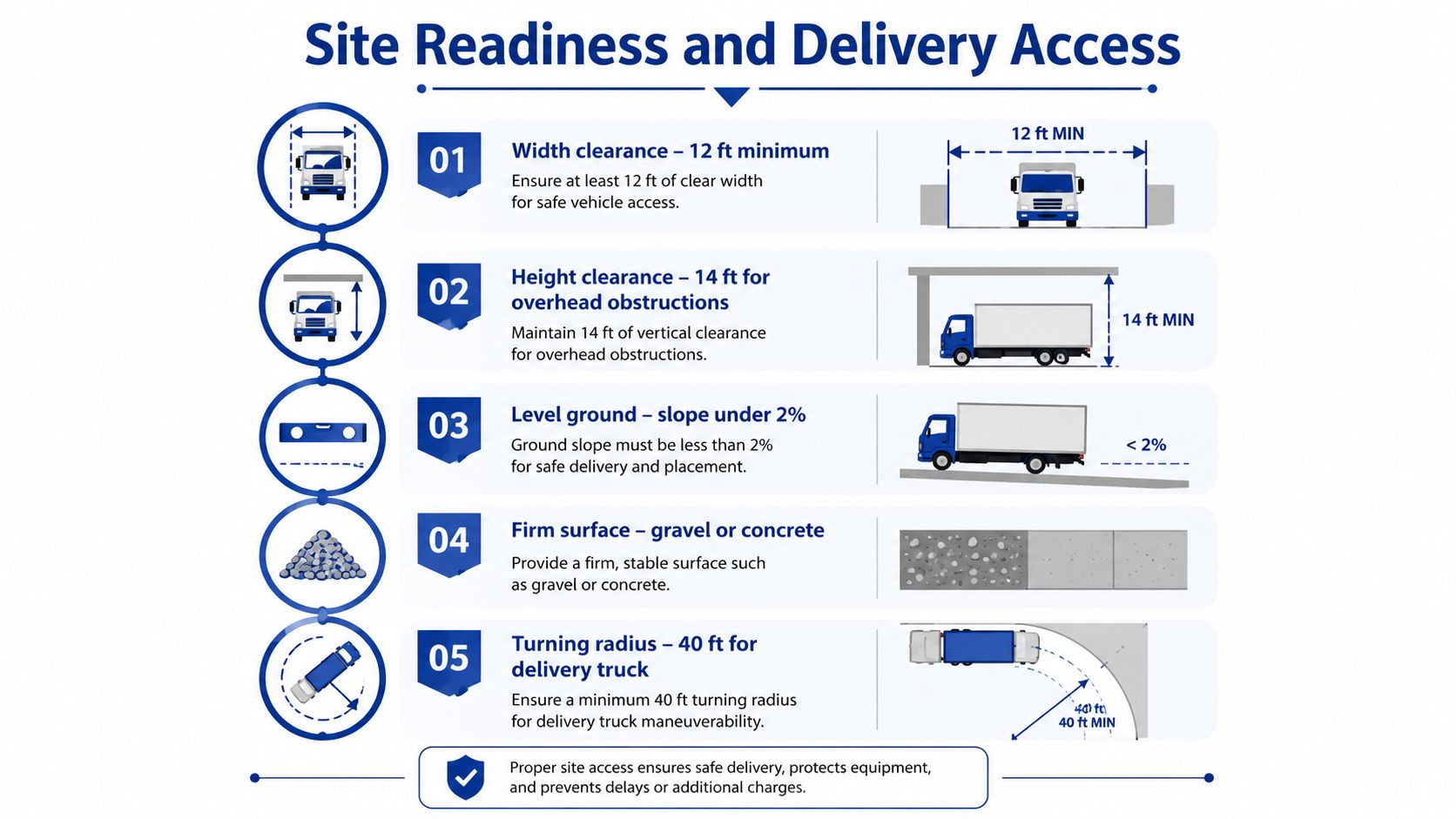
Independent rental guidance says delivery can require about 60 feet of straight clearance for a 20-foot container and about 100 feet for a 40-foot container, plus about 10 to 15 feet of width and up to 15 feet of overhead clearance (CCA N Store guidance). Those numbers are easy to ignore in the quote stage and hard to fix on delivery day. If the site can't meet them, the driver usually can't force the placement.
What stops a delivery before the container ever lands
Overhead wires cause more delays than many buyers expect. So do tree limbs, low awnings, signs, and gate hardware that looked harmless during the site walk. Soft ground is another problem, because a rollback or tilt-bed truck needs a firm surface when it's angled for placement.
A delivery crew can work around inconvenience. It can't work around physics.
Site access should be checked in layers. First, verify the truck can enter and exit without backing into traffic or squeezing through a choke point. Next, check the ground where the container will sit, because a container on unstable soil shifts, sinks, or becomes difficult to reposition later.
A good field checklist is short and blunt.
- Measure the approach path: Confirm the straight-line route is long enough for the unit size being delivered.
- Clear the overhead path: Remove or avoid wires, branches, canopies, and fixtures that reduce vertical clearance.
- Inspect the surface: Gravel or concrete is usually easier to work with than soft soil or freshly disturbed ground.
- Check turning room: Make sure the truck can line up and exit without a multi-point maneuver.
- Watch for utility conflicts: Mark anything buried or exposed that could complicate placement.
Dense campuses and urban facilities often need more than a delivery truck. That's where coordination with a provider that understands special transport and routing can save the schedule.
The fix is simple, but it has to happen before dispatch. Measure the site, walk the truck path, and assume the container quote is incomplete until the access plan is confirmed. That's the difference between a clean drop and a return trip.
When a Standard Storage Container Is the Wrong Choice
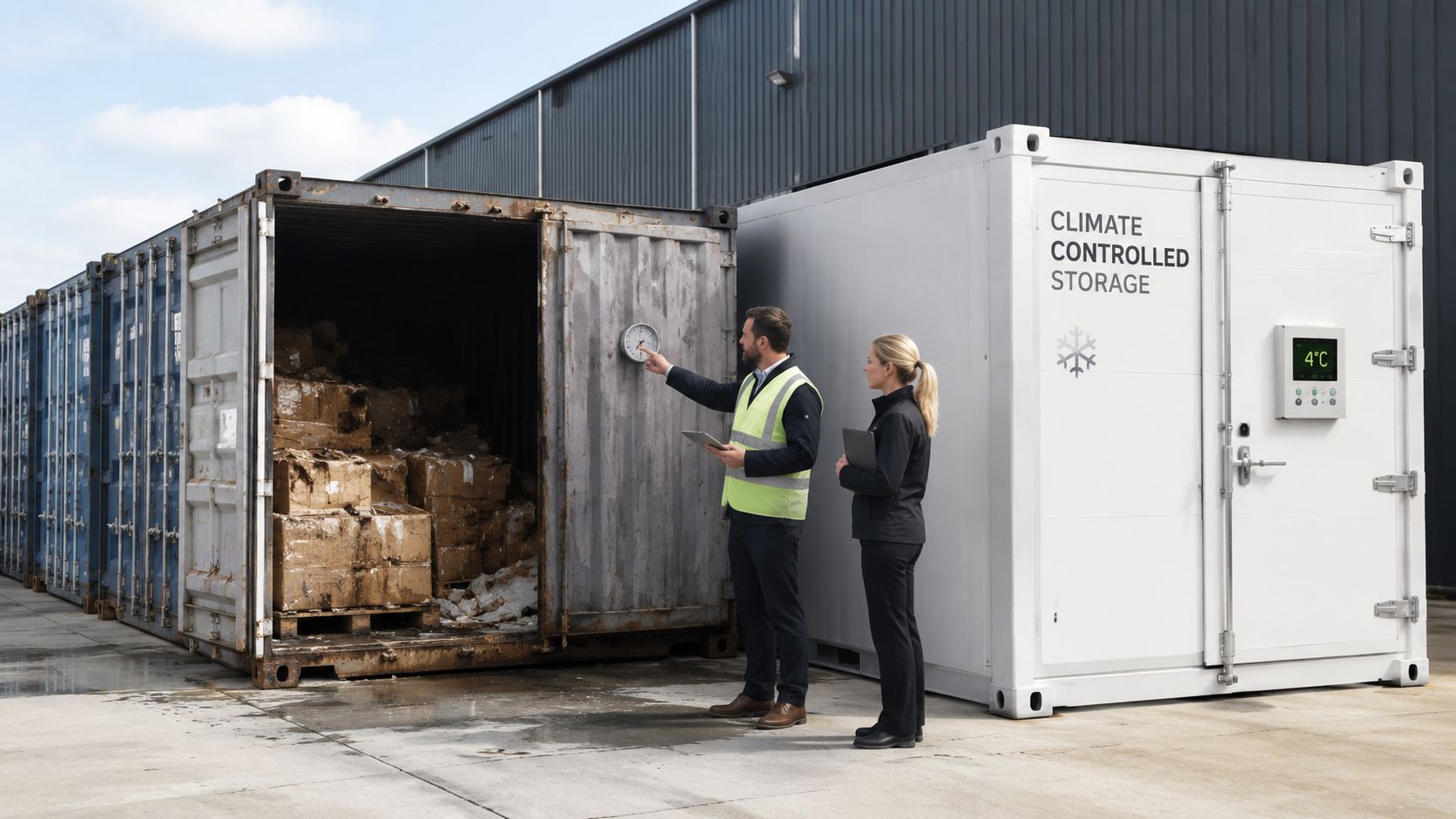
A dry storage container works well for cargo that stays dry, stable, and uncomplicated. It stops being the right answer once the job calls for temperature control, tighter compliance handling, or a workflow that shifts faster than a basic box can support. The primary mistake is treating every rental as interchangeable.
Recent market coverage points to a container leasing market that is still expanding, with dry units still carrying the largest share while refrigerated, tank, and short-term leasing demand continue to gain ground (MarketIntelo). The operational takeaway is simpler than the market sizing. More teams are using digital leasing platforms because they need faster ordering, cleaner approvals, and fewer delays when a site needs a unit now, not after a long quote chain.
Where a basic dry container falls short
Temperature-sensitive inventory is the obvious mismatch. Pharmaceuticals, specialty food, sensitive electronics, and controlled materials need more than steel walls and a lock. They need a container setup that matches the cargo's handling requirements, not just its footprint.
The same problem shows up when one unit has to do two jobs. A site that needs storage and workspace at the same time usually works better with combination modular units than with a plain dry box. That layout can cut unnecessary foot traffic, improve supervision, and keep crews from using separate rentals for tasks that should sit together.
Site access can also turn the cheapest quote into the most expensive decision. A low monthly rate means little if the delivery path is tight, the placement area is unstable, or the truck needs extra coordination to reach the drop point. Those hidden access costs, missed deliveries, and repositioning calls often matter more than the rental line item.
For teams comparing container grades and condition levels, not all containers are created equally is a useful reference point, especially when the decision goes beyond simple dry storage.
The practical rule is straightforward. If the cargo has a condition requirement, if the site has a delivery constraint, or if the workflow cannot tolerate a generic box, a standard storage container is the wrong tool. The cheapest unit becomes expensive when it creates workarounds every day it sits on site.
Verifying Container Safety and Compliance Standards
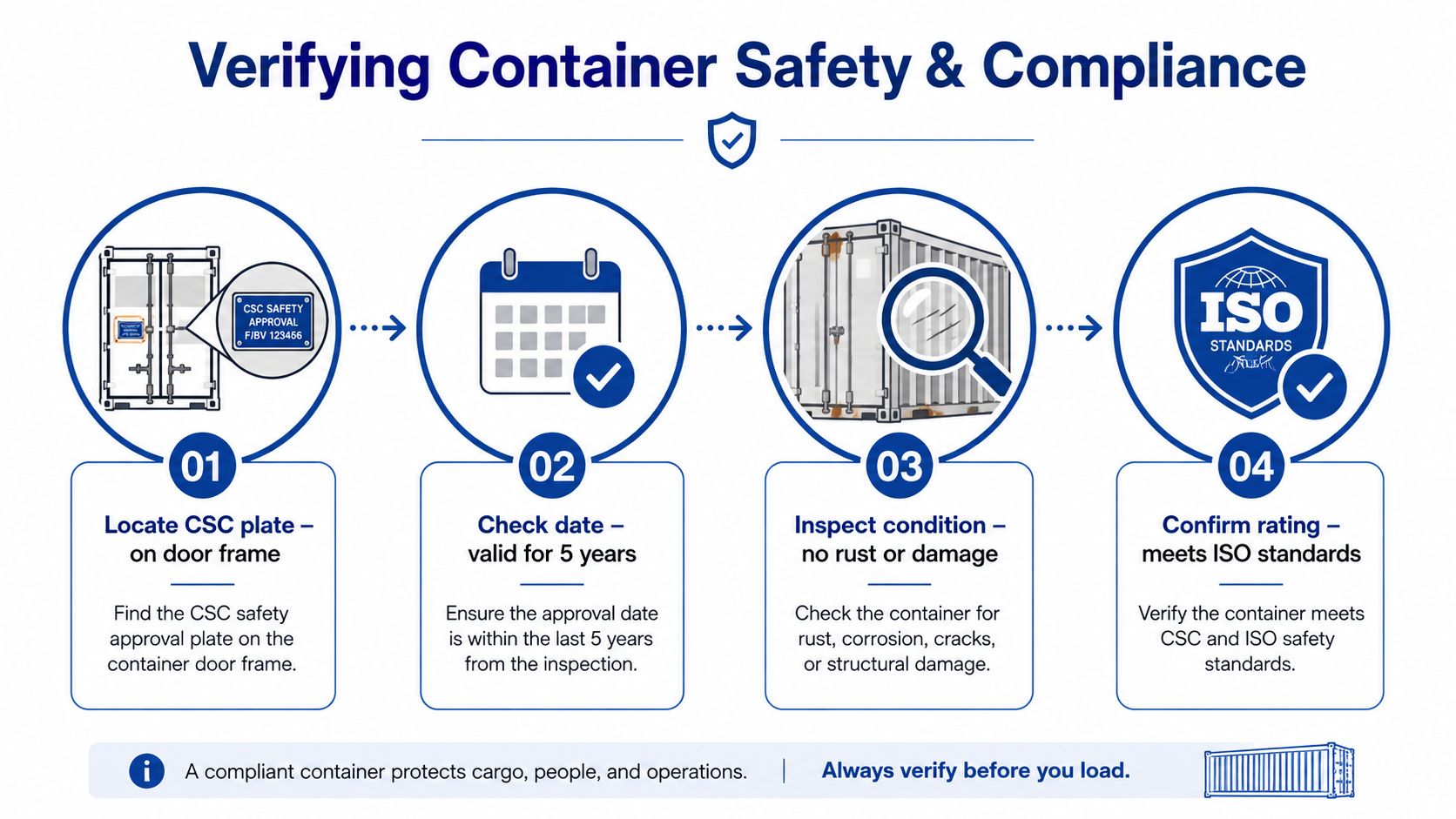
A container can look clean and still be wrong for the job. The check starts with the CSC safety approval plate, because that plate is the clearest evidence that the unit has been inspected for lifting, stacking, transport, and yard storage. It must be permanently attached, non-corrosive, and fireproof, with a minimum size of 200 mm by 100 mm (BIC code plate guidance).
That plate also carries the details a site manager needs on active work, including manufacturer, manufacturing date, owner code, maximum gross weight, allowable stacking weight, rack test load, and next inspection date. The point is practical. If a container is going to be moved, stacked, or repositioned, those markings help confirm it can still be handled safely.
What to inspect before accepting the unit
The inspection should be quick and disciplined. A damaged plate, missing data, or visible corrosion deserves attention before the driver leaves.
- Locate the CSC plate: It should be on the door frame, easy to read, and permanently fixed.
- Check the date: Confirm the inspection information is current and the plate is intact.
- Inspect the condition: Look for rust, deformation, missing fasteners, or impact damage.
- Confirm the rating: Make sure the listed approval matches the way the container will be used.
Rental units get repositioned and stacked often, so the compliance plate is the clearest proof that the box is still fit for lifting and transport. Accepting a questionable unit pushes that risk onto the site crew.
For teams comparing grades and condition expectations, this container grade guide is a practical companion to the plate check.
A container should be treated like equipment, not decor. If the plate is compromised or the condition does not match the job, stop the delivery there. Once a weak unit is accepted, every move afterward is harder to justify.
Your Storage Container Rental Decision Checklist
A rental quote looks cheap until the site proves otherwise. The better decision starts with the job, the load pattern, and the route the truck has to take to get there. If the box cannot be delivered cleanly, the monthly rate is beside the point.
On the jobs I have managed, the teams that avoid trouble follow the same order. Size comes first, then access, then ground conditions, then the compliance plate. That sequence keeps a site from signing for a container that never had a realistic place to land.
Use a checklist that reflects those trade-offs.
- Define the job clearly. General storage, equipment staging, overflow inventory, and mixed-use space all point to different container choices.
- Match the size to the load pattern. Judge by floor space, stacking behavior, and vertical clearance.
- Walk the delivery route. Confirm the truck can reach the drop point without a choke point, utility conflict, or overhead obstruction.
- Prepare the pad. The ground should be firm, level, and ready for placement.
- Inspect the CSC plate on arrival. Accept only units that are compliant, legible, and suitable for the intended use.
- Compare total deployed cost. Delivery complexity, site prep, and access problems belong in the calculation, not just the monthly rate.
Before approving the order, use these five questions before renting a storage container to pressure-test the quote against the actual site conditions.
A container rental should be treated like field equipment, not a line item. If the site is tight, the pad is weak, or the delivery path has a hidden conflict, the cheapest quote can turn into the most expensive mistake. Pacific Mobile Structures, Inc. provides mobile offices, storage containers, and modular construction services, including delivery and setup support for on-site storage needs.